 Director: Ruben Östlund
Release Date: April 10th, 2015 (UK)
Genre: Drama
Starring: Johannes Bah Kuhnke, Lisa Loven Kongsli
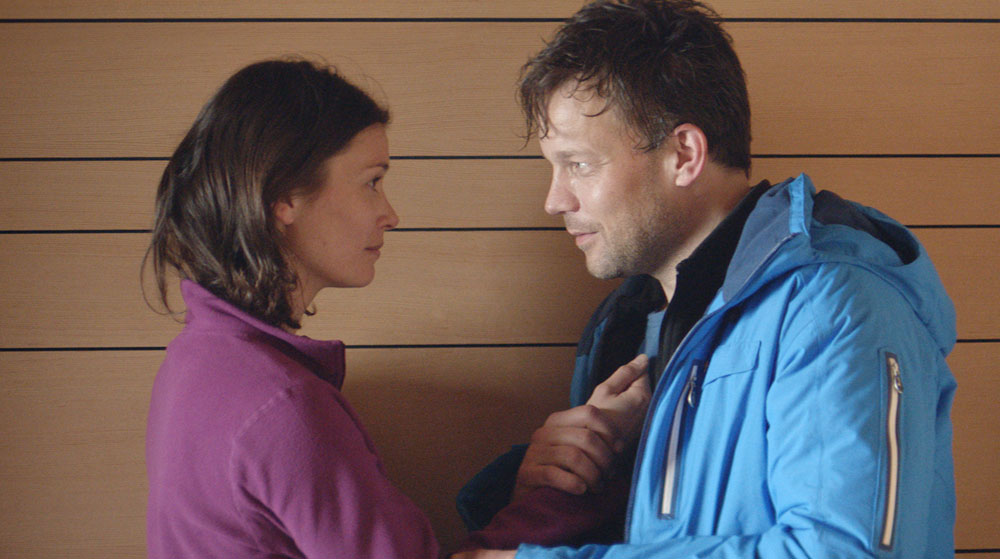
As far as family vacations go, this is one for the ‘iffy’ pile. Force Majeure unfurls a day-by-day account of a couple’s wintry retreat to the French Alps where, as it turns out, avalanches are the least of their worries. We join Ebba (Lisa Loven Kongsli) and Tomas (Johannes Bah Kuhnke) as they ski with their two children atop vast snow ranges, surrounded by ominous looking mountains. An eerie atmosphere driven by the mechanical squawks of equipment dominates early, but it soon becomes clear that there isn’t anything conventionally disconcerting going on here.
The titular “superior force” indeed exists, but not exactly in the way you would think. Director Ruben Östlund delivers a bait-and-switch disaster piece, one entirely without action and instead built upon the perceived consequences of disaster. Had the Swede focused primarily on the drama element, Force Majeure would almost certainly be one of the year’s most suspenseful and unnerving films (it still manages to be both of those, to a lesser degree).
After a seemingly enjoyable first day, our spotlighted family sit down with other holiday-makers to enjoy an outdoor lunch. An innocuous explosion unsettles everyone and, despite Tomas’ insistence that nobody is in danger, mounds of snow begin pillaging towards the restaurant. The scene is intense, but it is the characters’ instinctive reactions to potential fatality that provides the pivot from which Östlund’s parable spins.
What we end up with thereafter is a sniping ninety minute liquidation of family life and patriarchal values, completely fuelled by this avalanche experience. It becomes an anecdotal reference point, recounted particularly by Ebba in awkward situations. Through her increasingly disturbed exterior, Lisa Loven Kongsli manages to rekindle much of the earlier scene’s tension when conversing with others. The topic is somewhat over-egged by the end of a discussion between Ebba, Tomas and two acquaintances (one of whom is Game of Thrones’ Kristofer Hivju, he in a somewhat familiar setting). It’s an unnecessarily long sequence that, resultantly, veers close to overdoing Östlund’s message. “I can’t take this seriously anymore, we’ve been going on for hours,” says one of the party. Touché.
The characters themselves are quite annoying, but they’re meant to be. Nobody exits with an outright air of self-preservation, though Ebba is clearly supposed to garner the most sympathy. Tomas, played well by Johannes Bah Kuhnke, manoeuvres from an apparently unfocused husband to a crumbling mess. Bearing tonal continuity, the various characters niggle away under your skin with the same irritation as the events unfolding around them. Wisely, screen time for the children is kept to a minimum.
Alongside this overtly sombre underbelly, Östlund opts to incorporate a satirical layer that serves only to butt helmets with the aforementioned seriousness. If you can forgive a wintry gag: it’s as if the director is trying to put on a pair of skis when he’s already wearing snowboard boots. The nudging comedy isn’t nearly as effective, instead often awkward and confused — an outpouring of emotion from Tomas seems like something that should be taken seriously, but the prevailing attempt at satire renders it somewhat amusing.
Force Majeure wanders into a tonal snowstorm on occasion: is it meant to be piercing and tough, or self-aware and playful? The accompanying subtitles are funnier than most of the attempts at humour, which is a blessing in disguise (though ultimately damning). It is worth noting a crowd-gathered-around-a-mobile scene that does successfully evade the tonal ambivalence, generating a chuckle or two.
In an attempt to bridge this gap between witty satire and ponderous drama, the film succumbs to some heavy-handed storytelling — a conversation between Ebba and her frivolous friend about the pros of an open relationship is too coincidental, then ends up going nowhere anyway. This clumsiness reaches a crescendo during the concluding moments, presenting an ending that is ridiculously on-the-nose. Any tonal reservations notwithstanding, Östlund shows throughout that he is a smart writer with interesting ideas related to perceived societal norms. Why the filmmaker choose to pen such a careless finale is baffling, as it completely undermines much of dramatic effect laid out in earlier scenes.
There is no disputing Fredrik Wenzel’s brilliantly engrossing cinematography, nor the equally impressive sound design. A sense of discomfort and discombobulation gradually grows from elements such as worrisome wooden creaks and an odd sci-fi night-scape. A Clockwork Orange is the obvious musical touchstone and Wenzel’s patient, scoping shots are certainly Kubrickian, though whether the famous director’s influence goes beyond style is up for debate.
Force Majeure is an intriguing film, perhaps on the cusp of something really biting. However, its tonal imbalance distracts a great deal from the thought-provoking drama on display. Anything the film might say about parenting, peer trust, and human instinct is left frozen by an oddly misfired ending. Much like Tomas, it seems Östlund shouldn’t have let his guard down.
Images credit: IMP Awards, Collider
Images copyright (©): TriArt Film

 Consumed By Film