Release Date: August 10th, 2012 (US); September 28th, 2012 (UK)
Genre: Comedy
Starring: Will Ferrell, Zach Galifianakis, Jason Sudeikis
Released in the midst of the 2012 Presidential Election in the United States, The Campaign struggles to reach the lofty heights set by Jay Roach’s previous work. More often than not the jokes are without any real substance and by the time the credits finish rolling, the film has cemented its place as a forgettable one.
The Campaign follows the naive Marty Huggins’ introduction into politics as he is propelled into the normally competition-scarce race for election in North Carolina’s 14th District. His opponent, Cam Brady, has spent the previous four terms as congressman of the district due to nobody running against him. However, two corrupt businessman use Brady’s involvement in an indecent incident to install Huggins into the race, with their motives less than noble and their focus solely on using Huggins to strike a profit-blazing deal with a Chinese company.
The film is at its best and funniest when it gets the political satire elements right (pointing out how far politicians will go to expose each other, for example), but too often these attempts fall flat and instead come across more like parody sketches on politics. When the events begin to enter the parody realm, the film veers dangerously close to Meet The Spartans and Epic Movie territory (although not quite as bad as either of those). This is unfortunate as the few times the writing does work the film is very funny, particularly with the added bonus of Will Ferrell and Zach Galifianakis who are fully versed in successfully delivering humour with the correct material put before them.
Another problem The Campaign encounters is that there is no clear character to root for (perhaps this an intentional attempt to mirror real life election battles). From the get-go it is clear that the villain of the piece is intended to be Cam Brady (Ferrell’s character). Brady comes across as a cocky, chauvinistic jerk, and Ferrell plays the role to a T. With the introduction of Galifianakis’ Marty Huggins, it is clear that the simple tourism director is set to be the sympathetic character. Brady is obnoxious, often degrading Huggins and taking advantage of the political newcomer’s nativity. However, the film does not even reach the half-way mark before the roles begin to reverse and Brady becomes the brunt of all of the jokes. The influential businessmen we see at the beginning of the film are clearly the puppeteers who are in need some sort of comeuppance, but they do not appear on-screen often enough to develop their nastiness and be paraded as the bad guys — must the audience rely on what they know from previous films of similar ilk to decipher who is playing what role? The Campaign sorts itself out in the end, but by then it is too late as the two main characters are not really worth caring about.
It is not all bad news though. As mentioned beforehand, Roach and the writers — Chris Henchy and Shawn Harwell — do hit the correct notes on a number of occasions and the film does conjure up a couple of genuinely humorous moments. Ferrell and Galifianakis play off of each other well enough, but neither really seem to be completely committed 100 percent to the cause. In fact, Ferrell’s Brady holds a number of similar characteristics to those of his much-loved Anchorman character, Ron Burgundy. However the difference between the two is clear — Burgundy is given both the time and the correct narrative to evolve and become something more than just an egotistical news anchor, whereas Brady must suffice with punching babies and being a horrible father. Galifianakis is essentially playing the same role he has played since starring in The Hangover. It is not that the role is not funny, rather it is just not funny the fifth time around.
The Campaign suffers from one or two glaring problems, namely a weak script and non-existent character roles. Nothing really sticks out: the performances are nothing special, the laughs are few and far between and story is over-played and without inspiration. With that being said, Roach, Henchy and Harwell do get the balance of discreet-yet-understandable humour correct on a few occasions and the film is better for it. Perhaps Roach should have cast Rick Santorum in the role of Marty Huggins — at least then there would have been a consistent cause for laughter.
Release Date: April 1st, 2011 (US); April 29th, 2011 (UK)
Genre: Horror; Thriller
Starring: Rose Byrne, Patrick Wilson, Ty Simpkins
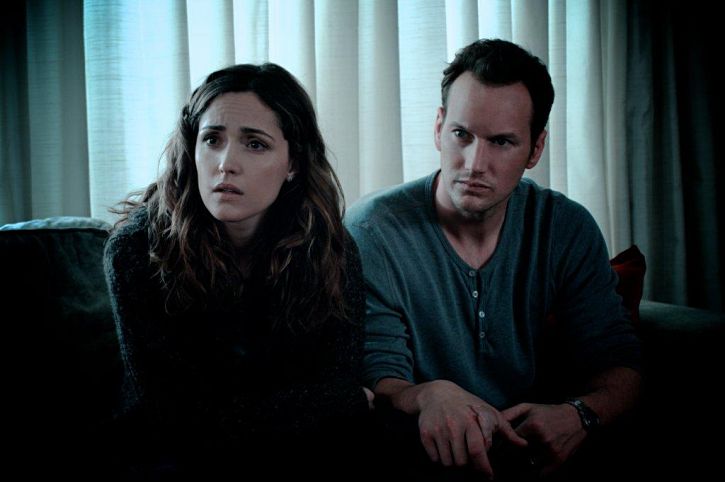
As far as haunted house tales go, Insidious certainly does not fall into the dud category and for 40 minutes is actually very good. Unfortunately, the high volume of tension expertly built up throughout the first half of the film is let down by an average, scare-lacking second half which delivers a hokey logical explanation of the goings-on.
The film depicts the lives of the Lambert family — husband and wife, Josh and Renai, their two young sons and baby daughter — after the quintet’s relocation to a new house. The parents’ hopes for a new start absent of problems are soon dashed when their eldest son Dalton falls into a coma, triggering a series of weird and unsettling events.
James Wan, whose first directorial role was the innovative Saw back in 2004, is in his primary element when he is establishing trenches of tension and utilising shiver-inducing imagery to impart fear. This is exactly what Insidious offers for the first half of proceedings, as an ordinary family falls victim to a tragedy which bats away any explanation, and are then the subjects of various abnormal happenings, which are also devoid of explanation. The two are obviously linked, but in attempting to uncover how or why this is the case, the seeds of dread and fear for both the Lambert family and the audience are planted. This, along with a variety of common but still efficiently adapted elements of horror (doors randomly opening, figures appearing), ensure that the film sets standards high going into its second half.
When that second half arrives, however, proceedings begin to unravel a little. For every disturbing image in part one, there is a corny one in part two. For every discreet moment of tension built earlier on in the film, there is a disheartening logical explanation later. Delivering a unique, scare-inducing haunted house film is difficult in the present era, and this is mainly down to the vast majority of the tricks and frights being over-saturated year upon year. The ironic aspect of Insidious is that Wan gets the clichéd parts completely right, and even manages to add a twist to them. By the time we reach the end of the film though, it is Wan’s attempts at doing something different that comes back to haunt him. The logical (and I use that term lightly) explanation of events the audience is given is not scary at all, rather it is groan-worthy.
With that being said, the second half of Insidious is not without merit. Again, when sinister, almost maniacal imagery is present on-screen, the film grumbles as it threatens to erupt in a flow of ominous atmosphere. Wan delivers such imagery in the climax, but not nearly frequently enough, causing the scares to be overshadowed by some uninspired plot developments leeching onto Insidious towards the end. The opening 40 minutes does such a good job of building an unsettling atmosphere that it possible the remaining hour’s inability to keep up with what came before exposes the misfire more than the film deserves. Wan can do inventive, as he has proven in the past with Saw, but this time his attempt at originality veers too near to nonsensical logic than spontaneous genius.
Patrick Wilson and Rose Byrne star as the husband and wife pair and are thoroughly effective in their roles. Both come across as believable parents still trying to settle down into a comfortable way of living with their three young children. In line with the film separating into two parts, Wilson and Byrne appear to each take a turn at being the focal point of the piece. Byrne is at the centre of much of the spooky occurrences throughout the first phase of the film, and plays the traumatised, protective mother very well. Wilson on the other hand, sees much of the action in the second phase of the film, and is better than the hand he is dealt. Lin Shaye also makes an appearance as a paranormal investigator who fluctuates between calm and eccentric quicker than a tennis ball switches sides at Wimbledon.
The film’s tremendous box office returns have meant that Insidious: Chapter 2 has been scheduled for release later this year, and looks certain to be the autumn horror hit of 2013. James Wan will return to direct it and if he focuses on delivering a sequel more in tune with the first half of Insidious than the second, Chapter 2 will be as much of a critical hit as it will be a monetary one come September.
Touted shortly after its release as a cult classic in the making, Spring Breakers delivers a unique blend of boisterous partying, melancholic musings and rhythmic tones. Following the exploits of four college students desperate to escape and experience spring break, we see two well-known former Disney stars averted from their origin and instead fuelled by drugs and desire.
The most prominent and intriguing question going into Spring Breakers was always going to be how Harmony Korine, the man behind the curtain, would be able to portray Vanessa Hudgens and Selena Gomez in particular as anything but two ‘teen queens’ idolized for their roles in the High School Musical franchise and Wizards of Waverly Place, but to focus solely on that aspect would be doing the film a huge disservice. It is to the trio’s credit that they manage to pull it off to the degree they do (the characters, and the film, are both hard-hitting), but the success of Spring Breakers is also down to the inclusion of many more elements.
From start until finish, Spring Breakers boasts a mesmeric quality (much akin to that of Drive) which amplifies the hauntingly idyllic narrative the film follows. This is partially down to the score, which blends hip-hop, synth and a surreal-yet-effective use of Britney Spears’ “Everytime”, to create a diverse audio backdrop to the story. However, the trance-inducing nature of Spring Breakers also owes a debt to just how well-edited the piece is. Although the film follows a linear structure, certain events are replayed in various different forms — such as in slow motion or from another character’s perspective — and these events are often interlaced with unassuming dialogue — such as phone calls to home. Every time an event or a piece of dialogue is repeated, it evokes a more fulfilling meaning than the last time, and so the film delves deeper into the characters’ psyche as it progresses.
Even as all of the beer-swigging, party-going and bikini-wearing (or otherwise) is playing out on-screen, Spring Breakers consistently retains and gradually develops its primary message: when somebody wants to escape, just how far are they willing to go? For each of the four women the answer is different, and their realisation, or lack thereof, varies in extremity. Although ‘spring breakers’ signifies the age-old clichéd representation of college students and their annual partying and alcoholic exploits, the real spring break is the one that the four females encounter, which is far from clichéd yet remains very real in terms of the power of persuasion, desire and accountability in society.
Vanessa Hudgens, Selena Gomez, Ashley Benson and Rachel Korine are all very good in their roles, and even begin to amalgamate into a single being as the story progresses. The abnormality of seeing Gomez and Hudgens portraying the characters that they do only adds to the overall bizarre and peculiar feel the film has to it (which is by no means a negative point). With that being said, perhaps even further astray from his comfort zone is James Franco, whose character Alien is a rapper who delves into a number of unconventional activities. Franco has never been more distant from square one with his performance here, and he is on full throttle from the get-go. His charisma and unconventional charm are in effect throughout, and by the end of the film Franco is almost entirely unrecognisable (not just visually). Whatever mindset James Franco had going into filming Spring Breakers was the correct one as he pulls the character off, cementing an excellent casting choice.
Spring Breakers is very vibrant and colourful, and at just over one and a half hours long does not overstay its welcome — another 20 minutes would probably have hurt this. The combination of many of the aforementioned devices (integration, repetition, colour etc.) come together to produce a film similar to that of a relentlessly meandering piece of art. There is more than a hint of beauty in the madness. Even without the use of special on-screen trickery such as CGI, Spring Breakers remains a spectacle in every manner: visually, audibly, and in relation to its narrative. The film has divided opinion since its release and will probably continue to do so, but Harmony Korine does something daring and provocative, and it works.
Yes, ever since Matt Smith announced his pending departure from the much-loved science-fiction television show back in June — which will celebrate its 50th Anniversary with a special program this November — Whovians the world over have been perched on the edge of their seats wondering, debating and asking who the Twelfth Doctor will be.
The rumour mill has churned out everyone from Luther’s Idris Elba, to Academy Award winner Dame Helen Mirren. Recently, the likes of BAFTA winner Daniel Rigby and Aneurin Barnard of The White Queen have been the bookies favourites. There have even been those such as Barnard who have explicitly stated their interest in the role.
However, today’s unveiling of Peter Capaldi live on BBC1 means that the Tardis will play host to the man who has previously starred in shows such as The Thick of It and even Doctor Who itself, back in series four. Capaldi will join another recent addition to the cast, Jenna Coleman, who after only one season as Clara, the Doctor’s companion, will be the show veteran of the duo.
I began watching Doctor Who when Matt Smith landed the role, meaning Smith’s upcoming exit is bound to be a sad one for me. Smith’s charisma, timing and charm over the past few series’ have made the program hugely enjoyable to watch and resulted in myself becoming a really big fan — not to mention his performances earned Smith a BAFTA nomination back in 2011 — meaning he will be leaving a significant gap to fill.
Smith has a two episodes to go — a 50th Anniversary and Christmas special — before handing the Sonic Screwdriver over to Capaldi, who will fully take control of the role when series eight hits television screens around Easter 2014. The immediate reaction to Capaldi’s selection as the Doctor has been a positive one, and although I personally have not seen too much of him, I am sure he will be a hit on the show.
Release Date: October 24th, 2008 (US); May 15th, 2009 (UK)
Genre: Drama
Starring: Philip Seymour Hoffman, Catherine Keener, Samantha Morton, Michelle Williams
From the eccentric mind of Charlie Kaufman comes Synecdoche, New York, the story of a debilitated theatre director who, fearing his impending death and the loss of his identity and legacy with it, decides to create a grandiose production based on his life in order to leave something behind.
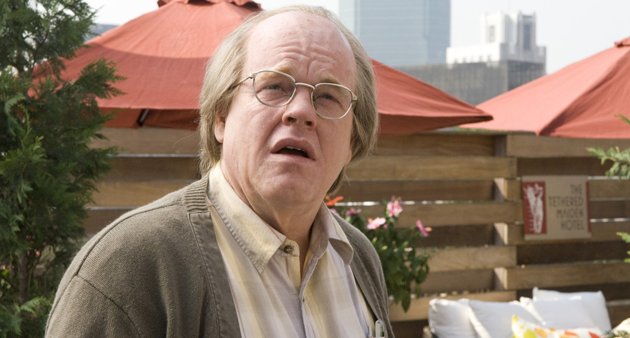
Synecdoche, New York is like a Chris Nolan film blown way out of proportion. Which, by the way, is not necessarily a negative thing. Philip Seymour Hoffman takes a turn at a man, Caden Cotard, who is slowly losing his grip both on life physically and mentally, as his perceived reality becomes something of a concoction of what is real and what is not real. Suffering from numerous ailments which are taking a toll on his health, Caden’s decision to devise an out-of-this-world (literally) theatre production in a massive warehouse in the theatre district of New York strikes up a number of questions about life, both for himself and for the audience (or, myself at least).
His inability to sustain a relationship with any woman plays an integral role in throughout film. He has three significant relationships during its course: his wife at the beginning who moves to Berlin to pursue her career in art, Adele Lack (Catherine Keener); an actress who is part of his cast and who becomes disenfranchised with Caden’s obsession about his production, Claire Keen (Michelle Williams); and Caden’s long-time assistant and box office manager, Hazel (Samantha Morton). Caden also has a less than productive relationship with his therapist Madeleine Gravis (Hope Davis) and a non-existent to heart-wrenching affiliation with his misguided daughter, Olive (Robin Weigert). Perhaps this lack of a consistent connection and commitment mirrors Caden’s loss of a base in real life — he seemingly cannot sustain a healthy absolute existence — thus prompting him to focus all of his energy into an epic-scale production where his life, and all of those around him, he is able to view from the outside, as if it were fiction.
“Does anyone have any idea what the hell is going on?” Credit: Yahoo! Movies
Having only watched Synecdoche, New York once, I am absolutely certain there are a number of elements I missed whilst viewing the film, but one that definitely stuck out was Caden’s seemingly bleak view regarding his own life. For example, he is left almost angered at his original wife’s success over in Berlin, so much so that he continues to increase the scale of his own production, as opposed to Adele’s dedication to miniature art-work. Caden does not feel the world he lives in notices him (his wife and daughter have left him, his health continually deteriorates) and the only time it does muster something up for him — a MacArthur Fellowship — he takes that as a sign to build a legacy that he believes will have to be noticed and highly regarded when he inevitably passes. As the film progresses, so too does Kaufman’s direction and informal misdirection, as Caden’s life becomes increasingly blurred and entangled with the lives of his and his casts doppelgängers, with each doppelgänger hired to portray significant players in his own life as a part of his production. As a viewer, it is often difficult to distinguish between what is actually happening in Caden’s life, and what is a part of the production — even his actors often need to ask Caden to halt proceedings in order to talk in reality — adding to the overarching trench of mind-numbing facets on display.
Hoffman is exceptional as the lead character, forcing Caden’s anguish down the viewer’s throat, leaving a lump in it and generating total empathy for the character. At this stage in the game, average performances are not on the menu when it comes to Hoffman, who seems to be churning out one gourmet dish after another. The supporting cast all provide the necessary emotion and disconnection towards Caden, with Samantha Banks in particular standing out as Hazel, who seems not to share Caden’s fear of impending death as she decides to live in a burning house where death crackles along every wooden beam. Michelle Williams, pre-Blue Valentine fame, effectively acts as a fountain of sympathy towards Caden, before her disillusionment evokes the eruption of a fiery side. Charlie Kaufman certainly deserves praise for successfully carrying out the seemingly unenviable task of progressively directing doubt and fictitious elements into the film, without going overboard and turning proceedings into a complete mesh of insincerity.
“Not a clue.” Credit: The Film Stage
In the midst of all the gloominess and lack of clarity, Synecdoche, New York boasts characters who are crying out (again, literally) for sympathy and who, regardless of their faults — of which there are many — deserve sympathy from the audience. After being left speechless at the contents of the film itself, the emotion followed through like a ton of bricks for me. Although much of the film is based on deciphering what is real from what is not, there is a distinct element of something present which is grounded in everyday life. At its very simplest, the film is a portrait of a middle-aged man who is struggling through his job when we first see him on-screen, whose health is continually threatened and whose relationship(s) is crumbling. Okay, so it is not grounded in my everyday life (I am not quite middle-aged yet), but it certainly provides a commentary on a potential and very realistic life.
This is without doubt the most challenging review I have written, and it probably does not make a whole lot of sense if you have not seen the film (it might not even make any sense if you have), but to me that is in fitting with the surreal, but equally rational, thought-provoker that is Synecdoche, New York.
It will make you think, and then it will make you think again.
Around the end of March last year, I ventured up to Cineworld in Glasgow and settled down to watch The Hunger Games — code adhered to, of course. The adverts I had seen on the television beforehand had looked fairly interesting and although I was expecting to watch an enjoyable film, I certainly did not expect to like The Hunger Games as much as I did. The film was more or less critically lauded and I have already mentioned in a previous Genre Toppers post that I think The Hunger Games is very good and a film which, when I first watched it back in March 2012, far exceeded my expectations. In fact, after seeing a few times since then, I think it is even better on second and third viewings.
On to today then and switching focus to the future of the franchise with this post, which will hopefully act as an informative and entertaining (okay, perhaps just informative) preview looking ahead to the next instalment of Suzanne Collins’ novels: Catching Fire. Unlike when I went to see the first film, I have read the book which the second is based on and therefore I more less know what is going to happen, thus I have a lot of confidence that Catching Fire will be an even greater success than its predecessor, which took just under $700 million from a budget of just under $80 million. Since then, the franchise has become one of the most actively popular today, and this popularity is only likely to increase as the second instalment nears its release.
The first trailer for Catching Fire was unveiled to the world a few months back and set the scene for another storming outing, which this time will be directed by Francis Lawrence (director of I Am Legend and, more recently, Water for Elephants). The second trailer, released today at the San Diego Comic Con, goes into a bit more detail about the story and we even get a glimpse at some of the new characters. Trailers often give away too much these days, and I do think the new Catching Fire trailer shows quite a lot, but one thing is for certain: it is on an epic scale. Hopefully Francis Lawrence can do what Gary Ross done so well for The Hungers Games, and keep the focus on the characters in a film which will move along at break-neck speed at times.
Please keep those pinky fingers down.
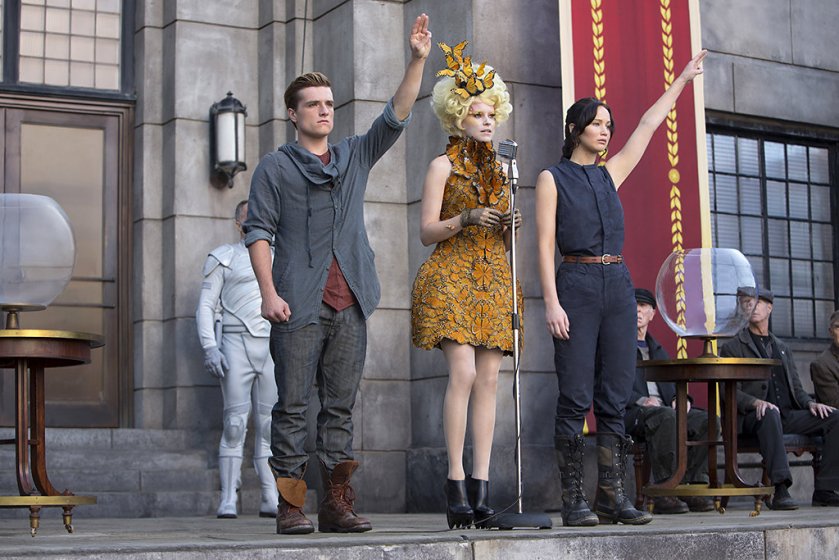
It goes without saying that Jennifer Lawrence is up there with the most-talked about actors on the planet — it also goes without saying that I think she is the most talented out there at present — and she will more than likely pick up from exactly where she left off last time around as Katniss Everdeen, in Catching Fire. Josh Hutcherson is back as her love interest and fellow Hunger Games victor Peeta Mellark, and Liam Hemsworth is sure to see more screen time here as her best friend and another District 12 resident, Gale Hawthorne. Elizabeth Banks, Woody Harrelson and company will also return for Catching Fire, which will also see newcomers such as Sam Claflin and Jena Malone offer their hands in making the film the success which it is bound to be. The newcomer I am most looking forward to seeing is Philip Seymour Hoffman, who is set to portray Plutarch Heavensbee and who comes across delightfully smug and sinister alongside the untouchable Donald Sutherland in the first trailer in particular.
With a somewhat covertly semi-political backdrop accompanied by elements of class-relations and discrimination, combined with characters who the audience care about and will root for and action which should appease the masses, Catching Fire could well be on its way to becoming the biggest film of the year come November, and I for one am certainly looking forward to seeing it on the big screen back in Cineworld in Glasgow.
Below is the brand new trailer for The Hunger Games: Catching Fire.
Money in the Bank has garnered a reputation since its conception of being arguably the most exciting Pay-Per-View of the year. Last night, the combination of a raucous Philly crowd, two excellent heavyweight title matches and two exceptional ladder matches held up Money in the Bank’s reputation in what turned out to be another very good Pay-Per-View in a year of very good WWE Pay-Per-Views.
PPV Thoughts
With so many newsworthy developments, I think it is only fair to begin with the match that bludgeoned up the majority of these — the All-Star Money in the Bank ladder match. With Kane out of proceedings after the Wyatt Family debut and subsequent steel-step-face-mush on RAW last week, the match became a six-man bout. The Philly crowd were hot just about all night and exploded when Rob Van Dam made his (almost) triumphant return. It is very cool to see RVD back in the WWE. It is also incredible (though not particularly surprising) that he looked like more of a superstar in one night than he has done in the past three years over in TNA.
This match closed the show and was one of the more brutal Money in the Bank ladder matches in recent years, with both RVD and CM Punk needing staples to close head wounds afterwards (poor Christian also chipped his tooth — yes, he was in the match). RVD executed the usual RVD spots just about as well as he has done in the past, and even hit a Five-Star Frog Splash from the top of a very high and jittery ladder. Sheamus took a painful looking tumble through a ladder parked on the outside towards the end of the match — apparently Sin Cara is giving away DVDs of this moment to any and all.
As the match began to gear up to its conclusion it looked like Daniel Bryan — one of the favourites — was going to win after taking out everybody, but was attacked with a steel chair out of nowhere by Curtis Axel (who successfully defended his Intercontinental Title against The Miz earlier in the night). I am unsure if this was just there to set up the next spot, or if it is the beginning a Daniel Bryan-Curtis Axel feud, but I sincerely hope the latter is not true. After the summer he has had thus far, it would be unfair to see Daniel Bryan relegated to an Intercontinental title match at SummerSlam.
“Dammit – i can’t do my pose with this briefcase.”
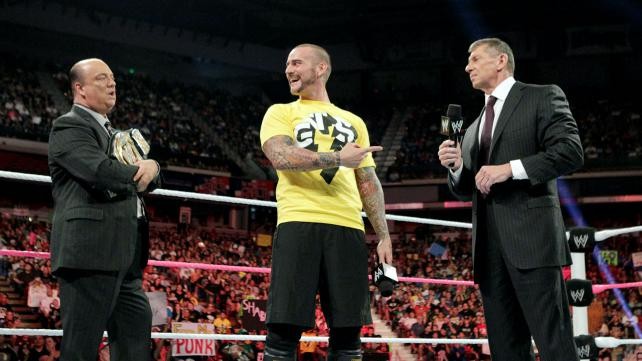
With everybody out of the proceedings, CM Punk was then left with the opportunity to win the match. Everybody was waiting for Brock Lesnar to show up (even the Philly crowd who were chanting his name) but instead Paul Heyman turned on Punk and whacked him over the head with a ladder. Why Paul why? Before RVD could close in on the briefcase, he was RKO’d off of the ladder by Randy Orton (which looked very cool), who went on to win his first ever Money in the Bank briefcase. I liked it.
With the All-Star ladder match closing the show, the World title was once again shafted to the beginning, with the World title ladder match kicking-off Money in the Bank. Going into this one there was not really a clear favourite to win (I picked Wade Barrett, for goodness sake), which made the match all that more intriguing. It would have been interesting to see this one play out in a less-significant wrestling city, but Philly got behind a number of the heels and seemed to like letting everyone else know that they were people (I would never have guessed).
The most innovative spots in this one included Dean Ambrose skinning the cat onto a ladder held horizontally by Cesaro and Swagger (now known collectively as The Real Americans, brother) and trying to grab the briefcase before being tossed to the outside. Fandango hit a smooth-looking sun-set flip power bomb from the top of a ladder on Wade Barrett. Heck, Barrett even went all Ryback on everyone after dismantling part of a ladder and using it as a weapon. Fandango was actually pretty over in Philly, with a lot of the crowd cheering every time he climbed the ladder — there was also a Summer Rae chant at one point (works for me).
The Intellectual Saviour of the Exchequer
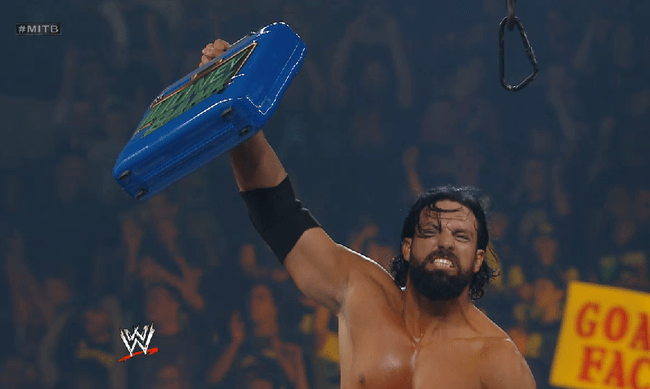
Cody Rhodes was definitely the MVP of this one, with the crowd firmly behind him and it looked like he was on his way to winning the Money in the Bank briefcase and finally receiving that push he has deserved for years. After being stopped by Seth Rollins and Roman Reigns the first time around, Rhodes was whacked off the ladder by his tag team partner Damien Sandow who went on to win the briefcase. I am absolutely fine with this. It looks like WWE are going for Sandow vs. Rhodes at SummerSlam, but I will get into that a little more later. Even though he did not win this match, Rhodes probably came out looking the strongest, and hopefully this is a career-defining moment for him.
The two heavyweight title matches were very good, with John Cena defeating Mark Henry and Dolph Ziggler losing to Alberto Del Rio via disqualification. There was a lot of interference throughout the PPV, but each time it made sense and therefore I do not have any complaints. AJ (‘inadvertently’) cost Dolph Ziggler the World title after hitting Del Rio with her previously retained Divas belt. The ending here was a little anticlimactic, but the match was quick-paced, with many near-falls and could have gone either way at any moment. The Philadelphia crowd were firmly behind Ziggler more than any other crowd since his babyface turn, and he shone in the match. Del Rio and Ziggler do work well together.
In terms of the WWE title match, Cena and Henry put in a good effort — a better effort than some may have expected beforehand in fact. The fans in attendance were firmly behind the World’s Strongest Man and Cena got a pretty hostile reception, which is more or less expected in places such as Philadelphia these days. Both guys kicked out of the other’s respective finishers, and Cena won after causing Henry to tap-out to an STFU (is the ‘U’ still there?). I am not a big fan of Mark Henry tapping out, but what can you do. Cena winning was probably the right decision, even though most of the Philly fans wanted to see Henry pick up the title.
The rest of the card was fairly solid, if not a touch underwhelming, with the exception of a good Tag Team title match between The Shield and The Usos on the kick-off show, with The Shield retaining. As I mentioned earlier Curtis Axel successfully defended his Intercontinental title against The Miz, although the most noteworthy part of this match involved the ejection of Paul Heyman, which was not well received by the ECW-Philly fans. AJ and Kaitlyn contested another decent Divas title match, which AJ won by way of her very painful looking Black Widow submission. Chris Jericho guided Ryback through a better-than-normal Ryback match, which Ryback won via roll-up.
Going Forward
“Why does this always happen?”
With two new Money in the Bank briefcase holders and a whole load of other developments, the question now is what happens next? Over the last month or so, the internet has been buzzing with the rumour that Daniel Bryan is set to face John Cena for the WWE title at SummerSlam. While this match is still a possibility, after last night its prospects have somewhat diminished in my eyes. Are WWE going to go with Randy Orton vs. John Cena at SummerSlam (for the third time), or will Henry get a rematch? For me, the ideal situation would be for Daniel Bryan to face John Cena and win the WWE title at SummerSlam, only for Randy Orton to cash in his Money in the Bank briefcase, win the title off of Bryan and turn heel in the process. This would set up a program involving those three guys throughout the autumn, perhaps up until the Royal Rumble. We know Orton and Bryan work very well together, and Orton and Cena have had some brilliant matches over the years — and John Cena, in spite of any “you can’t wrestle” chant, is capable of having great matches with anybody — so this seems to make sense in my view.
It looks like Cody Rhodes will be a babyface going forward after Damien Sandow turned on him last night, and it would be excellent to see these two feud over the briefcase and have a match at SummerSlam. They were a brilliant, if not a vastly under-used tag team as Rhodes Scholars, and both guys are very good in the ring and on the mic, so this one has a lot of potential. I see Sandow keeping the briefcase and not cashing in for a while (maybe not until after WrestleMania next year), unlike Orton. Sticking with the World title picture, the break-up of Dolph Ziggler and AJ is imminent. The question is: who gets custody of Big E? Most likely AJ, setting up a Ziggler-Big E match for SummerSlam (nothing new here). If this is the case, hopefully after SummerSlam Ziggler will get the World title run he deserves. That leaves Alberto Del Rio free for next month’s PPV. There are a few opponents he could face — Sheamus, Chris Jericho, maybe even a returning babyface Big Show? I am going to go out on a limb here and say Del Rio will defend the World title against RVD at SummerSlam.
“So you’re telling me this guy was right all along?”
One thing we do know for certain heading into ‘the biggest party of the summer’ is that CM Punk will face Brock Lesnar at the event. With Heyman now fully against Punk, the duelling between both guys on the mic over the next month or so will be absolutely golden. It remains to be seen if Lesnar will show up tonight on RAW or even how often he will show up on the road to SummerSlam (that does not quite have the same ring to it), but if anybody can sell a match, Paul Heyman can. Punk vs. Lesnar could be a show-stealer at the event, and with all three guys involved here accustomed to going against the mould, there could be fireworks.
I really do not know what will happen the Wyatt Family tonight, but I cannot wait see what they have in store for us. Some people are suggesting that Kane will end up being a part of the family, although the most likely situation is a Wyatt Family vs. Kane and Undertaker match at SummerSlam. The latter would be incredible, and having the Undertaker on the card would make the PPV that extra bit special. Looking at the other trio on the roster, The Shield, they seem to have lost a bit of momentum recently. The Tag Team title match should never have been on the kick-off show last night, and Ambrose was lost in the shuffle of Money in the Bank participants in all honesty. A Shield vs. Wyatt encounter is surely pencilled in at some point over the next few months, but until then I hope The Shield get back to somewhere near the dominance they were showing around three months ago. I am fine with seeing them defend the Tag and US titles against guys likes The Usos and Christian, as long as they retain the gold and are not dismissed as unimportant.
The McMahon story-line? I think I will pass for now. It has hardly been must-see television recently, and I cannot see it getting any better in the coming weeks, nor am I sure how it will evolve.
One thing is for sure though — RAW should be explosive tonight.
Match Rundown
Kick-off:- The Shield (Seth Rollins and Roman Reigns) (c) defeated The Usos, to retain the WWE Tag Team titles (14:48)
1:- Damien Sandow defeated Cody Rhodes, Wade Barrett, Dean Ambrose, Antonio Cesaro, Jack Swagger and Fandango, to win the World Heavyweight title Money in the Bank briefcase (16:25)
2:- Curtis Axel (c) defeated The Miz, to retain the Intercontinental title (09:08)
3:- AJ (c) defeated Kaitlyn, to retain the Divas title (07:03)
4:- Ryback defeated Chris Jericho, in a singles match (11:20)
5:- Alberto Del Rio defeated Dolph Ziggler via disqualification, to retain the World Heavyweight title (14:29)
6:- John Cena defeated Mark Henry, to retain the WWE title (14:46)
7:- Randy Orton defeated CM Punk, Daniel Bryan, Christian, Sheamus and Rob Van Dam, to win the WWE title Money in the Bank briefcase (26:38)
Starring: Ewan McGregor, Hayden Christensen, Natalie Portman, Ian McDiarmid
Three years after the onset of the Clone Wars, Revenge of the Sith sees the galaxy ravaged by fighting. With Jedi dispatched all over battling the Separatist droid army, Obi-Wan Kenobi (Ewan McGregor) is assigned to exterminate their leader, General Grievous, while at the same time a now more powerful Anakin Skywalker (Hayden Christensen) becomes drawn ever closer to Chancellor Palpatine (Ian McDiarmid). Fearing the loss of his wife Padme (Natalie Portman) and their child, seen through his visions, Anakin goes to extreme lengths to prevent such an event taking place, with disastrous Sith-related consequences.
By far the best of the prequels (and from what I have read, the best of the four Lucas directorials), Revenge of the Sith has a variety of positive things going for it. For me, of the blemishes held by the previous two instalments, the main falter of both was the fairly shoddy dialogue and script-writing. In fact, Lucas has even admitted in the past that writing has never been his strongest asset. This time around, however, there is a vast improvement. Partly, this is to do with Revenge of the Sith driven more-so by action and battle scenes, as opposed to the number of pure dialogue scenes slowly bulging out of the previous two instalments (around half of Attack of the Clones‘ main plot-line was dreary dialogue between Anakin and Padme). With that being said, to Lucas’ credit, I also think there is a general overall improvement in writing here. Yes, portions of that clichéd dialogue pop up every now and again between those two aforementioned characters, but on the whole the quality of interaction is much better and much more meaningful in Revenge of the Sith than before. Scenes between Anakin and Palpatine in particular stand out, which leads me deceptively impressively to my next point…
Something in your eye?
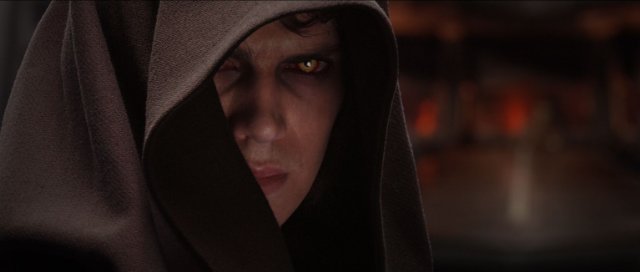
Hayden Christensen is much better here. So much better, in fact. I mentioned in my review of Attack of the Clones that he comes across as stale at times, but his efforts this time around pretty much put the reasoning behind that to bed — he was simply not given good enough material to work with. In Revenge of the Sith, on the other hand, he is given vastly greater material and his depiction of an increasingly misguided Jedi and seemingly helpless husband is very good. By no means does he put in an Oscar-worthy performance (nobody does), but it is one worthy of the platform he finds himself rooted to. The ‘best performance in the film award’, without a doubt, lies with Ian McDiarmid as Chancellor Palpatine. He exudes vileness, but at the same time remains engrossing and delightful to watch as the manipulative Darth Sidious (it is not a spoiler if it is in the trailer). His calm-yet-menacing tone during scenes with Christensen actually remind me of Alan Rickman as Professor Snape in the Harry Potter films — which is a very good thing. Again, Ewan McGregor is solid here and probably puts in a trilogy-best performance, which all of the cast do to be fair.
The best aspect of Revenge of the Sith, and the aspect which makes it Lucas’ best directorial performance out of his three prequels, is the character development throughout. The unravelling of Anakin into Darth Vader is the primary focus of the film and everything else fits in nicely around his capitulation. The seeds of self-doubt, originally planted in Attack of the Clones, come to fruition in a harrowing nature here and, as I mentioned before, Christensen does a fine job at portraying the evolution of one of the best and most well-known villains in cinematic history. Obviously, it is fairly straightforward to keep a character on a consistent path throughout a number of films when the films are prequels and therefore his (or her) fate is already known by both director and audience. But what I would absolutely commend Lucas on is the way in which he delivers the consistency in Anakin’s transformation — from his resultant actions after discovering his beaten mother in Attack of the Clones, to the outcome of his duel with Count Dooku and their subsequent dialogue, both Lucas by way of direction and narrative and Christensen through his delivery on-screen ensure that the birth of Darth Vader is an appropriately emphatic one.
“Is it just me, or is it hot in here?”
To have Anakin pulled in a number of directions here is the key to the film, and this actually makes me sympathise (and, I guess, empathise) with the character. Having visions of his wife and unborn child dying, feeling unappreciated by his master Obi-Wan and being shut down at almost every opportunity by influential Council member Mace Windu — I do not like that guy, and I am still not sure if I am meant to or not — certainly provides a substantial basis for reason to go off the rails. And that is not even taking into account his manipulation at the hands (and speech) of Palpatine/Sidious. Natalie Portman plays a necessary and potent role in generating much sympathy for Anakin, and the simultaneous sequence of the two towards the end is rightfully one bursting with emotion.
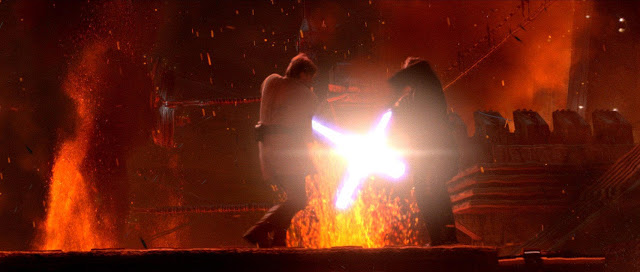
Having blabbed on about the content of film itself, it would be unjust for me to ignore the sheer visual spectacle that is Revenge of the Sith. The improvement from film to film to film between the prequels is tremendous, and by the time Revenge of the Sith comes around, the magnitude of visual achievement is protruding the pinnacle of the scale (bearing in mind that the film was released in 2005, over eight years ago). The final battle scene between Anakin and Obi-Wan (in the trailer thus not a spoiler) is the most visually enticing of the entire trilogy in regards to battle sequences, and those in the CGI department deserve a huge amount of credit for their creation of a number of stunning set-pieces (at its absolute primitive, the whole saga is one massive, impressive set-piece after another). From the first scene until the last, the effects are on point and, for a film which is more or less dominated by fight scenes, I was encapsulated throughout and this is not only a testament to the stunt people, but also to the actors themselves — for the battle scene at the end, Christensen and McGregor choreographed the sequence for the most part on their own, and did not use stunt doubles at any point. Well-played.
Revenge of the Sith is everything that modern cinema is all about: intelligent film-making with a clear, effective narrative, emotionally-investable characters and awesome visuals. I would even go as far as saying that Revenge of the Sith makes both The Phantom Menace and Attack of the Clones better films, whilst remaining an outstanding piece on its own.
Set 10 years after the events of The Phantom Menace and in the midst of a Separatist rebellion, Attack of the Clones sees an older Obi-Wan Kenobi (Ewan McGregor) undertake a mission to discover who is behind the assassination attempt on former Queen and now Senator Padme Amidala (Natalie Portman), whilst a talented-yet-over eager Anakin Skywalker (Hayden Christensen) is tasked with protecting Padme, whom he has strong feelings for. Meanwhile, the creation of a massive clone army and a potential conspiracy at the head of the Republic both threaten the beginning of a destructive and uncontrollable war.
Often regarded as an improvement on The Phantom Menace, Attack of the Clones certainly lays the foundations for a slightly more sinister Star Wars going forward — which is a good thing in my eyes. We see a number of these more sinister traits come to the forefront as the film progresses: elements of Anakin’s darker side and his ambition to “become the most powerful Jedi in the world,” the introduction of Jango Fett and his son Boba along with all that goes on surrounding them, and the themes of betrayal, conspiracy and abuse of power amongst leaders of the Rebellion. All three of the aforementioned plot-points are positives not only in terms of Attack of the Clones as a film on its own, but also in terms of the Star Wars saga going forward as they provide the basis for key narrative in the future.
No jokes from me this time around, just admiration.
Firstly, I do think that Hayden Christensen is a little bit hit-and-miss here. This is partly to do with the rather cliché-laden script — he is far better at the beginning of the film and towards the end, as opposed to the middle section where both he and Natalie Portman are hindered by, for lack of a better term, soppy dialogue. But his performance is also probably a result of his inexperience on the big stage — back in 2002, Attack of the Clones was only his fourth or fifth film, and his first significant one in terms of scale. Having said that, however, and having seen Christensen in other films later on in his career, I would like to think that his performance, which is a tad wooden at times, is on the whole an unfortunate product of an uninspired script. To clarify, the whole romance sub-plot between Christensen and Portman is absolutely fine, but the execution is poor and this is primarily down to the wishy-washy dialogue between the two. I like Christensen as an actor and am a big fan of Natalie Portman, but it just did not quite work this time for me. Ewan McGregor does well in carrying his half of the proceedings where the goings-on tend to be more exciting and eventful as he is involved in uncovering an assassination plot rather than a romance (just like it would be, right?). Yoda, voiced by Frank Oz, gets a bigger role this time around and, unlike Jar Jar Binks (who thankfully has a minor role here), is a necessary character who adds to the film. We also see Christopher Lee in a familiar bad-guy role, which he executes with charisma and typical bad-guy exuberance.
Although the script is questionable at times, in general, I do think that Attack of the Clones has a better story than its predecessor. More things are happening this time around — exemplified by the two main characters splitting up and following different agendas for the majority of the film, unlike The Phantom Menace — and, although there is more going on, the plot is still easy enough to follow and makes sense on the whole. With neat nuances such as Anakin’s exploits when he goes back Tatooine to look for his mother and Obi-Wan Kenobi’s trip to the ocean planet of Kamino, the key events of the film have not only more meaning than those in The Phantom Menace (we did not really need to see Anakin as a child or pod-racing), but also an increased sense of direction as the eventual intersection of the varying plot-lines makes sense. Although middle films in trilogies are often looked upon as not much more than a device to further the character development outlined by their predecessor and set up events for their successor, Attack of the Clones veers just enough away from this stereotype to be a success on its own — however there is an element of my latter point in the film.
“Gladia- Jedi, are you ready?!”
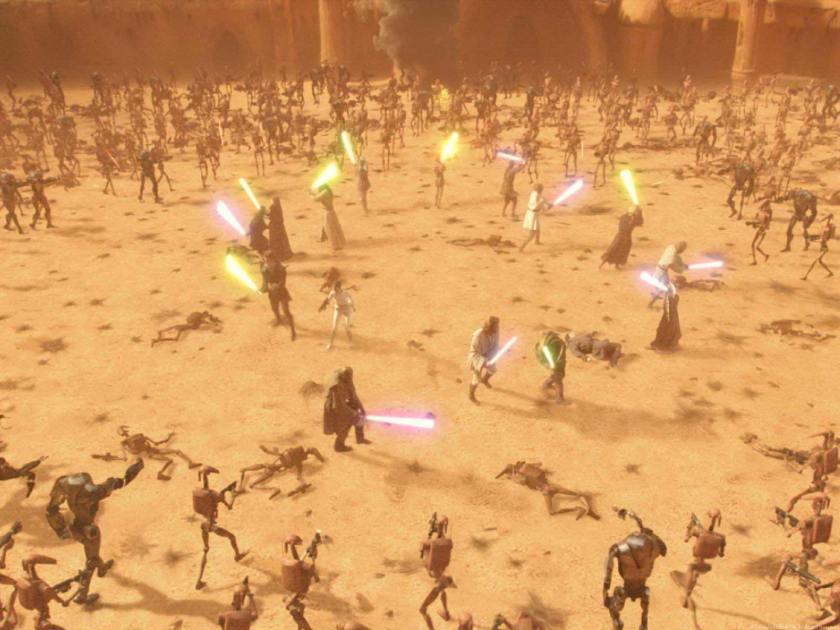
Again, in tune with The Phantom Menace, Attack of the Clones is an awesome visual specimen from start until finish. It would even be fair to say that it overtakes The Phantom Menace in the looks department, which is expected considering a lot can happen in three years in regards to image and special effect technology (and evidently did happen, as Attack of the Clones was one of the very first films to be shot entirely on the high definition digital 24 frames-per-second system). Apart from the opening scene with the pod chase — which by all means looks fine, but drags on a little too long — the film moves forward at a decent pace and boasts a fair amount of enjoyable action sequences, with the Gladiator-style battle on Kamino between the Republic and the Separatists towards the end being the pick of the bunch. On that note, I do think Attack of the Clones is missing a really evil villain, and in that sense it does act as more of a buffer between the first and third films in the trilogy. Do not get me wrong, as I mentioned before, Christopher Lee does a fine job as the main villain of the piece, but he does not quite exude that total evilness and heartlessness that Darth Maul did in the previous instalment.
That is all I really have to say about Attack of the Clones. For me, this is perhaps a minor improvement on The Phantom Menace due to the overall more intriguing plot and the introduction/reinforcement of a few key characters, however the clichéd, flat dialogue between Christensen and Portman, which consumes a good proportion of the film, lets Attack of the Clones down slightly.
 Director: Jay Roach











 Consumed By Film