The Hunt (2013)

★★★★★

Director: Thomas Vinterberg

Release Date: November 30th, 2012 (UK); January 10th, 2013 (Denmark)

Genre: Drama

Starring: Mads Mikkelsen

“What’s your favourite dish?”

The question, posed by a young, chirpy girl not long after the opening credits, is a humdrum one. The kind of conversation starter that represents the mundanity of everyday life, or in this case, the imagination of a child yearning to learn more about people, the world and everything. But also a sentence that sets the proceeding tone, run-of-the-mill, at least for 20 minutes or so. The question then, is a devious one. It represents a laid-back, frothy atmosphere that in hindsight turns to chilling and haunting given the almost two hours of harrowing on-screen events that follow. The question, therefore, is brilliant. At least, its connotations are in the long run. The two whose conversation includes said food-related musing are also the two whose actions and reactions determine what is come. The question, above all else, is apt. Because only a daring director can script a meal question and pose it to Mads Mikkelsen. And, apparently, only Thomas Vinterberg possesses the smarts to cheekily have an imagination-driven child ask the question. And only once the lingering shroud of Hannibal-esque clouds are confronted and subsequently expunged, can the narrative truly advance and become one of the year’s toughest and absolute best.

Venison, by the way.

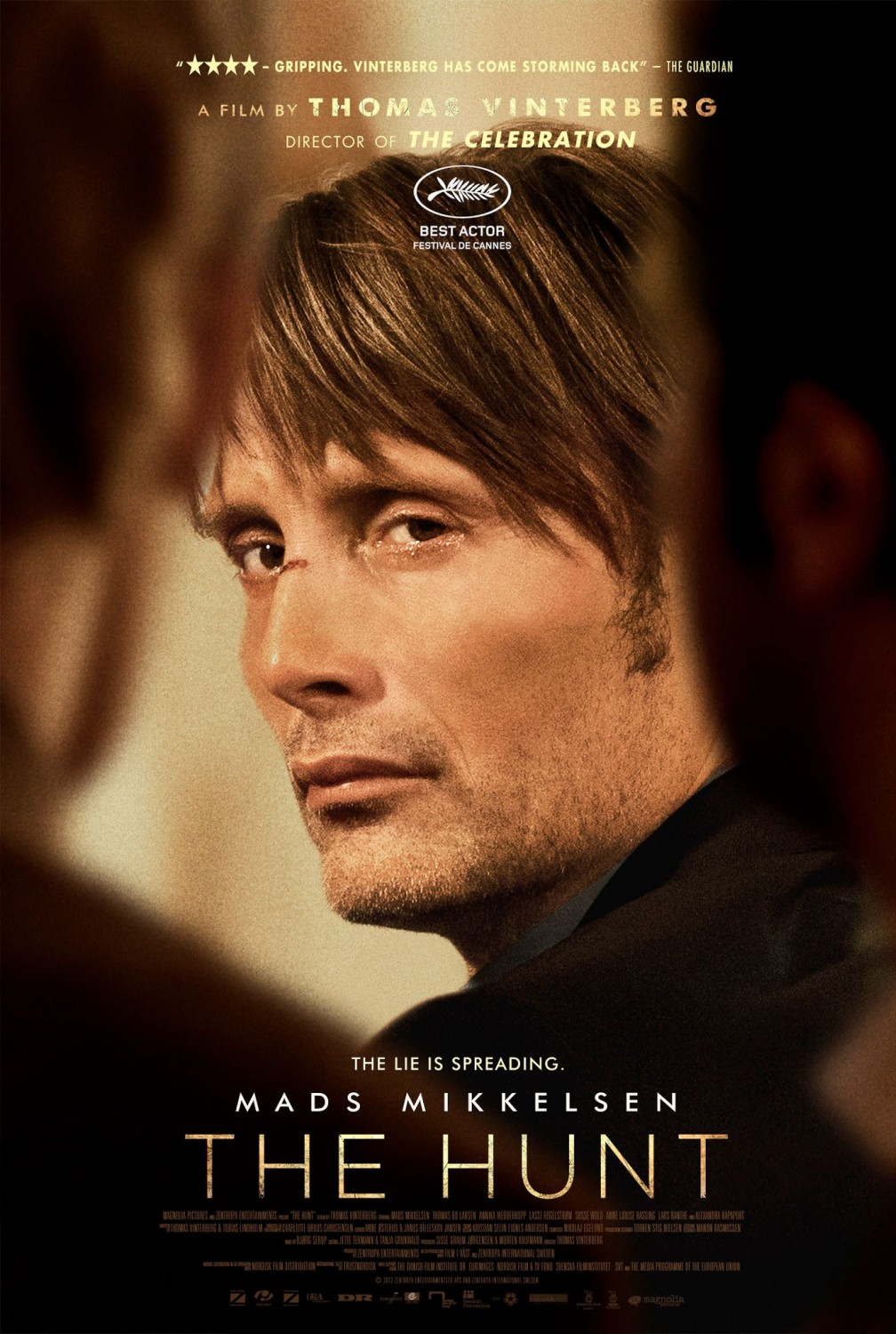
Lucas (Mads Mikkelsen) is a caring fellow; his dedicated work at the local kindergarten secondary only to a day-to-day template constructed by the enthusiastic youngsters, to whom he abides. In the evenings, Lucas spends time endorsing the merriment brought on by the combination of alcohol and a tight-knit community, and at weekends he either crazily plunges into freezing water with his chums, or tactfully hunts with his gun. Normal life. In fact, the only oddity encasing this small Danish community is that it is so friendly. That is, until a fleeting comment escapes the mouth of Klara (Annika Wedderkopp), one of the children Lucas looks after. The words are untrue, generated from the petulant anger of an unassuming child, but they still send shock waves around the neighbourhood. Subsequently, that day-to-day existence Lucas thrives on spirals through an unforgiving rigour. For an ingrained belief can never truly be shaken.

From the get-go, director Thomas Vinterberg sets out to achieve a specific but absolutely necessary tone. Lucas is always the central cog from which we gauge emotion. As daylight seeps from the screen, early interactions are conversational. When darkness falls, raucous beer-fuelled gatherings evoke jolly connotations of Nordic Vikings. There’s a familiar communal atmosphere, enveloping familiar people. Therefore when the agonising allegation is made, by a child no less, the audience has already bought into the realism shrouding proceedings. From then, a simmering tension takes over. Vinterberg does not over-egg or ‘Hollywoodize’ anything; even though detective teachers and informed parents are aware of the situation, they don’t explode in fits of rage or anger. Rather, internal disgust consumes all, allowing the narrative to tentatively build to its anticipated crescendo. Vinterberg’s controlled approach is admirable and ultimately successful; in this sense, the film is very mature and the filmmaking is very accomplished.

Vinterberg also hammers home the accused’s criminal status: at no point during the film is Lucas positioned as guilty. That’s never an issue, not in the eyes of the audience anyway. We know Lucas is innocent, but we also find it difficult to persecute a child for a mistaken phrase. And what right, if any, does anyone have in denouncing the actions of parents and a community trying to protect their own? Lucas himself mightn’t even challenge the paternal instinct, given his own attempts to secure custody of his son. The Hunt ponders this question, and tackles resultant topical societal issues. Important ones. Soon after Klara’s confession (“I don’t believe a child would lie about these things”) disapproving fumes centred on Lucas’ apparent actions spread like wildfire throughout the area, as he becomes the poster-boy of wrongfulness. These reverberations are not only felt by Lucas himself, but also by his son and partner. The teacher’s identity being revealed so soon after the incident essentially scalds an innocent man for life, a notion the film appears to consider unfair.

Bookended by two apparently different but thematically resounding hunting outings, proceedings never really ease up — mirroring probable real life. Towards the climax, a scene involving Lucas and Klara will have you watching through bated breath, and there’s more still thereafter. Speaking of the two primary players in this chess game of moral standing and right or wrong-doing, the actors involved all have something to offer said disturbingly riveting happenings. As Lucas, Mads Mikkelsen delivers arguably a career-best performance; amiable at the beginning, poignantly steadfast throughout his plight and never without dignity which, given his character’s predicament, is an extraordinary achievement from the Dane. Annika Wedderkopp plays Klara and more than holds her own surrounded by many adult peers. She’s a child obviously, thus inherently boasts that endearing quality, but is much better than simply charming. The pair share an unwaveringly realistic dynamic.

Other noteworthy performances emanate from Lasse Fogelstrøm as Lucas’ son Marcus, and Thomas Bo Larsen as Theo, Lucas’ best friend and the father of Klara. Marcus is troubled by the allegations made against his dad, yet determined not to let it get the better of him. One scene, subtle in delivery but upsetting in substance, sees Marcus barred from a supermarket while in the vicinity of a girl he likes. Fogelstrøm is just as meaningful in these moments as he is during his emotional tirade later on. Trust is the issue when it comes to Theo, whose immediate outpouring of anger subdues a lingering instinctive feeling that his best friend is innocent. This concept is highlighted throughout the film, where characters inadvertently advance a lie and ignore a truth in order to find some sort of closure. Larsen is excellent in his role, torn, bewildered and hurt by the goings-on. Alexandra Rapaport plays Nadja, the love interest of Lucas, another victim of events.

The Hunt is an exceptional piece of filmmaking, not afraid to explore tough questions and certainly not unwilling to challenge any subsequent societal issues. Chartered by a magnificent Mads Mikkelsen performance, and crafted meticulously by Thomas Vinterberg, the film doesn’t do much wrong. At times the silence is deafening, and as the nerve-shredding tensions builds, that silence turns to a harrowing closet hysteria.

The hunt indeed.

Oscars 2014 — Final Predictions

Hollywood’s favourite night of the year is once again upon us. Stars have campaigned. Odds have shortened. Dresses have been selected. Cinema trips have come thick and fast. Jared Leto’s hair has been straightened.

And, now that I’ve seen all the nominated films in all the most talked about categories, here are my final predictions for the 86th Academy Awards.

If you want to know a bit more about why I picked what/who, there are a few ponderings towards the end. For my review of each Best Picture nominee, click on the respective title.

Best Picture

American Hustle

Captain Phillips

Dallas Buyers Club

Gravity

Her

Nebraska

Philomena

12 Years a Slave

The Wolf of Wall Street

– What will win: 12 Years a Slave

– What I want to win: 12 Years a Slave

– What should’ve been nominated: Blue is the Warmest Colour

Best Actor

Christian Bale

Bruce Dern

Leonardo DiCaprio

Chiwetel Ejiofor

Matthew McConaughey

– Who will win: Matthew McConaughey

– Who I want to win: Leonardo DiCaprio

– Who should’ve been nominated: Tom Hanks (Captain Phillips)

Best Actress

Amy Adams

Cate Blanchett

Sandra Bullock

Judi Dench

Meryl Streep

– Who will win: Cate Blanchett

– Who I want to win: Cate Blanchett

– Who should’ve been nominatedAdèle Exarchopoulos (Blue is the Warmest Colour)

Best Supporting Actor

Barkhad Abdi

Bradley Cooper

Michael Fassbender

Jonah Hill

Jared Leto

– Who will win: Jared Leto

– Who I want to win: Barkhad Abdi

Who should’ve been nominated: N/A

Best Supporting Actress

Sally Hawkins

Jennifer Lawrence

Lupita Nyong’o

Julia Roberts

June Squibb

– Who will win: Jennifer Lawrence

– Who I want to win: Lupita Nyong’o

Who should’ve been nominated: Scarlett Johansson (Her)

Best Director

David O. Russell

Alfonso Cuarón

Alexander Payne

Steve McQueen

Martin Scorsese

– Who will winAlfonso Cuarón

– Who I want to win: Steve McQueen

Who should’ve been nominated: Joel and Ethan Coen (Inside Llewyn Davis)

Best Original Screenplay

American Hustle

Blue Jasmine

Dallas Buyers Club

Her

Nebraska

– What will win: American Hustle

– What I want to win: American Hustle

– What should’ve been nominated: Inside Llewyn Davis

Best Adapted Screenplay

Before Midnight

Captain Phillips

Philomena

12 Years a Slave

The Wolf of Wall Street

– What will win: 12 Years a Slave

– What I want to win: 12 Years a Slave

What should’ve been nominated: Blue is the Warmest Colour

Best Documentary Feature

The Act of Killing

Cutie and the Boxer

Dirty Wars

The Square

20 Feet From Stardom

– What will win: The Act of Killing

– What I want to win: The Act of Killing

– What should’ve been nominated: Blackfish

Additional Quick-hits

With the exception of a few glaring errors, The Academy has more or less come up trumps this year, at least nominations-wise. Time will tell whether the industry congregation get it right on the night, but until then, let’s take a look at some of the unfortunate snubbees (in a personal snub, I’ve opted not to include my Best Foreign Language picks above as, for whatever reason, i haven’t seen enough of the nominated films).

Inside Llewyn Davis, what is going on? Only up for Best Cinematography and Best Sound Mixing, my personal favourite film of the year has strummed a valiant strum, only to be waived by another Bud Grossman. As unlucky as Llewyn himself (irony eh?) the film should be up for a lot more.

Tom Hanks delivers the performance of a lifetime in the final moments of Captain Phillips, but his name is nowhere to be seen. I’m a fan of Christian Bale, and thought he was really good in American Hustle, but no phony wig can hide the travesty that places his performance ahead of Hanks’. Having said that, old Tom’s already won a couple, so he might not be that bothered.

Another disappointingly shunned near-masterpiece, the folks behind Blue is the Warmest Colour must feel hard done by. Adèle Exarchopoulos’ raw, enchanting portrayal is criminally ignored. The film was ineligible for a Best Foreign Language nomination, but Best Director, Best Supporting Actress and Best Film nods should’ve been calling. It’s almost as if some of those hardened Americana execs don’t fancy reading subtitles…

On to the actual bunch clambering for awards, and it seems Best Actor, Best Actress and Best Supporting Actor are all pretty much sown up. I’d love Leo DiCaprio to finally receive the adulation he deserves in the form of a golden statuette, but McConaughey is the favourite and a worthy winner. Barkhad Abdi surprised at the BAFTAs, but won’t here. Cate Blanchett is the definitive stick on.

Jennifer Lawrence and Lupita Nyong’o have been tussling for Best Supporting Actress throughout this awards season, the former having come out on top more often. Nyong’o delivers the more powerful and wholly better performance, thus should win the gong. Gravity is up for a lot, but outwith the technical categories, might only win Best Director for Alfonso Cuarón.

What then, of the top prize? Best Film. It appears to be a three-way jostle between the important 12 Years a Slave, the glitzy American Hustle, and the floaty Gravity. Apparently, some Academy members find 12 Years a Slave too tough a watch – which is absurd – and Gravity ain’t exactly at its best on a laptop screen (most voters see the films at home), therefore a shock could be on the cards which would see American Hustle hustle its way to the top. I don’t think so. For me, there’s no looking past Steve McQueen’s haunting 12 Years a Slave.

There we have it.

After a fairly lacklustre spring/summer, the arrival of that typical awards scent in late autumn summoned a plethora of very good to great films. From Captain Phillips to The Wolf of Wall Street, and many others in between, we’ve seen a mixture of high intensity drama, awe-inspiring visuals, harrowing story-telling and debaucherous eccentricity. All in all, I reckon it’s been a pretty good year.

Here’s to another!

Her (2014)

★★★

Director: Spike Jonze

Release Date: January 10th, 2014 (US); February 14th, 2014 (UK)

Genre: Drama; Romance; Science fiction

Starring: Joaquin Phoenix, Amy Adams, Scarlett Johansson

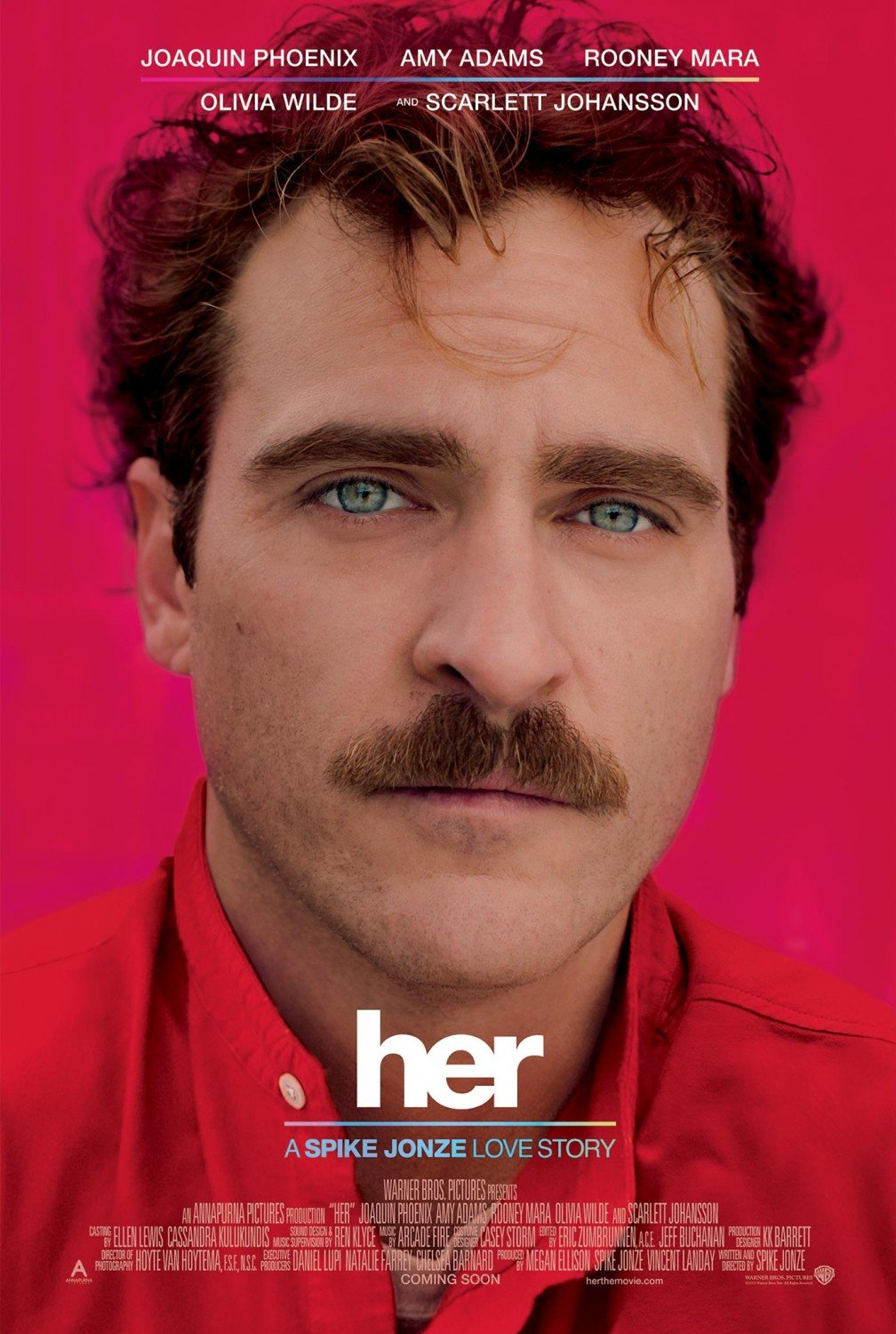
The last time Joaquin Phoenix and Amy Adams acted side-by-side they were components of an enigmatic collective, including the late Philip Seymour Hoffman, in an enigmatic film, The Master. Perhaps Scarlett Johansson’s most well-regarded stint in-front of camera was as part of Lost in Translation, and there are echoes here of that wayward soul in a hasty world mantra. Surprisingly then — given Phoenix, Adams and Johansson’s presence — Her somewhat ambles along uncertainly. Unlike The Master, it never reaches the pinnacle of engrossment, and it doesn’t quite have that admirable ambience of Lost in Translation. There is something delicate and charming though, admittedly often deriving from the performances of our fair trio. Yet aside from its lively textures, there’s a lacking sharpness, a missing clarity. Sometimes it’s all in the name, and the world in which Theodore Twombly exists is all a bit, well, wibbly-twombly.

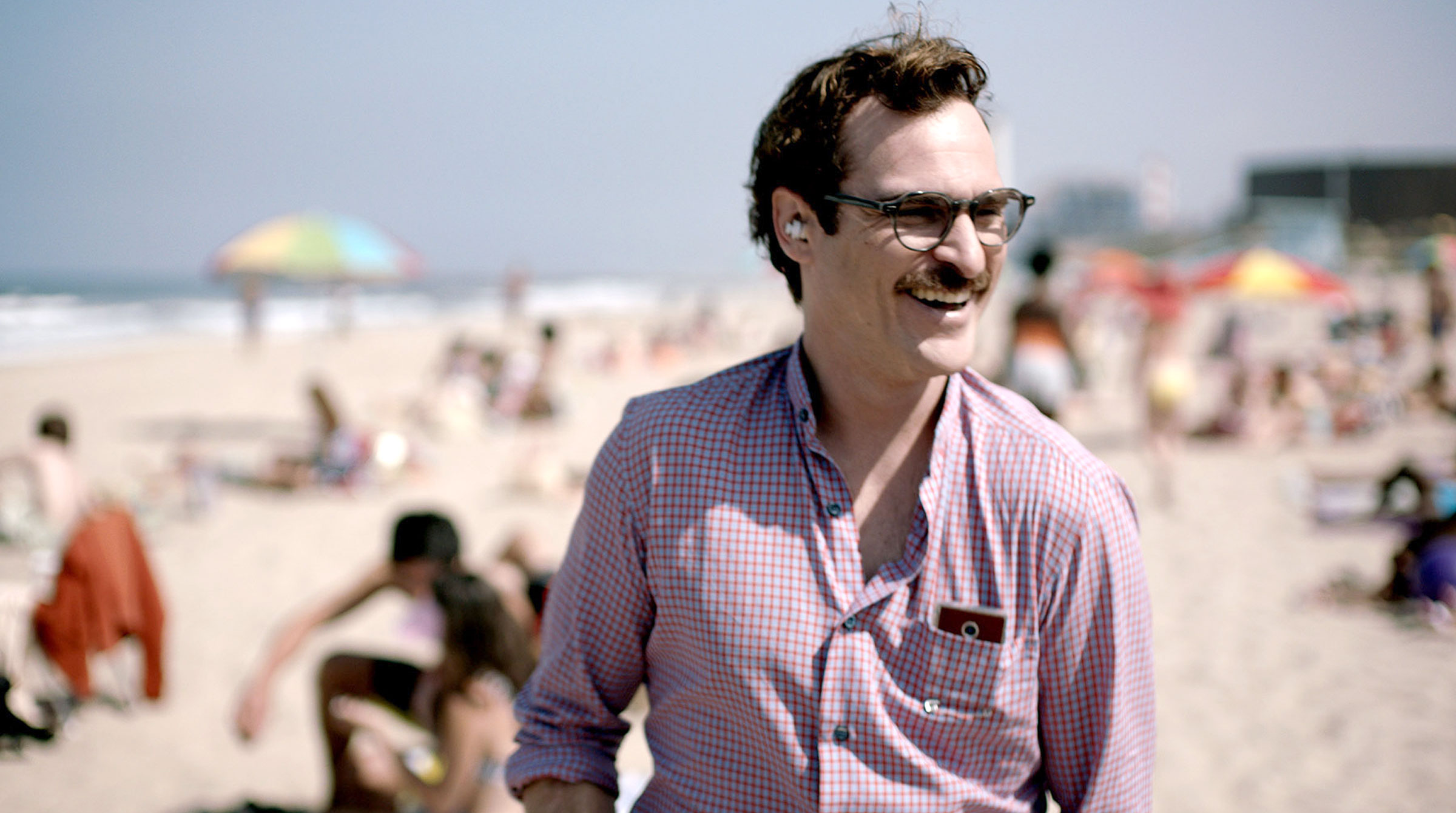
It’s 2025 and Theodore Twombly (Joaquin Phoenix) splits his time between love letter composition for those unable to elaborate on their feelings, engaging in virtual gaming, and moping about his impending divorce. Given his own stuttering when it comes to expressing emotions, it’s miraculous that Theodore succeeds in his paraphrasing-mediation job. Inward and suitably unnoticeable among the masses of technology consumed beings, Theodore decides to invest in a brand new OS system, shortly thereafter named Samantha (Scarlett Johansson). At first he’s unsure, but still awkwardly encapsulated; by the impossibly sophisticated technology, the presence of something new in his life, and more than anything, Samantha’s sultry voice.

A voice that absolutely entices. Scarlett Johansson delivers a pitch perfect audio performance that rings both affectionate and strong-willed, increasingly growing in knowledge and pseudo-humanity. As viewers, we know of Johansson’s actual beauty and picture her as the OS system exhales airwaves, therefore it is easier to grasp on to her allure and, ultimately, understand why Theodore is becoming more and more infatuated with those wispy tones. Essentially, we see what he hears. On the empirical side of things, Joaquin Phoenix amiably bumbles as the lead. In reality Phoenix has a tough job, considering many of his conversations take place without the presence of another human being, and there’s no central location for him to direct speech towards. In evading this obstacle, Phoenix creates a flailing uncertainty that, even in direct conversation with another body, would probably still have him glancing from ceiling to floor. Theodore’s fidgety, glasses-adjusting unsettled social existence works well, in turn ensuring another successful acting outing for Phoenix.

Aptly, women are the order of the day in Her and another three effectively contribute, only in smaller doses. Olivia Wilde manifests as Theodore’s date, spiky in exterior yet personifying that lack of assurance that runs throughout the film. Soon-to-be ex-wife Catherine is played by Rooney Mara, appearing in a few montages and even fewer real-time scenes. Mara is fine, but doesn’t really see enough light of day to develop character-wise. Amy Adams gets a lot more screen time as Theodore’s childhood friend Amy and, much like her mate, is adoringly awkward. Which raises the first issue – the pair are so alike, seemingly very close and totally get on, so why are they not together? When we meet Theodore he is recently removed from a committed relationship, and Amy’s collapsing love life isn’t far behind. The premise obviously demands that there be an absorbing connection between its characters and their technologies, but the narrative still seems far-fetched in that neither Theodore nor Amy ever raise the issue of a potential relationship between the pair, which considering all the evidence, would be a flourishing escapade. Perhaps Amy’s human-on-human romance exfoliating with negativity subsequently forces Theodore’s mechanical-driven desire.

The insistence, then, on contemplating and evoking a social commentary on how civilisation is becoming enslaved by technology, starts edging towards overbearing status. Constantly, the screen cuts from unfolding events to convey the number of humans seen aimlessly wandering with an electronic voice in one ear. Yet a number of these techno-captives — not all — still convey surprise when Theodore details his rapport with an OS system (“You’re dating your computer?”). The notion is weird for the viewer, of course, but in the context of a future world driven by the machine, Theodore’s budding romance doesn’t really seem all that peculiar. To get around this, writer-director Spike Jonze delves further into the land of philosophical thought, encountering Samantha as she raises her own moral dichotomy. “Are these feelings real, or are they just programming?” she wonders worriedly. Is she even a she? Instead of Her, would Thing be a more suitable title? For a while, this dilemma sort of works as it becomes more about the creation of a new, potentially dominant artificial intelligence, rather than a human-computer relationship. Inevitably though, it wears.

Once Jonze gets past the schmaltz and hit-or-miss musings (“The past is just a story we tell ourselves” — guess I don’t need to return that television I stole yesterday then) and focuses on purely simplicity, Her really hits its stride. When Theodore and Samantha are having banterous, funny conversations, that’s when the film oozes charm and good-natured infectiousness. Moments of energy reign supreme over soliloquies of sad reflection. The film is encased in vibrancy, a future world that somehow gleams with a retro feel, almost as if we’ve returned to the inception of computers rather than their sovereignty. Theodore’s moustache is as welcome as his bright orange shirt and the multicoloured glass windows his office. This glossy texture, coupled with a hypnotic soundtrack not dissimilar to that of Lost in Translation, aids in capturing a setting that you wouldn’t mind spending hours encapsulated in.

Strong performances provide Spike Jonze’s Her with a required dose of oomph, as often the director’s relentless societal ponderings become too much or increasingly repetitive. Having said that, the film is entirely watchable and probably just as rewatchable, given its wonderful cinematography and generous atmosphere. Despite a few significant misgivings, Her is actually pretty good fun.

The Wolf of Wall Street (2014)

★★★★

Director: Martin Scorsese

Release Date: December 25th, 2013 (US); January 17th 2014 (UK)

Genre: Biography; Comedy; Crime

Starring: Leonardo DiCaprio, Jonah Hill, Margot Robbie

It’s their fifth director/actor collaboration and The Wolf of Wall Street may well be Martin Scorsese and Leonardo DiCaprio at their most exuberant. This maniacal tale of excess drowns in a flood of alcohol, showers in a plethora of drugs and embezzles in enough debauchery, sex and controversy to last a lifetime, although probably not a Jordan Belfort lifetime. Yet, in spite of the countless unsavouries on display, there’s a hint of caution lingering. A moment of thought, of silent consideration. It’s only a whisper though, nothing more — caution is perhaps the only trait lacking throughout the film.

Is The Wolf of Wall Street, then, glorifying a repulsive glut-based culture? Perhaps for over two and a half hours, yes. You laugh, guffaw even, when a damning head shake should suffice. That is until a line of blood trickles down one character’s forehead, when perspective and sense reign supreme. Maybe not from Jordan Belfort or any other money-gorging lackey at his disposal. Rather, from Scorsese himself, who subtly denounces the previously lauded mounds of greed and subsequently, masterfully, ties this disastrous party in a bow of warning.

Jordan Belfort (Leonardo DiCaprio) is the kind of guy who would strut into a room full of more experienced heads and immediately present himself as bigger and as better. In fact, shortly after a Black Monday layoff, Belfort does exactly that as he aggressively and successfully makes an impressive sale in his new job as part of a small brokerage firm. This sale, or in layman’s terms customer manipulation, is the catalyst for Belfort’s booming career, one that sees himself and partner Donnie Azoff (Jonah Hill) set up their own financial consultancy business that, funded by immorality, skyrockets the pair to monetary heaven.

From the outset, The Wolf of Wall Street positions itself as relentless and indulgent, maintaining those tonal traits throughout, effectively, its entirety. Excess is the mantra, limits are ostracised. Belfort narrates in a gloating manner not too far removed from, “Hey, look at all this crazy, hilarious shit we got up to!” Animals are paraded, devoured. Women are either reduced to objects solely to aid the male desire, or are rendered forever in debt to their gender opposites. At one point Belfort bellows, “I want you to deal with your problems by becoming rich!” absolutely believing his own deplorable motto. Yet, in all its apparent glorification of the obscene — a glorification that has attracted waves of controversy in some parts — the film never dawns a disguise. Scorsese, and perhaps he has earned to right to do so, goes that bit further. Of course there’s distaste galore, how could there not be given we are seeing the world through Belfort’s eyes? The film is not a bait-and-switch — this isn’t a narrative presently neutrally, one which then props up one or two flailing dubious remarks. Far from it. The cards are on the table from the off, boisterous cards without question, but the only cards possible.

What then, of the unadulterated humour that often floods the screen? If these obscenities playing out before us are so hideous, uncaring and self-centred, why are they presented comically — or better yet, why are we laughing along? Primarily, you laugh because it’s difficult not to get caught up in it all; in the madness, the chaos, the highs… and that’s the point. Belfort’s story is a journey of ever increasing lavishness (if his sewage ran dollar-full, nobody would bat an eyelid) and there is so much surplus residue that realistic comprehension becomes ridiculous — “It was a madhouse,” says the ringleader, and it most certainly was. Quaalude binges at work. Customer misguidance at work. Chimpanzees at work. Less-romantic-than-animalistic group interactions at work. We meet FBI agent Patrick Denham investigating the dodgy dealings on Wall Street, and sure enough our disbelieving minds are served another shocking reminder, one that puts beyond doubt the main reason why we are recession-hit. These insanities are just that, yet they’re quickly glossed either with a witty one-liner that you chuckle at, or an utterly hilarious hum ritual simultaneously employed by everyone in a crowded room. Terrence Winter’s screenplay is at times uncompromisingly funny, often because it adheres to Belfort’s drastic lifestyle and blends vibrantly with Scorsese’s scoping direction.

Significantly though, the film does not condone its characters’ actions. Without giving too much away, Belfort’s status during the final twenty minutes ensures that his previous shenanigans are not to be heralded triumphantly, perhaps not even by the man himself. After loudly depicting his life of riches and numerous abnormal behaviours, the screen displays Belfort’s resultantly crippled existence. Yet it’s worth noting that the film refrains from divulging an absolute stance in its final scene; after two and a half hours incessantly shoving overabundance down your throat, Scorsese rightly lets the audience take for themselves that which they so desire — incidentally, the film is an 18 certificate, and surely any sensible adult would regard the on screen depictions as probably funny in the moment, but then even more wrong in reflection.

Matthew McConaughey looks set to pick up the Best Actor gong at this year’s Academy Awards for an incredible performance in Dallas Buyers Club, and he has a cameo here where the Texan gives an eccentric diatribe so oddly humorous that its seven and a half minute length races by. The speech sets the scene for what is to come, crudely summed up in three words: “Fuck the clients.” On the other end of said speech is the man McConaughey is likely to trump at the Oscars, Jordan Belfort himself, Leonardo DiCaprio. DiCaprio’s portrayal is awards-worthy, without doubt. From that first rampant manipulative sell he has the audience in the palm of his hands, unwittingly eating and then repentantly spitting out his soup of excess. Belfort is a dick; nuances such as talking down to the phone and beaming at the camera confirm exactly that. Somewhat surprisingly then, DiCaprio manages to keep you engaged in his aura just enough. It’s not that you ever like him, or that you feel sorry for him at any point. Yet DiCaprio ensures that there would be never any doubting a pleading second helping from the audience, even if Belfort sold you an initial injustice.

Jonah Hill’s acting stock ascends further up the ladder (no pun intended) as he once again proves his dramatic and comedic worth. The opposite of Belfort’s slick demeanour, Donnie is brash and instantly uncontrollable. If it weren’t for his gleaming teeth, you’d be certain that he’d kissed a few asses in his day. Hill is even better here than in Moneyball, where his underplayed wit is substituted for full on abrasion. Margot Robbie is Naomi, Belfort’s mistress and later wife, and she holds her own in a display of smutty elegance. As Swiss banking extraordinaire Jean-Jacques Saurel, Jean Dujardin combats Belfort’s booming ego with an even more pompously narcissistic mindset. Kyle Chandler solidly plays aforementioned FBI agent Patrick Denham and the narrative flirts with this idea that, on another day, Denham could’ve been a Jordan Belfort. However, this intriguing notion is regrettably gobbled up by the monstrous endeavours on show when, on another day, it might’ve played a bigger role.

Denham’s undervaluation is slightly disappointing, although like many other potential complications, his infrequent presence in a way adds to the overbearing message of excess. For example, problems such as the finance-driven plot becoming too difficult to consume and to follow, along with the superfluous length of the film, both drive home the exuberant attitude on display. Even the series of infomercials (Jordan Belfort’s Straight Line) all add to this inherently consumerist ideology. Another nit-picky annoyance that occasionally rears centres on editing. In particular, one glaringly obvious mishap occurs during the now notoriously funny Quaalude-incapacitating scene, where a set of stairs intermittently grows and shrinks in size. Maybe noticing that kind of sparing mistake is an indication that the action on screen has lost you which, for once, is accurate. The joke isn’t all that funny and this is a shame considering how well DiCaprio frustratingly manoeuvres.

The controversy surrounding this latest Martin Scorsese romp is unjust, or at least unnecessary. While the film does, to a degree, glorify the antics of its morally hideous protagonist played exceptionally well by Leonardo DiCaprio, the final few scenes denounce rather than herald all that has come before. Funny, rapturous, and although hampered by one or two problems of over excessiveness, the film delivers with punch. If The Wolf of Wall Street was a pen ready for sale, Scorsese would have me buying paper. Lots of it.

Dallas Buyers Club (2014)

★★★★

Director: Jean-Marc Vallée

Release Date: November 22nd, 2013 (US); February 7th, 2014 (UK)

Genre: Biography; Drama; History

Starring: Matthew McConaughey, Jared Leto, Jennifer Garner

About halfway through his moral readjustment and self-health stabilisation, Matthew McConaughey’s Ron Woodroof proclaims “Welcome to the Dallas Buyers Club”. It’s an off-beat moment in a fairly straightforward film (narratively speaking anyway). Woodroof, harassed by his own need and stricken circumstances, develops a strictly symptomatic relief program for AIDS, one that will help many others in a similar situation to his own. At its simplest the ‘club’ is a business, a money-making scheme to fund his own wellbeing. He’s a cowboy, a hustler, after all. But deep down it’s more than that. In his own plight against the horrible illness that Woodroof has mysteriously obtained, this homophobic, probably racist and really quite vile man has found humanity. So when he says, “Welcome to the Dallas Buyers Club,” of course he has dollar signs gleaming in his eyes and subsistence flowing through his limbs, but he also has a heart that beats in favour of survival. Not just his survival… everyone’s survival.

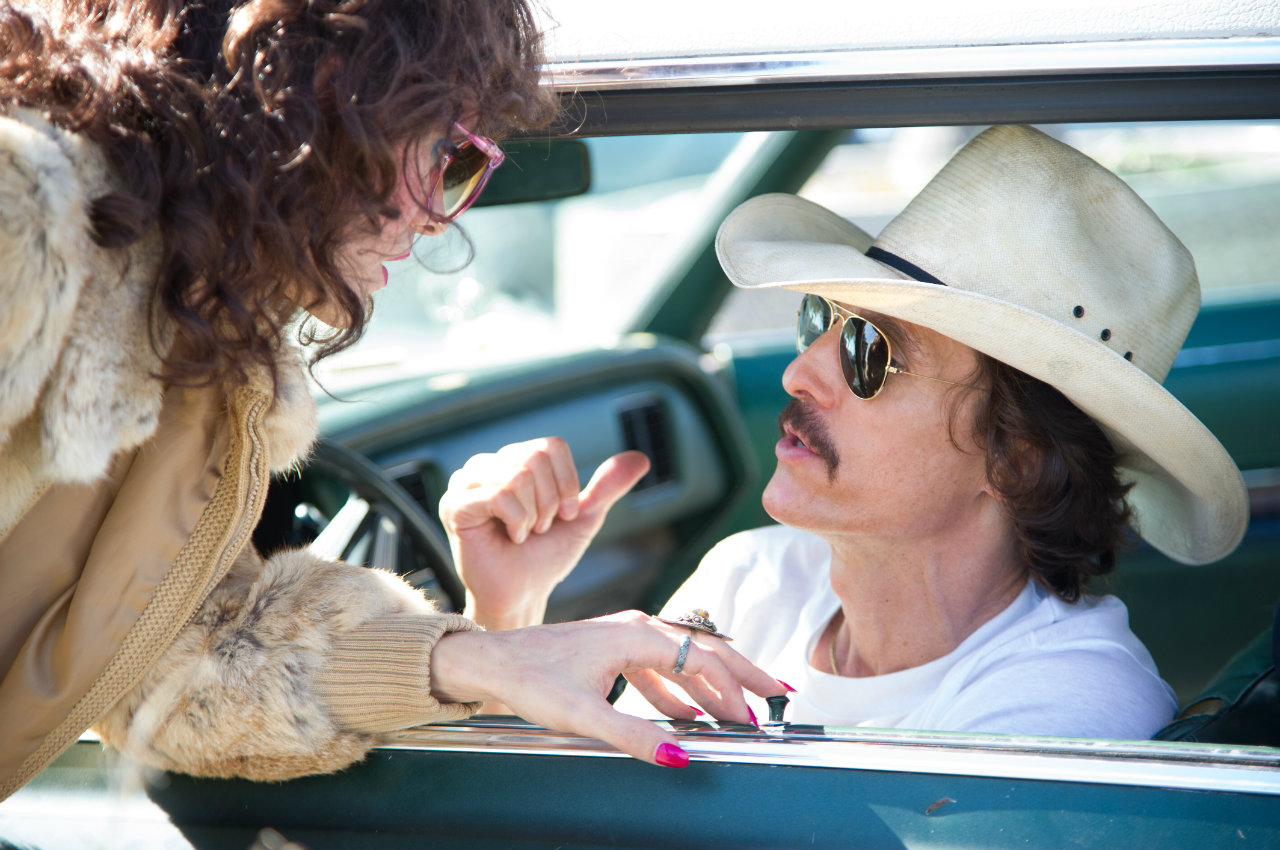
The macho Ron Woodroof dabbles in more than his fair share of alcohol, cocaine and women — behaviour that comes across more intrinsic than sporadic in his neck of the woods. He’s invincible, at least in his own mind. Recently though, coughing spurts have become common and dizzy spells just as a frequent, so when Woodroof collapses and shortly thereafter finds out he has contracted AIDS it’s less surprising than it is sad. Told nonchalantly he has around thirty days to live by Dr. Sevard (Dennis O’Hare), Ron initially dismisses the revelation as ridiculous, only to eventually succumb to reality. Often finding exuberance in the good-natured Dr. Eve Saks (Jennifer Garner), Ron uses his resourcefulness — he’s an electrician — to devise a plan of survival, one that also incorporates Rayon (Jared Leto), an extravagant and kind transgender woman whose shining demeanour aids Ron’s attitude as much as his health.

Dallas Buyers Club works on a number of levels, but the film’s most outstanding achievement centres on a pair of performances. First, Matthew McConaughey truly is extraordinary as the depleted Woodroof (the actor went as far as to lose 40 pounds for the role). He’s never made out to be a hero, not in the conventional manner anyway, and McConaughey never tries to sell him as such. When we first meet Ron he’s pretty loathsome, yet even this early on there’s a charismatic spark that seems to grow brighter and brighter the longer Ron lives. McConaughey often reigns in the sentimental tone; his persona is such that emotion, grace and vulnerability are not instinctive traits. Yet he still persuades you to unequivocally vie for him. Undoubtedly, his relationship with Rayon aids this audience connection. Jared Leto is utterly unrecognisable in appearance, but seeps total authenticity through the dress and make-up. He strikes a fine balance in the role, punchy and effeminate but never stumbling towards caricature mode. Together, and apart, the duo make you believe in these people, in their struggles and in their staunch resistance to the cards life has dealt.

There’s an interesting ‘corporate versus the little guy’ battle going on too. Essentially, this is your proverbial ‘Hollywood’ addition to a film wrapped up in a far from glamorous topic. The grappling-against-the-system element succeeds though, both in furthering Ron’s personal redemption and also injecting the story with a greater scope, a wider base to juggle on. Set in the mid-1980s, knowledge about combating AIDS is lousy at best (“Can I read a copy of the study?”; “No it’s still being written.”) therefore the most promising bet appears to be an antiviral named AZT, a drug flaunted and prescribed in high test dosages by the FDA (Food and Drug Administration), but one not entirely beneficial to patients. Ron discovers the non-truths, triggering his idea of a Dallas Buyers Club aimed at providing alternative medicines for sufferers. This fuels another morality fire, one which debates who is in the wrong: the multinational juggernauts selling false lies for cash, or the independent virus victim selling club memberships for life? FDA agent Richard Barkley (Michael O’Neill) is often the obstacle in Ron’s path only there’s a peculiar parallel that both men share. The duo are embezzled in the art of profiteering. However it’s what drives the men respectively that separates them, a moral compass that could not be more contradicting.

The film is based on a true story but envelops an artistic licence that sees it become something of a spiritual successor to Milk, and venturing further back Philadelphia, at least in terms of legal battles and humanistic principles. When Woodroof resolutely and poignantly exclaims, “I say what goes in my body, not you,” it resonates on both of these levels, particularly in regards to individuality and acceptance. There’s very little music going on the background to nudge your emotions in a certain direction. Instead your despairs and joys are all products generated from the poise of performance and presentation of story. A tough story at times, but one that is never told in an exploitative manner. Even still, director Jean-Marc Vallée seldom dismisses the presence of humour in telling the tale. Often these laughs emerge from McConaughey’s sly pretence and ingenuity — his character’s belief that he can get away with absolutely anything (including impersonating a priest) is endemic.

Dallas Buyers Club deals expertly with a painful subject, resultantly ensuring proceedings are far less demanding to watch in comparison to how tough they could easily have been. This is in no small part down to the performances of Jared Leto and Matthew McConaughey, the latter’s portrayal never shirking away from his characters shortcomings and non-heroic demeanour. Yet, you engage with the man so much that even as the shaky final scene of appreciation plays out, any personal misgivings are forgotten.

August: Osage County (2014)

★★

Director: John Wells

Release Date: January 10th, 2014 (US); January 24th, 2014 (UK)

Genre: Drama

Starring: Meryl Streep, Julia Roberts

Family reunions are often tarred with the ‘awkward’ label. And they can be, particularly if the participators share a common animosity. Or at the very least are in any way unfamiliar with each other. Both former and latter are absolutely the case here, only the stench of awkwardness is far from enough. To this family awkwardness encompasses simply the petulant appetiser before an enormous main course; a main course that presents a Sunday roast of hysterics, abrasion and arguments. The Weston family collectively exist in a pit of dysfunction. Sadly though, there’s far too much of it going on. Too much acting, too much shouting, too much loudness. In fact this film is so incredibly over the top it even reduced Sherlock to a blubbering idiot.

Welcome to Osage County. Presumably it’s August.

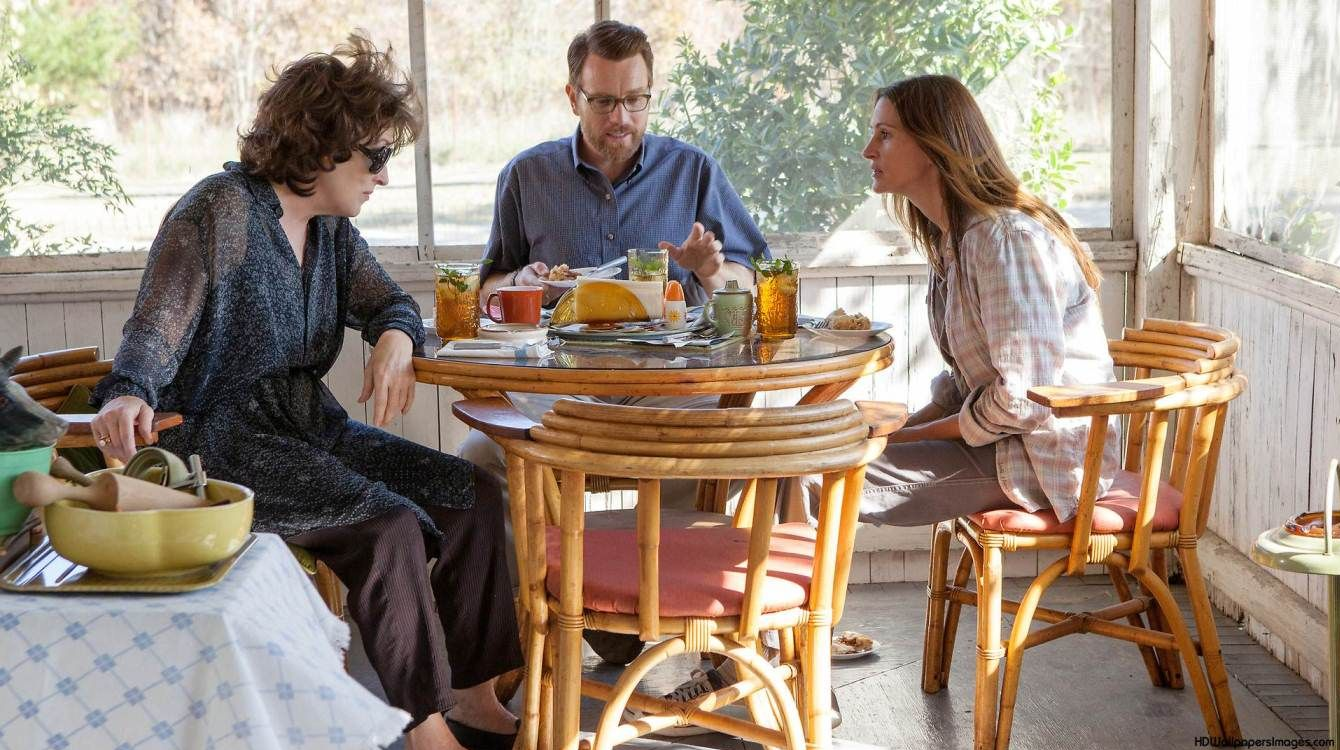
Upon learning about the apparent suicide of her father, Barbara (Julia Roberts) travels to her parents’ residence for the funeral and accompanying strenuous family congregation. Mother Violet (Meryl Streep) has mouth cancer, an affliction that never halts her ability to rattle out words nor does it subdue the uncontrollable pill-popping antics she vicariously partakes in. As she denounces her Native American maid’s right to refer to her own heritage, it becomes apparent that Violent isn’t a very likeable person. Perhaps she has every right to detest the world given her stricken circumstances, and if so who can hold such insignificant spiting against her? It could even be the drugs taking control and shoving each negative cell in her body to the forefront. But then her sister Mattie Fae (Margo Martindale) doesn’t exactly strike a chord of positivity either, relentlessly berating her own son for flaws overwhelmingly less vindictive than her own. And Violet’s aforementioned daughter Barbara, although at times a great deal more pleasant than mother and aunt, constantly finds herself battling against a future envisioning the same resentful tone as her elders. Only she’s already halfway there.

Therein lies one of two main problems that hampers this drama: it becomes increasingly difficult to pinpoint a character that you can actually relate to, one that you don’t feel guilty empathising with. As the saga plunges deeper and deeper into an abyss of loud shrieks and scalding off-the-cuff remarks, more and more family members are picked off by hate. It’s like a horror film, only instead of a mass-murdering antagonist the villain is a murky cloud of hostility, and instead of people perishing at the swing of a gleaming axe they choke on said whirling cloud and in turn lose any redeemability. Meryl Streep goes all out as the patriarch and is very good at being very bad, but her frenzies cast a shadow over other more genuine lower-key offerings from the likes of Julianne Nicholson and Chris Cooper, as Ivy and Charles respectively (ironically, the only sort of appealing characters on show). Yet even aside from all the noise and palaver, none of the people on screen are extensively interesting. You’d do well to connect with someone who is brash and a tad evil. At best it’s fun for a while, but by the time Streep has smoked her seventh cigarette and Roberts has blown her fourth gasket it all becomes a bit boring.

The screenplay is adapted from Tracy Letts’ critically lauded Pulitzer Prize–winning play of the same name and this provides the nucleus for significant problem number two. Everything feels quite artificial, almost agonisingly forced (tick off the proverbial stage props as you go: dinner table for ultimate congregation scene, porch for nighttime reminiscence scene). Few laughs are on offer, partly because the script can be whimsical but mainly due to the physical nature of delivery required for success. You can clearly see why the hair-raising approach works on stage, where the interaction with audiences who are part of a communally emotive atmosphere surely aids matters too. On screen though the execution is wooden meaning conversational exchanges — of which there are many — wear quickly. Having run out of relevant anecdotes, Streep and co streamline into discussing dying birds and more topics which feebly bear contrived relevance to their situation.

There’s no substance to the dialogue. Petty attempts at stirring the thought-provoking pot (or perhaps cauldron in Violet’s case) backfire as words fall on deaf ears: “Die after me, I don’t care what you do… just survive” might hold some sort of emotional resonance in a John Hughes film, but here it just sounds like terrible advice from a mother to her teenage daughter. Speaking of questionable behaviour, why do some members of the family grasp so tightly to the courtesy of grace at the dinner table, when they’ve just conducted a post-funeral fashion extravaganza? The film often appears to be trying to assure its own direction and often fails. One moment it’s a black comedy, the next a family drama, shortly thereafter a sentimental life-lesson. At one point I was certain the film blaring in view was some sort of Anchorman/Thor hybrid. Turns out Ewan McGregor just has a dodgy accent (“You’re a pain in the ass!”).

It does wave a few white flag-esque redeemable qualities in fairness. A charming soundtrack interweaves amongst the chaos, one which deviates from pleasant to sombre depending on which mode the narrative has shifted to. The extended family dinner is probably the best sequence on display, and is a very good one at that. Only here do each of the characters get to evolve their varying dynamics with other family members. It is the one time where you are absolutely certain proceedings are going to erupt at any given moment, yet the film deviously keeps you guessing and engaged for an extended period of time. The performances on the whole are excellent, if a smidgen awards-gesturing at times. Heck it even conveys the know-how to be funny on the one or two occasions laughs permeate the volatility (reasoning behind Abigail Breslin’s desire to get home is particularly apt).

August: Osage County is just about as messy as the family it thrusts on screen. Half of the characters are undesirable, whilst the other half’s presence merely equates to making up the numbers. There’s a lot of acting going on — bouts of which are very good — but sadly performances aren’t the be all and end all when it comes to engaging an audience.

Tomatoes at the ready.

Blue Jasmine (2013)

★★★

Director: Woody Allen

Release Date: August 23, 2013 (US); September 27th, 2013 (UK)

Genre: Comedy; Drama

Starring: Cate Blanchett, Sally Hawkins, Alec Baldwin, Peter Sarsgaard

Upon its release Blue Jasmine received rave reviews from viewers and, after a few months hovering around cinema screens and iffy online streams, is variably considered a return to form from the eccentric Woody Allen. I’m not extensively versed in Allen-lore, not nearly as much as i ought to be considering his lofty status in Hollywood and abroad. That being said, whilst his newest offering brims with scintillating performances (two Oscar nominated deliveries stand out in particular) the content, narrative and direction all add up to something a bit… bland. It’s a difficult story to consume and a tricky one tell, a story that shouldn’t insist on generating humour as often as it tries, particularly when there’s non to be shared. It’s possible that I just don’t get it; that the quirky, erudite versus blue-collar joust is something not entirely compatible with this 20-year-old. More than that though, Allen seems to be trying overly hard as he attempts to deliver on one too many fronts, leaving the intended humour absent and the compulsory drama simmering. But only just simmering.

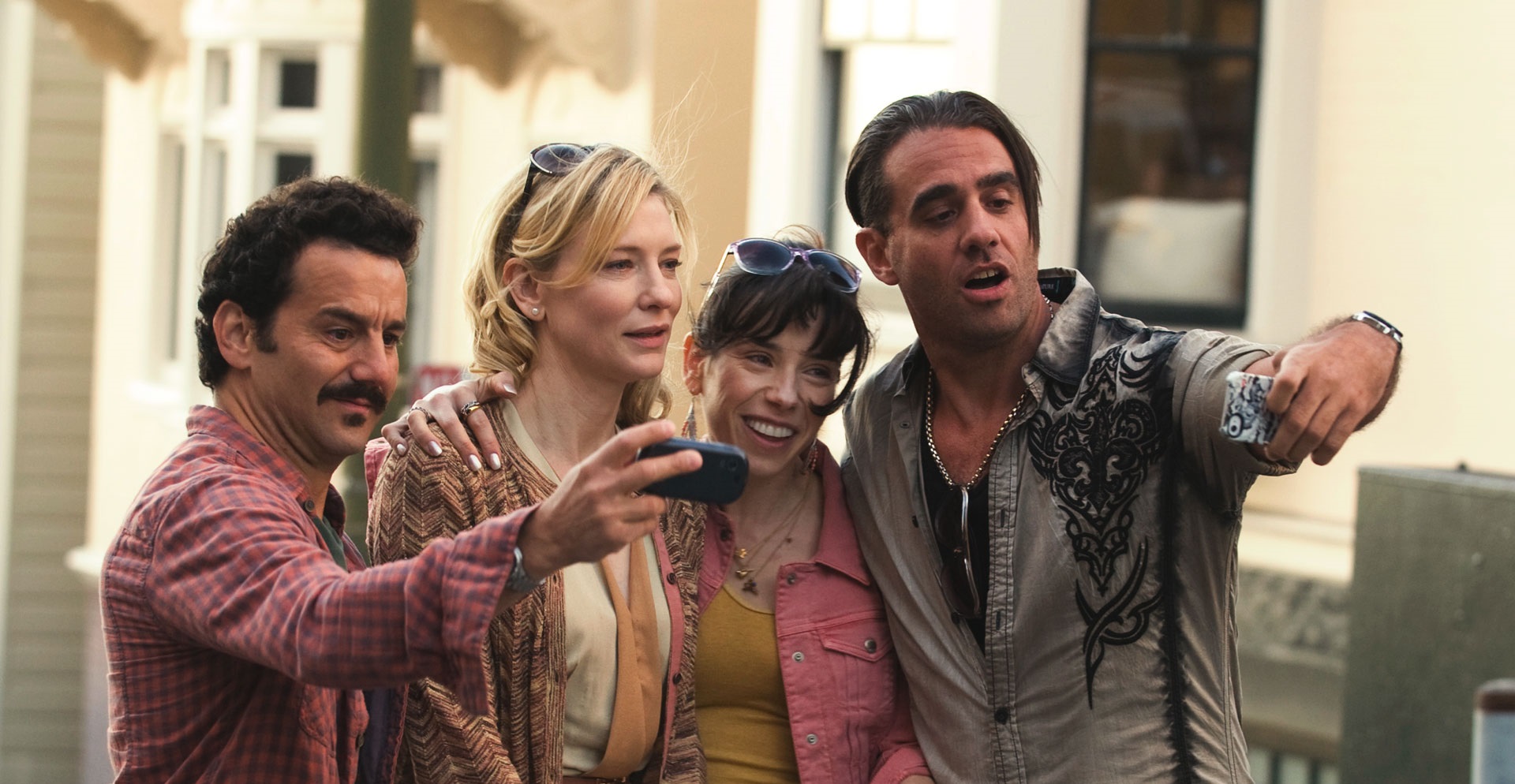
Jasmine (that’s Jasmine, not Jeannette) Francis is an upper-class socialite from New York who finds herself mentally, physically and financially drained following separation from her unashamed husband, Hal (Alec Baldwin). She isn’t used to earning, to maintaining herself and her life outwith superficial externals such as high-brow struts and an aristocratic ambience. Only it’s not an ambience, it’s an annoyance. An annoyance that has haunted her sister Ginger (Sally Hawkins) ever since childhood, when their foster parents favoured Jasmine’s superior “genes”. In her time of need, Jasmine (Cate Blanchett) moves to San Francisco to live and survive by Ginger who remains frustrated over a misshaped business deal proposed by Hal, amongst a number of other issues related to her now spiralling sister.

Evidently there’s a lot going on, yet too often the happenings are overly trivial — discussions reigned in on antiques for example — and therefore aren’t substantial enough to fully engage the viewer. Perhaps that’s the point, that Jasmine is such a one-dimensional and flawed character, therefore the film should be too. This approach doesn’t catch on though as Jasmine and many of the other people on screen are very difficult to relate to. At one point Ginger points out the obvious: “When Jasmine don’t wanna know something, she gotta habit of looking the other way.” In a sense the narrative follows this mantra too — just when there’s a glimmer of something intriguing on the horizon the road suddenly detours back to stagnant repetitiveness.

And it certainly is repetitive. As their lives together progress and various agents enter and exit (boyfriends mainly), Jasmine constantly scalds Ginger for her poor taste in unworthy men. First it’s Augie, a working-class and slightly optimistic guy held down by the harsh realities of life. Chili follows, a mechanic who unlike Augie treats Ginger with respect even if at times his exuberance gets the better of him. Jasmine relentlessly disapproves, neglecting her own prior misdemeanours when it comes to settling with the right partner. In fact, her wrongful rejection of Chili is probably the only time Jasmine is not thinking about herself: she often reminisces about sailing around San Tropez in front of her less fortunate sister who has hardly travelled America never mind the world; she flies first class on her way to Ginger, even though she has no money, which is the main reason for her relocation; in fact Jasmine removes herself from all tasks unbecoming of her (“I never pay attention to house business affairs”). Combined, this makes it incredibly difficult for the viewer to like or even sympathise with Jasmine, which is essentially the downfall of the film as the camera stalks her every move and not much else.

Allen juxtaposes the past and present as life events interchange; from detailing the breakdown of Jasmine and Hal’s marriage to the breakdown of Jasmine herself. Occasionally happenings on screen are tough to watch, but it is often the case that these demanding moments are followed by attempts at humour thrown in as the embodiment of a panicky life-jacket, almost as if the film is fearful of advancing that extra step into Jasmine’s oblivion (which would’ve worked better than the half black comedy, half drama on show). For example, after a tortuous altercation pitting Ginger and Jasmine against an enraged Chili, Jasmine is seen quickly shaking off any resultant cobwebs as she searches for her ringing phone in a nonchalant manner. This woman has recently lost the love of her life in onerous circumstances — wouldn’t she be affected more by this attack with potentially mirroring connotations on her sister?

There is success emitted from Allen’s alternating timeline approach though, as the method distinctly displays the degree of culture clash between Jasmine and Ginger. Jasmine has had everything handed to her on a silver platter. Now that life has crumbled, her anxiety over what’s next conveys exactly how behind she is in the experience of every day normality: she wants to return to school (to study what?); will study fashion or interior design (can’t use a computer); takes computer classes (has no money to afford); accepts the “medial” job that she never wanted, the job that the vast majority of those around her do on a daily basis.

As average as the film is, there’s absolutely no denying the power and sheer struggle evoked by Cate Blanchett as Jasmine. It’s not even a case of the film’s downfalls making her performance glow even brighter, no, Blanchett’s display would stand out in any offering. Even though you don’t really like the character, it’s impossible not to be drawn in by Blanchett’s depiction of painful demise as Jasmine slowly loses all sense of wherewithal and dignity. The portrayal is uncomfortable to watch at times and it should be that way. Without Blanchett at the helm, the film might have teetered worryingly close to Diana territory.

Sally Hawkins also deserves plaudits for her starkly contrasting role as the less fortuitous sister; likeable and empathetic as she establishes and maintains a strong sense of empowerment throughout the film’s progression. In an abnormal role from his usual work, Peter Sarsgaard is astute and pompously slick as the yin to Jasmine’s yang. Their first meeting is actually one of the film’s better moments, where the pair enter a self-congratulatory word-off as they divulge many an “I” and “my husband and myself”. It’s arrogant and self-absorbed nonsense, and it completely works because these characters come across as utterly undesirable just as they are supposed to in that moment.

Blue Jasmine is a film where nobody really seems to be listening to each other (“Pay attention Augie”), where characters are solely focused on getting their two — or 20 — cents in, meaning proceedings feel too feeble. The darkly comic moments don’t really fit in, and the emotionally wrought sections seldom have the desired effect. It’s no surprise that that actors are receiving awards nominations left right and centre as opposed to the film itself. While it is far from terrible, there’s a lot of onus on Cate Blanchett to make the picture worthwhile. Thankfully, in doing her worst, she does her absolute best.

Oscars 2014 — Early Predictions

On March 2nd the film industry will pay tribute to the greatest cinematic achievements of the past year. The best of the best. The cream of the crop. For the most part, anyway. The Academy Awards always generate a hefty amount of hype – with Harvey Weinstein on the prowl there’s no surprise there! – and perhaps more so this year than in the recent past given the relatively open landscape in just about all the heavy-hitting categories.

The Academy announced their nominations for each category earlier today, so let’s go through some of them and pick out a few potential winners.

I haven’t seen all of the films listed yet, which means a portion of the following bout of foreshadowing will be partly down to instinct and partly taking into consideration where the main bouts of buzz are landing. Heck, we can come back and amend stuff nearer the time… once I’ve consumed all the films. Ahem.


The Nominations

Best Picture

American Hustle

Captain Phillips

Dallas Buyers Club

Gravity

Her

Nebraska

Philomena

12 Years a Slave

The Wolf of Wall Street

– What will win: 12 Years a Slave

– What I want to win: Undecided

– What should’ve been nominated: Blue is the Warmest Colour


Best Actor

Christian Bale

Bruce Dern

Leonardo DiCaprio

Chiwetel Ejiofor

Matthew McConaughey

– Who will win: Chiwetel Ejiofor

– Who I want to win: Leonardo DiCaprio

– Who should’ve been nominated: Tom Hanks


Best Actress

Amy Adams

Cate Blanchett

Sandra Bullock

Judi Dench

Meryl Streep

– Who will win: Cate Blanchett

– Who I want to win: Cate Blanchett

– Who should’ve been nominated: Adèle Exarchopoulos


Best Supporting Actor

Barkhad Abdi

Bradley Cooper

Michael Fassbender

Jonah Hill

Jared Leto

– Who will win: Jared Leto

– Who I want to win: Barkhad Abdi


Best Supporting Actress

Sally Hawkins

Jennifer Lawrence

Lupita Nyong’o

Julia Roberts

June Squibb

– Who will win: Jennifer Lawrence

– Who I want to win: Undecided


Best Director

David O. Russell

Alfonso Cuarón

Alexander Payne

Steve McQueen

Martin Scorsese

– Who will win: Alfonso Cuarón

– Who I want to win: David O. Russell


Best Original Screenplay

American Hustle

Blue Jasmine

Dallas Buyers Club

Her

Nebraska

– What will win: American Hustle

– What I want to win: American Hustle

– What should’ve been nominated: Inside Llewyn Davis


Best Adapted Screenplay

Before Midnight

Captain Phillips

Philomena

12 Years a Slave

The Wolf of Wall Street

– What will win: 12 Years a Slave

– What I want to win: Undecided


Best Documentary Feature

The Act of Killing

Cutie and the Boxer

Dirty Wars

The Square

20 Feet From Stardom

– What will win: The Act of Killing

– What I want to win: The Act of Killing

– What should’ve been nominated: Blackfish


On an interesting side note, every year the Oscars devote a part of the ceremony to a certain theme. Last year for instance, a variety of musical numbers were unfurled on stage (remember Seth MacFarlane’s “Boob Song”?) paying tribute to film music.

This year the theme is ‘Movie Heroes’. That’s everyone from the normal person on the street, to the surgeon saving a life, to those larger-than-life superheroes we’ve come to know and love.

His film won Best Picture last year… I wonder if a certain newly appointed masked crusader will unveil his bat-wings this time around.

Flight (2012)

★★★★

Director: Robert Zemeckis

Release Date: November 2nd, 2012 (US); February 1st, 2013 (UK)

Genre: Drama; Thriller

Starring: Denzel Washington, Kelly Reilly, Don Cheadle, Bruce Greenwood

It does not take long for Robert Zemeckis’ Flight to race into full throttle and deliver the intense plane crash scene from which much of the buzz surrounding the film has emanated. However, the film quickly switches gears and ends up spending most of its time delving into a more subtly intense story about a man’s plight against addiction — a ruthless concoction of lies, alcohol and drugs succinctly summed up by the lead character’s quip, “Don’t tell me how to lie about my drinking”. It becomes a dramatic character study rather than an event-driven thriller, and with each extra lie that Denzel Washington’s Whip tells, or additional drink he swigs, you just want to give him a shake and remind the heroic pilot that he can be a decent human being.

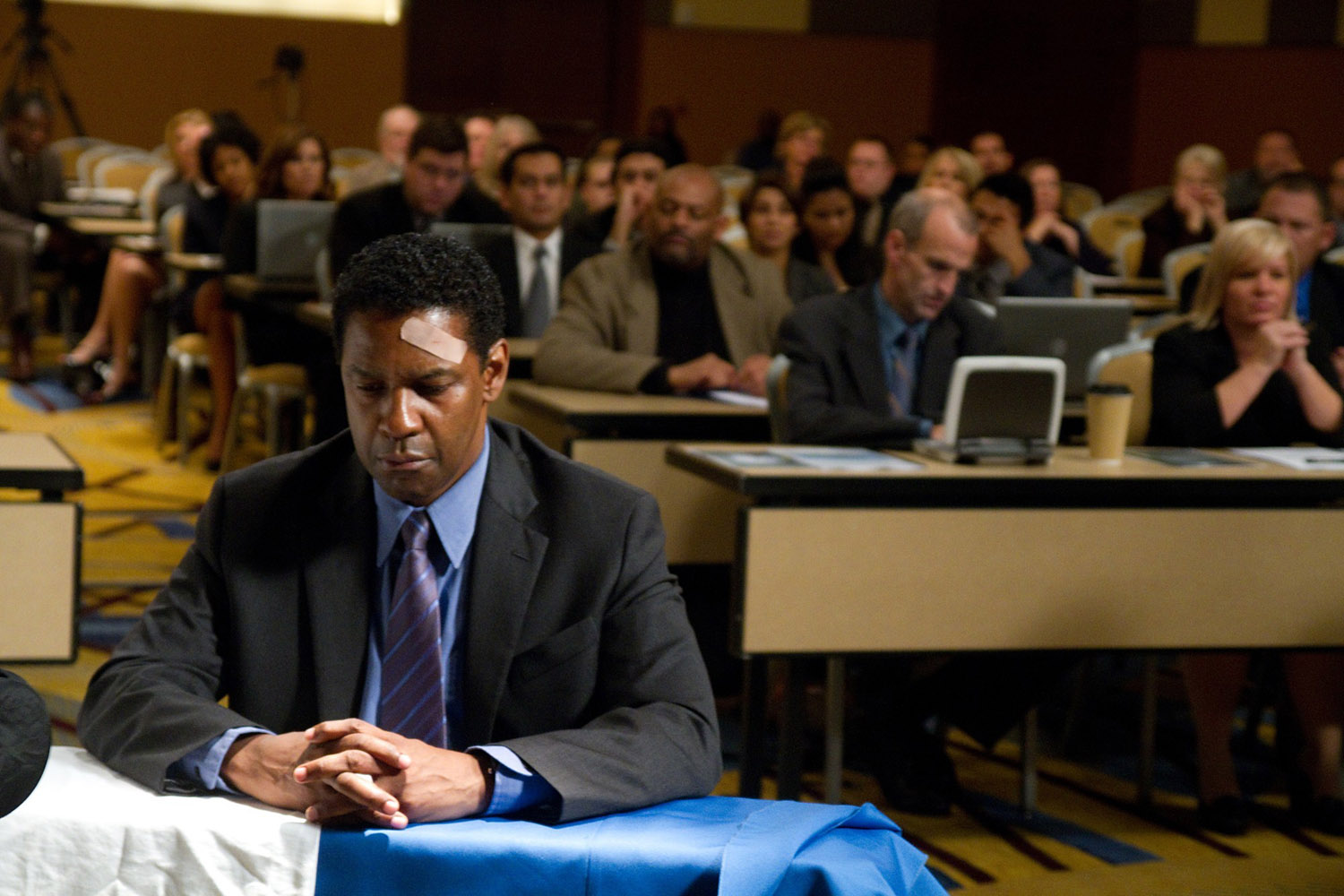
Whip Whitaker is a seemingly disenfranchised airline pilot who spends his evenings with co-workers (more specifically, air hostesses) in hotel rooms partaking in substantial alcohol consumption and drug use — and that is only on pre-flight nights. He awakens from his extravagantly unprofessional routine one morning both sleep-deprived and lumbersome, before heading out to captain a flight to Atlanta. After successfully, and somewhat surprisingly, manoeuvring his plane through a bout of rough turbulence, an alcohol-influenced Whip is forced to execute an emergency landing in a field. A plane crash is a once-in-a-thousand-lifetimes event that, for the vast majority of us, is something only experienced through the likes of news reports or documentaries. Zemeckis and cinematographer Don Burgess do a nail-bitingly horrifying job of emulating the chaos, destruction and terror of such an event, far eclipsing the director’s tumultuous Cast Away aviation incident. Washington’s poise is both unsettling and admirable as a captain who is just as dependent on booze and drugs as his passengers are on his flying skills.

Whip awakens in hospital a hero to the public but quietly uncertain and continuously seeking reassurance over his role in the crash. “My [condition] had nothing to do with the plane falling apart,” is often closely followed by, “Nobody could’ve landed that plane like I did”. The film does not shy away from making clear that the doomed aircraft was a result of mechanical failure, but a combination of Whip’s pre-flight misdemeanours and post-crash internal conflict raises doubt. Is there the possibility that Whip’s demons lead to the accident? Zemeckis’ direction plays a role in casting this ambiguity over proceedings, however Washington’s depiction of a man unravelling creates doubt not where there should be none, but where there is none.

The Academy Award winner has the stench of alcohol protruding from him throughout the film and stands out, in particular, in two scenes of mental jousting. The first, soon after cleansing himself and his life of all toxic substances by way of sink or toilet, sees a fidgety Whip down his first drink in the knowledge that he is facing potential criminal prosecution. The second comes towards the end of the film where Whip is surrounded by people, but more alone than ever as he juggles morals in his head. It is testament to Denzel Washington’s acting abilities that he ensures Whip commands sympathy in spite of all of his negative traits. Perhaps this is partially down to those traits tearing away at nobody but Whip himself — “What life?” is how highly he regards his existence. It is eerily fitting that said traits, which without aid are leading to the downfall of the man himself, are also responsible for saving the lives of many others.

Flight is not without faults. The film does an excellent job of creating the Kelly Reilly character, Nicole, who sets off in the same place as Whip but ends up moving in the opposite direction. Reilly is convincing as a manipulable heroin addict trying to turn her life around, and she shares an intriguing if not entirely believable relationship with Whip (although this lack of believability is probably the point). However her character fails to really go anywhere. There is also a very noticeable comedy element which rears its jokey head every so often, and every so often it fails to fit in with dark nature of events. Or at least is should fail. Bizarrely, the humour provides some welcome light relief, with John Goodman often the vehicle of funny. Don Cheadle and Bruce Greenwood succeed in their semi-conflicting roles (both are there to help Whip, but only one shows affection towards him). James Badge Dale also makes a scene-stealing cameo as a dying man in the hospital and delivers film’s best one-liner after receiving a carton of cigarettes from Whip.

Ultimately, Flight sets out to tell the story of a man struggling through addiction while encased in special circumstances, and it does this very well. Denzel Washington’s engrossing performance at times teeters on the incredible, and just like the Coke can that follows Whip around his hotel room reminding him of what he cannot have, Washington’s prominence on screen provides another reminder of just how great a performer he is. Not that anybody needed reminding.