Selma (2015)

★★★★

Selma PosterDirector: Ava DuVernay

Release Date: January 9th, 2015 (US); February 6th, 2015 (UK)

Genre: Biography; Drama; History

Starring: David Oyelowo, Tom Wilkinson, Carmen Ejogo

Carrying on the awards-fetching tradition that tends to follow flicks of biographical and historical heritage (a tradition particularly in vogue at this year’s Oscars) is Selma. We all know the argument by now: ‘the only reason this weighty film about that important figure doing those serious things has been made is purely to fill the brazen palms of those involved with golden statuettes’. As a general rule I don’t really toe that line. There are too many external factors that’d have to align for a filmmaker to predict prizes before even rolling a camera, and then successfully follow through with that prediction. Oscar bait. It’s a bit of a nonsense assumption anyway. Selma is a film first and foremost, about struggle and perseverance and dignity.

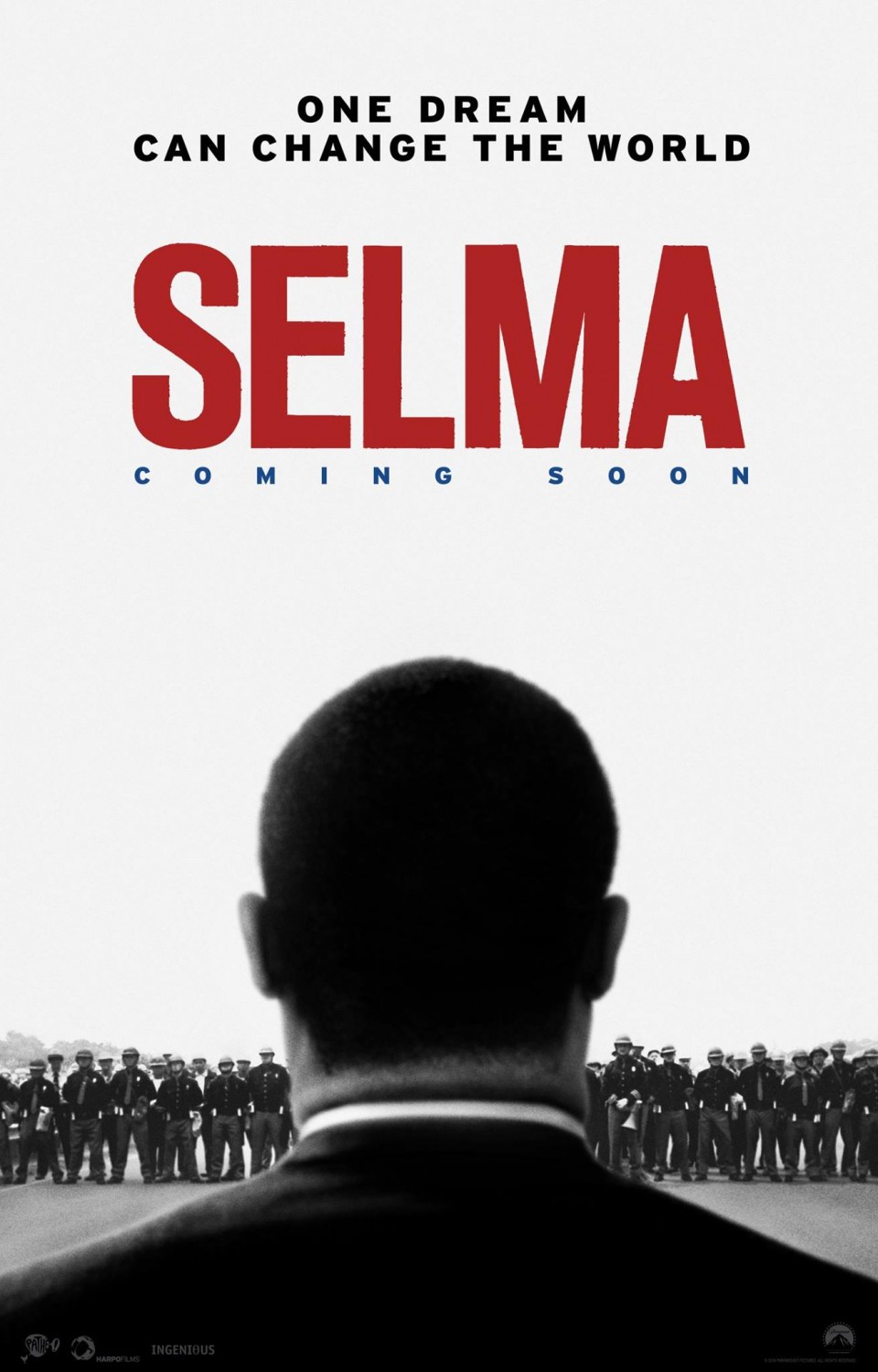
Movies aren’t made to be awarded then, but when the turn of the year approaches and the air begins to smell that bit more Weinsteiny, it’s still an exciting time for cinephiles the world over. And it can be a kick in the teeth when evidently deserving performances aren’t given at least a nod of appreciation by those all-knowing folks in Hollywood. David Oyelowo’s shunning by the Academy is as bewildering as it is unfair on the Brit. He plays Martin Luther King, Jr., minister and activist at the helm of the African-American Civil Rights Movement in the middle of last century.

Director Ava DuVernay’s film centres on Dr. King and his collaborative attempt alongside other SCLC members to gain voting rights for black US citizens in the 1960s. As such, success hinges upon how effectively Oyelowo embodies the famous fellow. In some ways, playing a prolific figure such as King might be easier because his presence has continued to circulate in some form for so many years and his mannerisms and tones therefore exist in great volume, essentially forming a vault of primary sources for the actor to refer to. Having said that, there’s very little room for error because the man is so recognisable — if you’re watching Selma, you’re probably pretty well-versed in the humanitarian’s past. The audience knows King and Oyelowo has to convince, not after 30 minutes or 60 minutes but after 10 seconds, that he is King.

Goodness me, he convinces. Oyelowo’s portrayal is very similar to Eddie Redmayne’s manifestation as Stephen Hawking in The Theory of Everything, not because the roles reflect each other in too many ways but because each actor completely dissolves into the persona he is playing. The magnetic charisma is there, shining through particularly during speeches delivered with power and precision, but Oyelowo also conveys a vulnerability in King that humanises the god-like leader. Moments of self-doubt creep in and harness his stubbornness; this unusually burdened appearance can be seen in a prison cell conversation or an emotional debate between husband and wife.

At this point it’s also worth noting some really solid work done by Oyelowo’s supporting cast, namely Carmen Ejogo as Coretta Scott King and Tom Wilkinson as President Lyndon B. Johnson. King and Coretta’s relationship is frosty when we meet them, the latter certainly an admirer of her husband’s moral graft but not as keen on any potentially nasty consequences. “I don’t joke about that”, she says after he quips about dying in the line of protest. Ejogo’s Coretta is strong-willed but clearly at odds with the viable threat posed to her family.

On the other hand, King’s combative rapport with the US head of state is driven by ethical politics. Wilkinson plays the President with that familiar governmental defensiveness — sympathetic to a degree but only really in favour of King because he’s not “one of those Malcolm X types”. It’s a shame we don’t get to see more of Malcolm X (Nigel Thatch plays him in one short scene) as the clash in styles between he and his activist colleague could’ve added another layer to the film’s fairly cut-and-dry morality. Henry G. Sanders’ heartbreaking turn as a pained grandfather is as affecting as anything else on screen. Unfortunately Tim Roth hams it up a too much as the Governor of Alabama, his performance lacking somewhat in authenticity when pitted up against the others.

As alluded to previously, there are a few heavyweight vocal diatribes laced throughout the film but DuVernay smartly avoids employing the famous “I Have a Dream” speech. Instead the material is fresher and Oyelowo is afforded the chance to inject less high profile dialogues with his own portentous verve. Thus there’s never a preachy air but rather a story bound by the bluntness of immorality, one that holds a mirror up against an inconceivable blotch on our history whilst also hauling shocking relevance today.

Despite the obvious humanity failure on display, DuVernay manages to avoid the gloominess of the subject and instead directs with spirit. A bubbling, soulful soundtrack compiled by Jason Moran — which reminded me of a Coen/T-Bone Burnett concoction, oddly — gives energy to proceedings. This vibrant approach means when the Selma to Montgomery protest marches from which the film pivots occur, their impact is heightened. The notorious Bloody Sunday walk across the Edmund Pettus Bridge is harrowing in its depiction but also sublimely executed; raw brutality is interspersed with a white reporter’s increasingly disturbed commentary and reactions of abhorrence from around America brought on by television broadcasts.

It might’ve been largely overlooked by awards shows but Selma isn’t a film that should be ignored by those who love accomplished filmmaking. Indeed, Ava DeVernay’s moving dramatisation of oppression in society fifty years ago reaffirms a life lesson that some are failing to abide by even in 2015. For that reason alone Selma is a film worth seeing.

Selma - David Oyelowo

Images credit: IMP Awards, Collider

Images copyright (c): Paramount Pictures, 20th Century Fox, StudioCanal

American Sniper (2015)

★★

American Sniper PosterDirector: Clint Eastwood

Release Date: January 16th, 2015 (UK and US)

Genre: Action; Biography; Drama

Starring: Bradley Cooper, Sienna Miller

The problem with American Sniper is not necessarily that it’s controversial — though that train of thought is somewhat justified — but that it’s rather dull. In regurgitating a story set almost entirely during the worst of the conflict in Iraq post-9/11, and one based upon real events, you’d expect director Clint Eastwood to have something potent to say about war. At the very least, it’d be fair to expect a consistently taut human drama. We get neither from American Sniper, a film weighed down by overt patriotism and silly writing.

Bradley Cooper (now the recipient of three consecutive acting nominations at Academy Awards) stars as US Navy Seal Chris Kyle, a former rodeo cowboy so pained by news reports of terrorist attacks on his home soil that he enlists to fight abroad. It’s nothing more than a solid performance from Cooper, certainly not one on the same level as his two previous Oscar nominated stints in both Silver Linings Playbook and American Hustle.

As the film progresses the bulked up actor’s role becomes an increasingly emotionless one, and consequentially quite thankless. Buying into the personal struggles of a man who spends his time in a place littered with death and despair — he, frankly, contributing to the mess — is a struggle in and of itself. This isn’t a critique of the real Chris Kyle, nor Cooper, and instead of the poorly conceived writing underpinning proceedings.

Adapted from Kyle’s own autobiography, Jason Hall delivers a screenplay severely lacking in nous or subtlety. Bearing no stance on the Iraq War that hasn’t already been exhausted on the big screen, or any screen, what we’re left with instead is a film trying desperately to convince itself that war is necessary. Men, women and children are all cast under the same umbrella marked “our enemy” and though this non-discriminatory outlook may well be a sporadically accurate reflection of reality, the film never suggests such a thing. Many of those whom the US soldiers meet in Iraq are carrying weapons with a view to kill. The suggestion is all civilians have been evacuated from the area of conflict, thus the ones who remain aren’t innocent. The fact that this wholesale evacuation hasn’t taken place compounds a lazily devised screenplay; as such, locals are placed on a morality gauge ranging from untrustworthy to terrorist.

In between head-scratching scenes that show Kyle conversing with his wife in the middle of a war zone — his attention should probably be on shooting all those baddies, right? — there’s a cat and mouse game playing out. An enemy shooter referred to as Mustafa (Sammy Sheik) is essentially the domestic Chris Kyle. Granted, the film is called American Sniper and therefore isn’t a piece that was ever going to pay as much attention to the non-American sniper, but the lack of dispersed humanisation is off putting. Kyle’s rapidly burgeoning Call of Duty kill count is celebrated with gusto amongst his peers whereas any damage done by Mustafa is vehemently denounced as the work of a “savage”. Of course it’s savagery, but there’s hardly even a nod towards the ambiguity of Kyle’s actions — when the film does venture down this route it only juggles the immorality of child-killing as opposed to people-killing.

The picture is at its most tense and best when Kyle is staring down the barrel of his deadly weapon, honing in on said infants and fuelled by uncertainty. Unfortunately any good work is undone by a laughably glorifying final sniper showdown. Intrigue edges up a tad when we’re back on home soil, where the military man feels more and more out of place as each tour ends. Sienna Miller plays his wife but doesn’t get enough to do as the narrative always chooses to follow Kyle when he goes overseas. She’s good though, infusing a bit of steel into Taya whilst also relaying the mental and physical exhaustion brought on by her husband’s constant displacement. Miller just about manages to overcome her unnecessarily bit-part function.

It’s this lack of urgency that hampers American Sniper, more so than any controversial portrayal or underwhelming performance. You’d expect it to be well made, and it is, but it doesn’t have the musky atmosphere of a Hurt Locker or the gruelling presentation of a Fury, nor does it bear the rich characterisation of those films. Tom Stern’s projection of a war zone is almost conventional, which is surprising given the cinematographer’s accomplished portfolio (Mystic River, Million Dollar Baby, The Hunger Games). Eastwood doesn’t do an awful lot to alleviate this encroaching mundanity, he generating a tone that stops short at implying the possibility of danger lurking around every pile of rubble.

American Sniper has done extremely well at the US box office and, despite a more conservative reception over here in the UK, has undeniably been a success — particularly when its financial clout is coupled with awards recognition. This review is a bit superfluous in that regard, but I don’t think it’s without merit. It is entirely probably that the patriotic element is something that works well in America but not as well elsewhere. We all suffer as equals through blandness though, and this is bland filmmaking.

American Sniper - Bradley Cooper

Images credit: IMP Awards, Collider

Images copyright (©): Warner Bros. Pictures

The Theory of Everything (2015)

★★★★

The Theory of Everything PosterDirector: James Marsh

Release Date: November 26th, 2014 (US); January 1st, 2015 (UK)

Genre: Biography; Drama; Romance

Starring: Eddie Redmayne, Felicity Jones

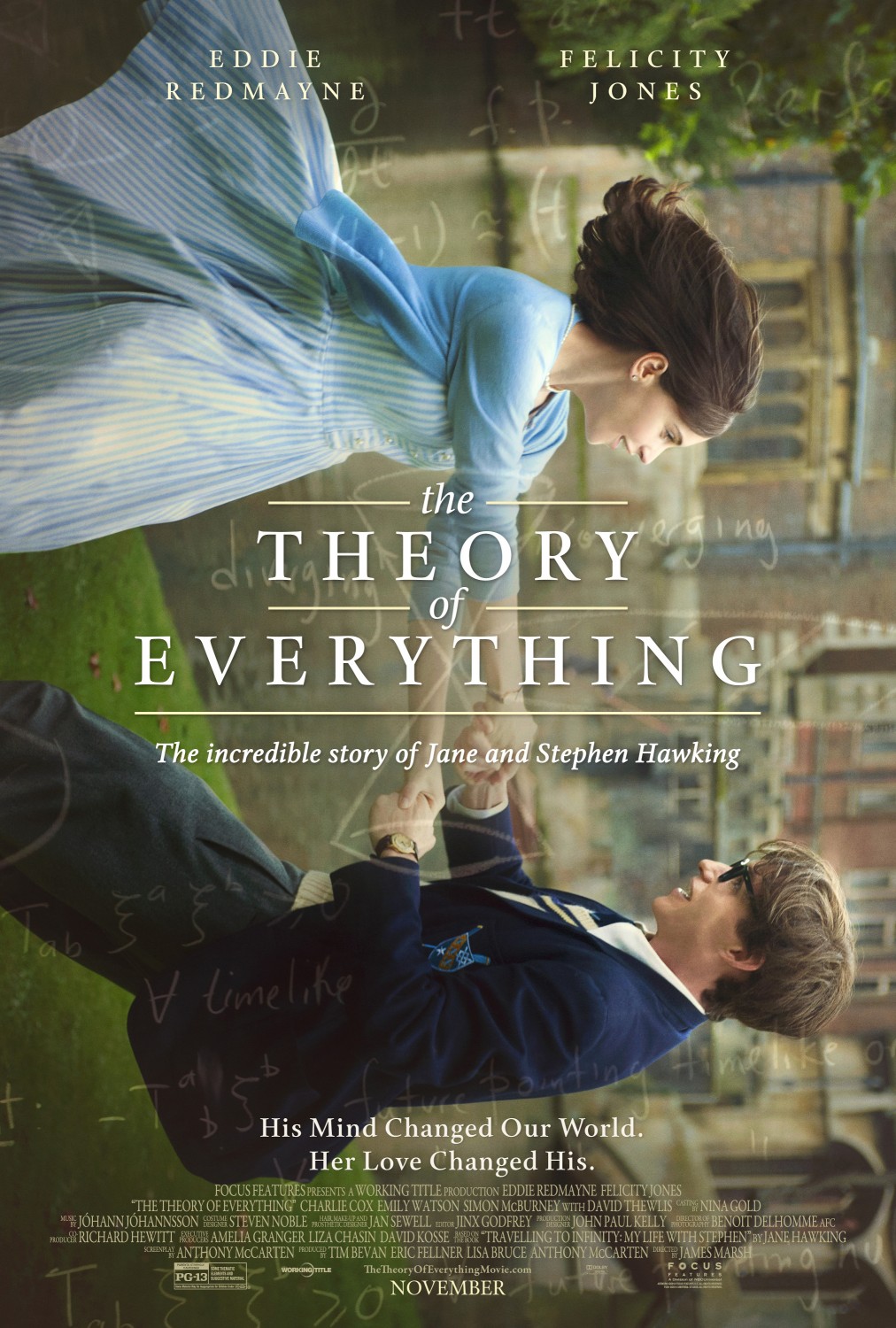
In The Theory of Everything Stephen Hawking (Eddie Redmayne) spends a lifetime trying to figure out the inception of our very existence. For all intents and purposes he succeeds in doing so. Or maybe he doesn’t. Maybe it doesn’t matter. This really depends on your own beliefs. James Marsh’s film ventures down a similar path to that of its central figure as it attempts to fulfil various thematic nodes: love story, tale of human adversity, science exhibition and so on. As these strands weave together to form Stephen’s story they don’t always feel complete. Or maybe they do. Maybe it doesn’t matter. This really depends on your own expectations.

Providing those expectations aren’t bound up by a need to see something totally flawless, The Theory of Everything should cover all bases sufficiently. Most of us are aware of Stephen Hawking; certainly of his illness if not the physicist’s scientific endeavours. The film takes us through Stephen’s adult life, from his first inclinations that something is wrong with his body to the writing of his best-selling book, A Brief History of Time.

But it becomes clear as the picture develops that Marsh’s vision isn’t necessarily weighed down by either disability or science, and instead the director wants to tell the story of a relationship. As such, The Theory of Everything becomes a co-biopic, its emphasis as much on the obvious struggles of Stephen as on the less obvious trials of his long time wife Jane (Felicity Jones). It’s because of this, and because the filmmaker only has two hours to capture a life of enormity, that key elements fall by the wayside. Shortly after Stephen is diagnosed with motor neuron disease — a scene shot so intimately by cinematographer Benoît Delhomme that the devastation is doubled — we learn that he only has two years left to live. Though, in a move that indicates the director’s desire to fit more stuff in, the film nonchalantly evades the two year mark.

It is an unenviable problem to have, one that leaves Stephen’s relationship with Elaine Mason (Maxine Peake) a little underfed, but the (admittedly necessarily) overstretched journey does afford us more than just an insight into the Hawking family. The early interactions between Stephen and Jane are reminiscent of those shared by Celine and Jesse in Richard Linklater’s Before… trilogy; he is quite awkward and she timid, but before long they are strolling around picturesque locales discussing the source of humankind. Both are defined by entirely separate ideologies too, Jane being a believer God and an arts student, Stephen an advocate for method and science. “I have a slight problem with the celestial dictatorship premise,” he says and from then we’re totally drawn into the pair’s capricious relationship.

In a manner of speaking, The Theory of Everything draws its pulpy interior from a clash of science and faith. Yet the film never exploits this duel beyond repair and instead uses it as an underlying catalyst for its central love story. Stephen, despite his adoration for the subject, is increasingly pillaged by science, his health deteriorating by the frame. He even defies the presence of a doctor, much to the chagrin of his wife. On the other hand Jane finds herself silently enraptured by the life she might’ve had as she and her husband spend more and more time with Jonathan Jones (Charlie Cox), a choir conductor whom Jane meets at church. The influence of the couple’s branching schools of thought is slight but entirely profound, a notion particularly felt when Stephen momentarily submits his incessant ignorance of God and then begins to backtrack. “Are you actually going to allow me to have this moment?” Jane asks.

Much of the praise the film have received thus far has been directed towards the performances of both Eddie Redmayne and Felicity Jones, and for good reason. It’s almost a foregone conclusion that in 2015 these actors will deliver excellence on screen, but the level the pair operate at here is truly magnificent. Redmayne does all the hard graft as Stephen, completely embodying the physicist’s eventual symbolic manifestation. It’s a role without a safety net and Redmayne should be commended for his artistic bravery as well as his tremendous portrayal. Jones is every bit as good, her subtlety and finesse perfectly complementing the physicality in Redmayne’s enactment. She’s more than simply a supplement though, Jones accentuating the strength of Jane through her pained-yet-defiant facial range. Supporting work from the likes of Charlie Cox and David Thewlis is also strong, though it is Redmayne and Jones who stand out significantly.

The Theory of Everything is at its best when Eddie Redmayne and Felicity Jones are united, projecting performances that are totally different but equally effective and affecting. The film is delightfully funny too, and not at all bogged down by disconsolation. And hey, if it’s good enough for Stephen Hawking, it’s good enough for me.

The Theory of Everything - Redmayne and Jones

Images credit: IMP Awards, Collider

Images copyright (©): Focus Features, Universal Pictures

Foxcatcher (2015)

★★★★★

Foxcatcher PosterDirector: Bennett Miller

Release Date: January 9th, 2015 (UK)

Genre: Biography; Drama; Sport

Starring: Channing Tatum, Steve Carell, Mark Ruffalo

You could single out any number of attributes and relate them to Bennett Miller’s directorial portfolio, but depth wouldn’t be one. The New Yorker has created four films since 1998 and, at a rate of one film every four or five years, Miller obviously doesn’t take job choices lightly. After a seldom seen documentary feature called The Cruise (1998) and his critically acclaimed biographical drama Capote (2005), Miller tried his hand at exploring the inner workings of American sport on the big screen. Moneyball (2011) was polished and affecting, but never set out to irritate because it was never meant to be that kind of story, just as baseball isn’t that kind of sport.

Foxcatcher, on the other hand, is that kind of story. Whereas Moneyball told a consumable tale that reflected the everyday popularity of baseball, Miller’s latest piece bathes in the sweaty discomfort and disassociation of wrestling. It’s uncensored, but subtly so. It’s damn good too.

Mark Schultz (Channing Tatum) is an amateur wrestler. We first meet him as he somewhat timidly relays semi-encouraging words to a less than half full hall of school children. Perhaps timidness is the wrong adjective. Mark isn’t necessarily a shy person, but his inability to open up is reflected in his distanced demeanour. All he knows is an everyday, basic existence. And amateur wrestling. Tatum excels as the hard-boiled grappler, his physicality more than matched by a powerhouse emotional range that develops alongside the story. He hobbles as you’d imagine a wrestler would, and wears sweatpants and an unforgiving exterior in and out of the gym, unlike the more outgoing Dave.

Dave Schultz (Mark Ruffalo) is Mark’s older brother, the man Mark is filling in for during the opening scene. Dave is also an Olympic champion and, for one reason or another, the more popular brother. Ruffalo brings an awkward charm to the role; we’re instantly drawn to him as he graciously interacts with American wrestling officials, Ruffalo dragging his toes as he shakes hands as if to highlight an inert clumsiness. The siblings train shortly thereafter, and Foxcatcher unleashes its first taste of the brutish sport — as Dave gets the better of Mark the latter lashes out, emphasising Mark’s simmering displeasure towards his overshadowing older brother.

Both men receive the opportunity to head up an all-American wrestling team at Foxcatcher farm, funded by John du Pont (Steve Carell). “Du Pont, a dynasty of wealth and power”, are the words that echo from a History Channel-esque montage about the rich family. Mark accepts, aspiration outweighing alertness, whereas family man Dave rejects. Though the film breeds an air of morbidity from the outset, it really kicks into gear upon the arrival of a terrifying looking du Pont. The three primary actors deliver wholly, but it is Carell’s skin-crawling turn as the internally maniacal financier that’ll stick in the memory and continue to probe long after the final pinfall. Assisted by facial prosthetics more suited to the latest House of Wax horror instalment, Carell maintains false poise that’s ready to burst. He’s devilish and utterly detestable.

Miller’s film teases the inevitability of chaos bred from a relationship between the three men, but refrains from delivering on the fact until the final act. Much of the first hour and a half of Foxcatcher instead focuses on the relationship between du Pont and Mark, a partnership that is clearly on iffy terrain from go. Their first face to face meeting at the farm is one of a catalogue of tension filled moments; du Pont sells his wrestling project to Mark (the multimillionaire wants to foster a gold medal batch of grapplers) under the guise of honour and patriotism. Rob Simonsen and West Dylan Thordson’s score is noticeably absent here as we hang on du Pont’s every word in tandem with Mark.

Although the screenplay relays a number of striking lines — “Horses are stupid. Horses eat and shit, that’s all they do” is a particular stand-out that comes from the mouth of du Pont, breeder of amateur wrestlers — the piece doesn’t necessarily rely on words to succeed. Rather, it’s about tension and ambiguity and the toxic atmosphere burning the three men involved. The overarching moodiness serves a purpose, but it is also a necessity given the real life framework. Foxcatcher resembles David Fincher’s Gone Girl in many ways, though the Gillian Flynn-penned film alleviates tension via brief moments of humour, unlike Foxcatcher. This incessantly serious approach works given the context, and Miller’s tactful management of the potentially tricky sullenness is a true masterclass in pressure-building on screen.

Taking all of the above into consideration, it’s unsurprising that the camera refuses to shy away from raw moments — shots are dynamic when showing matches and totally still otherwise. Greig Fraser’s cinematography effectively positions the audience in amongst any wrestling and as such captures the fleshy warring in full flow. Both Tatum and Ruffalo ought to be commended on their very immersive abilities, and it’s also worth noting the most horrifying celebratory expression in recent memory from Carell after a victory.

The culmination is game of pawn playing, a deliberation of moral values, and of blind understanding. Three men are at the forefront, their rapport with each other and with amateur wrestling challenged. Foxcatcher might only be Bennett Miller’s fourth film in almost 20 years, but it is absolutely his most accomplished.

Foxcatcher - Carell & Tatum

Images credit: IMP Awards, Collider

Images credit (©): Sony Pictures Classics