Videodrome (1983)

★★

Videodrome PosterDirector: David Cronenberg

Release Date: February 4th, 1983 (US); November 25th, 1983 (UK)

Genre: Horror; Science-fiction

Starring: James Woods, Deborah Harry, Sonja Smits

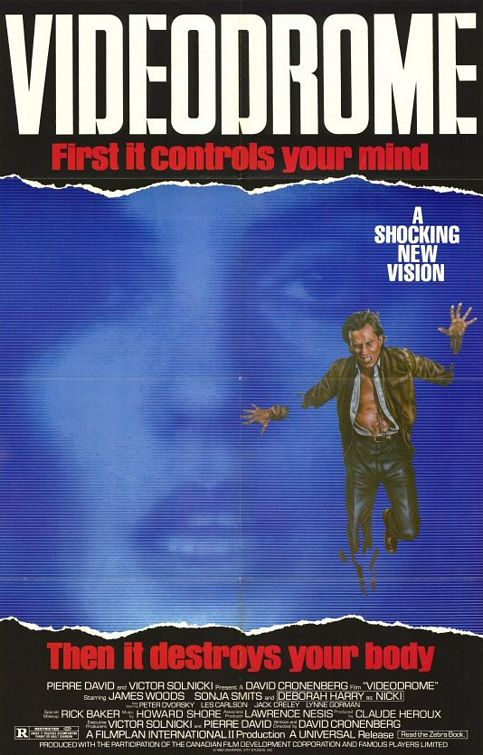
If David Cronenberg was as good at picking lottery numbers as he is at predicting the future, then he’d absolutely be a millionaire by now. No, a billionaire. You know that modern culture of consumption to which we all find ourselves enslaved, the same one that probably has you reading this on an electronic device? (Email, Twitter, Facebook, and Netflix later, perhaps?) It’s all here, in Videodrome, only thirty years early. Cronenberg unfurls a prophetic prosecution of television that feels even more relevant in 2014 than it likely did back in the early eighties, when small-screen dominance was probably just an anxiety-wrapped possibility. Videodrome, therefore, is steeped in a philosophy of purpose and accuracy, one that is interesting to consider within our contemporary context. Unfortunately, the film itself struggles to keep up with the ideas developed. Perhaps it’s because we’ve seen it all before, but Videodrome is just a bit… boring.

Max Renn (James Woods) is the kind of guy Sigmund Freud would’ve been had Freud awoken a century later and veered closer to the sexual in psychosexual. He runs CIVIC-TV, a television station based in Toronto that relays unorthodox programming, and is on the look-out for something new to up the ante, something different. Luckily for Max — or perhaps unluckily — he stumbles across a feed airing uncoordinated brutality, called Videodrome. What appears to be sensationalist artifice quickly takes on a disconcerting meaning, and begins to invade more of Max’s existence than desired.

“Television is reality and reality is less than television,” retorts Brian O’Blivion, a professor who professes only through the televisual medium. His character is the essence of Cronenberg’s agenda: a victim of media gobbling. O’Blivion has dedicated a significant portion of his own life to the study of human obsession when it comes to television in particular, employing the visual instrument ultimately as a means not to an end, but to a forever. If O’Blivion is the essence, then his creation Videodrome is the agent of consumption. Though the exhibits on screen are morally questionable, perhaps even legally ambiguous, our leading man Max is increasingly drawn towards goings-on. And not only Max, his romantic interest Nicki too. She, having seen Videodrome, desires only to become a part of it. To be infused in a new televisual reality. Up until this point, there’s a precise and engaging ideology being explored, one that is embedded firmly in the fabric of modern times. (We’re so absorbed by television that we now watch people watching it). The domineering TV pull is a wholly engaging stance and Cronenberg deserves credit, given how accurately Videodrome mirrors today’s norms.

Eventually, notions of mass societal control, planted memories and geopolitical monopolies come into play as Cronenberg’s condemnation of the television culture expands — in truth, perhaps too many strands are added. The tone switches from one of warning to one driven by preachy sound waves. Instead of a cautionary tale about how an inanimate object can become empirical upon leeching itself onto humanity, Videodrome advances down a route of denunciation as it attempts to make our minds up for us. We watch and listen as characters discuss standing firm against “savage new times”; society having to be “pure, direct and strong”; and a “cesspool TV station” whose viewers are “rotting civilisation away from the inside”. The message is clear: beware any abnormal pseudo-violent tendencies in order to avoid them flowing into real life. A noble message, had it not come by way of a fictional film.

A film, incidentally, coughing up splurges of violence from beginning until end. Torsos pave way for VCR slots and hands take on the form of guns. These images are nasty and gooey, yet not as memorable as Cronenbergian bloodshed normally is. The body horror prosthetics are as slimy and grimy as ever, but don’t quite fit the reality-imbued mould proposed by the film. There’s no denying the clarity illustrating this as an inherently Cronenberg creation: grotesque bodily malfunctions, a techno-infection prerogative, the socio-political framework, some inconclusive chronologies. Yet, unlike many of the Canadian’s previous outings, Videodrome manifests without much gusto. It feels a tad worn. Though the ideas mentioned earlier are engaging, perhaps they only really draw a fresh appeal because of their prematurity. These ideas of global consumption have been tossed to-and-fro relentlessly over the last few decades; only recently Transcendence hit cinemas, a film that takes this notion a step further by physically infusing technology with a human being.

James Woods is good as the disingenuous-cum-traumatised CEO Max Renn. He’s not a very likeable chap — not many of the characters are, another issue intertwined within the film’s ever-growing list of problems — yet Woods ushers forth enough of a switch in morality to justify some form of sympathy. As Max’s love interest and radio host Nicki Brand, Deborah Harry doesn’t have an awful lot to do, nor does her character boast any redeemable qualities, instead only a flip-flopping ethical stance. (“I think we live in over-stimulated times… and I think that’s bad,” explains Nicki, before chatting up Max whilst wearing a red dress.) Sonja Smits has a cup of tea as O’Blivion’s daughter Bianca, whereas O’Blivion himself Jack Creley implores us to listen through his direct and sincere vocal delivery.

David Cronenberg encourages discussion about issues of media consumption that herald even more relevance within the context of today’s cultural and societal posture. However, as Videodrome progresses and happenings lose practical clarity, the film too squanders precision and veracity by introducing extra narrative elements that preach to us rather than alongside us. Never mind, I think I’ve got an episode of Gogglebox to catch up on.

Videodrome - James Woods

Images credit: IMP Awards, Collider

Images copyright (©): Universal Pictures

Jurassic Park (1993)

★★★★

Director: Steven Spielberg

Release Date: June 11th, 1993 (US); July 16th, 1993 (UK)

Genre: Adventure; Science-fiction

Starring: Sam Neill, Laura Dern, Jeff Goldblum, Richard Attenborough

Who knew rippling water could be so menacing? Steven Spielberg’s early 90s dino classic swings from a slyly humorous thrill-ride to a tense environmental duel harbouring geopolitical connotations. Visually enticing beyond its years, the opening of Jurassic Park’s gates ushers forth a landmark in technological achievement on screen with effects that wouldn’t look too far out of place amongst the CGI blockbuster behemoths of today. There are one or two missteps along the way, most notably a paternal plot strand that feels forced rather than instinctive and an outrageous accent that seeps from the mouth of Richard Attenborough which at times threatens to boil over into caricature territory. Subtlety mightn’t be on the menu (that spot is reserved for human beings) and nor should it be in this rip-roaring tale of imagination, immorality and animatronics.

After a worker is killed by an errant Velociraptor, lawyer Donald Gennaro (Martin Ferraro) converges on Jurassic Park, an island owned by entrepreneur John Hammond (Richard Attenborough) and inhabited by cloned dinosaurs. Hammond simultaneously invites doctors Alan Grant (Sam Neill) and Ellie Sattler (Laura Dern), a palaeontologist and palaeobotanist respectively, to join the certification jaunt knowing the pair have more than keen interest in the fossil business. Mathematician Ian Malcolm (Jeff Goldblum) gets wind of the goings-on too and accompanies the party on their venture around the island that is prospected to open publicly in the near future. They ought to fix that fencing first though.

From the moment our ragtag band of explorers and suits reach their ill-fated destination, David Koepp’s screenplay based on Michael Crichton’s novel — also a co-writer here — strikes up a juxtaposition bearing an awesome visual gloss, but with a dirty underbelly. We first see the immense dinosaurs roaming across the landscape at the same time as Dr. Grant and company, the creatures’ awe-inspiring repertoire generating a sense of splendour. However, it’s not long before crass ignorance and abject misconduct take over; touring car doors are missing locks, the park is understaffed, a disinterested slob controls central safety measures and flimsy wired fencing is implemented as a harnessing mechanism. In essence, the park is a sham.

This notion of lawlessness disguised as grandeur is developed further as it latches onto certain characters. In a scene pivotal to the narrative’s apparent wary message, the group settle around a sleek table to discuss degrees of wrong. Is humanity’s imperious domination over nature — mirrored by CEO John Hammond’s genetic manipulation and cloning — immoral? Effectively, is this the rape of the natural world, to paraphrase mathematician Ian? Financial gain is presented as the ultimate destination for some (“We will have a coupon day or something”) whereas it’s the inherent allure of discovery for others. Spielberg refrains from indirectness here, instead placing his cards on the table and facing the query head on. The film asks questions that are perhaps even more relevant to this day, and doesn’t shirk away from picking sides. It’s a mature approach that, coupled with a visual affluence, successfully challenges the viewer to consider external prosperity gained at the cost of nefarious biochemical control and human tyranny over nature.

Tonally, Spielberg hammers a balance between the geopolitical and the humorous. Admirably, there’s no shortage of the latter as we see a witty, banterous dynamic rear between the various characters on display. As resident number-cruncher Ian, Jeff Goldblum scoops and skilfully delivers many of the funniest quips. Goldblum’s timing is terrific and the film would’ve benefited further if he had garnered more screen time towards the conclusion. Sam Neill’s Dr. Alan Grant relays humour cut from a blunter cloth, and his pseudo-Indiana Jones demeanour — the attire, the adventurous mind, the standoffish personality — is a tad camp, but amusing when paired alongside Ian, his polar opposite. In fact, an ongoing campiness exists throughout the film, embodied by zoomed-in camera shots on shocked faces and the occasional line cheesy in obviousness (“They’re approaching the tyrannosaur pen”).

The only significant issue Jurassic Park must contend with is a sub-plot that is unnecessary in existence and contrived in execution. John Hammond’s grandchildren arrive mid-way through, and it just so happens that they find themselves under the care of Dr. Grant, who dislikes children (“They smell”). Though the actors do a fine job and present a duo of child characters who are not in any way annoying, their inclusion feels primarily like a method solely intent on generating sympathy where sympathy is superfluous to requirements. At a stretch, it is conceivable to consider that the intention behind these characters is to reflect civilisation’s should-be protective instinct towards nature, though there is already enough weight behind this particular cog.

Other than Richard Attenborough’s disastrous Scottish accent that chimes more off-putting than funny, the remaining performances invariably contribute peripheral goofiness and/or tension. Laura Dern is Dr. Ellie Sattler and endears from start until finish. Samuel L. Jackson’s hard-headed poise is particularly humorous, playing a cigarette smoking engineer who oversees many of the park’s operations. Computer geek Dennis Nedry (paha) grumbles in his chair and bumbles in the rain — pathetic fallacy is almost a character on its own — and funny man Wayne Knight portrays this ineptness as well as anybody. And aside from the accent, Attenborough does well as the increasingly flaying visionary whose plans are progressively falling apart.

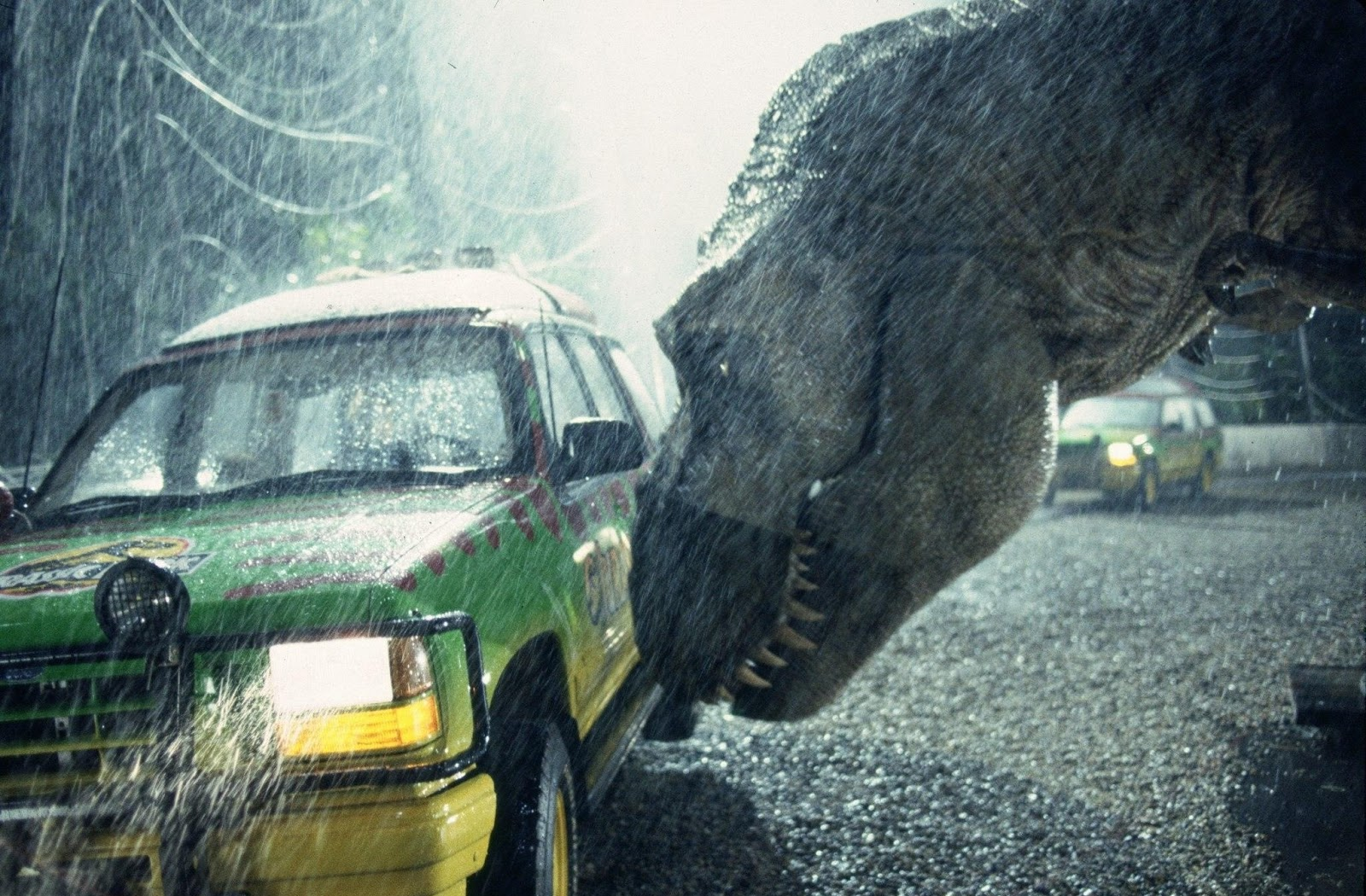
When we aren’t laughing or contemplating moralities, a brooding atmosphere grabs hold and gains momentum as the film evolves. The T-Rex reveal is timely; held back long enough to allow simmering anxiety and in turn create a mystique that bellows danger upon the dinosaur’s appearance. Cinematographer Dean Cundey captures the mechanical appearance of the park where metal fences, armoured vehicles, durable weapons and giant food dispensers retract from the dinosaurs’ animatronic motions, subsequently accentuating their perceived fluidity. Some scintillating sound work complements the tremendous visual array and bolsters said ominous atmosphere.

“We never had control, that’s the illusion!” bellows Dr. Sattler as proceedings begin to go awry. The line effectively sums up an inquisitive narrative that denounces immorality, but also wholly contradicts the efforts of Spielberg and co who absolutely always have control and resultantly chisel out an optical cinematic milestone.

Her (2014)

★★★

Director: Spike Jonze

Release Date: January 10th, 2014 (US); February 14th, 2014 (UK)

Genre: Drama; Romance; Science fiction

Starring: Joaquin Phoenix, Amy Adams, Scarlett Johansson

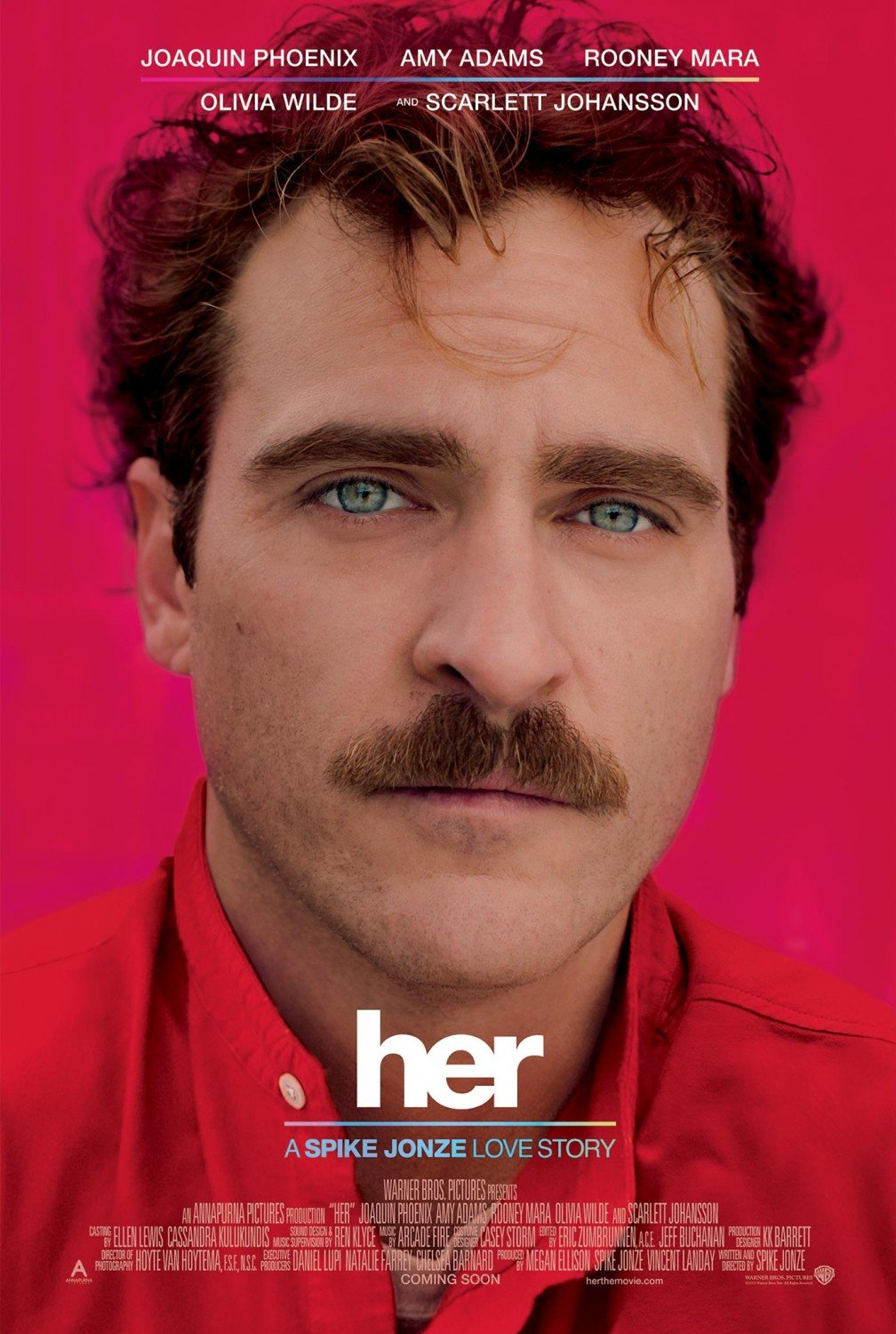
The last time Joaquin Phoenix and Amy Adams acted side-by-side they were components of an enigmatic collective, including the late Philip Seymour Hoffman, in an enigmatic film, The Master. Perhaps Scarlett Johansson’s most well-regarded stint in-front of camera was as part of Lost in Translation, and there are echoes here of that wayward soul in a hasty world mantra. Surprisingly then — given Phoenix, Adams and Johansson’s presence — Her somewhat ambles along uncertainly. Unlike The Master, it never reaches the pinnacle of engrossment, and it doesn’t quite have that admirable ambience of Lost in Translation. There is something delicate and charming though, admittedly often deriving from the performances of our fair trio. Yet aside from its lively textures, there’s a lacking sharpness, a missing clarity. Sometimes it’s all in the name, and the world in which Theodore Twombly exists is all a bit, well, wibbly-twombly.

It’s 2025 and Theodore Twombly (Joaquin Phoenix) splits his time between love letter composition for those unable to elaborate on their feelings, engaging in virtual gaming, and moping about his impending divorce. Given his own stuttering when it comes to expressing emotions, it’s miraculous that Theodore succeeds in his paraphrasing-mediation job. Inward and suitably unnoticeable among the masses of technology consumed beings, Theodore decides to invest in a brand new OS system, shortly thereafter named Samantha (Scarlett Johansson). At first he’s unsure, but still awkwardly encapsulated; by the impossibly sophisticated technology, the presence of something new in his life, and more than anything, Samantha’s sultry voice.

A voice that absolutely entices. Scarlett Johansson delivers a pitch perfect audio performance that rings both affectionate and strong-willed, increasingly growing in knowledge and pseudo-humanity. As viewers, we know of Johansson’s actual beauty and picture her as the OS system exhales airwaves, therefore it is easier to grasp on to her allure and, ultimately, understand why Theodore is becoming more and more infatuated with those wispy tones. Essentially, we see what he hears. On the empirical side of things, Joaquin Phoenix amiably bumbles as the lead. In reality Phoenix has a tough job, considering many of his conversations take place without the presence of another human being, and there’s no central location for him to direct speech towards. In evading this obstacle, Phoenix creates a flailing uncertainty that, even in direct conversation with another body, would probably still have him glancing from ceiling to floor. Theodore’s fidgety, glasses-adjusting unsettled social existence works well, in turn ensuring another successful acting outing for Phoenix.

Aptly, women are the order of the day in Her and another three effectively contribute, only in smaller doses. Olivia Wilde manifests as Theodore’s date, spiky in exterior yet personifying that lack of assurance that runs throughout the film. Soon-to-be ex-wife Catherine is played by Rooney Mara, appearing in a few montages and even fewer real-time scenes. Mara is fine, but doesn’t really see enough light of day to develop character-wise. Amy Adams gets a lot more screen time as Theodore’s childhood friend Amy and, much like her mate, is adoringly awkward. Which raises the first issue – the pair are so alike, seemingly very close and totally get on, so why are they not together? When we meet Theodore he is recently removed from a committed relationship, and Amy’s collapsing love life isn’t far behind. The premise obviously demands that there be an absorbing connection between its characters and their technologies, but the narrative still seems far-fetched in that neither Theodore nor Amy ever raise the issue of a potential relationship between the pair, which considering all the evidence, would be a flourishing escapade. Perhaps Amy’s human-on-human romance exfoliating with negativity subsequently forces Theodore’s mechanical-driven desire.

The insistence, then, on contemplating and evoking a social commentary on how civilisation is becoming enslaved by technology, starts edging towards overbearing status. Constantly, the screen cuts from unfolding events to convey the number of humans seen aimlessly wandering with an electronic voice in one ear. Yet a number of these techno-captives — not all — still convey surprise when Theodore details his rapport with an OS system (“You’re dating your computer?”). The notion is weird for the viewer, of course, but in the context of a future world driven by the machine, Theodore’s budding romance doesn’t really seem all that peculiar. To get around this, writer-director Spike Jonze delves further into the land of philosophical thought, encountering Samantha as she raises her own moral dichotomy. “Are these feelings real, or are they just programming?” she wonders worriedly. Is she even a she? Instead of Her, would Thing be a more suitable title? For a while, this dilemma sort of works as it becomes more about the creation of a new, potentially dominant artificial intelligence, rather than a human-computer relationship. Inevitably though, it wears.

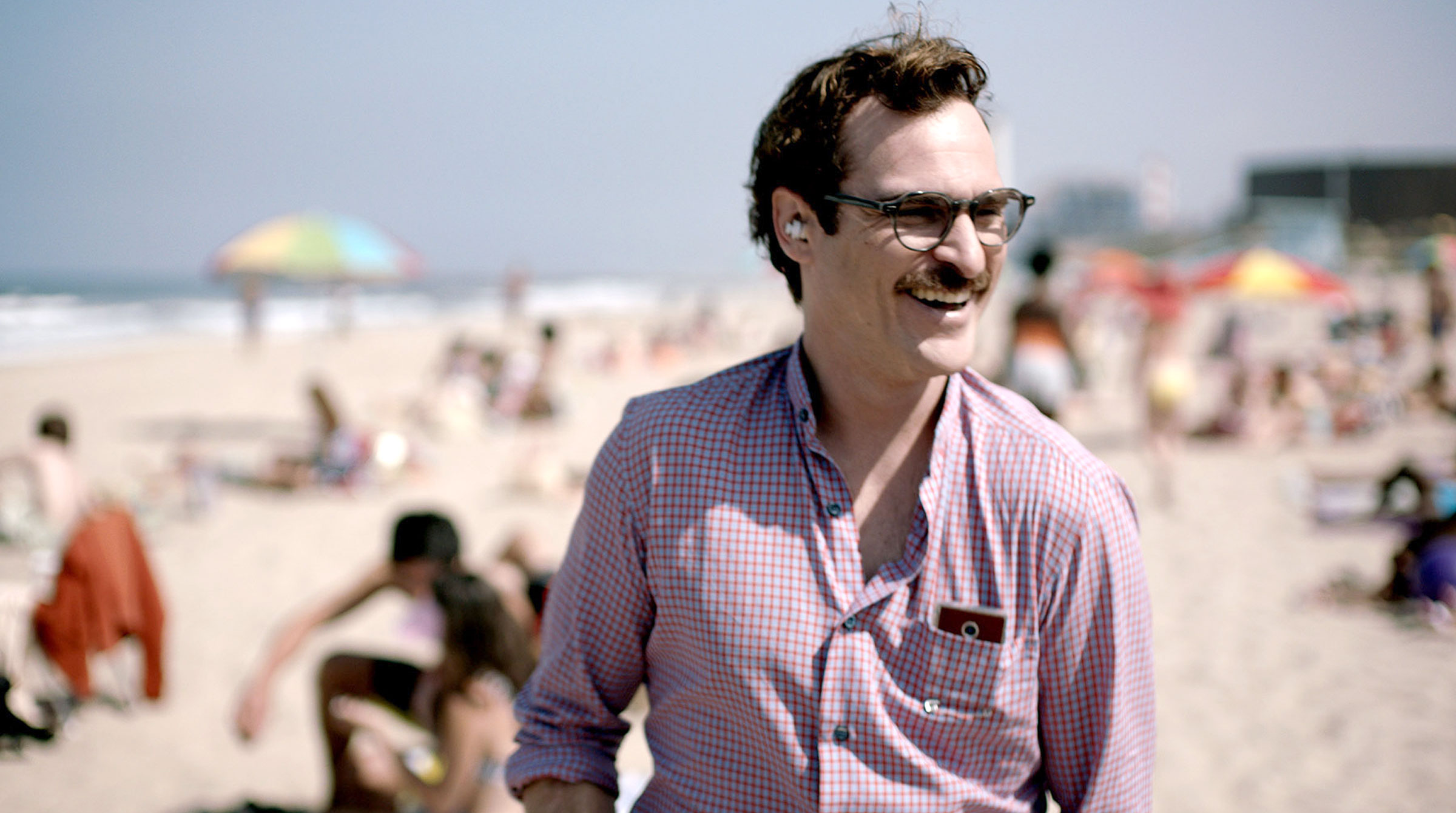
Once Jonze gets past the schmaltz and hit-or-miss musings (“The past is just a story we tell ourselves” — guess I don’t need to return that television I stole yesterday then) and focuses on purely simplicity, Her really hits its stride. When Theodore and Samantha are having banterous, funny conversations, that’s when the film oozes charm and good-natured infectiousness. Moments of energy reign supreme over soliloquies of sad reflection. The film is encased in vibrancy, a future world that somehow gleams with a retro feel, almost as if we’ve returned to the inception of computers rather than their sovereignty. Theodore’s moustache is as welcome as his bright orange shirt and the multicoloured glass windows his office. This glossy texture, coupled with a hypnotic soundtrack not dissimilar to that of Lost in Translation, aids in capturing a setting that you wouldn’t mind spending hours encapsulated in.

Strong performances provide Spike Jonze’s Her with a required dose of oomph, as often the director’s relentless societal ponderings become too much or increasingly repetitive. Having said that, the film is entirely watchable and probably just as rewatchable, given its wonderful cinematography and generous atmosphere. Despite a few significant misgivings, Her is actually pretty good fun.

2001: A Space Odyssey (1968)

★★★★★

Director: Stanley Kubrick

Release Date: April 3rd, 1968 (US limited)

Genre: Adventure; Mystery; Science-fiction

Starring: Keir Dullea, Gary Lockwood, William Sylvester, Douglas Rain

Where to begin?

The beginning of time, apparently. A group of apes, shepherded by an apparent leader, are growled at and hounded from their waterhole having already lost a member via the scissor-like teeth of a leopard. It appears; seemingly from nowhere, from nothing: a large and brooding object, known as the monolith. The beasts shriek, cower and then gain strength in its presence. Shortly thereafter, the now tactical, abrasive early hominids have reclaimed their waterhole. Clutching a bone, envisioning a tool, the leader tosses his symbol of construction, destruction and all else into air.

We’re floating in space.

It truly is a remarkable opening sequence, Stanley Kubrick’s depiction of premature life dissolving into an achievement-driven existence, an existence embodied by the amazing feat of spatial prosperity. By squashing life’s inception all the way through to thriving humanity into only a few minutes, is Kubrick trivialising said time period? Is he playing down the importance of thousands of years in anticipation of what is to come next? Perhaps. Yet it is the black structure, the monolith that is most intriguing. So odd in its appearance, the edged object turns ominous; what of its instantly empowering effect on the apes? Stanley Kubrick’s 2001: A Space Odyssey is one of the most influential pieces of cinema, of art, to be born out of the last century, and in less than 10 minutes it pillages viewers with more questions than answers. Over a two hour and 40 minute run-time these questions double, treble, as Kubrick raises issue after issue including our reliance on machines, mechanical manipulation, the significance of alien existence, of shapes even. He does all of this whilst celebrating humankind and our limitless prerogative. It’s wonderful.

Zarathustra, speak. Cue the brass…

Across four far-reaching periods of time, each one linked existentially and thematically to the next, 2001: A Space Odyssey engages in a tale — the tale — of life. After encountering the early hominid creatures, we ascend over the horizon into space and join Dr. Heywood R. Floyd (William Sylvester) are he prepares for a mission to Clavius Base in the midst of some abnormal goings-on. The narrative sprints ahead thereafter, to the Jupiter Mission, doctors Frank Poole (Gary Lockwood) and David Bowman (Keir Dullea), and their increasingly claustrophobic relationship with ship computer HAL 9000 (Douglas Rain). Finally, Kubrick takes us on a peculiar and tantalising journey across, through and around the cosmos, blanketed in an array of magnificent cosmological phenomena.

This collection of chronological mini-movies, although odd at first glance, succeeds two-fold: in compounding the monumental story being told, and in detailing the development of mindful curiosity, technological prowess and emotional manipulation. The first strand — the only section to be located on land — portrays everything primitive. The ape, soon to become man. The waterhole, soon to become territory. The bone, soon to become a sword, and a sceptre, and a hammer. It’s smart, cunning almost, as the sequence sets your brain clogs in motion. And the viewer’s mind is certainly going to need to be switched on, as the black vacuum above plays host to everything that follows.

An iconic image: the bone thrown and subsequently plummeting through the air, snappily followed by a space shuttle harnessed by gravity. Perhaps an indication of humankind’s selfishly perceived stability all these years later. Selfish in their control over nature, and negligence of mechanical reliance. Machines that seemingly have a “dependence on people,” at least that’s the view of Heywood, and later both Frank and David. Kubrick switches his line of questioning, batting that now aged-old ‘man versus machine’ adage that was gaining prominence around the film’s release in 1968. The internal AI system, HAL, is essentially the ticking heart of Discovery One, Frank and David’s space liner — HAL’s physical appearance burns a bright reddish-orange, symbolising the sun. Yet the system is almost secondary to the humans on board, simply a part of their routine; machinery assists in cooking food (unlike the raw meat off the slain bone eaten by apes), in steering the ship, providing entertainment (HAL wins at a game of chess), and almost all else.

This notion of machine-driven consumption prevails throughout the film, climaxing in HAL’s eventual devilishness and therefore implying both that machine has absolute rule over man, and that it is perhaps the next stage in the evolution of life. Douglas Rain is deadpan as the system’s voice, verbalising in an incredibly unassuming-turned-condescending manner (“Without your space helmet, Dave, you’re going to find that rather difficult”). Coincidentally, this converging relationship between man and machine has once again reared its societal hand recently, in Spike Jonze’s Her, a story about a man who falls in love with his AI system. The topic is an intriguing one, and Stanley Kubrick tackles it as well as anybody has done (or will do).

There are also other subtexts rummaging around, including our intrinsic attraction to the search for alien existence, conveyed by how characters interact with the menacing monoliths scattered throughout. Another irregular data byte comes by way of shapes — the sphere: HAL, the ship’s centre, and planet Earth indicating a form of coming full circle; the rectangle: those brooding and dangerous monoliths, offering no leeway; and the picturesque octagon: part of Discovery One’s walkway, an uncommon shape signalling strange happenings.

Interspersed within this ocean of thought-provoking query is a soundtrack as wide-ranging as the eon covered, yet one that maintains a common brassy undertone. Celebratory and grandiose, Richard Strauss’ “Thus Spoke Zarathustra” blares as a triumphant recognition of achievement. Conversely, scores of haunting, ghostly tones wail out like human souls in fear of extraterrestrials; it’s the ambience of the unknown. Geoffrey Unsworth has a whole universe to work with, and his cinematography is marvellous. The special effects, though obviously not up to present day standards, are admirable in their imagination — the influence of the camera work on show here can be seen propelling modern movies like Gravity. Performances from Keir Dullea, Gary Lockwood, and William Sylvester are by no means the centrepiece of proceedings, but Dullea in particularly stands out depicting of the authority-battling and bearings-losing Dr. David Bowman.

Stanley Kubrick films are renowned for offering more questions than answers. This potentially problematic mantra shows no sign of miss-deployment here, instead thriving in tandem with 2001: A Space Odyssey, a film that encompasses all of time and that debates the multitude of lives lived throughout.

Images copyright (©): Metro-Goldwyn-Mayer

Gravity (2D) (2013)

★★★

Director: Alfonso Cuarón

Release Date: October 4th, 2013 (US); November 7th, 2013 (UK)

Genre: Drama; Science-fiction; Thriller

Starring: Sandra Bullock, George Clooney

Alfonso Cuarón’s Gravity has been lauded with praise from audiences and critics alike since its recent big screen release, being labelled groundbreaking, pioneering cinema. Emphatically described as immersive and emotive. Even breathtaking. Perhaps so much so that no space-set extravaganza will ever be the same again, purely because space on film in the future has a Gravity-esque brass ring to aspire to.

This abundance of praise, however, has been attributed primarily to Gravity in its 3D format (heck, even Mark Kermode thoroughly enjoyed this version). The jury is therefore still out on Gravity in its classic, run-of-the-mill 2D version. Does the trend-setting cinematography and floaty camera work succeed at all in two-dimensions? Is the film as engrossing and all-encompassing without the plethora of protruding debris and George Clooney-ness?

Quite simply, the answer to these questions is no. Not a resounding no, but a no nonetheless. And this flares up a number of issues, the most significant being whether or not Gravity in 3D is, more-so than any other three-dimensional film to date, essentially a theme park thrill ride in a cinema. Perhaps even — put in the plainest of terms — a gimmick. This is not necessarily a negative — film critic Danny Leigh on BBC’s Film 2013 mentioned that the film which Gravity reminded him most of was the Lumière Brothers’ L’arrivée d’un train en gare de La Ciotat (known in the UK as Train Pulling into a Station).

First shown in 1895, the film is a short 50-second piece depicting a steam train’s arrival at a bustling station. The first of its kind, the oncoming train apparently startled audience members and sent them fleeing in fear of the vehicle. The Lumière Brothers, themselves pioneers in the art of filmmaking, perceived cinema and the cinematic experience as a physical one, where audience members would be totally entranced and involved in what they were seeing. This was the birth of cinema and back then cinema was an out-of-body experience.

Fast-forward over a century and, by all accounts, this wholly enveloping feeling has returned as Gravity in 3D. But the same cannot be said for Gravity in 2D. The film sees Sandra Bullock’s Ryan Stone on her first space shuttle mission, partnering spacewalk veteran Matt Kowalski (Clooney) on his final mission (you can see where this one is going). After hearing news of a Russian satellite accident, the pair are bombarded with the resultant debris and metal, leaving them separated, low on oxygen and in desperate need of a safe return to Earth — to gravity.

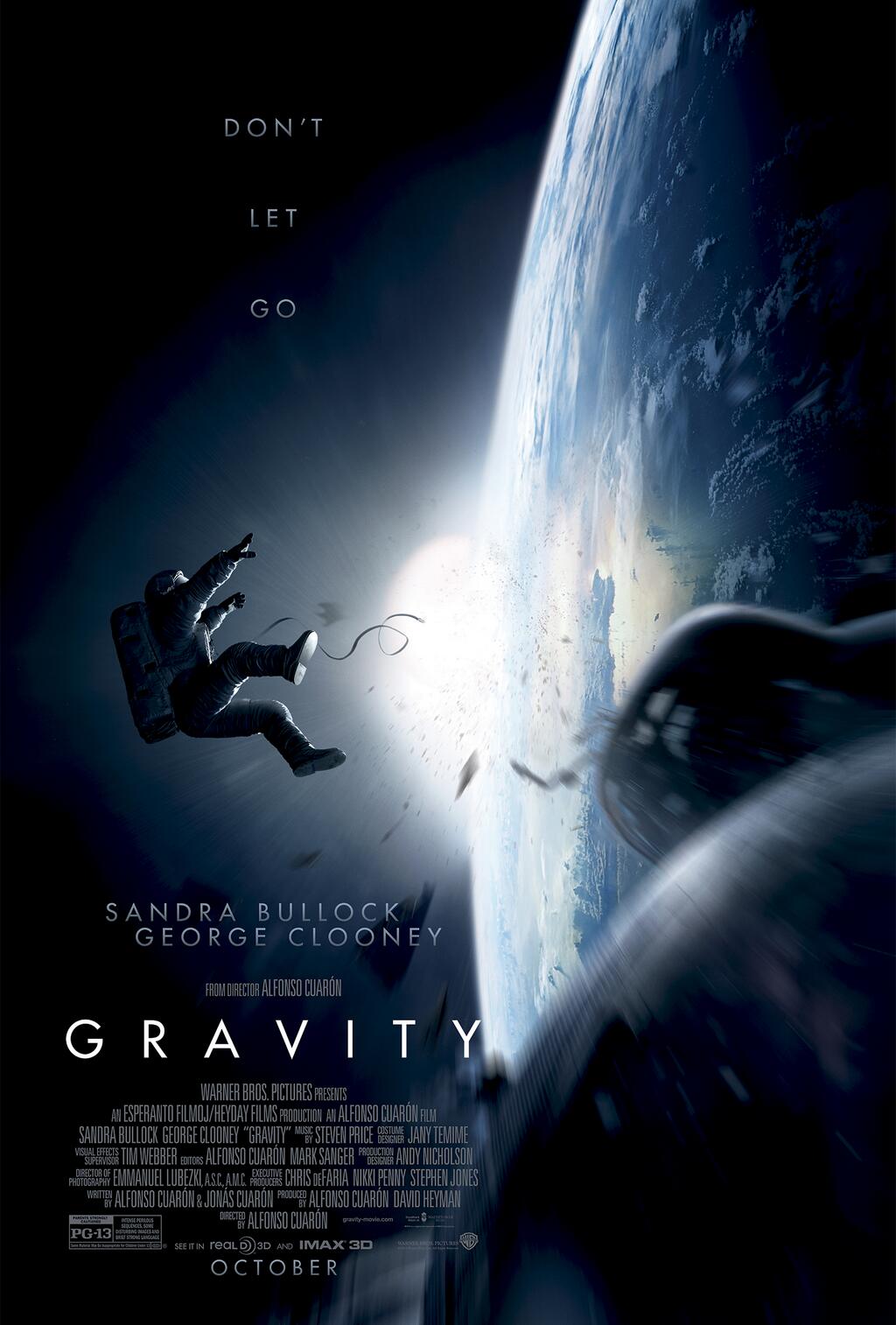
Gravity (2D) looks stunning. The intricately manoeuvring astro-camera delicately shifts around the blackness, almost giving off the sense that the viewer is up there with the mission team (it probably does relay this sensation entirely, in 3D). The screen displays the magnificence of planet Earth in its fullest form and the film, as a purely flat visual output, looks simply awesome. So awesome that the philosophical Kowalski comments on the “beauty” a number of times.

Bullock is good as Dr. Stone, a woman who has recently lost her child and finds solace in the emptiness of space — an emptiness that no doubt has engulfed her for what feels like millennia, and that has left her devoid of any genuine happiness or enthusiasm for life. George Clooney does George Clooney very well, bursting with unbridled charisma and charm. The pair, and Bullock in particular, do genuinely come across as actors who have gone hell-for-leather and to ensure that there is a completely organic impression emitted from their space-set performances, an organic understanding that the film itself does incredibly well to generate (a generation likely far greater in 3D) as it was obviously unable to shoot on location.

Here is where Gravity (2D) returns from cloud nine to the bleak pavements of earth: the narrative is nothing more than just alright. Much of the film sees the astronauts glide around space for a period of time before colliding with a number of space stations and shuttles as they search for a route back to Earth. The novelty of watching these small, inconsequential beings wander at times aimlessly around the dark beyond wears off fairly early on, and unfortunately the dialogue is too commonplace and puffy to keep the audience attentive. There are bountiful amounts of clichés (“I’ve got a bad feeling about this”) and a number of deep-rooted conversations about existence and life (foetal position alert) recycled from sci-fi B-movies. The film is self-aware of this, and it would seem that the 3D version of Gravity does not need to worry about plot because the entrenching nature of proceedings means viewers are too busy being wowed by that new, exciting feeling of immersion in space alongside the characters.

Here lies the fundamental dispute that the 2D versus 3D debate boils down to: Gravity (2D) is a visually wonderful, but narratively generic drama about people in space trying to return home, whereas Gravity (3D) is a revolutionary experience in watching and becoming part of a film — it is pure cinema, the essence of what the Lumière Brothers envisioned all those years ago.

There is a moment towards the end of Gravity (2D) where the camera pans above a number of objects travelling very rapidly over the Earth. Even in two-dimensions this is a spine-tingling moment, and it evokes a final 15 minutes that is tense, goosebump-inducing and quite simply brilliant. These final moments probably equate to every moment in Gravity (3D). If that truly is the case, Alfonso Cuarón has done something pretty special indeed. The director has vehemently pushed for the film to be seen in all its three-dimensional glory, on the biggest screen, and it seems that is exactly how it should be seen.

I’m off to the IMAX.

Genre Toppers

Having spent the past few days thinking about different ideas and topics to write about, I have come up with a new ‘feature’, if you will.

Instead of primarily relaying new film announcements or reviewing recent film releases (which I will still do, obviously) I think it is time to write about my some of favourite films that I have had the pleasure of viewing throughout my nineteen years of existence.

However, rather than just creating a generic top ten list, I have decided to focus on particular genres and decipher my favourite films encompassed by each genre. I have yet to decide how many genres I will include, but you can count on the usual ones being in there (drama, horror, sci-fi, action, comedy and so on).

The plan is to lay out five top films in each genre and then give a sort of ‘mini-review’ of each film, basically outlining why I like the film so much.

Watch out for my first genre list which will be available to read either later today or tomorrow, and will be titled something like “CBF’s Genre Toppers: (insert genre)”. CBF stands for Consumed by Film, but you already knew that.

The word ‘genre’ is really getting on my nerves now.

Gravity (Out November 7th, 2013)

He’s been there once and he enjoyed it so much that he has decided to return. That is right, George Clooney is back on the big screen this autumn — in space. Unlike Steven Soderbergh’s 2002 film Solaris starring Clooney, Gravity is a brand new script written and directed by Alfonso Cuarón, his first film in seven years.

Set in space, Gravity follows the progress of astronaut Matt Kowalsky (Clooney) — a veteran serving his last mission — and medical engineer Dr. Ryan Stone (Sandra Bullock) — a rookie on her first Space Shuttle outing. The film is set for release on October 4th in the Unites States, therefore we do not know much about the plot at the time of writing other that what is shown in the recently unveiled teaser trailer (below): whilst carrying out a spacewalk — activities conducted by an astronaut outside his/her spacecraft — Kowalsky and Stone’s shuttle explodes leaving both space inhabitants stranded.

There have been countless films creates depicting helpless individuals trapped in space — either on a planet or in a shuttle. Recently, Apollo 18 graced our screens: a fictional portrayal of events after the cancelled Apollo 18 mission. Before that, Duncan Jones’ impeccable debut film Moon starring Sam Rockwell carried the mystique and tension of the stuck in space scenario. Going even further back, Event Horizon, Silent Running and Alien are all examples that the stranded in space genre — although still intriguing — is not a new one.

“Ten across, four letters, ‘to unveil one’s buttocks’ — any ideas?”

However, the commonality between all of the aforementioned films with which Gravity does not appear to share is that the helpless characters were trapped in a spaceship or on a planet, whereas Cuarón has delivered Clooney and Bullock to us suspended and floating in space. All signs point towards this being the case for the vast majority of the motion picture, which is something I personally have not seen before.

The trailer offers very little in the way of plot development, but a whole lot in regards to visuals, which are simply stunning. This should not come as a surprise to those who have seen Cuarón’s last outing in the director’s chair, Children of Men, which encapsulated and illustrated a dystopian Earth both effortlessly and beautifully. He was also the mastermind behind the highly regarded third act in the Harry Potter film franchise: Prisoner of Azkaban.

Alfonso Cuaron
“This is so heavy, stupid gravity!”

With a similar budget to Children of Men (Children of Men came in at around $76 million and Gravity has hit the $80 million mark) and with two very accomplished and impressive actors at the helm (albeit after a number of cast changes — Robert Downey Jr and Natalie Portman were once the leading candidates), Gravity has the potential to blow audiences away. Having originally been scheduled for a 2012 release and been pushed back a year to 2013, I think it is about time the Gravity shuttle was grounded so that we can all witness Alfonso Cuarón at work once again.

The Summer of Sci-Fi

Okay, I will admit it: only fairly recently have I jumped on the sci-fi bandwagon. I have always enjoyed the odd science fiction film, but I used to be much more of a drama or comedy guy. Not anymore. Over the past two years, I have really begun to develop an admiration — through intrigue and awe — for science fiction. I think it started around the time Ridley Scott’s Prometheus was announced. Having never watched the Alien films (I have now) I was surprised that Prometheus had grabbed my attention as much as it did. The plot sounded interesting, the poster looked ominous, the actors lined up were of a very high calibre. Then the trailer arrived and I was completely sold. The mood set in the trailer was outstanding — total atmospheric eeriness. In terms of the film itself, I went to the cinema to see the day it came out and, in my opinion, it lived up to the hype. Perhaps having not seen any of the Alien films beforehand I went in with a different mindset to those who had seen them — I was not expecting a lot of Alien-related content because I didn’t really know what Alien-related content would look like.

But I digress. This summer — and beyond — we have the pleasure of being offered a significant number of science fiction films in cinemas. Having just finished my exams at university, I have only been afforded the chance to go to the cinema once in the last few weeks and that was to see Iron Man 3. But now that I am off university and free to do what I like for five months, the cinema beckons along with the upcoming sci-fi films. Up first, at the end of March The Host was released in cinemas, starring Saoirse Ronan, and having been panned more or less by critics — holding a 9% rating on Rotten Tomatoes — it has performed pretty well at the box office. Up next, the highly anticipated Oblivion, starring Tom Cruise. I regret not seeing this film in cinema as, at least for an hour, it harps back to classic sci-fi films like Silent Running and Total Recall according to Mark Kermode of Mayo and Kermode’s Film Reviews on BBC 5 Live. Other reviews have been moderate to favourable and the film has grossed over $200 million dollars. Of course, the biggest and most looked forward to science fiction film of the summer has to be Star Trek: Into Darkness (which I plan to do a blog post on soon, watch this space).

Following that are films such as The Purge (2013) starring Lena Heady and This Is the End (2013) with an ensemble of comedy stars. In July, Pacific Rim hits cinemas — perhaps literally going by the trailers. Billed as Giant robots vs. Giant monsters, Pacific Rim has a tough job in ensuring it does not just become a film where, well, giant robots hit giant monsters. The well-publicised Elysium begins screening towards the end of August — a futuristic take on current political issues, helmed by Matt Damon and Jodie Foster. Before the summer ends, The World’s End (hopefully not) will complete Edgar Wright’s “Three Flavours Cornetto Trilogy” and again it boasts the funny duo of Simon Pegg and Nick Frost. Even after summer, the science fiction fountain keeps flowing with the likes of Riddick, Ender’s Game and the second part of The Hunger Games franchise — Catching Fire.

I guess the reasoning behind this blog post is to not only give you an insight into how I got into science fiction, but also encapsulate how much the genre dominates our cinemas. Back in the 1970s and 80s — when I was not alive — sci-fi films were at the forefront of cinema: films like Blade Runner, Silent Running, The Terminator, and even before then Kubrick’s 2001: A Space Odyssey. Perhaps now, in 2013, science fiction is on a parabolic rise and hitting a return to form. Or maybe not. Perhaps it is simply an easier way for filmmakers to grab an audience’s attention with awesome visuals. But why can’t it be both? I for one am very much looking forward to this summer and am excited to get stuck into some sci-fi — are you?