The Lego Movie (2014)

★★★★

Directors: Phil Lord & Chris Miller

Release Date: February 7th, 2014 (US); February 14th, 2014

(UK) Genre: Animation; Action; Comedy

Starring: Chris Pratt, Will Ferrell, Elizabeth Banks, Morgan Freeman

“Everything is awesome!”

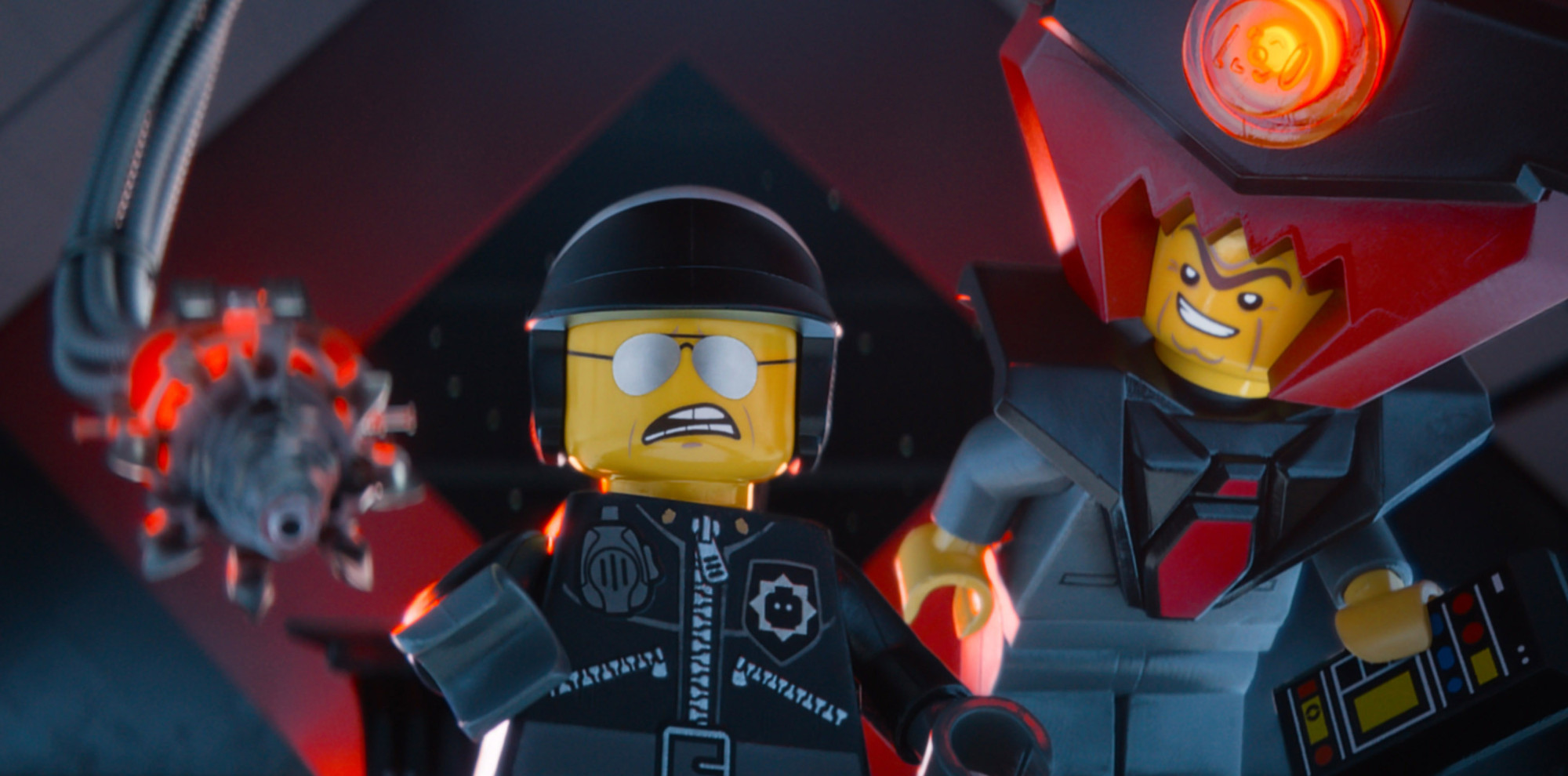
Everything is also chaotic, bonkers and pretty hilarious too. The Lego Movie doesn’t hold back. It cracks the obvious gags when they’re hovering around. There’s a lot of shouting, screeching and wailing, and that’s not just from the children watching in the same screening as you. Engines are set to full-throttle from the off and remain that way. What’s left then, is this gigantic ball of merriment that sees it origins in a whole host of previous box office-busting successes, but one that also conjures up a few smart quips of its own. Truly abiding by its ‘Universal’ rating, The Lego Movie builds on the colourfulness, catchy riffs and outright pandemonium aimed at the young’uns, and ends up also divulging a witty, often reminiscent backbone for the oldies. So yes, everything is awesome.

Emmet Brickowski (Chris Pratt) is a middling construction worker who blends into his job and surrounding world as much as the next Lego figure. He abides by the bustling code of Lego life, a step-by-step process meticulously ticked off by everyone, a job designed to assist progress, and an anthem heralding President Business’s (Will Ferrell) seemingly glorious society. On the periphery though, there’s a menace, an evil at work. President Business has devious intentions, with sights set on using the ‘Kragle’ to glue the world motionless. Only the MasterBuilder can stop him, and maybe Emmet isn’t as ordinary as first perceived.

Unlike the mechanical and simple block-by-block creation style, The Lego Movie manages to deliver a well-rounded story with unimaginable scope. We’re bumbling around a fairly stagnant period of animation on the big screen, a time far removed from the Lion King’s and Shrek’s of cinema, films that combined humour and joy with underlying strands declaring positive living. The Lego Movie teeters on the verge of getting back there. For all its energetic prowess and funny moments, the film motions along a deeper, more satirical platform. One that denounces a lack of intuition and promotes difference. President Business — aptly named — embodies the proverbial symbol of power-hungry, corrupt domination. The addictive song “Everything is Awesome”, sung everyday all-day by the civilians of Bricksburg, is a means to an end for the evil overlord. It’s catchy for a reason, constructed by President Business to brainwash the masses. Yet there are those aware few fighting against the autocratic system, a misfit band of special, talented Lego warriors. This narrative works; it has meaning, evokes emotion and demands investment, even amongst all the surface madness and hilarity. The film trumpets variety against monotony and should be admired and applauded for doing so, perhaps even more so than for its many other accomplishments. Having said all that, it is interesting to consider how much authenticity this prevalent notion of non-corporate domination holds, when you take into account the film’s basis: a multinational, mega-encompassing, money-gorging branded toy.

Snappy comedy is one of the films main triumphs. A lot of the time you find yourself laughing not just on the back of current pop culture references (when Batman refers to Bruce Wayne as a “cool guy”), but also at the expense of historic political blunders — voting machines, for example. The gags are constant, relentless even, but their respective foundations are juggled around allowing a freshness to circulate throughout the film’s progression. On the odd occasion that a consistently fielded joke does become wearisome, writer and director duo Chris Miller and Phil Lord work hastily to replace staleness with another funny wisecrack, and very often that wisecrack is another jaw ache-er.

The dialogue is an audible sea of movie-innuendos, for the experienced and the novice. Aside from bountiful puns and hidden humours rewarded to tickle the quick-eyed (“Bob’s Kabob” is outstanding), we also get hilarious Star Wars absurdities and are showered with a number of popular superheroes — at one point proceedings take on a very Avengers’ Battle-of-New-York-like manifestation, with portals and whizzing machinery aplenty. Batman plays a significant role all through the film, and is probably the only running joke that slightly wears towards the end, which is a shame because Will Arnett does a tremendous job with the raspy Bat-voice, even if you’re throwing honey at the screen by the time the credits roll.

In fact, all of the voice-acting sounds terrific. Chris Pratt provides that exuberant bravado as Emmet, one that gradually pitches more assuredly as the film progresses. Emmet strikingly resembles another animated hero, Flick, both in characterisation and story arc. Similar to the A Bug’s Life protagonist, Emmet is an over-eager-yet-normal guy who possesses the willpower to do the extraordinary. Much like Flick, his apparently crazy, useless ideas are those that turn out to be crucial and imperative — the double-decker couch, for instance. On the contrary to Flick though, who was originally a spanner in the ant hole, Emmet tends to blend into his surroundings and therefore must ascend more than an echelon of innovation to save the day. Elizabeth Banks is zesty and strong as the voice of Wyldstyle, Emmet’s partner-in-heinous-prevention, a wickedness perfectly sounded loud and nastily by Will Ferrell as President Business. Liam Neeson is arguably the best of the lot though, his distinct raspiness toned down (or up) a tad to combat any Batman correlations. Neeson voices Bad Cop/Good Cop, but mainly Bad Cop, and provides a fair helping of humour as the Lego police officer carrying out President Business’s gluey work. A whole host of other names — from Morgan Freeman to Jonah Hill, and Channing Tatum to Cobie Smulders — add their choral airwaves to the very fun and easy-listening vocal front.

Visually, for the most part, the film succeeds too. It runs into a bit of a problem as events set sail across before diving under water. Up until this point, we’re fully engrossed in Lego-land where everything is constructed wonderfully of Lego pieces. The landscape accommodates those ever-noticeable spherical cogs, ready as always to ground an attached brick (a notion that goes over nobody’s head). Water, then, also runs and sprays as Lego parts, until the crew of saviours find themselves underneath the substance which then turns into a non-Lego, standard computer-animated sea. It’s a bit odd, and for a moment removes the viewer from the plastic world. In all fairness though, that’s nit-picking at its crudest and as a whole, the visual output explodes with colour, fluidity and life.

Based on a toy that encourages creativity and imagination, The Lego Movie upholds and listens to its own traditions rather than decimating them (à la the poor-tasting Transformers franchise). The film is controlled, uncontrolled chaos, a rapidly advancing and visually accomplished offering that sparks life into the animation genre. For over an hour and a half you won’t be able to keep the smile off your face, unless it’s to exhale another round of laughter.
World War Z (2013)

★★★

Director: Marc Forster

Release Date: June 21st, 2013 (UK and US)

Genre: Action; Adventure; Horror

Starring: Brad Pitt, Mireille Enos

As Brad Pitt’s UN investigator Gerry Lane swoops over the city of Jerusalem encased in an enormous fortified wall, you are reminded of all that is wrong with World War Z. There’s a lingering generic-ism abound, one that stockily lumbers around without promise nor priority. When Drew Goddard, Damon Lindelof, Matthew Michael Carnahan and whoever else’s script this is attempts to overcome these commonalities, the film struggles to successfully juggle its grandiose ideas and instead is blighted by one or two gaping plot holes. Yet, before Gerry’s helicopter settles on the dusty plains below, you’re also privy to World War Z’s great elements. The magnificent visual landscapes on show. A sense of urgency that not only ensures problems are swiftly left hanging far behind, but also relents in tandem with the film’s menacing creatures. And also Brad Pitt himself, whose screen presence is a welcome, wholly capable one supported robustly by Mireille Enos. Occasionally frustrating, often energetic; World War Z ain’t all that bad actually.

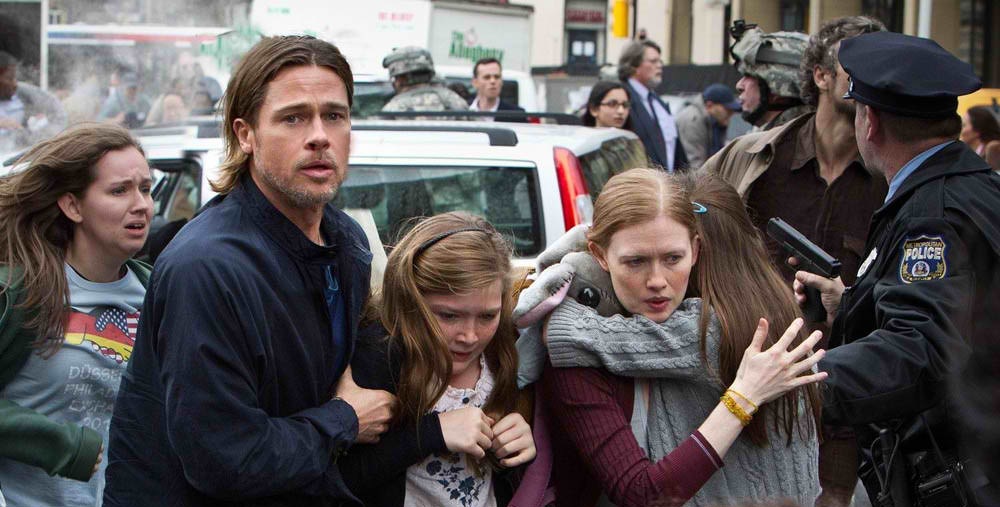
Having allayed his United Nations requisites in order to spend quality time with his family, a commute-turned-zombie attack must be the last thing on Gerry Lane’s (Brad Pitt) mind as he drives his wife Karin (Mireille Enos) and two daughters through a busy Philadelphia street. You get the sense he misses his old investigative job though, therefore it’s unsurprising that Gerry is speedily roped back into a life of danger and heroism, recruited by UN Deputy Secretary-General Thierry Umutoni (Fana Mokoena) to find the origins of the harrowing virus. Where did it come from? How can it be harnessed? These are apt, important questions demanding rapid answers in the narrative context, but questions that don’t quite elevate the film to any significant height.

World War Z, then, suffers two-fold. One on hand its familiar formula reeks of a sterility, whilst characters and plot advancements are constrained by the formalities of the pandemic sub-genre. Instantly, the screen reels off a variety of intertwined media, life, death, disease images in a montage designed to propel the likelihood of ecological threat in a shrinking world. It’s quite clichéd, but just about works as a warning (or confirmation) detailing the film you’re about to watch. Then a hair-strewn Brad Pitt appears, assuring his daughter that he’s done with the ‘leaving home’ business and is now employed solely in the confines of his own four walls — of course those busy, reminiscing eyes say something a little different. And after five minutes, you know exactly what you’re going to get: a rampant, solid action flick. This isn’t necessarily a negative, a ‘rampant, solid action flick’ will often conveniently fill up a few hours. What works, works, right? At times though, there’s an inherent over-predictability that, shuffled in lesser hands, could be construed as laziness (a taped arm will probably get bitten; a family left behind will more than likely come off worse for wear; a semi-retired family man will leave loved ones in the time of need).

These oh-so-common nuances do not affirm laziness though, because it’s evident that the conglomerate of director Marc Forster, actors and writers do care about the film they’re unstably constructing. Here’s the second problem then. In caring, and in striving to cast aside generic formulae, the film unwittingly jumps around, up, down and all over. Big surface ideas fall foul of gaping discrepancies, and there isn’t really a specific overarching tone, rather a number of intermittent murmurings. As a tormented, abrasive group of zombie-humans trample through the streets of Jerusalem, you’re watching (and probably enjoying) that ‘rampant, solid action flick’. But later, when Doctor Who appears and, stopping short at TARDIS-ing back in time, signals an atmospheric switch to one attempting Danny Boyle-esque tension. That’s not forgetting the splatterings of humour (the “Mother Nature is a serial killer” diatribe is oddly built on comic undertones) and misplaced masculine camaraderie throughout. Individually these tonal constructs are more hit than miss, but collectively the mishmash is a tad sloppy.

There’s also a significant plot-contrivance that perhaps stems from this rewrite plague that the film suffers from. The whole of Jerusalem is surrounded and protected by a gigantic wall, the idea being that Israeli officials were aware of the forthcoming viral attack and therefore planned ahead. The reason we are given explaining their premature knowledge is that these officials worked on the basis of a ’10th Man’ theory — where the assumption is that this 10th man (of a consistent group of 10, obviously) would always disagree with every unanimous decision agreed upon by the other nine, and then work to prevent the seemingly unpredictable. Essentially, this time the 10th man came across the virus, and that’s how Israel was alerted early. The issue then is, firstly, are we to believe that this earth-shattering discovery was successfully kept secret from the rest of the world? Secondly, if the 10th man always goes against the grain harvested by the other nine, wouldn’t his subsequent research always uncover (and thus prevent) past tragedies, therefore no global, human-based, disaster would ever have happened? Come on.

I digress. This is not a bad film, it’s only because the plot could’ve been tighter and the tone could’ve been structured and therefore the film could’ve been far better, that its weaknesses divulge frustration. For it looks incredible. Each visual is well-developed and astutely executed. In particular, there’s a tidal wave attack scene that’s ominous, turbulent and exceedingly well done. There’s also a sizeable amount of looking down at burnt, destroyed cities going on, although the terrific special effects anoint this a positive rather than a negative trait. And all of the fast-paced, energetic actions sequences deliver. In fact, Forster makes a point to move away from the early stereotypical set-up by quickly flashing the aforementioned disaster-threatening montage and then driving head-first into a bellowing helping of action.

These popcorn scenes do provide the majority of the film’s strengths, however on a few occasions there is a sense that Forster et al are striving to do more with the morality of said pandemic. A dancing moral stance that could’ve gone further, but one that flickers intelligently ever so often. This virus has spread worldwide, but what happens to civilizations in areas without sufficient protection, areas not ready and alert in their security measures? At one point we’re told “[it’s] pretty obvious nobody back home read it” in response to questioning over an email that circulated eleven days prior with the word “zombie” embedded. Is this a thinly veiled reference towards prior real-life mistreatment of threatening politically-bound documents? And are these creatures really zombies, or affected, compromised humans? They still wear human features, only now are assisted by growling eyes.

In an interview, Brad Pitt recalled his reasoning for seeking out the source material (of which his production company Plan B Entertainment secured the screen rights to). Effectively, something for his younger sons to watch and enjoy — apparently they like zombies. World War Z suffers from a number of faults, but it also boasts a few excellent aspects too and, at the end of the day, has been made with good intentions.

Hey, I’ll have whatever Brad Pitt’s children are having.

Inside Llewyn Davis (2014)

★★★★★

Directors: Joel and Ethan Coen

Release Date: January 10th, 2014 (US); January 24th, 2014 (UK)

Genre: Drama; Music

Starring: Oscar Isaac, Carey Mulligan, Justin Timberlake

The bumbling Llewyn Davis sits opposite Bud Grossman, a music mogul the folk singer has literally gone lengths to meet. Grossman, perhaps out of good grace rather than expectation, whispers he wants to hear something from “Inside Llewyn Davis”. You can see the toil in Llewyn’s guitar strumming hands, the plight in his aching voice and the desperation in his knowing eyes. Knowing, because he’s seen failure before. Always. It’s a powerful moment in a bleakly rich tale about a music churner on the periphery of a scene ready to erupt. Although Llewyn is often the source of his own downfall and despite his tendency to be a bit of an asshole, you campaign dearly for him. Out of sympathy? Sure. But also because Oscar Isaac plays the bedraggled artist to an absolute tee. And if not that, then it’s the harmonious melodies and captivating words emanating from Llewyn’s mouth that seal your approval. The Coen’s are back, and Inside Llewyn Davis is a drowsy doozy.

It’s 1961. Layered with frost and shrouded in the icy breath of its residents, New York’s Greenwich Village is a hotbed for folk music. Llewyn Davis is part of the emerging scene; at least he aspires to be, but his newest album hasn’t sold and his partner-in-song recently committed suicide. Lower on luck than money — and he’s pretty damn tight on both — Llewyn plays intermittently at the Gaslight Cafe before scrounging a stranger’s couch for the night. When we first meet him, the folk singer laments lyrics that ring true alongside his sombre existence (“Hang me, oh hang me”). Soon after Llewyn finds himself beat up in a dank and saturated alleyway, a physical and painful embodiment of his musical struggles.

And it gets worse before it gets worse again. His friends, perhaps the only ones, are moderately successful and on the rise. John (Justin Timberlake) and Jean (Carey Mulligan) are a singing duo, often Llewyn’s haven both financially and in shelter. Only now Jean is pregnant and unsure of the father, effectively severing any amiable ties between herself and the unfortunate Llewyn. The Gorfien’s also boast a couch familiar to Llewyn. This very mundane-yet-collapsing existence is exceedingly prevalent for the Welsh-named man. It’s a Coen trademark, harking back to one of their recent outings, A Serious Man. Llewyn and Larry (the serious man) are dealt similar misfortunes in life — it wouldn’t come as a total surprise to discover the pair are related, they certainly share a kindred luckless spirit. Just like in A Serious Man, arguably even more so, you find yourself hampering alongside the lead fortune-insulator in an attempt to lighten the load.

Oscar Isaac is outstanding in the lead role. His portrayal of Llewyn Davis does not boast charisma, rather that trait flares from everyone else around him. Instead he is controlled, restrained, almost as if the next bout of bad news is a given at any moment. His inhibitions outside performing — Llewyn’s depth is less than the milk bowl he feeds his temporary cat with — are the reason for the folk singer’s lack of progression (“not a star”; “there’s no money there”). Isaac’s expertly lacking in grandiose performance is probably the reason he was wrongly snubbed by the Academy, when in reality this is certainly one of the best performances of the year.

It’s his lack of success that bolsters Llewyn’s admirability. Near the beginning of his torrid week, he mistakenly-yet-not-unexpectedly lets the Gorfien’s cat out. His subsequent adventures alongside the furry animal are telling, and often mirror Llewyn’s personal detriments. Suddenly, there arrives a point where you question Llewyn’s reasoning for still carrying the cat, but realise the answer is glaringly obvious: as it clambers on his chest in the underground, the cat represents Llewyn’s own conflicts. It’s his proverbial ‘chip on the shoulder’ if you like. Llewyn can’t seem to grasp the advancing folk culture, perhaps because his mind is cramped full of other problems which demand facilitating — he takes a fee rather than royalties on the comical song “Please Mr. Kennedy”, one that he detests but records at the mercy of instant cash. Often the cat escapes Llewyn’s person yet he always finds and reclaims it, indicating Llewyn’s unconscious inability to let go and develop his own self. The singer is hemmed in — not just by tight corridors — and seemingly the only means of escape is the sole entrance that takes him directly back to where he began.

In one of their heated debates, Llewyn labels Jean a “careerist” not realising the folk scene only offers success via the semi-corporate route she is traversing. “Please Mr. Kennedy” is an upbeat, topical space tune illustrating the rise of its vocalist, whereas Llewyn often finds his own passion in singing songs about death (“If I Had Wings”); songs that draw you in and sell your ears a piece of Llewyn’s heart, but songs that indiscriminately distance themselves from commercial flourishing. When Llewyn sings the film bursts into life, ironically a tantalising life that Llewyn himself can’t live, one he only provide. Another Coen collaboration with T-Bone Burnett sizzles up a wonderfully echoing and at times heart-wrenching soundtrack, one that hums alongside a smoky moodiness. O Brother, Where Art Thou? is the benchmark, and Inside Llewyn Davis just about reaches it.

Oscar Isaac’s tremendous rendition aside, the film is bolstered by an array of eccentric, humorous and penchant performances. Justin Timberlake and Carey Mulligan exude a genuine chemistry, one that is sort of awkward in the wake of Llewyn, just as it should be. Coen stalwart John Goodman is back and funnier than ever (“You throw yourself off the Brooklyn Bridge!”) as a loudmouth, jazz musician who derides folk music. Military man by day folk artist by night, Stark Sands provides an early measure of off-beat hilarity at the beginning of Llewyn’s dourness, a comical thread that is never lost on the Coen’s and therefore one that often successfully prevails over the textured malaise.

From the second Llewyn Davis enters the viewer’s presence to the moment the viewer’s presence leaves the cinema, you find it exceedingly difficult to believe in his music success story. It’s not that you don’t want too, far from it. Rather, the Coen brothers have meticulously mechanised an early 1960s folk scene that blends the unfortunate with a frustration, an atmosphere Oscar Isaac’s Llewyn Davis gloomily basks in.

At the end of a tediously long journey that eventually renders itself pointless, Llewyn’s questioning of a beat poet’s escapades is met with a staunch, “Long story”. In a way it’s fitting because that long story, encased in uncertainty, hapless luck, and banality, is Llewyn’s life in a nutshell.

Dallas Buyers Club (2014)

★★★★

Director: Jean-Marc Vallée

Release Date: November 22nd, 2013 (US); February 7th, 2014 (UK)

Genre: Biography; Drama; History

Starring: Matthew McConaughey, Jared Leto, Jennifer Garner

About halfway through his moral readjustment and self-health stabilisation, Matthew McConaughey’s Ron Woodroof proclaims “Welcome to the Dallas Buyers Club”. It’s an off-beat moment in a fairly straightforward film (narratively speaking anyway). Woodroof, harassed by his own need and stricken circumstances, develops a strictly symptomatic relief program for AIDS, one that will help many others in a similar situation to his own. At its simplest the ‘club’ is a business, a money-making scheme to fund his own wellbeing. He’s a cowboy, a hustler, after all. But deep down it’s more than that. In his own plight against the horrible illness that Woodroof has mysteriously obtained, this homophobic, probably racist and really quite vile man has found humanity. So when he says, “Welcome to the Dallas Buyers Club,” of course he has dollar signs gleaming in his eyes and subsistence flowing through his limbs, but he also has a heart that beats in favour of survival. Not just his survival… everyone’s survival.

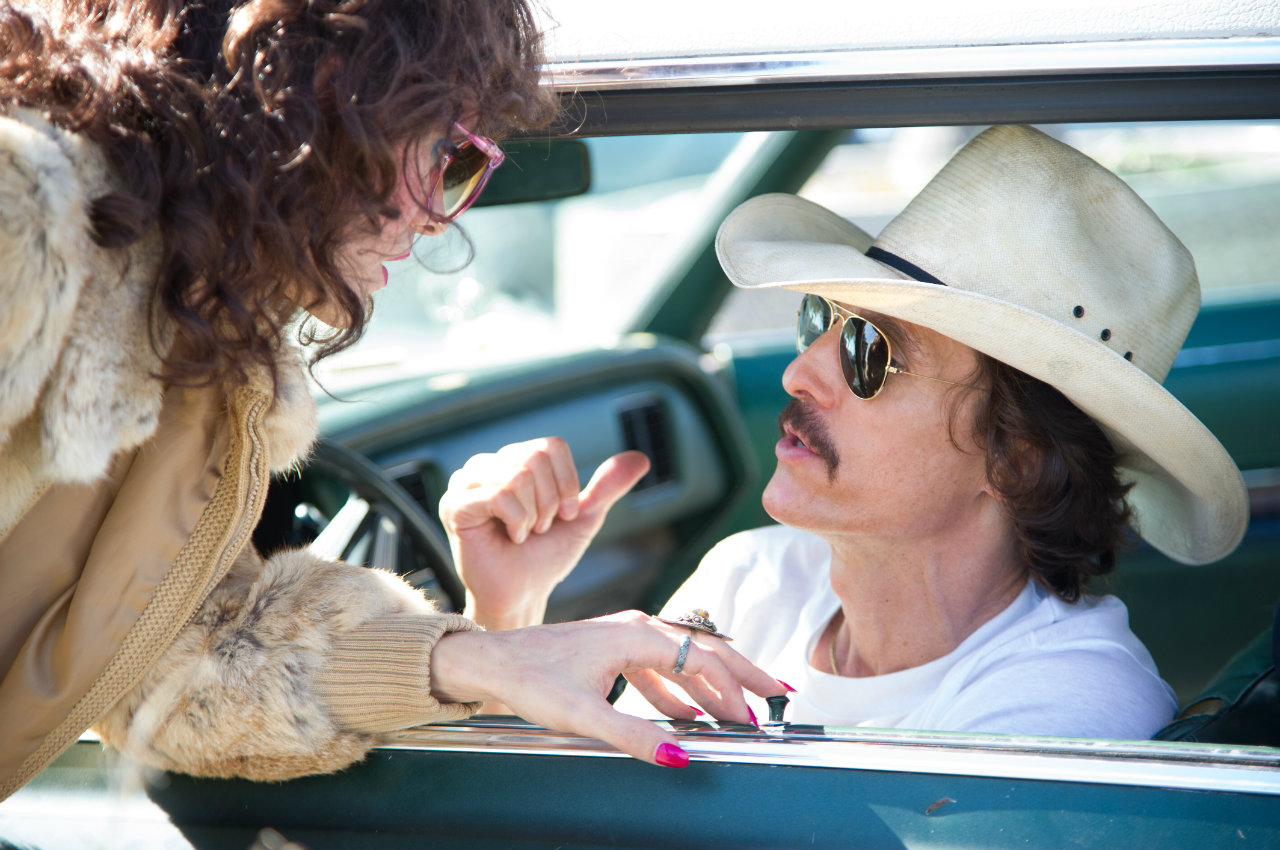
The macho Ron Woodroof dabbles in more than his fair share of alcohol, cocaine and women — behaviour that comes across more intrinsic than sporadic in his neck of the woods. He’s invincible, at least in his own mind. Recently though, coughing spurts have become common and dizzy spells just as a frequent, so when Woodroof collapses and shortly thereafter finds out he has contracted AIDS it’s less surprising than it is sad. Told nonchalantly he has around thirty days to live by Dr. Sevard (Dennis O’Hare), Ron initially dismisses the revelation as ridiculous, only to eventually succumb to reality. Often finding exuberance in the good-natured Dr. Eve Saks (Jennifer Garner), Ron uses his resourcefulness — he’s an electrician — to devise a plan of survival, one that also incorporates Rayon (Jared Leto), an extravagant and kind transgender woman whose shining demeanour aids Ron’s attitude as much as his health.

Dallas Buyers Club works on a number of levels, but the film’s most outstanding achievement centres on a pair of performances. First, Matthew McConaughey truly is extraordinary as the depleted Woodroof (the actor went as far as to lose 40 pounds for the role). He’s never made out to be a hero, not in the conventional manner anyway, and McConaughey never tries to sell him as such. When we first meet Ron he’s pretty loathsome, yet even this early on there’s a charismatic spark that seems to grow brighter and brighter the longer Ron lives. McConaughey often reigns in the sentimental tone; his persona is such that emotion, grace and vulnerability are not instinctive traits. Yet he still persuades you to unequivocally vie for him. Undoubtedly, his relationship with Rayon aids this audience connection. Jared Leto is utterly unrecognisable in appearance, but seeps total authenticity through the dress and make-up. He strikes a fine balance in the role, punchy and effeminate but never stumbling towards caricature mode. Together, and apart, the duo make you believe in these people, in their struggles and in their staunch resistance to the cards life has dealt.

There’s an interesting ‘corporate versus the little guy’ battle going on too. Essentially, this is your proverbial ‘Hollywood’ addition to a film wrapped up in a far from glamorous topic. The grappling-against-the-system element succeeds though, both in furthering Ron’s personal redemption and also injecting the story with a greater scope, a wider base to juggle on. Set in the mid-1980s, knowledge about combating AIDS is lousy at best (“Can I read a copy of the study?”; “No it’s still being written.”) therefore the most promising bet appears to be an antiviral named AZT, a drug flaunted and prescribed in high test dosages by the FDA (Food and Drug Administration), but one not entirely beneficial to patients. Ron discovers the non-truths, triggering his idea of a Dallas Buyers Club aimed at providing alternative medicines for sufferers. This fuels another morality fire, one which debates who is in the wrong: the multinational juggernauts selling false lies for cash, or the independent virus victim selling club memberships for life? FDA agent Richard Barkley (Michael O’Neill) is often the obstacle in Ron’s path only there’s a peculiar parallel that both men share. The duo are embezzled in the art of profiteering. However it’s what drives the men respectively that separates them, a moral compass that could not be more contradicting.

The film is based on a true story but envelops an artistic licence that sees it become something of a spiritual successor to Milk, and venturing further back Philadelphia, at least in terms of legal battles and humanistic principles. When Woodroof resolutely and poignantly exclaims, “I say what goes in my body, not you,” it resonates on both of these levels, particularly in regards to individuality and acceptance. There’s very little music going on the background to nudge your emotions in a certain direction. Instead your despairs and joys are all products generated from the poise of performance and presentation of story. A tough story at times, but one that is never told in an exploitative manner. Even still, director Jean-Marc Vallée seldom dismisses the presence of humour in telling the tale. Often these laughs emerge from McConaughey’s sly pretence and ingenuity — his character’s belief that he can get away with absolutely anything (including impersonating a priest) is endemic.

Dallas Buyers Club deals expertly with a painful subject, resultantly ensuring proceedings are far less demanding to watch in comparison to how tough they could easily have been. This is in no small part down to the performances of Jared Leto and Matthew McConaughey, the latter’s portrayal never shirking away from his characters shortcomings and non-heroic demeanour. Yet, you engage with the man so much that even as the shaky final scene of appreciation plays out, any personal misgivings are forgotten.

August: Osage County (2014)

★★

Director: John Wells

Release Date: January 10th, 2014 (US); January 24th, 2014 (UK)

Genre: Drama

Starring: Meryl Streep, Julia Roberts

Family reunions are often tarred with the ‘awkward’ label. And they can be, particularly if the participators share a common animosity. Or at the very least are in any way unfamiliar with each other. Both former and latter are absolutely the case here, only the stench of awkwardness is far from enough. To this family awkwardness encompasses simply the petulant appetiser before an enormous main course; a main course that presents a Sunday roast of hysterics, abrasion and arguments. The Weston family collectively exist in a pit of dysfunction. Sadly though, there’s far too much of it going on. Too much acting, too much shouting, too much loudness. In fact this film is so incredibly over the top it even reduced Sherlock to a blubbering idiot.

Welcome to Osage County. Presumably it’s August.

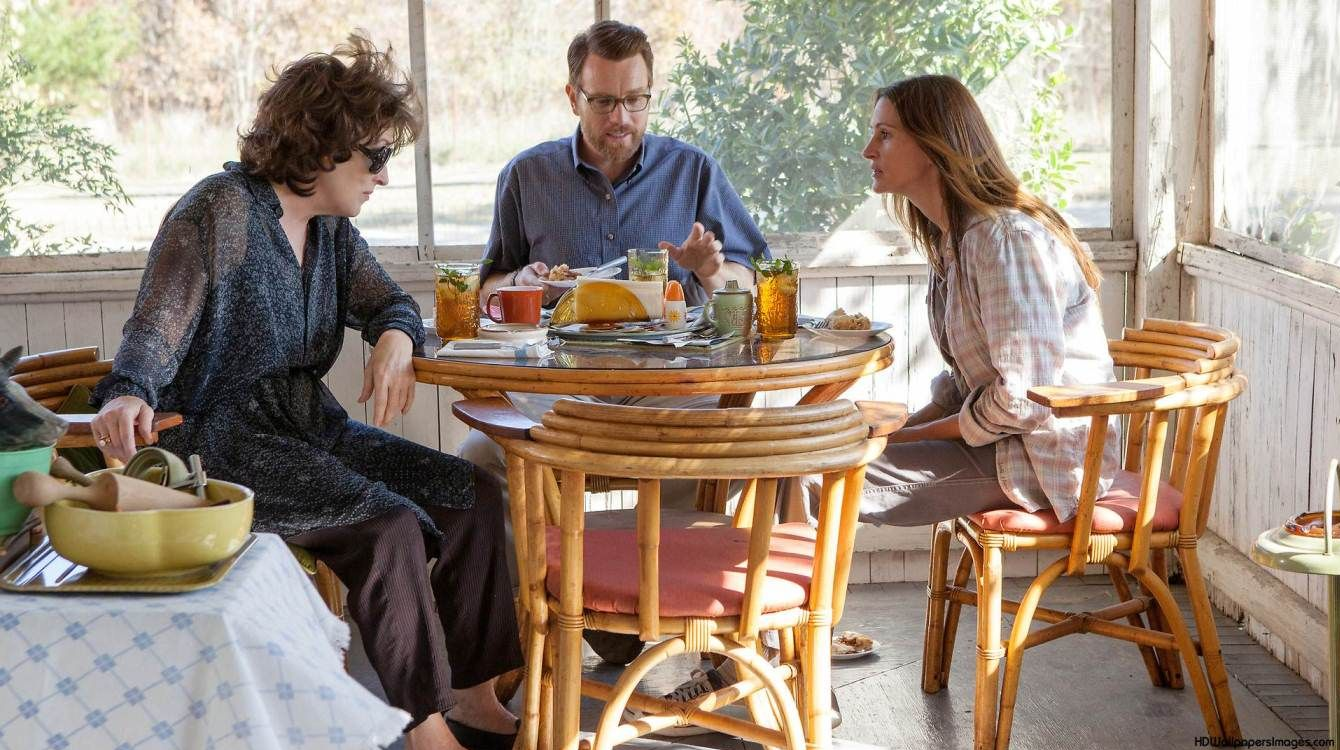
Upon learning about the apparent suicide of her father, Barbara (Julia Roberts) travels to her parents’ residence for the funeral and accompanying strenuous family congregation. Mother Violet (Meryl Streep) has mouth cancer, an affliction that never halts her ability to rattle out words nor does it subdue the uncontrollable pill-popping antics she vicariously partakes in. As she denounces her Native American maid’s right to refer to her own heritage, it becomes apparent that Violent isn’t a very likeable person. Perhaps she has every right to detest the world given her stricken circumstances, and if so who can hold such insignificant spiting against her? It could even be the drugs taking control and shoving each negative cell in her body to the forefront. But then her sister Mattie Fae (Margo Martindale) doesn’t exactly strike a chord of positivity either, relentlessly berating her own son for flaws overwhelmingly less vindictive than her own. And Violet’s aforementioned daughter Barbara, although at times a great deal more pleasant than mother and aunt, constantly finds herself battling against a future envisioning the same resentful tone as her elders. Only she’s already halfway there.

Therein lies one of two main problems that hampers this drama: it becomes increasingly difficult to pinpoint a character that you can actually relate to, one that you don’t feel guilty empathising with. As the saga plunges deeper and deeper into an abyss of loud shrieks and scalding off-the-cuff remarks, more and more family members are picked off by hate. It’s like a horror film, only instead of a mass-murdering antagonist the villain is a murky cloud of hostility, and instead of people perishing at the swing of a gleaming axe they choke on said whirling cloud and in turn lose any redeemability. Meryl Streep goes all out as the patriarch and is very good at being very bad, but her frenzies cast a shadow over other more genuine lower-key offerings from the likes of Julianne Nicholson and Chris Cooper, as Ivy and Charles respectively (ironically, the only sort of appealing characters on show). Yet even aside from all the noise and palaver, none of the people on screen are extensively interesting. You’d do well to connect with someone who is brash and a tad evil. At best it’s fun for a while, but by the time Streep has smoked her seventh cigarette and Roberts has blown her fourth gasket it all becomes a bit boring.

The screenplay is adapted from Tracy Letts’ critically lauded Pulitzer Prize–winning play of the same name and this provides the nucleus for significant problem number two. Everything feels quite artificial, almost agonisingly forced (tick off the proverbial stage props as you go: dinner table for ultimate congregation scene, porch for nighttime reminiscence scene). Few laughs are on offer, partly because the script can be whimsical but mainly due to the physical nature of delivery required for success. You can clearly see why the hair-raising approach works on stage, where the interaction with audiences who are part of a communally emotive atmosphere surely aids matters too. On screen though the execution is wooden meaning conversational exchanges — of which there are many — wear quickly. Having run out of relevant anecdotes, Streep and co streamline into discussing dying birds and more topics which feebly bear contrived relevance to their situation.

There’s no substance to the dialogue. Petty attempts at stirring the thought-provoking pot (or perhaps cauldron in Violet’s case) backfire as words fall on deaf ears: “Die after me, I don’t care what you do… just survive” might hold some sort of emotional resonance in a John Hughes film, but here it just sounds like terrible advice from a mother to her teenage daughter. Speaking of questionable behaviour, why do some members of the family grasp so tightly to the courtesy of grace at the dinner table, when they’ve just conducted a post-funeral fashion extravaganza? The film often appears to be trying to assure its own direction and often fails. One moment it’s a black comedy, the next a family drama, shortly thereafter a sentimental life-lesson. At one point I was certain the film blaring in view was some sort of Anchorman/Thor hybrid. Turns out Ewan McGregor just has a dodgy accent (“You’re a pain in the ass!”).

It does wave a few white flag-esque redeemable qualities in fairness. A charming soundtrack interweaves amongst the chaos, one which deviates from pleasant to sombre depending on which mode the narrative has shifted to. The extended family dinner is probably the best sequence on display, and is a very good one at that. Only here do each of the characters get to evolve their varying dynamics with other family members. It is the one time where you are absolutely certain proceedings are going to erupt at any given moment, yet the film deviously keeps you guessing and engaged for an extended period of time. The performances on the whole are excellent, if a smidgen awards-gesturing at times. Heck it even conveys the know-how to be funny on the one or two occasions laughs permeate the volatility (reasoning behind Abigail Breslin’s desire to get home is particularly apt).

August: Osage County is just about as messy as the family it thrusts on screen. Half of the characters are undesirable, whilst the other half’s presence merely equates to making up the numbers. There’s a lot of acting going on — bouts of which are very good — but sadly performances aren’t the be all and end all when it comes to engaging an audience.

Tomatoes at the ready.

Blue Jasmine (2013)

★★★

Director: Woody Allen

Release Date: August 23, 2013 (US); September 27th, 2013 (UK)

Genre: Comedy; Drama

Starring: Cate Blanchett, Sally Hawkins, Alec Baldwin, Peter Sarsgaard

Upon its release Blue Jasmine received rave reviews from viewers and, after a few months hovering around cinema screens and iffy online streams, is variably considered a return to form from the eccentric Woody Allen. I’m not extensively versed in Allen-lore, not nearly as much as i ought to be considering his lofty status in Hollywood and abroad. That being said, whilst his newest offering brims with scintillating performances (two Oscar nominated deliveries stand out in particular) the content, narrative and direction all add up to something a bit… bland. It’s a difficult story to consume and a tricky one tell, a story that shouldn’t insist on generating humour as often as it tries, particularly when there’s non to be shared. It’s possible that I just don’t get it; that the quirky, erudite versus blue-collar joust is something not entirely compatible with this 20-year-old. More than that though, Allen seems to be trying overly hard as he attempts to deliver on one too many fronts, leaving the intended humour absent and the compulsory drama simmering. But only just simmering.

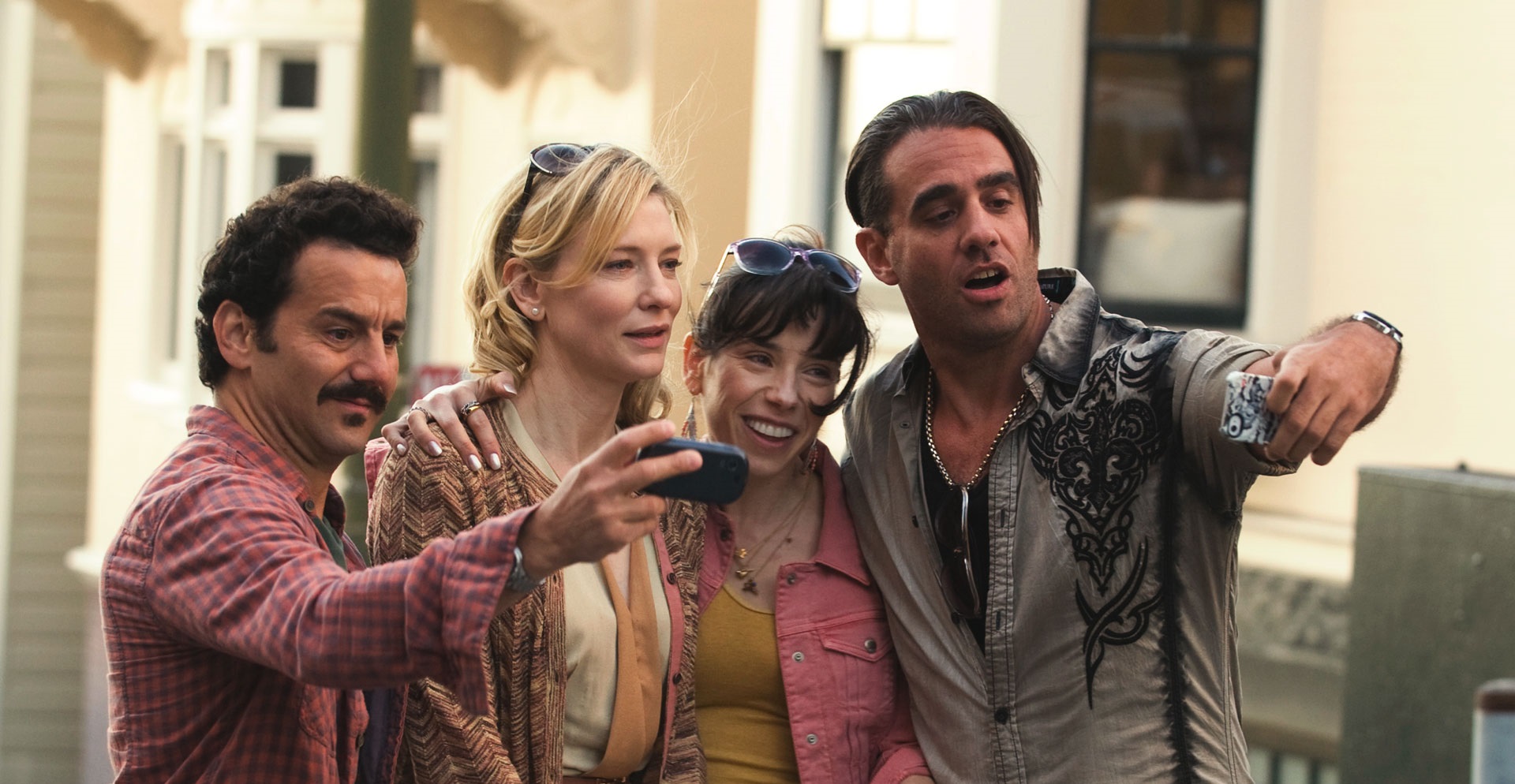
Jasmine (that’s Jasmine, not Jeannette) Francis is an upper-class socialite from New York who finds herself mentally, physically and financially drained following separation from her unashamed husband, Hal (Alec Baldwin). She isn’t used to earning, to maintaining herself and her life outwith superficial externals such as high-brow struts and an aristocratic ambience. Only it’s not an ambience, it’s an annoyance. An annoyance that has haunted her sister Ginger (Sally Hawkins) ever since childhood, when their foster parents favoured Jasmine’s superior “genes”. In her time of need, Jasmine (Cate Blanchett) moves to San Francisco to live and survive by Ginger who remains frustrated over a misshaped business deal proposed by Hal, amongst a number of other issues related to her now spiralling sister.

Evidently there’s a lot going on, yet too often the happenings are overly trivial — discussions reigned in on antiques for example — and therefore aren’t substantial enough to fully engage the viewer. Perhaps that’s the point, that Jasmine is such a one-dimensional and flawed character, therefore the film should be too. This approach doesn’t catch on though as Jasmine and many of the other people on screen are very difficult to relate to. At one point Ginger points out the obvious: “When Jasmine don’t wanna know something, she gotta habit of looking the other way.” In a sense the narrative follows this mantra too — just when there’s a glimmer of something intriguing on the horizon the road suddenly detours back to stagnant repetitiveness.

And it certainly is repetitive. As their lives together progress and various agents enter and exit (boyfriends mainly), Jasmine constantly scalds Ginger for her poor taste in unworthy men. First it’s Augie, a working-class and slightly optimistic guy held down by the harsh realities of life. Chili follows, a mechanic who unlike Augie treats Ginger with respect even if at times his exuberance gets the better of him. Jasmine relentlessly disapproves, neglecting her own prior misdemeanours when it comes to settling with the right partner. In fact, her wrongful rejection of Chili is probably the only time Jasmine is not thinking about herself: she often reminisces about sailing around San Tropez in front of her less fortunate sister who has hardly travelled America never mind the world; she flies first class on her way to Ginger, even though she has no money, which is the main reason for her relocation; in fact Jasmine removes herself from all tasks unbecoming of her (“I never pay attention to house business affairs”). Combined, this makes it incredibly difficult for the viewer to like or even sympathise with Jasmine, which is essentially the downfall of the film as the camera stalks her every move and not much else.

Allen juxtaposes the past and present as life events interchange; from detailing the breakdown of Jasmine and Hal’s marriage to the breakdown of Jasmine herself. Occasionally happenings on screen are tough to watch, but it is often the case that these demanding moments are followed by attempts at humour thrown in as the embodiment of a panicky life-jacket, almost as if the film is fearful of advancing that extra step into Jasmine’s oblivion (which would’ve worked better than the half black comedy, half drama on show). For example, after a tortuous altercation pitting Ginger and Jasmine against an enraged Chili, Jasmine is seen quickly shaking off any resultant cobwebs as she searches for her ringing phone in a nonchalant manner. This woman has recently lost the love of her life in onerous circumstances — wouldn’t she be affected more by this attack with potentially mirroring connotations on her sister?

There is success emitted from Allen’s alternating timeline approach though, as the method distinctly displays the degree of culture clash between Jasmine and Ginger. Jasmine has had everything handed to her on a silver platter. Now that life has crumbled, her anxiety over what’s next conveys exactly how behind she is in the experience of every day normality: she wants to return to school (to study what?); will study fashion or interior design (can’t use a computer); takes computer classes (has no money to afford); accepts the “medial” job that she never wanted, the job that the vast majority of those around her do on a daily basis.

As average as the film is, there’s absolutely no denying the power and sheer struggle evoked by Cate Blanchett as Jasmine. It’s not even a case of the film’s downfalls making her performance glow even brighter, no, Blanchett’s display would stand out in any offering. Even though you don’t really like the character, it’s impossible not to be drawn in by Blanchett’s depiction of painful demise as Jasmine slowly loses all sense of wherewithal and dignity. The portrayal is uncomfortable to watch at times and it should be that way. Without Blanchett at the helm, the film might have teetered worryingly close to Diana territory.

Sally Hawkins also deserves plaudits for her starkly contrasting role as the less fortuitous sister; likeable and empathetic as she establishes and maintains a strong sense of empowerment throughout the film’s progression. In an abnormal role from his usual work, Peter Sarsgaard is astute and pompously slick as the yin to Jasmine’s yang. Their first meeting is actually one of the film’s better moments, where the pair enter a self-congratulatory word-off as they divulge many an “I” and “my husband and myself”. It’s arrogant and self-absorbed nonsense, and it completely works because these characters come across as utterly undesirable just as they are supposed to in that moment.

Blue Jasmine is a film where nobody really seems to be listening to each other (“Pay attention Augie”), where characters are solely focused on getting their two — or 20 — cents in, meaning proceedings feel too feeble. The darkly comic moments don’t really fit in, and the emotionally wrought sections seldom have the desired effect. It’s no surprise that that actors are receiving awards nominations left right and centre as opposed to the film itself. While it is far from terrible, there’s a lot of onus on Cate Blanchett to make the picture worthwhile. Thankfully, in doing her worst, she does her absolute best.

Mud (2013)

★★★★★

Director: Jeff Nichols

Release Date: May 10th, 2013 (UK and US)

Genre: Drama

Starring: Matthew McConaughey, Tye Sheridan, Jacob Lofland, Reese Witherspoon

“Well ain’t that somethin’?”

Matthew McConaughey’s would-be convict Mud appreciates the trivial simplicities of life: a boat for crossing water, food to quench hunger and loyalty in a time of need. What else if not the bare minimum, would a man of his troubles seek refuge amongst? His runaway status evokes moral juggling — do you root for the criminal, or sentence the lover? Jeff Nichols’ admirable tale of two boys who tend to see the best in otherwise dour surroundings works well on a number of narratively distinct levels. However it’s only when each aspect blends with the other elements above, below and to either side that Mud emerges from good film status, to really great film status.

And that most definitely is something.

Ellis and Neckbone spend their days stretching their curfews to the maximum in the jungle-like plains of Arkansas. They’re young, ambitious and boast that primitive exuberance driven by the desire to learn and discover, an energy that only fully manifests out on the edge of civilisation, where uninhabited landscapes taunt with hidden secrets. On another planned excavation to an abandoned boat planted high in a tree, the boys encounter the mysterious Mud: grizzled, somewhat wearisome yet poised and alert. From then, perhaps partly captivated by the stranger who appears to be the ultimate wild-man and also drawn upon the notion of trust, optimism and loyalty, Ellis and Neckbone make it their prerogative to assist the moored Mud in his attempts to reconnect with the girlfriend he murdered a perpetrator to protect.

On full throttle through his self-professed McConaissance, Matthew McConaughey delivers another outstanding performance as the titular Mud. The romcom stalwart turned highly-rated ‘serious’ star has an underplayed role, seldom emitting bouts of raw emotion (although when he does, he succeeds). McConaughey is challenged opposite two younger actors; he must act as a buffer for their highly-spirited intuition whilst developing his own character’s persona simultaneously. It’s fitting that he is the centrepiece of the narrative, the proverbial glue holding everything together, however it should be noted that McConaughey is not the centrepiece of the film. That’s the pair of maturing youths, Ellis and Neckbone, both portrayed brilliantly and charmingly by Tye Sheridan and Jacob Lofland.

Ellis and Neckbone are instantly drawn to the rugged fugitive. Although indecisive (particularly Neckbone) the boys see something in Mud that they do not have in their own lives — a father figure. Ellis, parents’ relationship cracking, is often faced with a distant dad who worries more about his own future rather than that of his son. Neckbone lives with his uncle, an outgoing type resembling the cooler big brother as opposed to a caring father. Growing up in a masculine culture, one defined by putting food on the table, working and earning and treating women with utmost respect, Ellis sees hope in Mud’s outright optimism. Optimism for love and a secure relationship in the face of violence and restraint. Optimism for freedom against restriction. Tye Sheridan, who the camera follows more than anyone, holds his own in scenes opposite a multitude of big-name actors: other than McConaughey, the likes of Reese Witherspoon, Sarah Paulson and Michael Shannon make up an efficient, talented supporting cast.

Stand by Me is an obvious comparison but the coming-of-age component is only one of two main plot lines, the other channelling a more commonly depicted fugitive (and subsequent search for) story. Mud, having murdered the man who impregnated the love of his life Juniper (Reese Witherspoon) and later thrown her downstairs, has no allies. Police prompt his image in the faces of residents and passers-by. The father and brother of Mud’s victim spend their relentlessly watching Juniper, ready to pounce and eliminate the outcast on sight. Mud has done wrong, but his eloquent treatment of the two boys demands admiration. He becomes their guru, and a trusted one at that (“It’s a hell of a thing ain’t it?” Hell of a thing”). You want him to succeed, just as much as you root for Ellis and Neckbone in their numerous quests: for maturity, for relationship, for acceptance.

The two primary narratives amalgamate into one, creating a wonderful Winter’s BoneMoonrise Kingdom hybrid. Our main characters share a familier desire. Others are interested in self-preservation of body, property and history. There are even boats and water, a lot of it. The setting shares connotations with both films too, and is the very first nuance you are aware of as the outing begins. Shot beautifully by Adam Stone, the widespread landscapes juxtapose Mud’s isolation and loneliness, highlighting just how much he is hemmed in by a multitude of threats. His lack of ever-presence reinforces this idea of being trapped, and along with McConaughey’s composed-yet-ready-to-burst demeanour, you are always captivated by Mud and ultimately invested in his fate.

Jeff Nichols writes as eloquently as he directs. Camera enveloping atmosphere, words rhyming off lips propelled by their engrossing southern drawls, Nichols offers up a truly splendid piece of film. Alongside his young co-stars, McConaughey matches the excellence served up by his director and delivers on all fronts.

On present form, is there any stopping him?

Blue is the Warmest Colour (2013)

★★★★★

Director: Abdellatif Kechiche

Release Date: October 25th, 2013 (US limited); November 22nd, 2013 (UK)

Genre: Drama; Romance

Starring: Adèle Exarchopoulos, Léa Seydoux

Adèle ambles hurriedly along a busy high street. The sun gleams on her fidgety demeanour as the apprehensive student makes her way to meet up with a guy. They don’t have much in common, if anything at all, but he appears nice enough. Do you believe it? Not really. As she crosses the road, Adèle’s anxious glance catches a calmer, more assured one. We don’t know it yet, but the recipient is Emma and the pair seem to share an instant, intriguing connection. Do you believe that? Absolutely.

Blue is the Warmest Colour has been shrouded in controversy since release, partly brought on by a selective reaction to certain scenes, and partly accentuated in a row between director and actor in regards to their working environment. Forget all that for a moment. Not because those concerns are invalid, rather it seems unfair that a film so honest and captivating should be tainted in any way. Regardless of any hostility, actors Adèle Exarchopoulos and Léa Seydoux are utterly entrancing in director Abdellatif Kechiche’s simple story that flourishes in its beautiful depiction of love, maturity, desire and emotion.

In her late-teens, Adèle (Adèle Exarchopoulos) is someone who looks and acts uninspired. She drifts through classes at school, ones she possesses a passion for but can’t get into because the teacher isn’t right. Even hanging out with friends is awkward and confused. When it doesn’t work out with a boyfriend, her love for food leads to a comfort eating embrace. It’s at a crossroads in her life, literally and metaphorically, when sparks begin to ignite. As Emma (Léa Seydoux), blue hair and all, glimpses wonderingly back towards Adèle — sun prodding the direction of her vision — the film’s engines begin to rev. With the exception of one or two charming exchanges, all that preceded becomes inconsequential. Adèle rhymes, “No words? No melody? It’s not my thing.” Well the melody has just kicked in.

One of the prevailing successes of Blue is the Warmest Colour is how unassuming it is. Indeed, we want to know more about Adèle and Emma’s relationship, but the film never becomes abrasive towards its characters and scenes are allowed to play out fully and eloquently. Of course in doing so the three-hour runtime becomes essential rather than optional. Normally I’d groan at anything north of two hours, and in all honesty the prospect of watching this felt tiresome. However: the fluid nature of the dialogue; the immersive delivery from both Adèle and Léa; the contrasting elements of each character; the way that the cinematography ensures a sense of immediacy — much in the same vein as Drake Doremus’ Like Crazy does — all combines to shun that three-hour hurdle into non-existence. You could spend a lot longer with these people and not become bored.

And it is all about the people. Adèle delves in literature, delighting in French and English and adores children as much as she detests shellfish and strawberry milkshakes. On the other hand, Emma carries a greater intellectual air about her, studying Fine Arts as a student (she’s a little older than Adèle) and mingling with similarly cultivated friends. In fact, the film in general has a European art-house underbelly going on: there’s street music with odd instruments; rallies supporting sexuality and protests over cuts; philosophical discussions entailing Picasso. Yet it still maintains a breath of commonality. You don’t mind the artsiness because it’s their artsiness, and its appeal actually starts to beckon after a short time. Having said that, the film does slightly teeter on the edge when it’s not Adèle and Emma swapping these conversations — they’re sometimes replaced by other characters who we don’t know well enough and as a result come across a tad overbearingly.

Inevitably the discussion over how necessary the extended scenes of intimacy between Adèle and Emma will arise. One sequence, which clocks in at around eight minutes, is far too long. Is it controversial? Maybe. But from a viewing perspective, its innate longevity actually removes the viewer from the genuine, heartfelt love-story which both pre and succeeds it. Thereafter said scenes are shorter, but probably still linger unnecessarily. It’s a shame because the film is so much better than some of the backlash those eleven or 12 minutes have generated, made even more annoying as the source of much of the controversy isn’t really a narrative necessity anyway.

The film is speckled with truly emotional moments throughout: from an upset Adèle being exposed to uncertainty in the midst of her classroom, a place of refuge, to a tale of two family dinners, one outgoing and the other conservative. As their existence together progresses, jealousy sets in and differences clash: this notion of fulfilment in life takes hold as Emma encourages Adèle to enter the world of writing, whereas Adèle sees happiness in continuity. There’s an inherently tragic undertone at times, and in a way the narrative mirrors that of Romeo and Juliet — in a bar, their second meeting and first magnetic interaction shares a whole host of similarities with how Romeo and Juliet first encounter each another.

Both actors are phenomenal in their depictions. Adèle Exarchopoulos, a relative newcomer to French cinema, shines in particular as Adèle. It’d be a shame for her not to pick up an Oscar nomination because there’s nobody in the past year who has delivered a more eclectic performance, beginning succinctly before unravelling a diverse range of emotions along the way. Her on-screen partner, BAFTA Rising Star nominee Léa Seydoux — who you might have seen in Inglorious Basterds or Mission: Impossible — Ghost Protocol recently — is also tremendous in her occasionally mysterious and always binding portrayal, as her character often acts as the anchor for Adèle’s insecurities.

Sometimes words aren’t enough, not unless they’re being exchanged between Adèle and Emma. It’s not an entirely groundbreaking narrative drama, but it is honestly and wonderfully executed. Blue most certainly is the warmest colour, however, if there’s any justice in the world, this film’s future will rain Academy gold.

A Good Day to Die Hard (2013)

★★

Director: John Moore

Release Date: February 14th, 2013 (UK and US)

Genre: Action; Crime; Thriller

Starring: Bruce Willis, Jai Courtney

If Jai Courtney wasn’t a younger, less-bald Bruce Willis he probably wouldn’t have been part of A Good Day to Die Hard. Similarly, if Live Free or Die Hard hadn’t scooped up almost $400 million at the box office, six years later we wouldn’t have to sit through this shallowest of John McClane sequels. A total horror-show it ain’t, but apparently some people don’t think cricket is boring and most of us hate that. After a long journey extending all they back to terror in the tower in 1988, there has been a severe breakdown at stop five. Though after two and a half decades spent invariably recycling old material, what more d’you expect?

A less capable, more cigar-and-newspaper-on-a-Sunday-morning appearing John McClane (Bruce Willis) travels to Russia upon hearing that his son has had a run-in with the law having been arrested for an assassination attempt. In reality, Jack (Jai Courtney) is an undercover CIA agent working to bring down dangerous and corrupt government official, Viktor Chagarin, although John doesn’t realise this, probably because of that age thing. An explosion coordinated by Chagarin during the resultant trial allows Jack and whistle-blower Yuri Komarov (Sebastian Koch) to escape custody, and chaos ensues.

The film is stuck between trying too hard to be slyly comedic on one hand and a serious action flick on the other. The original Die Hard got this mix spot on, mainly because the premise was ridiculously exciting, Willis looked interested and Alan Rickman delivered one of the finest villainous performances in recent cinema history. Here the narrative is a poorly executed mess and Willis looks like a guy who has randomly invaded a film set while on his holidays abroad, perhaps thinking it’s all part of a Russian cultural process. There are also more bad-guys on show than laughs, although having said that you’d be hard-pushed to exude more than a handful chuckles.

The plot then. Wearing more holes than an unending golf course, it doesn’t take long to induce a succession of wearisome head-shakes. After essentially saving the world throughout his previous four films, you’d expect John McClane to have a bit of know-how about him when it comes to dealing with machine-gun wielding terrorists. Apparently not anymore: his first conversation with Jack comes nonchalantly in the presence of bullets harpooning all over the place and the odd explosion going off. Ah, it’s probably to do with the age thing. There are far too many contrivances, the most notable being an endless progression of villains, each one ‘badder’ than the next. It gets so ludicrous that McClane himself to switching sides wouldn’t come as a total shock (hey, that sounds like a better film). I think son Jack gets it right as at one point he alludes to, “Making it up as we go”.

Sticking with Jai Courtney, he’s not a bad actor at all. In fact he’s fairly decent in this given the retched dialogue that’s being spluttered about: “But I’m your father”; “And I’m your daughter,” is probably the worst of a bad bunch that collectively cannot be saved by ‘knock, knock’ jokes or even former franchise favourites (“Yippee ki-yay…”). Willis’ spark as McClane is non-existent; the eccentric hero has turned charisma vacuum. Again the script really doesn’t help matters and there aren’t any outlandish sequences that give Willis the platform to be his glorious former action-star self, however the man simply looks like he really cannot be bothered with it all. One of the major let downs of the entire film is how little the super-talented Mary Elizabeth Winstead is utilised. McClane’s daughter was introduced in the previous outing and is relegated to a beginning and end cameo. Her only real contribution is offering McClane an ‘Idiot’s Travel Guide’ before his journey to Russia. That must be another age joke then. Given the lack of intuition on display, her scarcity is even more criminal.

On the plus side the action scenes do look great, having evolved to even grander scale this time around. In particular the helicopter scene at the end is excellently executed and actually gives the film a bit of oomph to clutch onto towards its climax. Unfortunately no visual escapade can save proceedings, and the only other glaring positive to take from A Good Day to Die Hard is that you only have to sit through an hour and a half before checking it off your list of films never to sit through again. The sheer disappointment stems from the franchise’s previous successes, principally the pleasantly surprising Live Free or Die Hard, and therefore there can be no excuses dealt in serving up this newest nonsense.

They say you can’t teach an old dog new tricks. On this evidence you can’t teach an old dog much else either. If only McClane had made do with living free, nevertheless, this is probably a good day for the Die Hard adventure to die hard.