Tomorrowland: A World Beyond (2015)

★★★

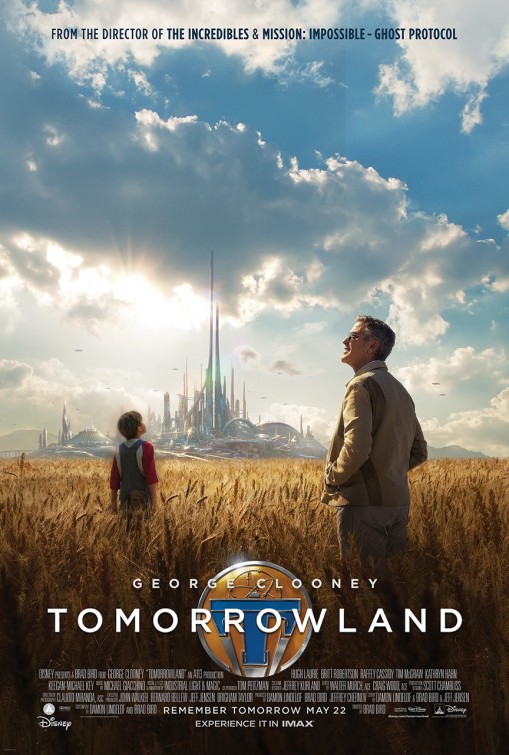
Tomorrowland PosterDirector: Brad Bird

Release Date: May 22nd, 2015 (UK & US)

Genre: Action; Adventure; Family

Starring: Britt Robertson, George Clooney, Raffey Cassidy

We shouldn’t be surprised that Tomorrowland is a giant bouncing ball of alacrity. From Brad Bird, director of The Incredibles (the hint is in the title), comes a film packed with a positive punch. “There’s a great big beautiful tomorrow,” we’re told at the very beginning via cheery song. Shortly thereafter, a young Frank Walker (Thomas Robinson) engages in conversation with Tomorrowland overseer David Nix (Hugh Laurie). Nix asks about the practicality of Walker’s jet pack creation. Walker, wide-eyed and all, replies: “Can’t it just be fun?”

Though it may not have been sufficiently clear from Disney’s muddled marketing campaign — one possible factor in a disappointing opening weekend financially — this is a film about incentive and inspiration, enjoyment and energy. Whereas evasive trailers have partly sold the piece as a sci-fi escape and partly as a family drama, the movie itself is far from confused. Tomorrowland is bright, and it knows it.

Starring Britt Robertson as the self-prescribed ultra-optimist Casey Newton (probably related to Isaac), the story follows her eventful journey as she searches high and low for a mysterious place called Tomorrowland. Accompanying her are recruiter Athena (Raffey Cassidy) and the now older, world-weary Frank (George Clooney). Casey is the human embodiment of the film’s joyful prerogative. Her school teachers drawl on about end of world scenarios — spouting warnings on everything from nuclear Armageddon to environmental degradation — but all Casey wants to know is how to fix these problems.

Just as the camera struggles to go more than a minute without whizzing towards a Hall of Invention or something of similar ilk, Casey can’t spend any significant length of time without exuding eagerness. She would be the perfect citizen of Tomorrowland, where everything is so big and bold. In Mad Max: Fury Road — which shares the same sticking-by-one’s-convictions mantra — vehicles are bolted on top of other vehicles. Here, we see skyscrapers double up to create super skyscrapers. Bird spends a long time worldbuilding, striving to convey a sense of wondrous momentum from the off. It is probably too long, especially when we spend so little of the two hours actually in Tomorrowland.

Robertson is charming and consistently watchable as our central character. Quite brilliantly, she manages to be sprightly but not sickening. Unlike in the television series Under the Dome, this is a much more assured performance from the actor (admittedly, her character in the former offers little in the way of depth). Young newcomer Raffey Cassidy is a victim of the hyped up and overly long sugary beginning, her verbiage a tad too sentimental. The talented teen increases in charm as the film progresses though, to the point where the screen significantly benefits from her presence.

Damon Lindelof’s screenplay avoids the politics and greed normally rife in the world we know. This lack of cynicism is actually quite refreshing, and the film shouldn’t be kicked for carrying a hopeful message. It should be saluted, really, for moulding its message of hope into a pertinent discussion about the state of humankind. At one point Casey exclaims, “It’s hard to have ideas and easy to give up!”, a statement epitomised by the film itself. Tomorrowland is more than just a surface level blockbuster. At its core, it boasts a perceptive idea about how we, humanity, have accepted and monetised our demise. Bird and Lindelof should have mined this concept further, but its inclusion is evidence that their script isn’t naive, nor ill-judged.

However, it can’t quite dodge plot holes. Terminator-ish humanoid robots show up occasionally wearing goofy smiles (obviously) and guided by a view to kill, though it’s never really apparent why. The existence of the film’s grandiose, hidden cityscape is also somewhat puzzling. Sure, it looks great and has some cool gravity defying roads, but what exactly is it? And where did it come from? Rather than answering these questions, Bird and Lindelof seem to be more transfixed by their attempts to include as many cinematic references as possible.

And who can blame them? There are so many fun touchstones: Baymax bubble suits are worn with jet packs as a safety precaution; attire-wise, the futuristic land resembles The Hunger Games’ unconventional Capitol style; visually, moments of inter-dimensional travel momentarily resemble David Bowman’s cosmological pilgrimage in Kubrick’s 2001: A Space Odyssey; and Charles Xavier’s Cerebro room gets an interactive Google Maps makeover. A Forbidden Planet-esque store that we enter midway through the piece is a treasure trove of movie geekdom.

Aside from his presence as part of an unnecessary narration tactic that materialises every so often, George Clooney is introduced to us with the sun beaming down behind him and illuminating half his face, probably because he is God. Frank has a grizzled beard and is a bit moody, but that’s as rebellious as it gets. He delivers a “son of a” but no “bitch”.

Frank’s downbeat personality is the story in a nutshell — someone once driven by promise who has presently accepted defeat, but can be saved. “Can’t you just be amazed and move on?” Frank muses when Casey persistently asks about his cool house gadgetry, and you sort of get the feeling that in lesser hands this would be the film speaking to its audience. Neither a baddie, nor a goody, Hugh Laurie’s David Nix is a misstep. The presidential figure is very thinly drawn, though the actor does deliver a really compelling speech towards the end summarising humanity’s passiveness.

Tomorrowland doesn’t throw the cat among the pigeons. The closest we get to edgy is a non-diegetic rock tune that accompanies Casey as she invades a NASA launch station while wearing a treasured NASA cap given to her by her NASA-employed father. The film tells the world that we have lost our way and that we can reclaim our rosy roots, but that we should strive to be even better than before. It is what it is and if you’re happy to spend a few hours riding a roller coaster of cerebral optimism, it is for you.

Tomorrowland - Hall of Invention

Images credit: IMP Awards, Collider

Images copyright (©): Walt Disney Studios Motion Pictures

Mad Max: Fury Road (2015)

★★★★★

Mad Max Fury Road PosterDirector: George Miller

Release Day: May 14th, 2015 (UK)

Genre: Action; Adventure; Science fiction

Starring: Tom Hardy, Charlize Theron, Nicholas Hoult

Vehicles have always played a huge part in the Maxverse and veteran director George Miller decides to hammer this point home in Mad Max: Fury Road. Various characters are seen to cherish steering wheels, hauling them around in the same way Bruce Spence’s Gyro Captain clung onto a spoon in Mad Max 2. His spoon could pick at leftover tinned food, a novelty apparently long gone. Small-scale scavenging is out. This is a world dominated by distance, by grandeur, by gasoline. The spoon has become the steering wheel.

Or, maybe such pensiveness doesn’t exist within these characters. Maybe they just love to thunder across the desert. Maybe they can’t wait to get on the road. Miller certainly can’t.

After a brief prologue from Max explaining his post-apocalyptic mantra (“A man reduced to a single instinct: survive”) we hurtle into a half hour opening sequence that obliterates anything remotely resembling action we might have seen in previous films. These thirty minutes of total carnage, of collapsed worldbuilding, shoot past in an aluminium whirlwind, leaving your eyes watering and heart bellowing. It’s almost as if Miller has been waiting three decades to get something off his chest.

The plot is simple but by no means inadequate: Max (Tom Hardy) finds himself in an unlikely partnership alongside Imperator Furiosa (Charlize Theron) as the pair attempt to evade the monarchical clutches of Immortan Joe (Hugh Keays-Byrne), a slave-keeping cultish leader. The destination, or “Green Place”, dreamt up by the formerly shackled wives of Joe, is unknown. It is more or less a mystery, the characters unable to shed much light and, as such, we are left in the dark. This doesn’t matter, the journey does.

The best thing, unquestionably, about the franchise has always been Miller’s ingenious and realistic-looking action sequences. They are here in abundance, bearing the hallmarks of even greater ingenuity and somehow appearing just as authentic. Oil trucks are christened “War Rigs” and subsequently live up to the name. Amazingly, the majority of effects are practical, in line with the director’s penchant for traditional movie-making. As such, praise should be heaped upon the many stunt performers whose death-defying efforts play a key role in raising the stakes.

We are constantly reminded of the urgency facing Max, Furiosa and company: as the camera pans back towards the chasing pack, all we can see is an ominous mirage, a giant metallic silhouette in the distance. The threat is real and incoming, energised by a booming score that carries more than a hint of Brian May’s earlier franchise work. Other throwbacks to past films include: Master-Blaster-esque siblings (one of whom is former WWE wrestler Nathan Jones), and the occasional lower front bumper camera shot. There’s even that familiar feeling of disorientation, where the screen is so rammed full of carnage that deciphering who is fighting who becomes a task.

Of course, absurdity is tossed around like a hot potato. From vehicles in the form of mechanical hedgehogs, to an electric guitarist who looks like a cross between The Silence from Doctor Who and Klaus Kinski’s Nosferatu, Miller has all bases covered. This includes humour: “Of all the legs, you had to shoot the one that was attached to his favourite”. Nicholas Hoult’s Nux is the ideal amalgamation of odd and funny, his obsession with the Gates of Valhalla both amusing and touching. Hoult absolutely throws himself at the role, which is arguably the best of his career.

Probably for the first time, Max truly is mad. He’s no more than a splash of white body paint away from being one of Joe’s skeletal followers, growling incoherently and shifting his gun aim maniacally. Hardy sometimes deviates verbally back into Bane-mode, but he is mighty impressive as the iconic loner. The Welshman is gruff, a far cry from Mel Gibson’s portrayal in the inaugural instalment and possibly more interesting too.

Hugh Keays-Byrne, the man behind Gibson’s nemesis in Mad Max, returns as new villain Immortan Joe. Perhaps it is not by coincidence that Joe’s world-weary appearance could very well be that of Toecutter after toiling for decades in the scorching desert. Imagine the sunburn? “Do not, my friends, become addicted to water,” Joe preaches to the subservient crowds upon affording them momentary respite from thirst. His voice croaks like the Uruk-hai from The Lord of the Rings, and he is almost as scary too.

In a film overflowing with eccentric and domineering characters, Imperator Furiosa is two things: a warrior and a realist. She handles herself in battle while aiding the escape of five enslaved wives, who are also each pretty handy when it comes to fighting and smarts (and who all somehow manage to keep their white clothing miraculously clean). Rosie Huntington-Whiteley is especially good, steely and determined, as Joe’s pregnant prized possession. The women drive this movie; Max is along for the ride through coincidence, but it is the female characters who initiate the chase because they value life.

“Out here everything hurts,” Furiosa states bluntly. Crucially, Theron does not play her as totally wound up — she is reasonable, and willing to work in a team because it is the right course of action. As a result, the relationship between her, Max and the rest of their ragtag band imbues believability. Some might accuse these characters of being too cordial too soon. They are all survivors though, in a harsh world, with a common enemy.

Without trying to sound overly hyperbolic, Mad Max has hit a new stratosphere. You can just about see Beyond Thunderdome — a perfectly fine outing, by the way — squirming in the corner. The direction, how the film has been pieced meticulously together only to then be blown apart, is all a work of art (in many other genres this would likely demand awards recognition). John Seale’s cinematography is wonderful — a night assault has the dreading echo and gloomy manifestation of something straight from Saving Private Ryan.

A Furiosa moment towards the end should, in time, cement its place in action movie lore alongside the likes of “Yippee-ki-yay motherfucker” and “Hasta-la-vista baby”. This is seminal cinema. The 80s had Die Hard. The 90s, Terminator 2: Judgement Day. Give it 20 years and we’ll be talking about Mad Max: Fury Road as the go-to action jaunt of the early 21st century.

Mad Max Fury Road - Hardy and Theron

Images credit: IMP Awards, Collider

Images copyright (©): Warner Bros. Pictures

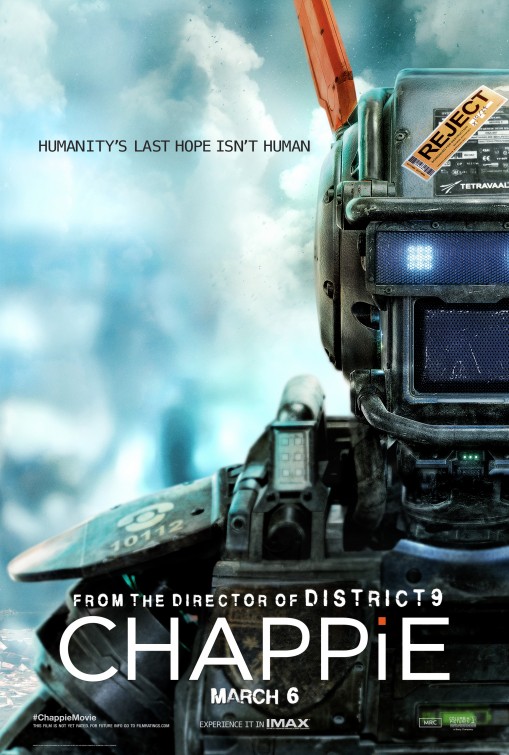
Chappie (2015)

★★

Chappie PosterDirector: Neill Blomkamp

Release Date: March 6th, 2015 (UK and US)

Genre: Action; Science-fiction; Thriller

Starring: Shartlo Copley, Dev Patel, Hugh Jackman

As Chappie gets under way atop a wave of rolling news clips and documentary-style snippets, there’s a vague familiarity in the air. We soon meet Dean (Dev Patel), a quirky and smart employee, and shortly thereafter encounter the film’s titular robot (Sharlto Copley). The two become entrenched in a rebellion against corporate injustice, where agendas are warped by power and economics. There is a CEO overlord (Sigourney Weaver) with iffy morals and a brash militant understudy (Hugh Jackman) with iffier intentions, and it doesn’t take long for our artificially intelligent robot to intertwine with humanity’s complexities.

If you can hear any bells ringing in your mind at this point, it is because Chappie is another Neill Blomkamp film wrapped up in the woes of society and class and science. It’s District 9. It’s even sort of Elysium. The thematic content isn’t bad at all — the director has proven in the past that exploring societal issues can be a rewarding experience. Rather, Blomkamp’s third film struggles because it doesn’t differentiate itself from his previous two.

Nor does Chappie click tonally. We’re in a constant kinetic flux, the tone jumbled and jumping around too much, a problem embodied by our central machine who manifests as a bubbly toddler one minute and a gun-wielding lunatic the next. The robot doesn’t garner enough empathy to start with because he (it’s male, apparently) has never been a human. But the disconnect is ultimately established due to Chappie’s lack of identity. A human character can get away with this lack of identification because we can relate to a person more than a robot. It is possible for an AI character to do the same — Alicia Vikander manages without personality in Ex Machina — but not in this instance. Chappie, voiced fairly well by Sharlto Copley, is at his most engaging when he’s acting up; a car-jacking scene is one of the film’s few brilliant moments, almost as culturally reflective as it is hilarious.

Generally though, the bits and pieces that make up the film are all a bit weird. As former soldier Vincent, Hugh Jackman (despite being an entertaining watch) looks like he is about to film a Steve Irwin biopic. The South African duo, a musical group known as Die Antwoord, don’t fit into the gritty urbanised world. They belong in a Tim Burton fantasy adventure, though on the basis of their performances here, that won’t be happening any time soon. For some reason, Sigourney Weaver — who will be teaming up with Blomkamp again for his upcoming Alien revival — is underused as a plain company figurehead.

On the more reality-mirroring side of things, we see capitalist manipulation: “It’s expensive, it’s big and it’s ugly,” is the reply Vincent receives as he tries to sell army-ready machines to the army (we’re subsequently left to wonder why money isn’t being thrown at him). A thematic favourite of Blomkamp, machine intelligence versus human ideology, fuels an underbelly that is certainly justified given the postmodern technological surroundings, yet never really amounts to much. Had they not been made in such close proximity to one another, you would be forgiven for thinking the folks behind Chappie were privy to Wally Pfister’s Transcendence in relation to ideas on concluding. Despite that movie’s many shortcomings, it is actually better and more accomplished than Chappie.

On an aesthetic front, the post-industrial setting is a good one, however instead of being a vehicle for entrapment, the relentlessly murky and dank atmosphere quickly becomes a trend-setter for the bland story unfolding (pathetic fallacy gone wrong). There are some impressive slow motion shots employed during the action sequences that reverberate well with the film’s technological arc. In fact, Trent Opaloch’s cinematography is a success — in purely visual terms the film does its job. Opaloch worked on Blomkamp’s previous two outings as well as The Winter Soldier, and his notable efforts have earned him a spot on the next Captain America film too.

Unfortunately, the visual aspect can’t quite rescue Chappie from a messy final third. The film slowly saunters along towards a fairly energetic conclusion but by then we’re sitting wondering why we should care. There are so many different parties involved in the action at the end that it feels like the battle of the five armies all over again. In screenplay terms, this wholly contrived finale is just about the final nail in a coffin of banality and nonsensicalness.

Chappie isn’t a bad film, but at some point Blomkamp needs to change things up or else risk artistic homogenisation. He is obviously a talented filmmaker; the simple fact that his films have something pertinent to say about how we live, have lived and might live is testament to his skill level. But after two solid outings, Chappie feels like a step backwards. It’s almost as if the director who once challenged the norm has conformed to it.

Chappie - Jackman

Images credit: IMP Awards, Collider

Images copyright (©): Columbia Pictures

American Sniper (2015)

★★

American Sniper PosterDirector: Clint Eastwood

Release Date: January 16th, 2015 (UK and US)

Genre: Action; Biography; Drama

Starring: Bradley Cooper, Sienna Miller

The problem with American Sniper is not necessarily that it’s controversial — though that train of thought is somewhat justified — but that it’s rather dull. In regurgitating a story set almost entirely during the worst of the conflict in Iraq post-9/11, and one based upon real events, you’d expect director Clint Eastwood to have something potent to say about war. At the very least, it’d be fair to expect a consistently taut human drama. We get neither from American Sniper, a film weighed down by overt patriotism and silly writing.

Bradley Cooper (now the recipient of three consecutive acting nominations at Academy Awards) stars as US Navy Seal Chris Kyle, a former rodeo cowboy so pained by news reports of terrorist attacks on his home soil that he enlists to fight abroad. It’s nothing more than a solid performance from Cooper, certainly not one on the same level as his two previous Oscar nominated stints in both Silver Linings Playbook and American Hustle.

As the film progresses the bulked up actor’s role becomes an increasingly emotionless one, and consequentially quite thankless. Buying into the personal struggles of a man who spends his time in a place littered with death and despair — he, frankly, contributing to the mess — is a struggle in and of itself. This isn’t a critique of the real Chris Kyle, nor Cooper, and instead of the poorly conceived writing underpinning proceedings.

Adapted from Kyle’s own autobiography, Jason Hall delivers a screenplay severely lacking in nous or subtlety. Bearing no stance on the Iraq War that hasn’t already been exhausted on the big screen, or any screen, what we’re left with instead is a film trying desperately to convince itself that war is necessary. Men, women and children are all cast under the same umbrella marked “our enemy” and though this non-discriminatory outlook may well be a sporadically accurate reflection of reality, the film never suggests such a thing. Many of those whom the US soldiers meet in Iraq are carrying weapons with a view to kill. The suggestion is all civilians have been evacuated from the area of conflict, thus the ones who remain aren’t innocent. The fact that this wholesale evacuation hasn’t taken place compounds a lazily devised screenplay; as such, locals are placed on a morality gauge ranging from untrustworthy to terrorist.

In between head-scratching scenes that show Kyle conversing with his wife in the middle of a war zone — his attention should probably be on shooting all those baddies, right? — there’s a cat and mouse game playing out. An enemy shooter referred to as Mustafa (Sammy Sheik) is essentially the domestic Chris Kyle. Granted, the film is called American Sniper and therefore isn’t a piece that was ever going to pay as much attention to the non-American sniper, but the lack of dispersed humanisation is off putting. Kyle’s rapidly burgeoning Call of Duty kill count is celebrated with gusto amongst his peers whereas any damage done by Mustafa is vehemently denounced as the work of a “savage”. Of course it’s savagery, but there’s hardly even a nod towards the ambiguity of Kyle’s actions — when the film does venture down this route it only juggles the immorality of child-killing as opposed to people-killing.

The picture is at its most tense and best when Kyle is staring down the barrel of his deadly weapon, honing in on said infants and fuelled by uncertainty. Unfortunately any good work is undone by a laughably glorifying final sniper showdown. Intrigue edges up a tad when we’re back on home soil, where the military man feels more and more out of place as each tour ends. Sienna Miller plays his wife but doesn’t get enough to do as the narrative always chooses to follow Kyle when he goes overseas. She’s good though, infusing a bit of steel into Taya whilst also relaying the mental and physical exhaustion brought on by her husband’s constant displacement. Miller just about manages to overcome her unnecessarily bit-part function.

It’s this lack of urgency that hampers American Sniper, more so than any controversial portrayal or underwhelming performance. You’d expect it to be well made, and it is, but it doesn’t have the musky atmosphere of a Hurt Locker or the gruelling presentation of a Fury, nor does it bear the rich characterisation of those films. Tom Stern’s projection of a war zone is almost conventional, which is surprising given the cinematographer’s accomplished portfolio (Mystic River, Million Dollar Baby, The Hunger Games). Eastwood doesn’t do an awful lot to alleviate this encroaching mundanity, he generating a tone that stops short at implying the possibility of danger lurking around every pile of rubble.

American Sniper has done extremely well at the US box office and, despite a more conservative reception over here in the UK, has undeniably been a success — particularly when its financial clout is coupled with awards recognition. This review is a bit superfluous in that regard, but I don’t think it’s without merit. It is entirely probably that the patriotic element is something that works well in America but not as well elsewhere. We all suffer as equals through blandness though, and this is bland filmmaking.

American Sniper - Bradley Cooper

Images credit: IMP Awards, Collider

Images copyright (©): Warner Bros. Pictures

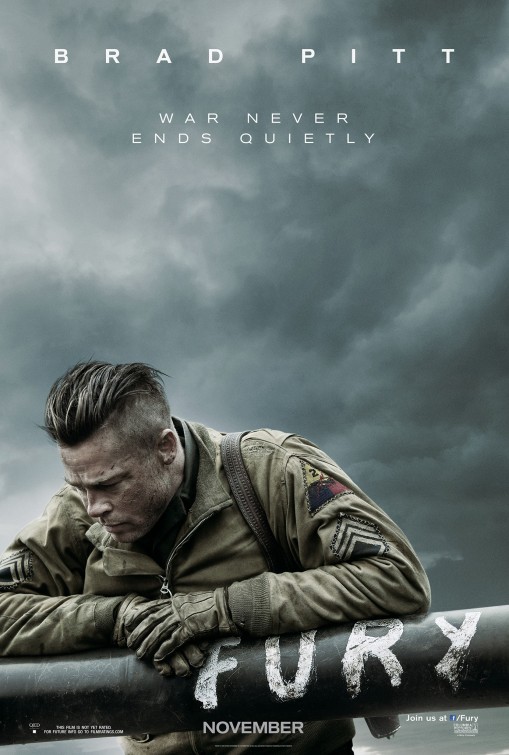
Fury (2014)

★★★★

Fury PosterDirector: David Ayer

Release Date: October 17th, 2014 (US); October 22nd, 2014 (UK)

Genre: Action; Drama; War

Starring: Brad Pitt, Logan Lerman, Shia LaBeouf, Jon Bernthal, Michael Peña

War is a nasty business. Of course, contemplating the nastiness of war isn’t a new undertaking, nor is it something that Fury director David Ayer feels compelled to shirk away from. His film is really quite horrendous. We see limbless bodies and bodiless limbs more often than we see rays of sunlight breaking through the clouds of 1945 Nazi Germany. Ayer’s intimate tale isn’t a fresh concept to the silver screen and it has absolutely been done better before, but there is a lot to admire here.

As World War II nears its conclusion, a Sherman tank troupe commanded by US Army sergeant Don Collier (Brad Pitt) is hurtled into the bloody doldrums of battle in Germany. Fighting through urban wastelands and disfigured countrysides, the ‘Fury’ group of five must survive via a combination of camaraderie and brute force, all the while depositing innocence at each rotation of their vehicle’s caterpillar track.

Ayer localises a grand story and his film is all the better for it. Often, the key to success in the war genre is engaging an audience in the plight of a few whilst also acknowledging the struggle of many. Fury manages this, no doubt aided by a stringently focused narrative that follows a particular group of soldiers. It’s their story and we’re always in their presence, allowing time (well over two hours of it) for us to empathise with the characters. And while the camera never ventures more than a few feet from at least one of the five, Ayer’s induction of a heavy and wearisome tone relentlessly captures the universal toil of war.

These characters don’t write the guidelines on positive morality either. In fact, their contribution to the Allied war effort has flurried any goodness purveyed by Collier and his crew. They each have a nickname — fittingly Collier’s is Wardaddy. That is not to say the man heralds a thirst for battle, rather it highlights Wardaddy’s efficiency in dark turmoil. (“Do as you’re told, don’t get close to anyone”). Brad Pitt plays him without immediate discernibility, casting doubt not over the sergeant’s motives, but over his methods. Ayer’s quintessential heroes are nothing of the sort. There are no good guys, only perceived bad guys.

The remainder of the group bear roles that are more clearly defined: Technician Boyd “Bible” Swan is the devoted religious type; Corporal Trini “Gordo” Garcia steers the tank with eccentricity; PFC Grady “Coon-Ass” Travis lacks moderation; and Private Norman Ellison carries the newbie status, a kid lost amongst a conflict in which he shouldn’t be fighting. Logan Lerman exudes ordinariness as Norman, reminding us of war’s infecting bullet wounds on humanity. Walking Dead alumni Jon Bernthal is also terrific as the gruff Coon-Ass but it’s Shia LaBeouf who wows more than any other. Scrubbing the stigma of celebrity from his face and replacing it with rotten dirt, LaBeouf displays a great deal of restraint, his eyes never far from filling with tears fuelled by a scarred mind. It turns out he can act, and act well.

LaBeouf’s character is the agent through which Ayer introduces a religious thread, one that doesn’t wholly endear itself to the narrative but does contribute towards an emotive punch. These faith-based overtones aren’t distracting as they only rear occasionally, and despite manifesting as a tad contrived, they do represent an attempt to manoeuvre proceedings away from any potential muscle bound machoness of battle. Indeed, the film manages to extract a large helping of connectivity from the audience through solemnity, a theme that runs along the piece like one of Nazi Germany’s seemingly endless mud trails. This helpless sobriety is first summed up in statement relayed by Jason Isaacs’ army Captain (“Why don’t they just quit?”), before revealing itself plainly in an extended Inglorious Basterds-esque dining room scene rightly devoid of any Tarantino quirk.

After 90 minutes of gruesome despair, the outing suddenly shifts its gaze in the direction of a more action-packed conclusion. The final act essentially wears the hallmark of a western standoff, trading cowboy hats for leather helmets. Granted in its final half hour Fury still maintains a gritty realism but this divergence in tone might not appease all. Tank jousts do occur before the lengthy concluding sequence, but frequently end in a matter of minutes. These battles are arduous in their execution, just as they should be, and do not glorify the mechanical face of war at all, whereas it could be argued that the long, underdog-ish rallying cry denoted in the final act does invite a semblance of glorification.

Technically, the film is a powerhouse. Cinematographer Roman Vasyanov turns the English countryside (where shooting primarily took place) into a bleak, putrefying Nazi Germany at the end of its tether. Two scenes stand out especially: a beautiful opening shot that patiently stalks a lone horseman as he tramples over smoky ruins and comes face to face with the fragility of tanks, and a dread filled moment nearer the end that involves a collection of simultaneously marching and chanting enemy troops. This uncompromising style meshes wonderfully with Steven Price’s score and pinpoint sound editing, and comes as close as any film to achieving the fist-clenching ambience of Saving Private Ryan.

It is certainly not as good as Spielberg’s aforementioned masterpiece, but not many outings born from this particular genre are. Fury is a visceral and effective retelling of war at its most desperate and least forgiving. If nothing else, it’s an example of high standard utility filmmaking.

Fury - Cast

Images credit: IMP Awards, Collider

Images copyright (©): Columbia Pictures

The Maze Runner (2014)

★★★

The Maze Runner PosterDirector: Wes Ball

Release Date: September 19th, 2014 (US); October 10th, 2014 (UK)

Genre: Action; Mystery; Science-fiction

Starring: Dylan O’Brien, Kaya Scodelario, Will Poulter, Thomas Brodie-Sangster

Twilight kick-started the craze only for it to ripen amongst the chaos of The Hunger Games’ Cornucopian anarchy. The young adult adaptation trend is sweeping cinema and its latest passenger, The Maze Runner, is certainly one of the better book to screen jobs. This latest jaunt owes a great debt to Suzanne Collins’ novels in particular, and manages to hold up stringently despite not sharing The Hunger Games’ politically infused backbone. It’s a solid film that will likely play better when pitted alongside the planned sequels, but for now Wes Ball’s directorial debut should be considered, at the very least, a steadfast success.

Devoid of his ability to remember, Thomas (Dylan O’Brien) awakens inside a noisy metal cage that is rapidly ascending skywards. It suddenly halts, opening to reveal bright sunlight and a group of grubby males. Thomas soon learns that about the Maze, an ever mobile entrapment monitored at night by dangerous spider-like Grievers. To make matters worse, the boys are stuck in the Glade — the grassy centre of the Maze — and there doesn’t appear to be any way out.

The rules: trust, run, return. Led by the longest serving inmate, Alby, the group of young males have systematically formed and subsequently cater to a subsistence society; some build bamboo prisons, some farm vegetables, some run the Maze. These Runners, we’re warned, must return from their exploration exploits before dark or else they’ll be trapped for the night and “no one has ever survived a night in the Maze”. The opening act is very pre-occupied with Basil Exposition. Launching us into this new, mysterious world without any briefing, the filmmakers do their damnedest to catch us up on happenings without giving too much away.

What we have, then, is a Lord of the Flies meets The Hunger Games narrative composite, and one that works rather well. Whilst thematic exploration is a tad frothy, the film definitely has the latter’s industry. It shows too. Visually, The Maze Runner dips into that familiar gloomy, metallic sheen before unravelling with energy and turbulence as characters enter the Maze. Perhaps too caught up in the action, the camera itself becomes overly-eager on occasion but cinematographer Enrique Chediak ultimately reflects the disparate tone of proceedings. It is worth pointing out John Paesano’s brooding score also, one that spikes in moments of danger and gets the heart racing.

And it’s not just in these areas of technicality that the film resembles its older cousin, but also in plot make-up. The Maze, it turns out, is split into eight sections much like games’ twelve in Catching Fire. The cage that elevates Thomas into the Glades at the start is essentially the glass pod that drops Katniss off at the Cornucopia. Although the piece doesn’t resonate thematically — at least not with the same rigour — there are interesting momentary flares. At its heart, The Maze Runner is an analysis of defeatism, of struggle and acceptance. Thomas’ arrival signals a resurgence in moral determination for some Gladers (“I don’t know if [Thomas] is brave or stupid but I think we should make him a Runner”) whereas others, such as the group’s perennial enforcer Gally, seem somewhat content with their chained destiny. We can almost empathise with him too, given the Glades isn’t really all that horrifying a place.

The aforementioned element of mystery — amplified when Kaya Scodelario’s sole female Teresa shows up — helps us relate to the characters as a collective; essentially, we know as much as they do and vice versa. By the same token, Wes Ball is faced with the task of balancing the integral build of tension with restraint when it comes to use of the Maze. He almost achieves this unity too and that simmering atmosphere is nearly there — the brutalist appearance of the snaring stone structure combined with hardly any knowledge, a sense of dissolution and a lack of someone to villainise all coalesce together into a medium-sized wave of carpeting tension.

We do get the sense that Ball and company have been sold down the river when it comes to matching the tone with on screen events. Put simply, the film needs to be a little more violent. Instead the audience can just about smell the stench of studio-implemented pandering at the expense of storytelling. Sequences in the Maze are effective yet never totally capture the risk that would normally be glaring from the screen, and it’s because of this sterilised approach. The Griever monsters, all hybrids of the Xenomorph, the Predator and Shelob, look like they could do some hefty damage but we never really feel the brunt of their potential capacity.

As is often the case in this genre these days, the cast do well. Dylan O’Brien leads the way as the “curious” Thomas and manages to garner a feeling of hard-to-pinpoint inner turmoil whilst also coming across as capable, as someone fuelled by purpose. The arrival of Teresa does prescribe in tandem worries over a clichéd romance between the pair, but love takes a back seat as it should under the circumstances. Kaya Scodelario is also effective in her role, but she’s the one who draws the shortest straw in terms of character development. More to come, I suspect.

Two other stand-outs are Will Poulter, who seems to be carving out a niche for himself as a promising big screen talent, and Thomas Brodie-Sangster. Game of Thrones fans will recognise Brodie-Sangster, here playing second in command Newt who is arguably the most accessible of the bunch. Despite his role as the most remonstrative resident, Poulter ensures that Gally retains an understandable righteousness. Friction-causing notwithstanding, Gally’s thoughts are always practical and occasionally hold greater verve than the riskier doings of others.

The inconclusive ending does hurt the film. Revelations arrive a tad too easily before concluding abruptly, and it is clear that those in charge have at least one eye on the sequel by the time the final act rolls around. It is also true that during the two hour runtime, there ought to have been a warrant for deeper examination into societal codes between the boys. Having said that, opting to engage with The Hunger Games over Lord of the Flies is probably a wise decision in 2014.

The Maze Runner is a very good three star film that could, given time and triumphant sequels, become a laudable four star franchise opener.

The Maze Runner - Dylan O'Brien and Will Poulter

Images credit: IMP Awards, Collider

Images copyright (©): 20th Century Fox

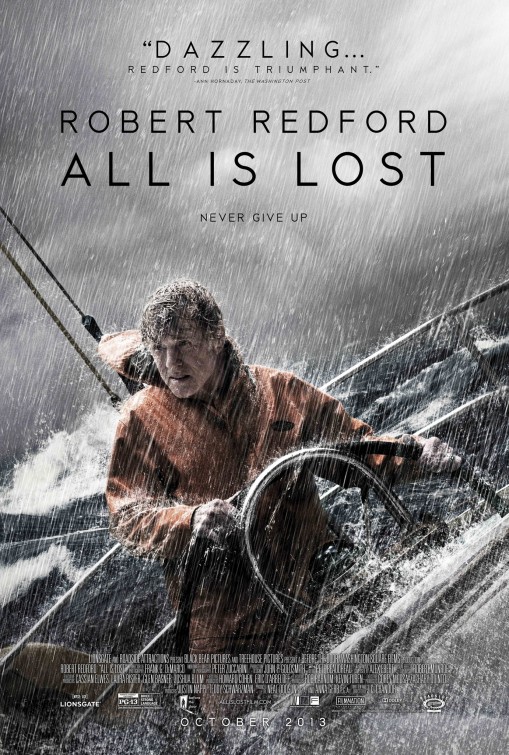
All Is Lost (2013)

★★★★

All Is Lost PosterDirector: J. C. Chandor

Release Date: October 25th, 2013 (US limited); December 26th, 2013 (UK)

Genre: Action; Adventure; Drama

Starring: Robert Redford

Robert Redford, in one of the most physically demanding roles to hit cinema screens as of late, is truly captivating in All Is Lost. But not in a flashy way. No, Redford is a loner here. An outcast, literally. He doesn’t talk much. Instead, nature does that for him. For this is a ferociously sounding film and one that, at just under one and three-quarter hours long, probably shouldn’t be as attention-clutching as it ends up consistently being throughout its runtime. There are limits exclusive to the genre, quite obvious at times, but those don’t really matter. This is a fine piece of filmmaking that boasts an even finer central turn from its lonely captain.

A man (Robert Redford) wakes up to an abundance of splashing water careering into his boat. Still half asleep, he ventures up top to check out the commotion and discovers a gaping hole in the vessel’s side caused by an errant shipping container. He doesn’t know it yet but despite fixing the damage in the short-term, the patched up hole is an indicator of the problems to come for the man, problems set to face exasperation at the mercy of an oncoming storm.

Such is the nature of the beast, All Is Lost serves up a very simple story. Man versus nature. There are only really two paths proceedings can slosh down; one, a venture towards the continuation of life and the other, quite frankly, death. Yet despite this perceived lack of narrative territory primed and ready for exploitation, what we see remains utterly captivating. Writer and director J. C. Chandor gets a lot of time out of his simple tale. The near two hour saga — a runtime that might ordinarily generate a tinge of doubt amongst viewers — surprisingly flies in, though given the filmmaker’s succinct track record perhaps surprise is not justified in this instance.

The storytelling is so easy, so uncluttered, that it becomes enticing. Watching Redford’s character patch up a damaged part of the boat transcends mundanity and evolves into something more. It is foreshadowing, but it is also life. This man’s life. He is a sailor and a carpenter. A geographer and chef. The simplicities are accentuated by Chandor’s precise direction and his natural screenplay, growing to the point where every action is must-see. All Is Lost emerges past the man too, though he is always at arm’s length, and considers nature as a pulsating force. The main centrepiece is a prolonged storm sequence that is noisy and intense. Wholly believable, it looks and sounds and presumably acts like a real storm, incessantly dangerous but not Hollywood-ised. We’re eagerly willing for it to pass.

Chandor utilises pathetic fallacy handily — though, admittedly, foreshadowing by way of some grumbling weather is a proposal already there for the taking. We see and hear the storm advance at the same time as Redford. There exists an incoming rush of dread as the captain bolts cupboards mechanically and secures glass bottles. Having said that, the anticipation isn’t overblown and nor should it be given the often low key approach of nature in reality. The inevitable punch carries more weight as a result, leaving Redford — and us — desperately clawing for some motion sickness tablets.

Robert Redford is undoubtedly the film’s infallible anchor. Aside from a sombre and somewhat playful opening monologue where we don’t actually see the actor, there is no verbiage whatsoever for the first twenty minutes. When the man (nameless due to a lack of necessity) finally utters words, he stutters as his throat is so lethargic. The ploy works because it isn’t really a plot. It’s another titbit of reality, one that captures the mood of solitude. Redford’s poise, his calmness laced with acceptance is magnificent. He never fully allows us into his thought process, maintaining a fairly stern stance. Therefore we’re captivated by what the sailor is doing and by what he is about to do — when Redford is analysing the wreckage, for instance. The actor purveys an uncanny grace in the face of turbulence and it is totally inviting.

In some ways, these traits pale in comparison to the sheer physicality of the role. We watch Redford engage in a heap of fixing and heaving and climbing and pumping, a quite miraculous measure given the actor’s advancing years. The eventual intrusion of heavy gale is relentless too, and in this regard Redford’s taxing demeanour adds both to the plight and strength of his lightly-worded character. His performance echoes that of Ryan Reynolds in Buried — we believe the struggle because the struggle is palpable and the sweat is dripping.

Credit should go to Frank G. DeMarco also, his cinematography presenting a quite wonderful setting. The film looks beautiful. Of course when shooting sunscapes that are cascading over waves of blue ocean, there already exists something of a platform to work from, but DeMarco’s excellent gloss aids our placement at sea alongside Redford. It is inventive too; diving with the vessel in a moment of peril particularly sticks out. This look is just one half of a lethal aesthetic duo, partnering up with the outing’s authentic audio. From the initial problem-causing container that groans in accordance, to the boat’s flapping sails caught in the wind, All Is Lost consistently complements our ears. Even the water has a voice, sometimes gentle and pondering, other times violently swelling.

The words ‘all is lost’ can be applied to much: materials that are swamped and destroyed by water; an aimlessly floating container; the doomed vessel; Robert Redford’s stranded, weary man. The film exists within a limited scope and there is only so much it can do, but a permanently laudable sole performance coupled with an incisive aesthetic ensures that All Is Lost a significantly worthwhile trip.

All Is Lost - Redford

Images credit: IMP Awards, Collider

Images copyright (©): Lionsgate, FilmNation Entertainment

Guardians of the Galaxy (2014)

★★★★★

Guardians of the Galaxy PosterDirector: James Gunn

Release Date: July 31st (UK); August 1st (US)

Genre: Action; Adventure; Science-fiction

Starring: Chris Pratt, Zoe Saldana, Dave Bautista, Bradley Cooper, Vin Diesel

As far as pure cinema goes, Guardians of the Galaxy has all the boxes covered. Sure, we’ve been running on the fumes of superhero momentum for a few years now and with a behemoth such as Marvel Studios behind the film, entering expecting entertainment is an entirely justifiable frame of mind. But James Gunn’s picture never rests on any laurels, it is not satisfied with simply entertaining. Guardians of the Galaxy sets out to interact with the paying customer, to re-establish the genre whilst also refining it. There are laughs, plenty of ’em. Societal threads designed to make us think. And real characters, most importantly. This isn’t just a great addition to the Marvel ranks, it is also a great piece of cinema.

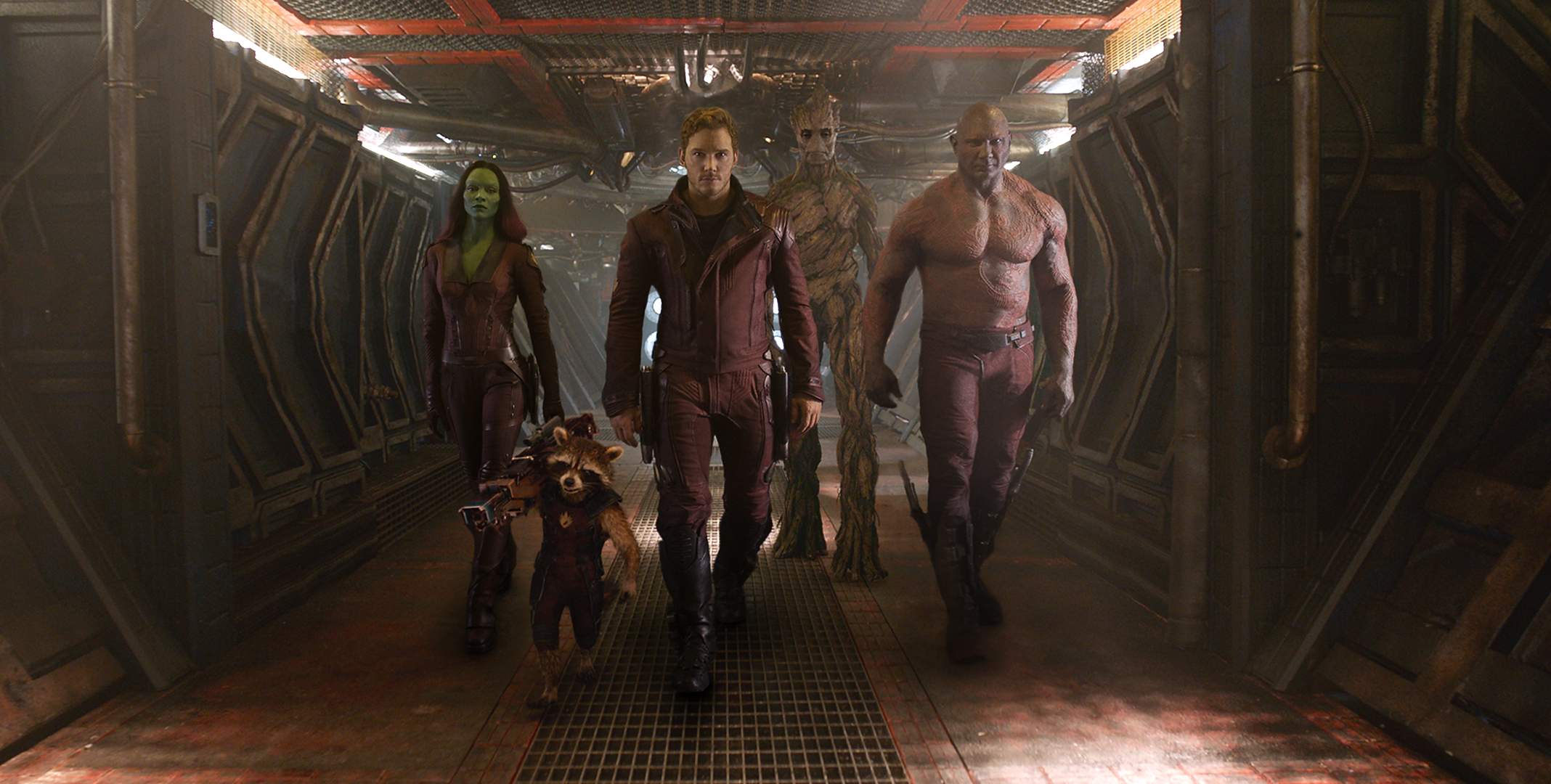
Having lived twenty-six years of his life aboard a scavenger spaceship, Peter Quill (Chris Pratt) somewhat innocuously finds in his possession a universe altering orb. The artefact is highly sought after, by none more so than Thanos (Josh Brolin). In an attempt to scupper the success of a threatening deal made between Thanos and Kree radical Ronan the Accuser (Lee Pace), Quill joins forces with an alien, a warrior, a tree humanoid and a raccoon. Chaos? Ensue.

Balance is pivotal, just ask the bloke in prison with only one leg. Gags, thrills and seriousness are all elements that see plenty of daylight under the astute guidance of James Gunn, a decision that wholly benefits the director’s film. It is tough too, cementing each individual strand without compromising the whole, a concoction Iron Man 3 failed to measure correctly (and look what happened there). Guardians of the Galaxy never stumbles into said pitfall and instead thrives on variation. If the essence of tip-top filmmaking is versatility, we’re looking at a lofty outing. As an audience overly saturated with superhero escapades, we need more. A divergence from the, albeit rather fun, company line. We need space adventures and fresh motives, and both are on the menu here.

As Peter Quill and co’s gallivanting adventures scamper between wondrously constructed civilisations, it becomes increasingly difficult to decipher what might happen next. Mystery and intrigue swivel in and flurry around proceedings, at which point our minds are buzzing with a thirst for more. 10 films into Marvel’s Cinematic Universe, this burst of authentic suspense is truly welcome, particularly at a time when the formula is beginning to wane. And it’s not just the raucous air that commands a sense of thought; Gunn and co-writer Nicole Perlman also include a frequently rearing class allegory, pitting different species side-by-side in disharmony and challenging social boundaries.

And if you’re just here for a laugh, you could do a whole lot worse. The film is hilarious, and it knows so. There’s a prevailing camaraderie between audience and filmmaker; collectively, we know this is all a bit absurd — a tree with a conscience, a raccoon with a rocket launcher — so why not revel in the madness? Brilliant one-liners (“Pelvic sorcery”) make way for equally funny banterous group deliberations. Despite oozing a retro vibe, the film still bears more than a semblance of accessibility. Newcomers will leave filled to the brim on “bro” lingo, whereas the more mature amongst us can lap up Footloose references — of all people, Kevin Bacon becomes one the best running gags on screen this side of 2014. Or, like me, you can inelegantly giggle at everything. Guardians of the Galaxy has a heart, one that beats for all-comers.

At the epicentre of its heart is a ramshackle gaggle of misfits. Forget cookie-cutter characters, these five are dense to the nth degree. Chris Pratt plays Peter Quill — though he prefers Star-Lord — and is the glue that holds the guardians together. Pratt is on a mission to stardom himself, and his performance here is another indication of the leading man’s talent. He injects Quill with some soul and, rather than becoming the conventional male hero, embarks down a slightly less glamorous yet equally loveable path. No doubt buoyed on by his Parks and Recreation experience, Pratt also has comic timing down to a T. Zoe Saldana is Gamora, the kick ass alien who is sort of Thanos’ daughter but sort of not. Saldana has already proven her worth on the blockbuster stage and her mystique is integral as it affords the group an ambiguous streak.

Perhaps the most impactful performance emerges from wrestler turned actor Dave Bautista. No doubt, his skills inside a ring prove handy when it comes to fulfilling a number of exciting fight sequences, but it is the big man’s sincerity that really shines through. Drax takes everything literally — a trait that often tickles the funny bone — but he is never presented as stupid. He’s had a tough time in life and he is a tough guy, but Drax is also an endearing presence and Bautista deserves huge credit for ensuring that this is case. Groot is the Hodor at large, partnered alongside the spitfire raccoon, Rocket. Bradley Cooper’s voice work is both persuasive and energetic. A wit-off between Tony Stark and Rocket must be in the pipeline. The aforementioned quintet mesh together like a rugged patchwork quilt: rough and probably a bit dirty, but entirely warming.

Unlike The Avengers, Guardians of the Galaxy is not an all guns blazing affair. There are a lot guns and they do embark on a hefty amount blazing, but that comes with the territory. We get the sense that the engine is only revved half-way, that the future is dangling the promise of a whole lot more. And that is thrilling. We’re only in the introductory phase of this particular relationship and, while the sparklers are sizzling now, fireworks undoubtedly lie ahead. The comparatively small-scale feel, then, is really charming and quite emotive. Subsequently a deeper connection with the characters ignites. The film’s mischievously dated soundtrack has a hand in generating this personable aura. Its compilation is a masterstroke, making for a number of unorthodoxly funny mishmash sequences — Cherry Bomb is particularly rollicking.

Going forward, one thing is a certainty: if this is Marvel’s new prerogative, then rest assured that next time the comic book logo appears on screen we’ll be in good hands. “If there’s one thing I hate it’s a man without integrity,” rings out early on. I’d like to think that Guardians of the Galaxy is gender-neutral and I’m convinced it is bursting with integrity. It’s also Marvel’s best film to date.

Guardians of the Galaxy - Cast

Images credit: IMP Awards, Collider

Images copyright (©): Walt Disney Studios Motion Pictures

Independence Day (1996)

★★★

Independence Day PosterDirector: Roland Emmerich

Release Date: July 3rd, 1996 (US); August 9th, 1996 (UK)

Genre: Action; Adventure; Science-fiction

Starring: Will Smith, Jeff Goldblum, Bill Pullman

Two years before his monstrous monstrosity Godzilla, Roland Emmerich hit the streets of Washington DC to tackle an alien invasion. Time — and a great deal more effort — would go on to prove extraterrestrial superiority over the giant lizard, though that’s not a particularly astounding declaration. Just how effective is Independence Day? If popcorn-munching and Coke Zero-slurping is your kind of thing then the global disaster flick works a treat. Don’t expect any intellectual poise for there’s hardly an ounce to be had. But that’s not a problem — you wouldn’t show up to Comic-Con looking for a Jane Eyre panel. Emmerich zaps many of the right notes here and, despite the modern datedness of a visual palette once heralded as ground breaking, Independence Day cajoles along boisterously.

The unexpected arrival of alien spaceships only a few days premature of July 4th sends the United States into disarray. Major cities are under immediate threat causing the peoples within them to scatter. With less than a spoonful of hope to consume, President Thomas J. Whitmore (Bill Pullman) finds himself seeking aid from somewhat unconventional sources; specifically, ambitious pilot Steven Hiller (Will Smith) and nutty computer expert David Levinson (Jeff Goldblum).

Technology finds its way into the heart of on-screen antics more often than not. Alien or otherwise, this is sort of a love letter to technological innovation. The grandiose ships planted neatly above cityscapes not only hover with pristine accuracy, they also completely wipe out the land below with bellowing power. It’s technological warfare and the otherworldly beings have the upper hand, even when it comes to pertinent human made artefacts. (“They’re using our satellites against us.”)

But this appreciation of and for innovation speaks to a higher purpose relayed across the exceedingly long two and a half hours. Though the implementation is fairly blasé in terms of a ponderous deficit in depth, the film does propose the age-old alien versus human musing that has captured the imagination of pop culture since Neil Armstrong and of cinema since Stanley Kubrick, more or less. Emmerich and co-writer Dean Devlin’s script struggles to delve anywhere past the glossy surface — in truth, it can be really glossy — but the vigilant thinkers amongst us are still able to briefly consider some interesting possibilities as events roll across the screen.

Initially, we’re fed a distinct juxtaposition: disparate humans manifest, from the amusing to the serious to the disbelieving, whereas the stoic extraterrestrials are collectively brooding and sophisticated. It’s not until further down the heavily destroyed road that similarities strike; aliens, though technologically adept, can be just as frail as humanity. The suggestion of familiarity is intriguing but it doesn’t receive enough focus to fully unravel.

That’s because Independence Day rockets along with energy and sappy joy. Let’s be honest: the President’s Independence Day speech is amiably absurd, even more so than preceding the alien invasion. (“Perhaps it’s fate that today is the Fourth of July, and you will once again be fighting for our freedom.”) This mightn’t boast the scholarly prowess of a 2001 or even the tingling tension of an Alien, but it does come armed with fun and humour. Maybe it’s simply the childhood beer-goggles still clouding my judgement 15 years on, however it seems like the 90s was a time for chaos and frantic comedy on the silver screen. I’m thinking Space Jam. Jurassic Park. Home Alone. These films each share the same semblance of bumbling pandemonium as Independence Day, a trait that is rather infectious.

Admittedly, it is true that the quartet of aforementioned films come equipped with the stock aloof goof. We’ve essentially got two here, though Jeff Goldblum’s David Levinson is a tad more measured than his father Julius. (“‘All you need is love’ — John Lennon, smart man… shot in the back.”) The two bounce off each other with amusing distrust yet above the familial cabin fever, they’re a healthy duo and probably the best characters. Will Smith is as charismatic as ever, it’s the lack of well-roundedness that lets him down. His character Steven Hiller, along with most others, suffers from genericism syndrome. At least the guys fare better than the girls, the few of whom don’t have an awful lot to do.

Granted, this isn’t a spectacular examination of the human psyche or anything, it’s pure entertainment with a spectacular visual array. Unfortunately almost 20 years has passed and this once award winning ocular jigsaw has become penetrable. There are a number of clunky moments — the tunnel fireball stands out — but it’d be unfair to criticise a film for ageing.

One area that ought to attract some denunciation though is the prevailing lack of threat, an element that is sorely needed in order to usher in the full effect of disaster. There’s hardly any depth to the story, nor is there any strand of worry interwoven throughout proceedings which is odd given we watch the decimation of huge cities. Personal anxiety should arise, but never really does. Exposing the audience to so much carnage early on sanitises the remainder of the film — we know the worst has come and gone and the characters themselves aren’t really worth investing in, thus there is no obvious agent of emotion to clutch dearly.

Nevertheless, that is not Independence Day’s primary prerogative. Emmerich directs a film that should command greater emotional gravitas given the velocity of proceedings, but when push comes to shove this does what it sets out to do with exuberance and laughter. In fairness, compared to Godzilla, this is Citizen Kane.

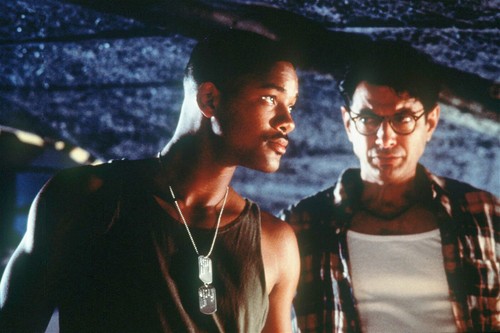
Independence Day - Smith and Goldblum

Images credit: IMP Awards, Collider

Images copyright (©): 20th Century Fox