Jason Bourne (2016)

★★★★

Jason Bourne PosterDirector: Paul Greengrass

Release Date: July 27th, 2016 (UK); July 29th, 2016 (US)

Genre: Action; Thriller

Starring: Matt Damon, Julia Stiles, Tommy Lee Jones, Alicia Vikander

The prospect of another Bourne movie with Paul Greengrass at the helm and Matt Damon in the mix brought out the hopeful side in my otherwise sequel-averse instinct. While The Bourne Legacy done its best to redistribute the focus of a successful, smart franchise onto a new character, it never really looked like hurdling the post-Damon problem. Jeremy Renner has proven to be quite the asset since 2011, each new turn as Hawkeye in Marvel’s Cinematic Universe more successful than the last. But Aaron Cross was no Jason Bourne and director Tony Gilroy couldn’t muster the same level of thrill as Greengrass had during his time in charge (it is worth pointing out that as screenwriter Gilroy has had as much to do with the Bourne franchise’s success as anyone).

Therefore in late 2014 when it was announced Greengrass and Damon would, in fact, be returning for a third outing together — and a fifth overall — I welcomed the news. A lot has happened in world of geopolitics since The Bourne Ultimatum, notably the rise of social media and the undercutting of questionable surveillance techniques by the likes of Edward Snowden. WikiLeaks has become a force, for better or worse disseminating otherwise secretive information around the world, affording us the opportunity to learn about foreign policy tactics and moral mistakes. And just recently, the Pokémon Go app launched to the delight of almost everybody with a smartphone, users a simple ‘yes you can use my location data’ away from catching Pikachu.

Miraculously, Jason Bourne covers all of those bases with a familiar garnish of Greengrass grit. We reconnect with Bourne (Damon) as he steps out of the bare-knuckle frying pan and back into the fugitive fire. The former sleeper agent, now practically free of his debilitating memory loss, learns from former Treadstone contact Nicky Parsons (Julia Stiles) about some new information regarding said program and his father (Gregg Henry). The CIA pick up on Bourne’s re-emergence and, under the guidance of Director Robert Dewey (Tommy Lee Jones) and rising star Heather Lee (Alicia Vikander), seek to bring him in — or worse.

Stylistically, Greengrass remains a champion of the 24-influenced techno-sheen: operatives hunch over computers showing complex maps and databases; Barry Ackroyd’s camera harangues characters, zooming in on their stressed faces and back out again; edits are snappy, driving momentum. A tip of the hat, too, to the practical effects used throughout and especially those on display during the final act. All of these visual footprints coalesce to invoke a sense of urgency, as you would expect. Perhaps more importantly they help to paint the on-screen world as our world, as an arena built for the era of borderless technology and ethically dubious decision-making.

The film manoeuvres around three typical set pieces: the first, a multiperson jaunt through an anti-government protest in Athens; the second, a London-based double-cross; and the third, a lengthy game of cat and mouse around the convention centres and streets of Las Vegas. These aren’t exactly new action frontiers for the series — the scene in Athens borrows heavily from the Waterloo Station sequence in The Bourne Ultimatum — but they are all expertly crafted and thoroughly involving. Primarily because they place us right there with Bourne as he searches for answers while attempting to avoid the CIA’s traps. It can get quite tense.

Unsurprisingly, then, the outing is a winner both structurally and technically. What about themes, character, and narrative? The latter two are certainly weaker, though that’s not to say they are weak. Bourne himself has always got by on Damon’s brutish charisma which is again the case here (for a marquee attraction, the actor has but a few pages of dialogue). We see an ageing protagonist at the onset, a lost soul battered by a gruelling life: “All that matters is staying alive,” he says, yet he earns his way as an underground fighter. Tommy Lee Jones’ gruff Dewey is as world weary as the man he wants to capture, but has amassed experienced and is a master player of the game. There is no villain per se — Vincent Cassel comes closest as a hitman employed by the CIA — meaning the piece evolves into a grey area battle between Bourne, courting a lighter shade, and Dewey’s darker prerogative.

Alicia Vikander was always going to be a winning get for the franchise, though the shuffle does dizzy her character at times. She unveils a great glare, her serious face on point throughout as Lee, however the actor is asked to use it a little too often. It’s as if the filmmakers want to her to be the next Bond so badly they’ve created a character so brisk in personality that the casting suits over at MGM simply have to take notice. I suppose everyone on-screen is wrapped up in the seriousness of their various predicaments, and rightly so. Lee does get more involved as the piece progresses and her final destination is an intriguing one, it’s just that Vikander’s talent, for my liking, should have commanded that bit extra. Julia Stiles likewise. Parsons serves a purpose here but as one of the few characters already ingrained in the Bourne community, a grander presence would have been welcomed.

Given this is the fifth instalment of the series, and a picture not based on any sort of primary source material, it is right to consider the film’s aim. What does Jason Bourne have to offer that the previous pictures did not? The answer almost wholly is of thematic content, in that the film expands upon its already established surveillance lexicon and roots itself in updated issues of the present day. That Athens protest I referenced earlier could be happening right now, for instance. Bourne’s unravelling of the Treadstone program brought to light a seedy government process, true, but it also revealed the location of active field agents and subsequently put them at risk. Similar, in conclusion but not effect, to the WikiLeaks reveals which, in some cases, have inconvenienced innocent civilians.

Greengrass and co-writer Christopher Rouse also incorporate the rise of social media and particularly its knife-edge promise to protect user information. The duo mean well and have the correct issue at heart; we are challenged to consider the probability that our personal data isn’t really that safe when in the hands of mega corporations, which is almost certainly true. It is a clumsily handled narrative thread though. When upstart CEO Aaron Kalloor (Riz Ahmed) exclaims “no-one will be watching you” before an audience of technologically savvy people during a lecture on what users should expect when they sign up to his new social media platform, those in attendance all vigorously applaud like mindless cattle. Surely we’re too sceptical for that sort of behaviour these days.

The filmmakers try to squeeze in as much compelling and relevant detail as possible, though are clearly mindful not to overdo it. (A discussion between Dewey and Kalloor even hints at the recent Apple-FBI iPhone encryption saga.) The series has always been admirably faithful to process, much more so than its genre counterparts. This approach doesn’t always work: the need to establish mission procedure and tick every box can occasionally halt character development, and I think it does here. But Jason Bourne is an intelligent action-thriller, a rare breed of tentpole movie that we should demand more frequently. Its message, apt: moral clarity has no place in muddy waters and our geopolitical world is utterly caked.
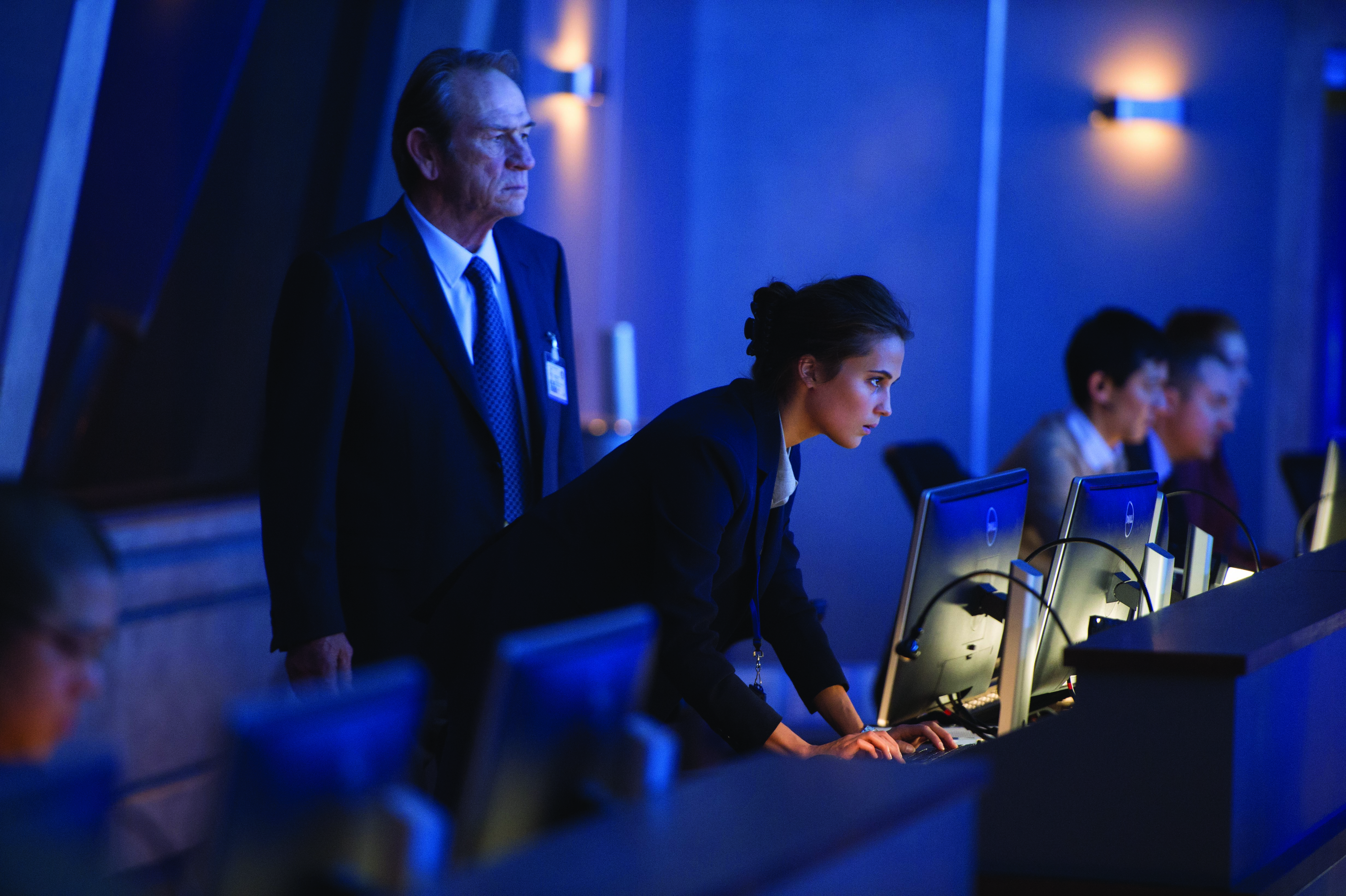
Jason Bourne - Tommy Lee Jones & Alicia Vikander

Images credit: IMP Awards, Collider

Images copyright (©): Universal Pictures

Ghostbusters (2016)

★★★

Ghostbusters PosterDirector: Paul Feig

Release Date: July 11th, 2016 (UK); July 15th, 2016 (US)

Genre: Comedy; Fantasy; Science fiction

Starring: Kristen Wiig, Melissa McCarthy, Leslie Jones, Kate McKinnon

You might use the term “whipping boy” to describe someone who is unfairly or unevenly hammered for the flaws of someone or something else. That political leader who bears the brunt of the blame for a vote gone awry. The footballer whose defensive error gives away the second goal in a 5-0 defeat. You get where this is going. Paul Feig’s Ghostbusters has been, for quite some time now, cinema’s highest-profile whipping girl. And for what? Because it’s a reboot of a cult classic? See Jurassic World. Because it’s the product of a big studio using an established brand to cultivate cash? See just about every summer blockbuster for the past decade. Or because it subs four leading men for four leading women? Ah. Bingo.

Well the four women are funny and, shock-horror, the film is funny too. It’s also in the same ballpark quality-wise as its predecessor, a movie apparently moulded in the hands of God himself (of course God is a guy, pfft). Ivan Reitman’s Ghostbusters was a fun flick with charismatic players and a popcorn plot. A lot like Paul Feig’s Ghostbusters, in fact. Neither is worth the buzz that surrounds it: Reitman’s Ghostbusters is far from the greatest comedy of 1980s, let alone all time, and Feig’s effort is far from the end of masculinity, let alone cinema.

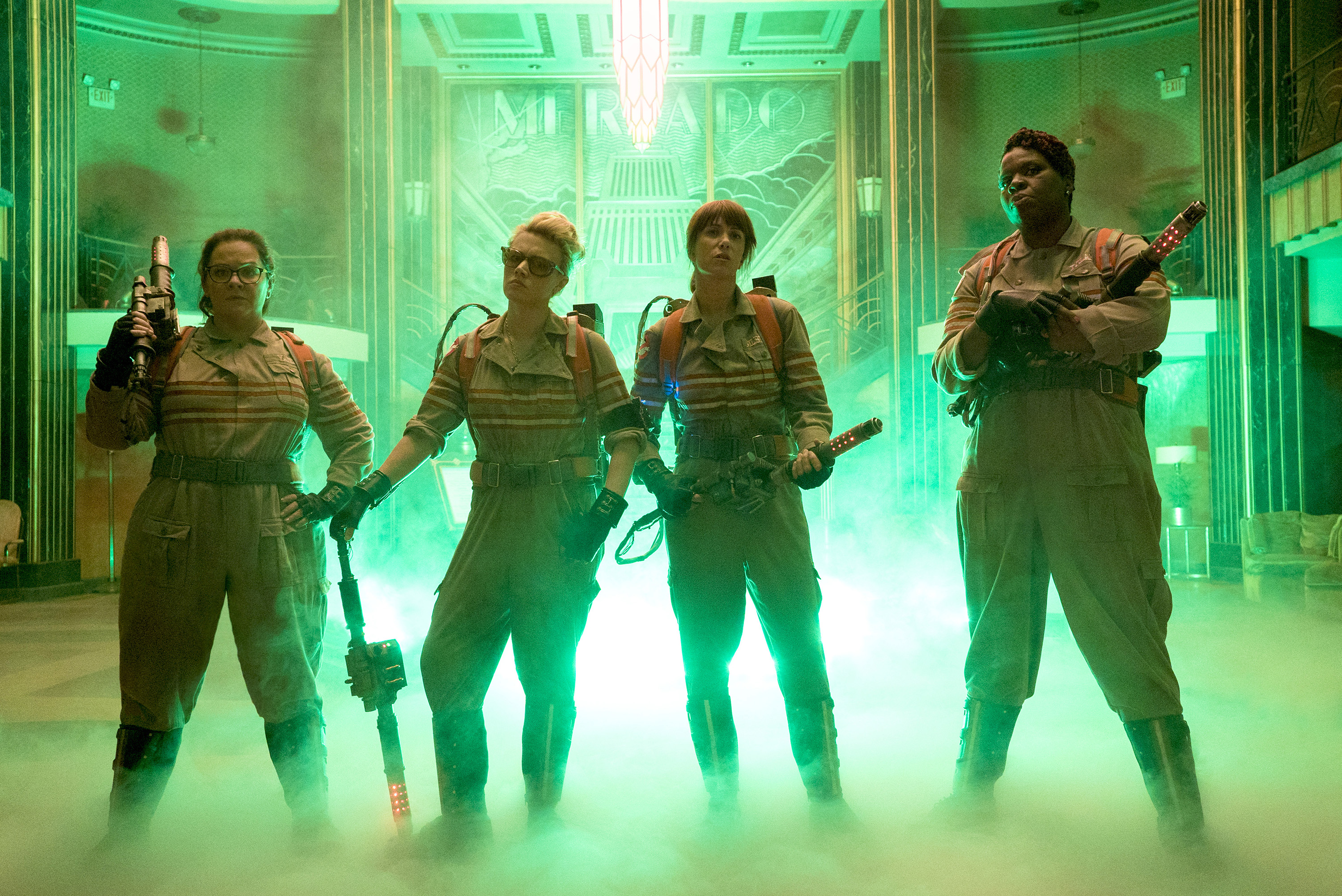
This incarnation follows Erin Gilbert, Abby Yates, Jillian Holtzmann, and Patty Tolan — Kristen Wiig, Melissa McCarthy, Kate McKinnon, and Leslie Jones — an academic, two scientific minds, and a general knowledge buff who collectively band together to defend the streets of New York City from insurgent ghosts. The ghosts’ sudden arrival has everything to do with spiritmonger Rowan North (Neil Casey), whose barmy devices pave a paranormal path to the real world. Though that hardly matters. What matters is the re-establishment of the ghostbusters, that they are legitimised both within and outwith the narrative, and that we get some laughs along the way.

And there are some laughs, often at the expense of the male characters in the piece. Chris Hemsworth, for instance, plays a dumb blonde receptionist, a role that has historically been reserved for the token female in big budget cinema. Spoiler alert: Bill Murray shows up as the film’s biggest sceptic. He doesn’t believe in ghosts, and by proxy, he doesn’t believe in these ghostbusting women. Even the male tour guide we see at the beginning is utterly afraid of bumps in the night, so much so that he has one of those juvenile ‘accidents’. I can’t recall one strong male character, and guess what? That’s sort of the point. That is the joke. The film does not set out to demonise men (#notallmen) but rather to pithily tear down the cultural and filmic stereotypes prevalent in cinema.

You could argue this approach is overplayed and that it perhaps gets in the way of other would-be satirical adages. For example, the ghostbusters find themselves not only battling their paranormal opposites, but also the non-believers. YouTube trolls bear the brunt of a quip or two: “Ain’t no bitches gon’ hunt no ghosts,” reads one comment. And still, they do. Maybe co-writers Katie Dippold and Feig’s stereotype-smashing could have even gone a tad further, but this is standard comedy fare after all. Besides, Hemsworth’s dopey Kevin — the longest-running and most vociferous of the stereotype gags — is worth his screen time. He wears glasses without frames and has a cat called Mike Hat (phonetics). Hemsworth plays the idiocy straight; Kevin is a cardboard cutout coloured with heightened irony, and it works as well as any other strand of amusement.

The remaining amusement is served up by our key quartet. You initially pin Wiig as the reluctant one of the group, her attire academic and her exterior distant, but that reluctance quickly evaporates. Wiig, perennially brilliant at being awkward and standoffish, gets to be awkward and standoffish before gelling with the gang. That Gilbert so suddenly abandons her academia in favour of beliefs she has repressed for many years does suggest a sense of rushed characterisation, but it at least affords Wiig the opportunity to exercise her versatility. Speaking of gelling with the gang, Jones’ Patty is treated as an equal instantly — it hardly matters that she has no scientific experience, only that she has valid local knowledge and a desire to rid the city of ghosts. Crucially, the performers season a believable camaraderie.

The action is run-of-the-mill. The visuals, expectedly lively (it all goes a bit weird during a Godzilla meets Avengers final act, particularly when Feig invokes 2001: A Space Odyssey. Theodore Shapiro’s score is fun and bombastic and nods admiringly towards its predecessor. And the costume design matches that bombast, effectively reflecting the variable personalities of our four leads — especially the goggles-wearing Holtzmann, McKinnon’s wide eyes purveying excited madness. The story itself isn’t especially laudable, a criticism that has been thrown at many a recent franchise reboot. In a lot of ways Ghostbusters is vintage Feig, cultivating a light atmosphere with steady technical facets and the occasional barb. It is not as volatile as Bridesmaids, and thus not as good, emphasised by McCarthy’s less-brazen approach.

But Ghostbusters is fine. It’s a solid reboot, not narratively groundbreaking but funny enough (listen out for a terrific Jaws gag). It isn’t mistake-free: for whatever reason, there is a disorienting Ozzy Osbourne cameo and the human villain is a barely-realised two-dimensional prospect. However, Feig’s Ghostbusters is not going to taint whatever legacy the original has mustered, but will instead encourage a new generation of fans. It’s frothy, not vindictive. It’s another big studio reboot in an era of big studio reboots that people will either love or hate, and as they decide the world will keep spinning. Relax.

Ghostbusters - Melissa McCarthy, Kristen Wiig, Kate McKinnon & Leslie Jones

Images credit: IMP Awards, Collider

Images copyright (©): Columbia Pictures

Independence Day: Resurgence (2016)

★★

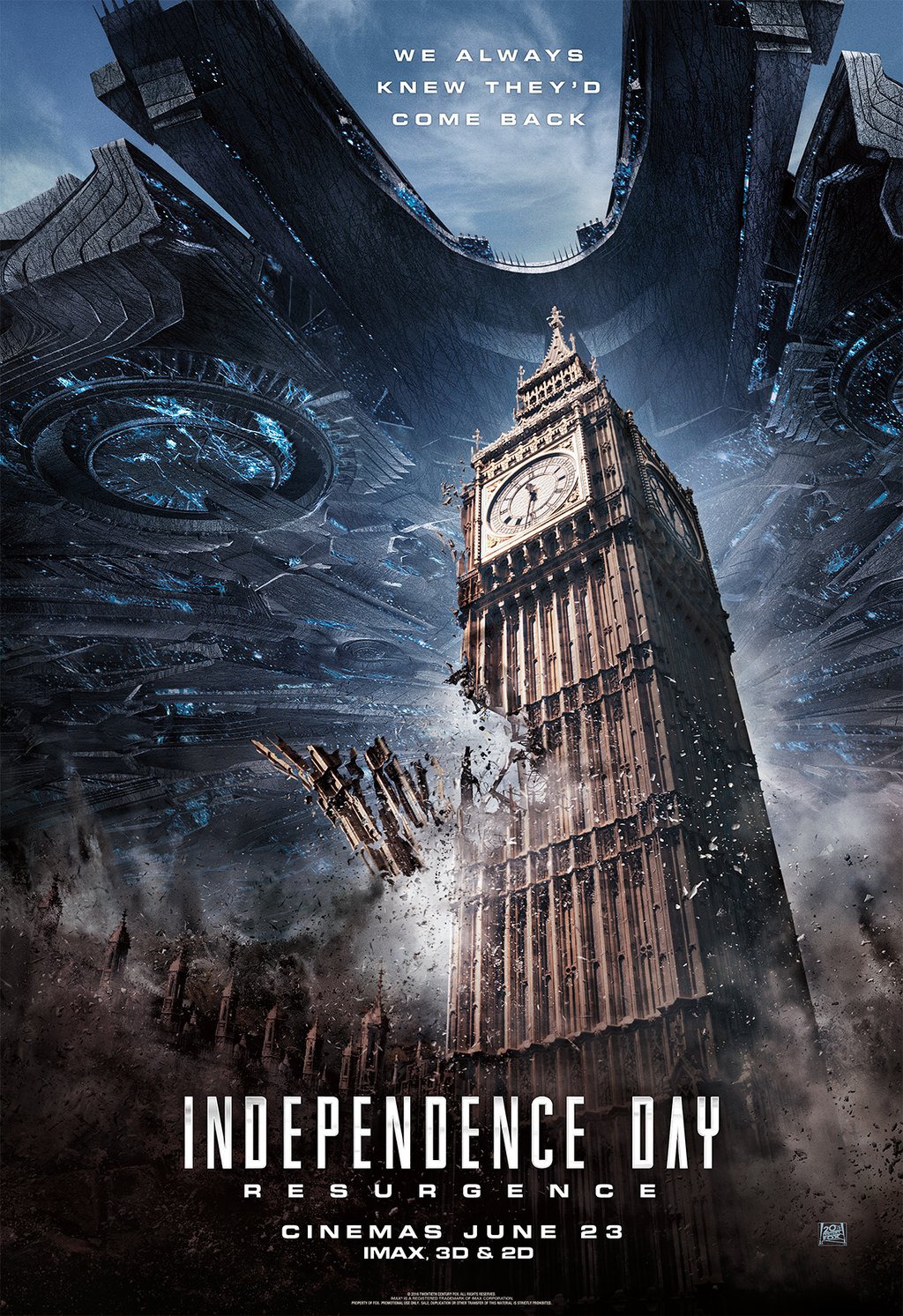
Independence Day Resurgence PosterDirector: Roland Emmerich

Release Date: June 23rd, 2016 (UK); June 24th, 2016 (US)

Genre: Action; Adventure; Science fiction

Starring: Jeff Goldblum, Liam Hemsworth, Maika Monroe, Jessie T. Usher

When you make as many disaster movies as Roland Emmerich, a few things are bound to happen. One, the law of averages suggests you’ll eventually churn out something a bit rubbish that’ll be branded a “disaster” by a publication whose wordplay skills aren’t quite up to scratch. And two, it is likely customers will start to encounter genre fatigue. Independence Day: Resurgence is Emmerich’s sixth out-and-out catastrophe appraisal, having averaged around one every two years since 1996. And while it certainly isn’t a poor effort, it is a tired one.

We’re 20 years removed from the events of Independence Day and humanity has taken significant steps towards protecting itself against future attacks. The Earth Space Defence programme operates from locations like the Moon, made habitable via good old militant colonisation. Jake Morrison (Liam Hemsworth) is one of those orbiting the Earth, a fighter pilot with skill and a cocky demeanour. He’s no Han Solo, but then Resurgence is no Empire Strikes Back. What the film is, though, is familiar, hitting many of the same notes as its predecessor only this time with crisper technical tendencies — the Moon base purveys that futuristic grey-silver Prometheus sheen. Hemsworth’s Morrison is a reflection of that sameness: a marketable replacement for Will Smith’s Steven Hiller, Smith either too expensive to rehire or personally fed up with sci-fi roles.

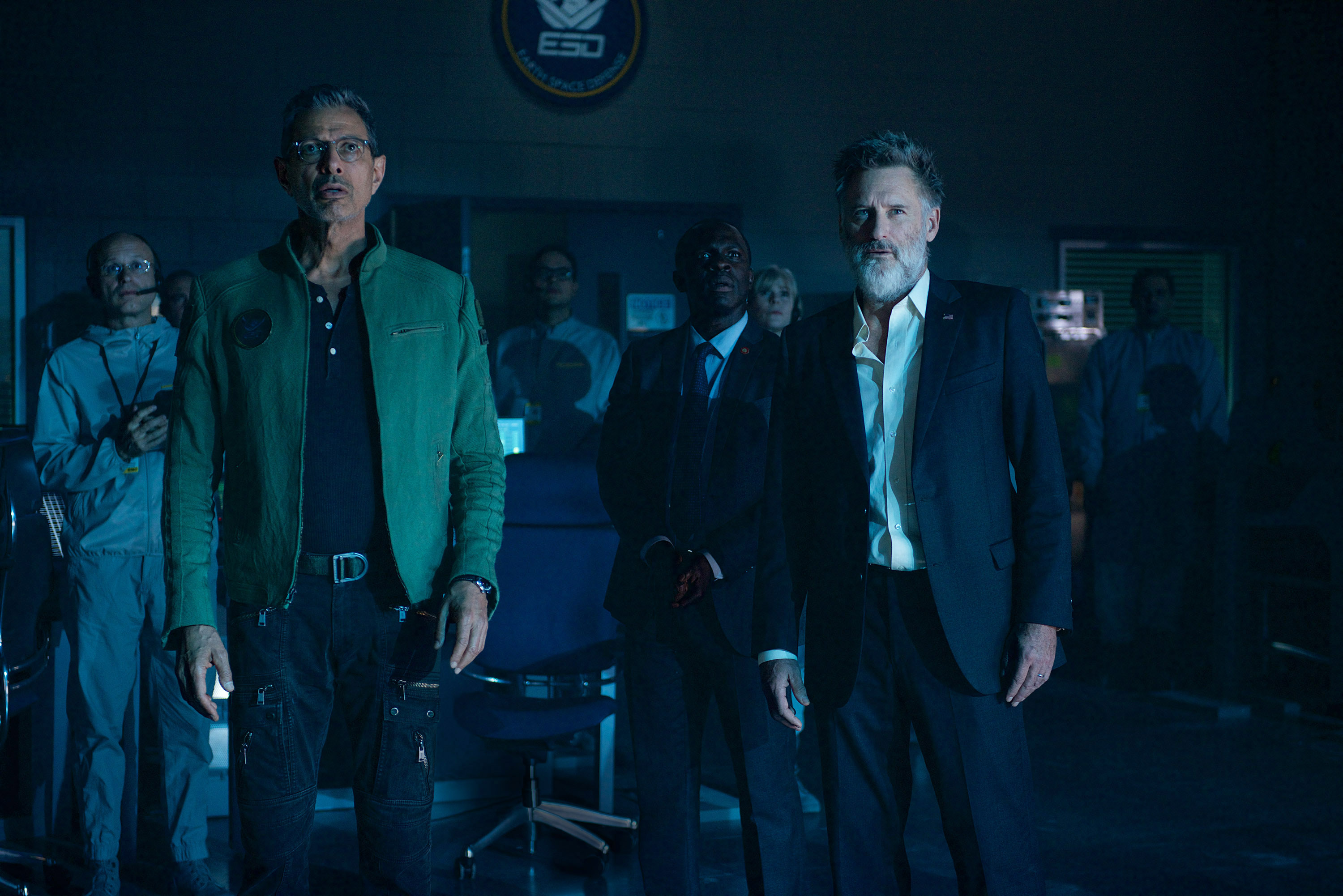
Some of the familiar is good though. Jeff Goldblum, for instance, recaptures plenty of that self-aware wit he displayed as scientist David Levinson (now a lead Area 51 researcher) in the original. Whenever he appears the film lights up, freely recognising its silliness and gleefully bathing in it. “I heard his son is much more of a moderate,” Levinson says in reference to warlord Dikembe Umbutu (Deobia Oparei) before meeting with the commander’s militia, each fighter sporting high impact weaponry and a no-nonsense facial expression. It is the sort of snappy levity popularised for better or worse by Marvel cinema, but perfected by Goldblum whose poise and timing are, arguably, unmatched.

However, just because the film is generally aware of its wackiness doesn’t mean it should skimp on an engaging story. Aside from its predecessor, Resurgence has more in common with White House Down than anything else in Emmerich’s portfolio, especially tonally. Both movies take would-be serious predicaments — an attack on the President there and an attack on the world here — and imbue them with carefree notes. There is no narrative weight, which is fine, but Resurgence doesn’t offer any alternative means through which stakes can conjugate. We have already witnessed a failed alien attack on this world and it’s not enough simply that the scale is larger this time around. The characters, though generally likeable, are as expendable as the other billion civilians squished by an enormous spacecraft docked atop half the globe.

The manoeuvring of pieces often feels forced. Former President Thomas J. Whitmore (Bill Pullman), whom we meet in a state of mental anguish, evades his high-level bodyguard and appears on stage alongside the current President (Sela Ward). You can only fathom such a thing happening because the story needs it to. It needs to have a panicked Whitmore warn the world about incoming aliens and the only way to get there is through an unrealistic turn of events. While it is true these calamity blockbusters rely little on sturdy plot dynamics, the successful ones often find a way around that issue. San Andreas managed to distract from any story inefficiencies by dabbling in simplicity: hosting a handful of straightforward characters led by a charismatic force of nature in Dwayne Johnson. Goldblum could be that force of nature here but there are so many other players in the game, therefore everyone’s arc suffers and the overarching narrative is rendered a bit baseless. This issue comes to a head right before the third act: as Goldblum spews out waves of exposition, he might as well be reading from the Instruction Manual for Ending Disaster Flicks.

Maika Monroe, breakout star of The Guest and It Follows, is someone who should have more to do. At one point you think she’s going be lumped into a love triangle opposite Hemsworth and Jessie T. Usher (he plays Steven Hiller’s son Dylan, another accomplished flyer). But the complexity of their three-way relationship soon makes itself known, born not out of love but Jake’s cockiness gone wrong (he almost killed Dylan in training). When it becomes clear Patricia’s only romantic ties are with Jake, the focus then shifts to her productivity elsewhere. She is Whitmore’s daughter and an adviser to the current President but Patricia can also handily navigate a fighter jet — not that the film wants to show it. She could be assisting the resistance from the air but instead splits her time between house-buying conversations with Jake and controlling her erratic father. There is a moment of reprieve as the film reaches its finale but by then it has already wasted the fiery talents of Monroe. She even says it herself: “You should’ve let me [fly].”

Emmerich and his squad of writers do try to reflect the catastrophic reverberations of the Independence Day attack in their characterisation of various individuals. Whitmore, as discussed, and also the returning Dr. Brackish Okun (Bret Spiner), fleetingly humorous as he ambles around excitedly looking for the next thing to shoot with a giant ray gun. It’s because these characters are played for laughs that the piece is unable to really delve into the emotional scarring they might be privy to. There is also an instance where you think the film might explore how said scarring has had an impact on the moral endurance of humankind: it involves military decision-makers and government officials debating whether to destroy a seemingly neutral ship. Alas, popcorny action stuff gets in the way.

The brooding hum that plays in tandem with the alien mother ship’s arrival is an example of what could have been had the outing further tapped into its natural sci-fi/horror instincts. Another such flirting occurs later, when military men and extraterrestrials play a game of cat and mouse in a dark bunker. It’s essentially a scene from Alien or Aliens, only without the benefit of a creepily construed atmosphere. Clearly Emmerich had one eye on Ridley Scott’s work when making Resurgence given the alien mother looks like a cross between H. R. Giger’s Xenomorph and Smaug from The Hobbit trilogy.

In 1996, Emmerich used scale models to achieve the level of bombast required to compel the cinemagoing public. While I can’t see too much that sets this sequel apart from its parent, there is something about the practicality of blowing up a mini White House that endears more than the admittedly impressive visual palette on display here. Maybe that sums up Resurgence: a film made with so much technical proficiency that it seems to forget about intuition, be it something akin to the scale model intuition that once charmed viewers, or the sort of narrative intuition that plants us in a recognisable world with new, engaging possibilities. It all feels too easily earned.

Independence Day: Resurgence - Jeff Goldblum & Bill Pullman

Images credit: IMP Awards, Collider

Images copyright (©): 20th Century Fox

The Conjuring 2 (2016)

★★★★

The Conjuring 2 PosterDirector: James Wan

Release Date: June 10th, 2016 (US); June 13th, 2016 (UK)

Genre: Horror; Mystery; Thriller

Starring: Vera Farmiga, Patrick Wilson

At one point in The Conjuring 2, Patrick Wilson — as Ed Warren, paranormal investigator — attempts to play an Elvis track on an old record player that he immediately discovers isn’t working. The record player belongs to the Hodgson family, mother and four children. Wilson notices an acoustic guitar upright in the corner of the room, left behind by a cheating husband and father, and opts to give the instrument a whirl. He plays “Can’t Help Falling in Love”, his Elvis twang in full effect, and the children join in soon enough. Mum sobs a little; it’s her moment of reprieve. Lorraine Warren (Vera Farmiga) cries too, envisioning a peaceful life with her husband, free from their hazardous occupation. It is such a sweet moment, quite possibly the sweetest of the year. And it occurs slap-bang in the middle of a horror movie.

I have long considered horror the genre most reliant on aid from other genres. Not because an exclusively scary movie can’t be successful in and of itself, but because it often takes added resonance for a scary movie to make that leap towards all-time great. The Conjuring 2 is not an all-time great. It is very good though, partially because director James Wan knows how to handle his surroundings (he’s been there before) and partially because those surroundings host reliable human drama. Just like in The Conjuring (a film I have seen again since this review and enjoyed a lot more), the sense of eeriness we feel as we watch holds more weight because we actually care about the characters on-screen. That’s good acting, good tone management, and good filmmaking.

Having exorcised demons aplenty, the Warrens decide it’s time to give up the ghost and focus on their own family. That is, until the Enfield case makes itself known: Peggy (Frances O’Connor) and her offspring quartet, Janet (Madison Wolfe), Margaret (Lauren Esposito), Johnny (Patrick McAuley), and Billy (Benjamin Haigh), are haunted by a spirit with historical ties to their flagging council house. At the request of the Church, the Warrens travel to England to observe from a distance, though we all know how that usually goes. It is worth noting that the decision to utilise a fairly unknown secondary cast, likely for budgetary reasons, proves a good one as it grounds those characters in a more believable reality. Since we don’t recognise any of the Hodgsons — Esposito’s role as Margaret is her first ever acting gig — it is much easier to get behind them as your average working class family.

The Warrens are roped into another paranormal investigation then, despite grievances. Lorraine has been struggling with the mental anguish brought on by her gift (she can see stuff) while Ed, though less pained physically, seems a bit fed up with the mainstream denial (we see this during a televised debate during which he sports a mean Wolverine hairdo). To his relief, England appears united in its belief that something spooky is going on in Enfield. One newspaper refers to the Hodgson home as “The House of Strange Happenings”. And the Warrens’ begrudging return to the fold becomes truly worthwhile when they meet their clients, a genuinely nice family due a break. Newcomer Esposito, playing the eldest, relays that same attitude of care for her brothers and sister as Emily Browning did in A Series of Unfortunate Events.

The siblings can’t afford to argue because they can’t afford anything. The closest thing we get to a squabble lasts mere moments and is over food. As well as poltergeists, they are up against a social climate preempting Thatcher’s Britain (the film is set in 1977, a few years prior to her Prime Ministerial venture, but it might as well be set in the early 80s). Thatcher herself even appears on television at one point. Although Wan and co-writers Carey Hayes, Chad Hayes, and David Johnson mightn’t have meant it, their movie does act as a symbolic decrying of the former leader’s era in government. Here we have a family isolated and afraid, troubled by a domineering force they themselves can’t touch, with no prospect of homegrown assistance. Their house, walls flaking and furniture dank, recalls The Babadook, another family drama disguised as horror. By contrast, the Warrens’ stateside residence is bright and sunny. A home.

Wan recycles a few elements from The Conjuring: the blunt, yellow text that opens the film, perversely serenaded by a malefic male chorus, is a stylistic consistency that works. The haunted house plot is a tad worn out, but when your central pairing are based on real people who often conducted haunted house visits, that’s a tough one to get around. For the most part any sense of tired repetition is painted over by the development we get character-wise. I’m not saying this is in the same ballpark as a Linklater sprawl or something of that ilk, not by a long shot, but it is a treat to watch well-rounded characters bear the weight of horror. Wan welcomes classic genre tropes, utilising Ouija boards and creepy toys as scare MacGuffins. It’s not really about how the characters use these artefacts but instead the emotional fallout of said usage.

Don Burgess delivers behind the camera, exuding initiative and variation. A jarring, jilted effect during an early séance sets the visual tone and justifies the sort of terror described shortly thereafter as “diabolical”. Later, we become part of the horror as the camera swoops around characters and spirits, flirting with disorientation. Sometimes it hovers above those below like an apparition. Perhaps it doesn’t add texture to the narrative, but Burgess’ work is different enough that it should engage viewers accustomed to the conventional. The cinematographer excels during quieter moments, when we expect a jump scare but instead witness unsettling portraits depicting faces that become unpredictable silhouettes in the dark. Wan and Burgess develop an eerie atmosphere that demands noise as silent scenes are unbearable — a Demon Nun sequence in the Warren household, or the odd actions of a firetruck toy back in Enfield.

It’s not perfect. There is a character arc that veers too near The Exorcist and a character, played by Franka Potente, who is drawn as thinly as can be. At over two hours the movie is too long to sustain its fairly straightforward story, which means the buildup to significant happenings is stretched beyond its narrative limit. The Warrens don’t start their investigation until at least an hour in, for instance, and we do miss the purposeful presence of both Farmiga and Wilson for large chunks of that hour. In fairness, the filmmakers are not doing nothing — they’re spending that time developing the plight of the Hodgsons. It’s just that there is sense of halted momentum, albeit momentarily.

Delighted with the financial prosperity yielded by their Annabelle doll spin-off (an incredible $257 million from a measly $6.5 million budget), Warner Bros. have announced the growth of another cinematic branch centred on the Demon Nun entity that haunts this instalment. Though efficient enough, Annabelle failed to match its elder’s genre know-how. The Nun is certainly a scarier visual prospect and a film based on it will undoubtedly rake in the cash, but I think The Conjuring series is at its best as it is here: more interested in its human characters, grounded by the performances of its human actors, and served admirably by its human director.

The Conjuring 2 - Nun

Images credit: IMP Awards, Collider

Images copyright (©): Warner Bros.

Warcraft (2016)

★★★

Warcraft PosterDirector: Duncan Jones

Release Date: May 30th, 2016 (UK); June 10th, 2016 (US)

Genre: Action; Adventure; Fantasy

Starring: Travis Fimmel, Paula Patton, Toby Kebbell, Dominic Cooper

It has become the norm: independent filmmakers, fresh off a critical and commercial doozy, cast as the head of a cinematic juggernaut. Colin Trevorrow went from Safety Not Guaranteed to Jurassic World. Gareth Edwards, Monsters to Godzilla and now Star Wars. And here’s Duncan Jones, a director with science fiction sensibilities and a penchant for creating smart stories, now perched atop the film version of arguably the biggest online role-playing game in the world. Warcraft has been years in the making (10, in fact, but at least three under the tutelage of Jones) and you can see that effort on-screen. You can also see and feel the director’s touch, his love of nuance and, as was the case in both Moon and Source Code, his heralding of complex characters.

Sure, Warcraft isn’t the most original fantasy movie ever made, and sure, there are some significant problems. But Jones brings a maturity that would have likely been missing had a less crafty filmmaker been in charge. Thank goodness too, because that maturity affords viewers the opportunity to engage with those on-screen. Those being: Sir Anduin Lothar (Travis Fimmel), a charismatic warrior charged with defending the world of Azeroth when a Horde of rampaging orcs appear via gigantic portal. One of the orcs is Durotan (Toby Kebbell) whose wife is heavily pregnant with their child and whose conscience defies the evil antics of leader Gul’dan (Daniel Wu). Essentially, the latter wants to sap the life from humans and use that energy to further power the aforementioned portal, paving the way for an unstoppable orc army.

It’s a lot to take in, especially when you consider the legion of other characters I haven’t yet mentioned: half-orc half-human Garona (Paula Patton), Guardian mage Medivh (Ben Foster), young apprentice Khadgar (Ben Schnetzer), and King Llane Wrynn (Dominic Cooper). There are more still, and you can see the mythology’s depth throughout the opening half hour as Jones and co-writer Charles Leavitt introduce each chess piece. What this means is a period of bamboozlement for us uninformed lot — early scenes are stitched together like multicoloured patchwork, at first confusing and a bit tough to get one’s head around. But to Jones and Leavitt’s credit, events become easier to follow when the individual story strands merge to create a cohesive whole.

In light of the ongoing refugee crisis, you might draw conclusions from the movie’s explicit imagery depicting the movement of populations. But there doesn’t seem to me to be any political point-scoring going on. Quite the opposite given we see good and bad on both sides, something reflected often in the real world though not necessarily promoted by Hollywood. Humans and orcs are treated equally: Jones opens on Durotan and his wife Draka (Anna Galvin) having a laugh and joke about their appearance. It’s made clear that these gargantuan creatures endure the same frailties and hold the same grudges as we do. Some of the orcs are evil, not because they’re orcs but because they’re evil and because they champion power-hungry agendas. Others like Orgrim Doomhammer (Robert Kazinsky) are more subtly shaded, though the reasons why are best left to the movie.

Of course, the human characters are ultimately the most sympathetic — fitting, given they are on the defensive throughout — and you get caught up in their plight. This is mainly down to the work of Fimmel as Lothar, a thoroughly effective protagonist with a magnificent weary war face, and Patton, whose sturdy Garona acts as a genetic bridge between the two races. Their interactions initially point towards a conventional destination but, again, the filmmakers explore a credibly different route. Lothar has been cast as the movie’s Aragorn and there are similarities between the two, however it is Cooper’s King Llane who really dons that crown: like Return of the King Aragorn, he values loyalty and manifests as an amiable ruler at a time where figures of power in real life are not so amiable (“War with us will solve nothing”).

Warcraft does struggle to evade the shadow of Peter Jackon’s trilogy, especially in an aesthetic sense. An extended fight sequence around halfway through might as well be a deleted scene from the franchise, set in a dark ashen gravel-scape resembling Mordor (there’s even an enormous fiery mountain in the background). Look out for an Isengard-esque construction shot, and listen out for a “for Frodo” declaration. Perhaps the comparisons are unfair but everyone who goes to see Warcraft will have seen The Lord of the Rings in some form and the similarities are tough to shake. Having said that, the visuals are generally impressive; minute details differentiate the orcs and make the individual CG characters stand out — a particularly evil baddie sports wolf skull shoulder pads and a pitch black beard. Kebbell, it should be noted, puts in another commendable motion-capture performance.

Paul Hirsch’s editing style occasionally jars as one scene fades to the next but there are fun visual snippets for fans of the game, including an aerial shot that jumps from town to town showing the damage done by a rampaging orc army. And I should point out a spot of superb editing towards the end: Hirsch flirts between two separate inter-species battles, highlighting the need for civilisations to solve their own issues before causing problems elsewhere. Flawed, somewhat parochial systems of hierarchy — Khadgar’s struggles as a young mage; the slave state we see Garona in when she first appears — would have benefited from deeper analysis had more time been available.

The film is bookended by two “Warcraft” title cards, the first of which arrives bearing a summer popcorn aura. Big, brassy letters. A booming score. Jones’ movie opens with that event cinema feel and almost capitalises thereafter. Even though it doesn’t quite reach the lofty heights set by the superior fantasy blockbusters of yesteryear, Warcraft wins favour in its attempt to establish captivating, varied characters (the feature passes the Bechdel test during a conversation between Garona and Ruth Negga’s Lady Taria). It’s three stars but three very good stars, and a very enjoyable, surprisingly engaging, two hours at the cinema.

Warcraft - Cast

Images credit: IMP Awards, Collider

Images copyright (©): Universal Pictures
The Gallows (2015)

The Gallows PosterDirector: Travis Cluff and Chris Lofing

Release Date: July 10th, 2015 (US); July 17th, 2015 (UK)

Genre: Horror; Thriller

Starring: Reese Mishler, Pfeifer Brown, Ryan Shoos, Cassidy Gifford

Remember the days when movie titles made use of inanimate objects and animals to induce a sense of clinical creep? The Birds. The Texas Chain Saw Massacre. Alien. Those are probably bad examples given chain saw massacres are far from inanimate and aliens aren’t technically animals, but the point is The Gallows could have been one of those movies with a creepy title backed up by creepier content. It’s not, as it transpires, and that becomes fairly obvious fairly quickly.

We’re back in the found footage dimension — you know, the black abyss of modern horror — and in the company of cameraman Ryan (he’s really a high school footballer but for the purposes of this film he’s also a cameraman), his girlfriend Cassidy, pal Reese, and Reese’s crush Pfeifer. The foursome find themselves locked in school after dark and, unsurprisingly, are drawn into a sinister game of cat and mouse opposite the ghost of tragic history. Moral of the story? School finishes at 3:30 pm.

A common problem with the found footage design is it tends to hinder character development because it limits how we literally see those on-screen, often from the same angle and same perspective, while hiding the person behind the camera. As such, the characterisation here is pretty sub-standard: “Hey Reese, can I borrow your blouse?” are some of the first words Ryan says to his mate after a dodgy drama rehearsal (Reese has decided the most effective route to Pfeifer’s heart is playing opposite her in their school theatre production). It’s a bland, easy introduction to a bland, easy set of students and one not at all aided by the rest of the football team’s boyish insults that follow.

This is the stereotypical, grating, douchey high school behaviour Richard Linklater mercifully avoided in Everybody Wants Some!! and the sort of behaviour that serves only to undermine any care we have for those on-screen. Even the drama students are unbearably caricature: geek attributes maximised, ‘dorky’ glasses abound, lead actress buoyed by more positive energy than the Sun. The film has only been on for around 10 minutes by this point but even by the 70th minute the same broad strokes are stifling people. At least in this version of high school the drama geeks manage to dish out some prank revenge on the football douches.

The actors use their own first names because it’s all real and they are not really actors. (On a serious note, aren’t we past the point of trying to pretend this found footage stuff is in any way authentic?) Their performances are fine, though Ryan — the guy hauling the camera around — oscillates between high-pitched wailing and incomprehensible whispering a little too often. Another thing that’s odd: the play that the students are rehearsing is a rerun of the same one that killed a child many years prior, and given people still seem traumatised by that event, why even do a rerun? Sure, it’s the 20th anniversary of the tragedy. But wouldn’t a memorial service have sufficed? It’s especially grisly when you consider the child died via accidental hanging.

Regardless, it’s an inevitable part of the plot therefore you’re left hoping for something to differentiate the film from the usual genre pack. Writer-director duo Travis Cluff and Chris Lofing dabble in the superstitions (“Break a leg”) of stage performing without reinventing them, or at the very least provoking any new connotations — maybe by not having the characters angrily coax the dead or leave an injured mate behind. Everything goes belly-up: open doors become locked (apart from the large brick one with an eerie cross engraved on it); the group start blaming each other amid ensuing relationship drama; the gallows’ noose, previously removed from its perch by Ryan, saunters back up there unassisted.

Of course, the school does bear windows that the group could break open and escape out of at any moment. The dialogue and situational development are both so poor you wonder whether the filmmakers are actually embarking down a purposefully satirical route — for instance, at the start of the movie Ryan discovers a damaged door primed for after-dark entry. See, Reese needs to destroy the play’s set because it is the only way he can get out of a would-be terrible performance. The only way. A performance, incidentally, that he agreed to deliver because he fancies Pfeifer and it is the only way Reese can initiate a relationship between the pair. The only way. That’s high school for you.

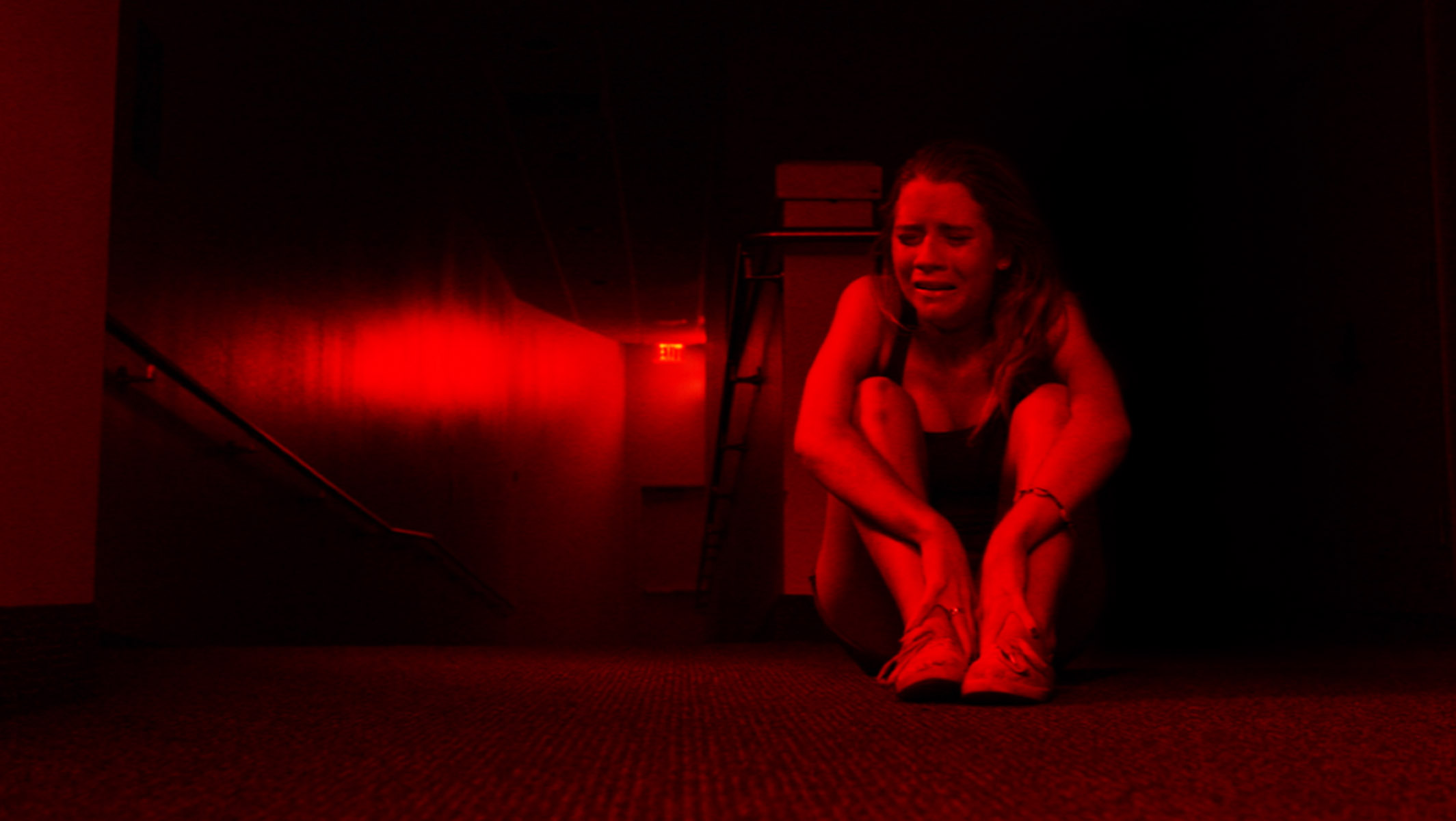
There are a handful of quiet-quiet-bang moments that give us a fright, but these are frights without substance. You won’t remember any of them because none of them hold any weight: they aren’t emotionally or audibly or visually scary (that’s not true: there is one suitably unsettling visual during a red-tinted scene that revisits the hauntingly quiet manoeuvres of the Babadook). But otherwise the attempted scares encourage a human reaction as natural as visiting the toilet during a three-hour Tarantino film.

Look, this is cheap horror, and worse, cheap found footage horror, made for popcorn audiences searching for an easy cinemagoing escape. I don’t doubt the people involved in the process put in a lot of hard work and effort, and perhaps for some of them The Gallows conveyed genuine promise. But it should be held to the same standard as the best outings, films like The Blair Witch Project, and there simply is no comparison. It’s another case of dollar bills over quality. Lo and behold, The Gallows made $43 million — so who cares?

The Gallows - Cassidy Gifford

Images credit: IMP Awards, Collider

Images copyright (©): Warner Bros.

X-Men: Apocalypse (2016)

★★

X-Men: Apocalypse PosterDirector: Bryan Singer

Release Date: May 18th, 2016 (UK); May 27th, 2016 (US)

Genre: Action; Adventure; Fantasy

Starring: James McAvoy, Jennifer Lawrence, Michael Fassbender, Sophie Turner, Oscar Isaac

It’s fitting that X-Men: Apocalypse should arrive on the heels of Captain America: Civil War, though not for the most flattering reason. Since Marvel Studios launched its Cinematic Universe back in 2008, the studio has carved out quite the mountainous niche for itself. From Iron Man onwards, the films under the MCU banner have followed a fairly compact narrative structure: stories with potentially world-ending consequences told atop a spine of levity. Civil War is the clearest, most effective representation of that structure we’ve had thus far, its serious themes of accountability and government distrust lightened via bouts of humour. While other outings have had some success, the Russo brothers’ tonal balancing act in Civil War is as close to faultless as the MCU might ever see.

Back, then, to X-Men: Apocalypse, a feature that strives to have more in common with this Marvel prerogative than its own pre-established mantra. Bryan Singer’s film, penned by Simon Kinberg (they last worked together on Days of Future Past), is probably the funniest X-Men instalment to date, bearing a commendable number of snappy one-liners and some less commendable instances of accidental amusement. But elements of its story are also deeply serious and the filmmakers struggle to marry this seriousness with the humour, at times to the movie’s downfall. The issue is not that Singer and Kinberg want to make us laugh, it’s that the filmmakers’ deployment of humour is grossly misplaced. More on that later.

It’s pretty much your bog-standard superhero showdown: a big bad (En Sabah Nur, played by an Oscar Isaac struggling valiantly against the character’s broad strokes) rises from the dust and ruin of a fallen ancient empire to wreak havoc upon the 1980s, and it’s up to the good mutants (led by Charles Xavier, played by James McAvoy) to stop him. En route to worldwide recalibration — an odd sequence sees Nur decry the weakness of humankind and our technologies via television montage — the super-mutant recruits a handful of powerful followers, one of whom is Magneto (Michael Fassbender), plucked from a covert life in Poland with his wife and daughter. There are a bunch of others involved but that’s about the gist.

Unsurprisingly, most of the others are mutants and again we see a few treated unfairly, like freak attractions. We are introduced to Angel (Ben Hardy) in the midst of a one-sided cage fight and reintroduced to Nightcrawler (Kodi Smit-McPhee) as his next opponent. Scott Summers’ (Tye Sheridan) unearthed Cyclops ability sets him apart in high school and primes him for bullying — lots of characters are either new or feel new because they haven’t had the chance to shine before, not that many get a chance to shine here. This demonisation of mutants, a class/race theme the X-Men series has sought to investigate more intensely in the past, is why Erik Lehnsherr wants to keep his true identity a secret from fellow co-workers and the authorities.

Lehnsherr is by far the most interesting character, not least because he’s the sort of intellectual powerhouse who can back up an Icarus and Daedalus reference (careful) with actual menace. While the excellent work carried out by the likes of Kinberg in previous outings has afforded Lehnsherr intrigue, it’s really Fassbender who has instilled authority and ethical contention into the character. A terrific moment in Apocalypse sees Lehnsherr have his peaceful family life unmasked through preventing the death of a co-worker, and Fassbender’s expression of subtle anguish as Lehnsherr realises his veiled existence is about to be torn apart is wonderfully judged. I won’t give anything else away about the catalyst that sends Lehnsherr over the edge other than noting its compelling moral dichotomy.

It’s fair to say this instalment is less concerned with class warfare undercurrents than before (Days of Future Past pitted human against mutant with more complex personal tension). Humour takes precedence in moments that otherwise would be weighty, most notably during a scene where Lehnsherr, Magneto tendencies in full flow, interrupts his own heartbreaking diatribe about loss and tragedy with a cheap made-for-laughs F-bomb. There are also unintentionally funny lines, such as Moira MacTaggert’s (Rose Byrne) revelation that Nur’s Four Horsemen of the Apocalypse might have fed religion and not vice versa (“The Bible got it from him”). Another hokily hilarious moment: an 80s hard rock guitar riff playing over a brooding shot of Nur.

Elsewhere we see a throughline about sacrificing oneself for the greater good, or bad. The film’s prologue — almost a National Treasure spin-off short — depicts the reinvigoration of an ageing Nur and those putting it all on the line to ensure his rebirth. Later, Charles offers himself up in a mental battle like any hero worth his or her weight in righteousness would do. Beneath these two opposing leaders are fractured souls: all four Horsemen are broken before teaming with Nur, for instance, while Jean Grey (Sophie Turner) feels the brunt of inner turmoil on the good side. Turner offers promise as the mind manipulator, a well-balanced mixture of Sansa Stark’s newfound steel and a teenager’s self-doubt, but the material doesn’t serve her well: “You’re not the biggest freak in the school now,” Grey laments to Summers as if reading from page one of How to Create School Stereotypes.

Summers fares little better, moping and angry in one scene then cockily orchestrating a mall trip the next. Their arc factors in burgeoning love, another trope explored under various guises with varying success. For Grey and Summers it’s about the immaturity of youth and finding common ground in how they are each unable to fully grasp their powers. Charles is whipped into an awkward frenzy when he reacquaints with Moira, she unaware of their previously held bond, he having erased it from her memory in First Class. The most effective relationship (or lack thereof), though, is also the most nuanced: shared by Raven (Jennifer Lawrence) and Hank (Nicholas Hoult), at least there is some historical clout behind it.

Newton Thomas Sigel delivers scintillating shots from above as nuclear rockets shoot skyward, images that brilliantly denote the scope of Nur’s plan. It’s a shame such scope falls by the wayside during a climactic battle scene that devolves into a disengaging CG stramash, something the MCU has also struggled with. It’s clear the filmmakers are visually better than their final act, especially when you factor in another superb Quicksilver (Evan Peters) sequence from earlier in the movie. Again it is one of the best scenes, vibrant and witty and full of style and flair. Peters’ version of the character is an alacritous gem, free of the cynicism incumbent upon other mutants who have spent so much time fighting wars. He really ought to be a banner act.

McAvoy’s hair is more glorious than ever in preparation for the balding we all know is coming, and that aesthetic prerequisite is indicative of the film in a general sense. There is a lot of surface promise going on, a bunch of mild chuckles and some solid acting endeavour, but when it comes down to thematic development there is a sense of inevitability. You can see how all the pieces are going to fit and that hasn’t always been the case with X-Men. I did find the two and a half hours enjoyable enough, but then this is a movie that had Oscar Isaac and Michael Fassbender standing next to one another reciting baloney, both limited by bad tone management. That’s almost unforgivable.

X-Men: Apocalypse - Rockets

Images credit: IMP Awards, Collider

Images copyright: 20th Century Fox

Everybody Wants Some!! (2016)

★★★★

Everybody Wants Some!! PosterDirector: Richard Linklater

Release Date: March 30th, 2016 (US limited); May 13th, 2016 (UK)

Genre: Comedy

Starring: Blake Jenner, Glenn Powell, Ryan Guzman, Quinton Johnson, Zoey Deutch

At times Richard Linklater’s latest hit resembles the idyllic college lifestyle you could never imagine. It’s almost too good to be true and yet it is true, to some extent. Everybody Wants Some!! is Linklater’s own recollection of student life in the 1980s, adapted for silver screen consumption and executed with golden-crisp flair and a penchant for non-sappy nostalgia. It brilliantly sweeps you along for the ride, your own student experience rendered almost irrelevant. At least it did for me. I’m not American, I didn’t live in college accommodation, I was never a jock, and yet Linklater’s outing had me laughing at and with those on-screen as if their antics were once my own.

The director has referred to his film as a sort of spiritual sequel to Boyhood given it opens with a young man about to embark upon college (spoiler: in other words, precisely where Boyhood ends). But I don’t think it is that. Whereas Boyhood exhausted storytelling possibilities by effectively emphasising the importance of the journey, often times with a sombre edge, Everybody Wants Some!! shows much more concern for the moment, for the high points and the hilarity of pre-adulthood. This is less about being unlucky in love or life and more about those unforgettably positive, mad experiences of youth. Dazed and Confused would be the more fitting, more obvious sibling.

For one, that film’s feeling of yesteryear is out in force again here, ushered in by retro yellow opening credits. Blake Jenner appears as they fade on and off-screen; he is Jake and he turns up at his new college residence sporting a crate of album vinyls under one arm and a noticeably smaller bag of baseball gear under the other. Upon entering the abode Jake encounters his new housemates: some instigating social order, some filling mattresses with water, some playing mini golf, and one lone cowboy. Student characters can be insufferable — particularly those painted with overly macho, jockish strokes — but under the tutelage of Richard Linklater that isn’t something we ought to worry about.

Sure, these guys seem douchey at first, and sure, they retain a degree of that douchiness throughout the piece, but they’re also oddly charming and bursting with infectious energy. Linklater calms any initial anxieties by having the group glide through the campus neighbourhood in their Cadillac, windows down, heads bobbing, voices loudly embracing the lyrics of The Sugarhill Gang’s “Rapper’s Delight” (the first of many era-aggrandising songs). Their intention is to woo girls; indeed, along with sports chatter, wooing girls is the guys’ primary intention throughout the movie. And suitably — crucially — they fail more often than they succeed.

See, the inspired thing about Everybody Wants Some!! is that it encourages you to engage with the lifestyle and the competitiveness and the nonsense as it simultaneously undercuts the jock stereotype: the characters are idiots just like the rest of us, and equally as crass. But they are also willing to integrate — they party with country music folk, punk rockers, and the theatre club — even if their endgame is ultimately sex and booze. But that doesn’t matter because sex and booze and having a good time is everyone’s endgame. Everyone is complicit, there is a communal acceptance of wild social norms (norms derived from the director’s lived experience).

That singular vision notwithstanding, and despite the group’s manipulation of internal hierarchy, Jake and company are purposefully geared more towards the endearing end of the moral spectrum, as opposed to the end that breeds malice. The newcomers are peasants and the seniors kings, that’s just how it is, and yet the entire team appear to get along royally, the invasive presence of pecking order only rearing in moments of silly buffoonery. Did you know you cannot sit upright when lying down with someone pressing their finger into your chest?

What’s more crucial is this clash of temperaments moulding together to create a cohesive unit strengthened by a baseball-shaped bond. The characters are individually distinctive and too many to recall, but here are a few bright sparks: Finnegan, Jake’s mentor of sorts, played superbly by Glen Powell who is both welcoming in nature and obtuse in personality; Dale, the coolest of the group, portrayed with starry suave by Quinton Johnson; and the cowboy, Will Brittain’s Beuter, whose “alright” might as well be a throwback to Matthew McConaughey. Then there is Willoughby (Wyatt Russell) who owns “almost every single episode” of The Twilight Zone, a real spaced-out dude, and Jay Niles (Juston Street), essentially Saved by the Bell’s Screech drunk on egomania.

Their collective chemistry is anchored by Jenner as Jake, he the most approachable of a surprisingly approachable bunch. We witness this affability via Jake’s budding romance with arts student Beverly (Zoey Deutch). Their relationship is sweet, matching the fun-loving tone of the film, and manages to maintain a significant level of intrigue despite being wrought with a predictable throughline. In other words, it’s a testament to both performers. Deutch is especially good given her fairly slight on-screen opportunities, Beverly’s confident demeanour that of someone afforded more time to explore their intricacies (a phone conversation that she steers sizzles with assured aplomb).

The suburban location, the frat-esque bunker, the amusingly dated costume design — these all conjugate together to recreate a nostalgic familiarity for some and to authentically establish the not-so-familiar for others. Moustaches are trimmed and not-quite, t-shirts are tight, trousers tighter. There is a terrific shot framed with playful perfection by cinematographer Shane F. Kelly that depicts a perplexed Jake in the foreground and his teasing housemate Nesbit’s (Austin Amelio) mirrored reflection in the background. Yet the film also bears some hallmarks of today, such as the presence of “Reagan” and “Carter” student stalls on campus, the activist culture fully mobilised.

Linklater, as he has done so often in the past, recreates a culture and camaraderie that many will recognise with such glee and admiration, and all the while he partially subverts that culture, thrusting forth human beings with quirks and hopes rather than muscle-bound, bellowing jock caricatures. This could have easily surrendered to hokey story points and annoying character traits. For a film so potentially difficult to get right Everybody Wants Some!! is so, so easy to watch. A disclaimer: when you do watch, and you should, prepare for the ensuing grin-induced jaw pain (it’ll be worth it).

Everybody Wants Some!! - Zoey Deutch & Blake Jenner

Images credit: IMP Awards, Collider

Images copyright (©): Paramount Pictures

Captain America: Civil War (2016)

★★★★★

Captain America Civil War PosterDirectors: Anthony and Joe Russo

Release Date: April 29th, 2016 (UK); May 6th, 2016 (US)

Genre: Action; Adventure; Science fiction

Starring: Chris Evans, Robert Downey Jr., Sebastian Stan, Scarlett Johansson, Anthony Mackie

Cards on the table: I’m a massive Captain America fan. Film series and character, but especially character. In The First Avenger, Steve Rogers is puny. A frail, ailing body with great aspirations and an admirable mantra. So he becomes a super solider and fights for his country against the Nazis. It’s great. By the time The Winter Soldier rolls around, Rogers is doing laps of the Capitol building in the year 2013. From the confident patriot, he’s now the unsettled defender of American freedom in a truly globalist world. It turns out Hydra has infected SHIELD; Rogers’ reliance on authority takes a hit. He still fights for freedom, but against whom?

Fast forward to Captain America: Civil War. His corporate distrust has never been more palpable — Rogers, once a willing propaganda figure for the USA, is now thoroughly anti-government. Which poses something of a problem given a guilt-ridden Tony Stark (he funds the projects of MIT students as it “helps ease his conscience”) has aligned himself with a legal arrangement drawn up by the United Nations to help govern superhero affairs. It’s why this incarnation of Stark, completely different from the incarnation relayed by Robert Downey Jr. in the first Iron Man movie, is so interesting. Just like Rogers, Stark has flipped, but in the opposite direction: no longer the rebel, now a willing integrator. And we sympathise with that penchant for integration as much as we do Rogers’ disassociation.

The aforementioned Sokovia Accords are developed in harmony by a conglomerate of nations following the Avengers’ role in the destruction of various cities across the globe. Spearheaded by the UN, the Accords split the protagonists evenly down the middle with Rogers heading up the ‘out’ gang and Stark the ‘in’. From the moment sides are established, screenwriters Christopher Markus and Stephen McFeely serve up viable sparring justifications: Rogers fears the new world and its new politics, and believes each superhero should be accountable for his or her own actions. Stark regrets the path his actions have paved, that in shaping a team of valiant world-defenders he has also bred deadly foes like Ultron.

Markus and McFeely have been with Captain America from the beginning and they’ve done the character justice on the page, though kudos also ought to go to those who have helped shape Iron Man. You really feel the weight of history behind each persona and both actors use that pre-established weight with considered aplomb — the first glance between Rogers and Stark in Civil War is momentary, fleeting, and yet the definitive visual symbol for what is to come (spoiler: a disagreement or two). It occurs during a crisis meeting where the film tests our moral mettle via a slideshow showing Avengers-induced decimation, a meeting notable not only because it sets the fragmentation touchpaper alight, but also because it represents the bureaucracy in Stark’s argument.

We see more of that bureaucracy later: when the returning General Thaddeus Ross (William Hurt) cuts a mission deadline from 72 to 36 hours, for instance, and also during a key UN conference. “Victory at the expense of the innocent is no victory at all,” states Wakandan leader T’Chaka (John Kani) at said meeting. These are significant words in any circumstance, but coming off the back of Gavin Hood’s Eye in the Sky — its premise based on powerful people juggling a young girl’s life before a potentially deadly terrorist strike — they resonate with significantly more gravitas. They place Rogers in a predicament that is ethically unusual for a blockbuster hero, especially one built upon a foundation of untainted righteousness: in arguing for free will, Rogers is by proxy defending the notion that some may die on the road to ultimate freedom.

There are grey tendencies in both camps that serve to ripen the narrative core. The ultimatum posed to the Avengers that they must sign the Accords or retire comes across as too heavy-handed, autocratic almost, while Rogers’ stubbornness suggests an insurmountable ideological purity that is perhaps blinding him from the harsh realities of modern geopolitics. The density of the fractured dynamic between those involved, especially between the lead duo, is endlessly compelling and fairly new to the genre I think, at least to the extent depicted here — you could argue X-Men: First Class tackled something similar, though even then Magneto’s presence shepherded a noticeable cloud of villainy.

Previous Marvel movies have been chastised for their lack of proper stakes, for their inability to suspend our disbelief when it comes to decisive matters such as estrangement or death. The nature of announcing franchise instalments years in advance has undoubtedly tainted the element of surprise (chances are Thor will make it past the end credits of Film Two when he’s on the call sheet for Film Three). Which makes Civil War all the more impressive. There are stakes this time, genuine gut-punchers centred on the solidity of relationships between various characters with whom we’ve spent the better part of a decade. If you don’t get that sense of clout from seeing such personal combustion, the frequent use of bold text to outline numerous city names ought to induce a big-time aura.

And despite all the bickering, there remains a wonderfully light touch; a vitality, a hilarity. At times the action is brutish — an apartment ambush involving Cap and Bucky (Sebastian Stan) borrows tepidly from the more crunching style seen in both Daredevil and Jessica Jones. It’s also fantastical: a monumental airport duel between the two teams almost certainly trounces all that has come before in terms of Marvel silver screen choreography. It’s at this point Ant-Man comes to the fore, Paul Rudd stealing scene after scene atop a wave of witty quips. We have seen him before but this is Ant-Man’s introduction to large scale superheroism and it is perfectly handled. Tom Holland’s Spider-Man is another positive, a bit immature, a bit overawed, a total do-gooder.

Though it may become ground zero for those looking to pull off their own future balancing act when it comes to handling personnel in an action environment, the airport clash only amounts to around one-fifth of Civil War’s runtime. The filmmakers manage to carve out meaningful narrative space for all their recruits throughout the piece in a way that does not indicate last minute hot-shotting. Black Panther gets a solid run-out, played with brooding authority by Chadwick Boseman who affords the newbie an air of instant importance. Scarlett Johansson’s Black Widow returns in a role that requires as much emotional interaction as it does ass-kicking.

Having landed the daunting task of sorting out so many moving parts — different enemies, different friends, different allegiances — the Russo brothers succeed by matching those variables to the many moving moralities on display. I haven’t even mentioned Paul Bettany’s Vision, Elizabeth Olsen’s Scarlet Witch, or Anthony Mackie’s Falcon. Nor have I brought up Daniel Brühl’s scheming villain Helmut Zemo, who might be a tad underserved but then it isn’t really about the baddie on this occasion. This is a formidable cast all in good form. Even Marisa Tomei sneaks in a playful jab clarifying aunts come in all shapes and sizes (take that internet).

Anyone who has any inkling of how blockbuster cinema works will likely recognise what they perceive to be a predictable arc unfolding. But the directing duo and their filmmaking collaborators work hard to induce genuine unpredictability, be it through character decision-making or surprising story reveals. Again the Russo brothers mix hard-boiled geopolitics with a palooza of popcorn-crunching proportions, and again they succeed. In trilogy terms, the Captain America series is by far the best the genre has cooked up to date (Nolan’s Dark Knight films are as much superhero movies as they are love stories) and Civil War is an ideal way to Cap it all off.

Captain America: Civil War - Chris Evans

Images credit: IMP Awards, Collider

Images copyright (©): Walt Disney Studios Motion Pictures