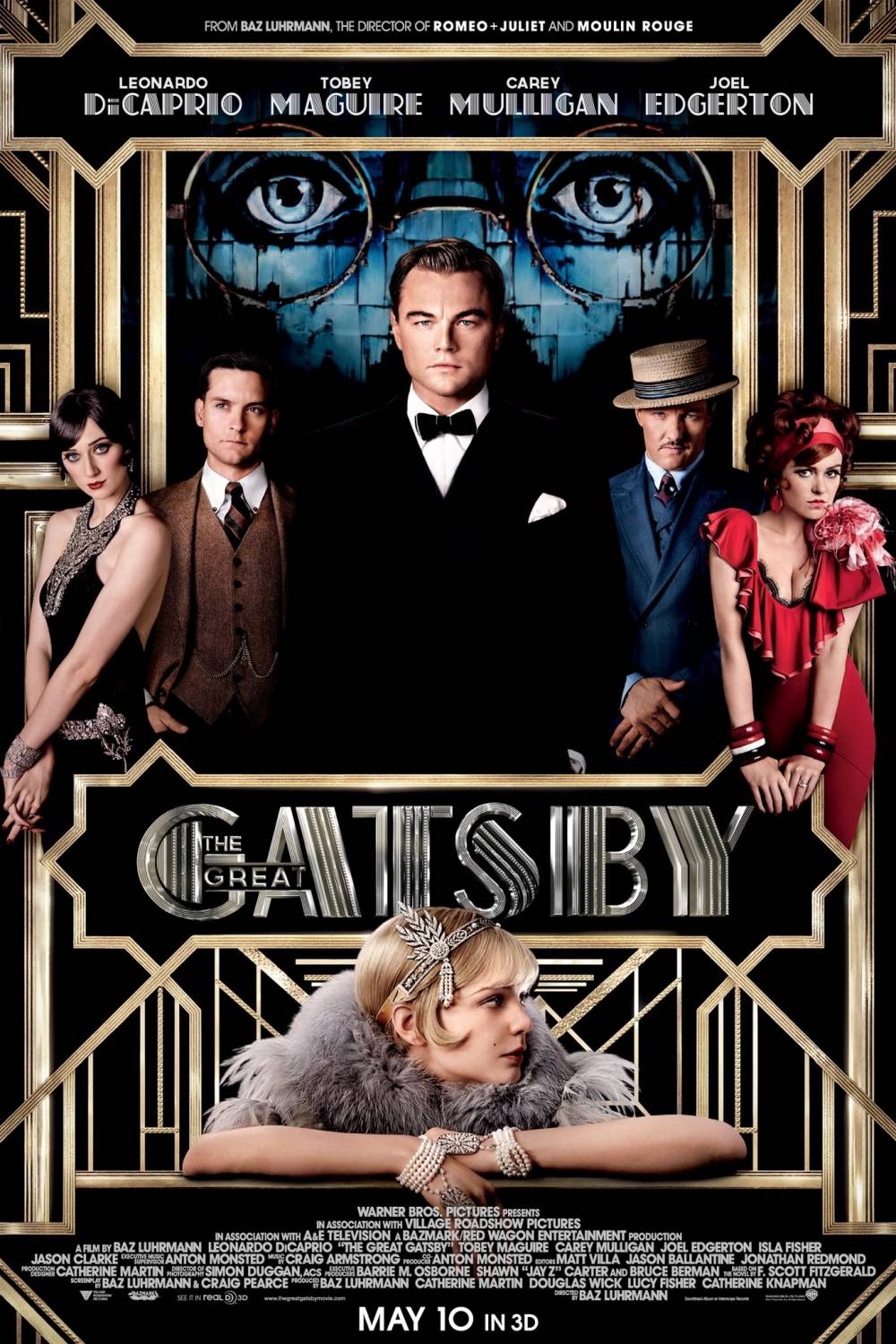
As Baz Luhrmann’s adaptation of the famous F. Scott Fitzgerald novel, The Great Gatsby stars Leonardo DiCaprio as the title character, Jay Gatsby, a very wealthy-yet-mysterious man seeking to rekindle his relationship with the woman he has loved for years, Daisy Buchanan (Carey Mulligan). The story is narrated by war veteran Nick Carraway (Tobey Maguire), who recalls his life living next door to Gatsby whose parties — attended by those from all over the country and overflowing with alcohol, entertainers and fireworks — are products of the Roaring Twenties, where the stock markets on Wall Street were booming and morale was at an all-time high post-World War I.
The Great Gatsby, or more aptly, ‘The Very Good Gatsby’, has Baz Luhrmann’s influence etched all over it, which by no means is a bad thing. Luhrmann, who had previously worked with DiCaprio on Romeo + Juliet, and whose recent directorial credits have included historical epic Australia and the extravagant Moulin Rouge!, certainly knows how to put on show — and more than anything else, The Great Gatsby is a spectacle. Everything from the acting to the set pieces to the costume design to the cinematography is set to full throttle here, as Luhrmann shows no restraint in his direction. And it needs to be this way: the man whose life the film centres on is an over-the-top, charismatic individual and therefore a film without extravagance would not have worked as well. Luhrmann puts the “Great” in The Great Gatsby, because had this film been anything different, it would probably have just been “Gatsby”.
“Jay Gatsby sure is tall.”
At a fairly substantial two hours and 20 minutes (or so) long, The Great Gatsby never really seems to let the pace drop which is a credit to Luhrmann and the writers, as too many lulls in the proceedings would have turned the film into a less-than-dramatic portrayal of a wealthy individual’s life. Personally, I feel that between the half hour and hour mark, there were a few extra-long party scenes which may have benefited from being trimmed down a little, but as I mentioned beforehand this may have taken a snippet of the excessive nature of the film away, a nature which The Great Gatsby relies on to be a success. The difference between, for example, The Hobbit: An Unexpected Journey (which, do not get me wrong, I enjoyed a lot) and The Great Gatsby is that just about every scene Luhrmann directs in Gatsby fulfils a necessary purpose in the plot, whereas An Unexpected Journey includes scenes which are, though entertaining, completely unneeded.
Since last working with Baz Luhrmann on Romeo + Juliet, Leonardo DiCaprio has moulded himself into one of the best actors in Hollywood at present (the best, for my money) and delivers another convincing, flamboyant performance as Jay Gatsby — a man who, on the exterior seems to have it all and lives the picturesque, glamorous life, whereas on the inside is broken and partially empty without the woman he has missed for five years. The mystique surrounding Gatsby during the first twenty minutes to half an hour of the film is very well executed, as he is a man seldom seen but mentioned very often, and spoke about with passion and awe. Tobey Maguire does a fine job carrying the film throughout the opening half hour or so, however as soon as DiCaprio arrives on the screen the film appears to move up another level (if that is even possible in a Baz Luhrmann offering). DiCaprio exudes importance and slickness as Gatsby and, as someone who has never read the book, completely sold me on the character. Tobey Maguire narrates the film very effectively and his voice never seems to make the film drag at any point. His on-screen acting is solid, much like it normally is, with himself and DiCaprio developing an intriguing dynamic throughout the piece (it is cool to see the two share the big screen together, having been very close friends since the early nineties). Carey Mulligan is elegance personified, balancing the correct amount of strength and frailty between her scenes with Gatsby and her husband, Tom Buchanan (Joel Edgerton — who is part of a very strong supporting cast boasting the likes of Isla Fisher).
“Good day, old spore.” “For the hundredth time it’s ‘sport’ – not ‘spore’!”
Much has been said about the modern soundtrack to the film which contains the likes of Jay-Z, Beyoncé and Lana Del Ray. Personally, I did not see a problem with it, in fact it gave The Great Gatsby an extra oomph which 1920s music would more than likely have withheld from offering. Although the film is set over ninety years ago, Luhrmann’s narrative provides modernity and the cinematography creates a classic-yet-fresh vibe throughout. The costume design harks back to the Roaring Twenties (I remember them well) without making the characters look outdated, and this is down to the bright colours — that pink suit Gatsby is wearing is a show-stealer — and the intricate details of each piece of clothing. The set design throughout the film is to the highest standard which helps to create that party atmosphere associated with Gatsby — by contrast, the Valley of Ashes (an industrial works situated between New York City and Long Island) has all the grit, sweat and coal required to reinforce that everything must begin from the bottom and work its way up, echoing the life of Gatsby.
Without giving any spoilers away (yes, there will be people who know nothing about with plot — much like myself beforehand), in a film where hope appears to dwindle throughout — and I stress ‘appears’ — the final few scenes were very well delivered in my eyes, with Tobey Maguire’s narration concluding the film in a seamless manner. The very philosophical final few moments essentially provide the basis for what has gone on throughout the film, which, at heart, is much more about desire and soul than extravagance and dazzling lights.
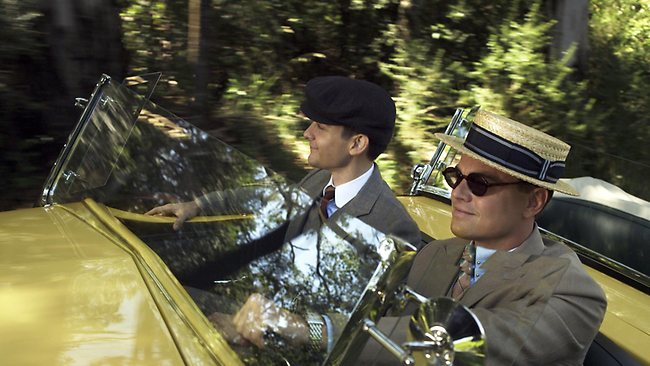
“Think we get to keep the car?”
One criticism which I do have is that, on a few occasions, the editing seems a touch off (when Gatsby and Carraway are in the car), but this is more of an annoyance than a significant error. Overall, in regards to such criticism as the film prefers style over substance, I do not believe this to be the case and that the substance is in there, just not always as apparent due to the overload of style. For rather than meaning the style completely overawes the substance, it signals that Luhrmann has done a tremendous job in creating a mysterious and distant Gatsby on the outside, who has bolted up his emotion on the inside — much like Gatsby is looking to rediscover that emotion he has long withheld since losing Daisy, the viewer must find the substance in the film for themselves.
Baz Luhrmann has been vindicated in summoning another Gatsby out of the ashes, as The Great Gatsby is a well-directed mesh of extravagance, emotion and booming life throughout the 1920s, all patched together triumphantly by way off Tobey Maguire’s narration as Nick Carraway, and wonderfully acted at the hands of the likes of Leonardo DiCaprio.
Guess what the next genre is? It is a mystery, isn’t it? No, it really is a mystery. Okay, enough of the shockingly bad jokes.
Not one of the more prominent genres, mystery tends to flirt around the edges of just about every other genre, without actually sticking out. However, there are a number of films which are defined by their mystery element. Personally, I am drawn towards films containing a mysterious element over most other types of films — mainly in the hope that such a film will keep me guessing all the way until the end.
Mystery films tend to be hit or miss — either the outcome of whatever mystery is going on is surprising or shocking or entertaining, or it is not. It will be to nobody’s surprise, then, that the five films on my list I consider to be five hits.
I have decided to change the format slightly from my previous Genre Toppers posts. The reasoning behind this is that I think reading large paragraphs over and over again can sometimes get a bit tedious, so hopefully this change will keep things more interesting. This newer format seems to work well with the mystery genre in particular, but who knows — I may use it again in the future.
Zodiac (2007)
From the acclaimed director David Fincher, Zodiac tells the story of one of San Francisco’s most notorious serial killers, known only as the Zodiac. Boasting a strong cast containing Robert Downey Jr, Jake Gyllenhaal and Mark Ruffalo, the film depicts the events surrounding the police investigation into the murders carried out during the 1960s and 1970s, and why the murders were occurring.
Where The Mystery Lies
Who is the serial killer known as the Zodiac, and what do the cryptic clues being sent to the police mean?
Three Top Five Clinching Reasons
Fincher’s target audience: Interestingly, Zodiac is David Fincher’s second-highest rated film on Rotten Tomatoes with 90% of critics enjoying it (second only to The Social Network at 96%), whereas it is Fincher’s lowest revenue-taking film, grabbing only (yeah, only) around $85 million worldwide. Why? Primarily because Fincher aimed the film towards a typically older audience, rather than playing up its slasher element and in turn appeasing only “16-year-old boys,” as Fincher put it.
“Hey, hey Jake — I’m Iron Man.” “Yeah, whatever Rob.”
Style and the 70s: Obviously I was not around in the late 1960s/early 1970s in order fully understand what those years were like, but Fincher certainly goes a long way to making sure Zodiac captures the tone and style of them. Everything from smoky newsrooms to wacky attires are in full display here, and although the film lasts over two and half hours, it is worth watching at that length just to enjoy the cinematography.
Delightful dialogue: The performances from the three leads in Zodiac are very convincing, and this is helped in no small part by the deliberate and encapsulating script the actors exchange between each other. Fincher has a knack for using excellent, well-crafted scripts (take Se7en and The Social Network as two prime examples) and Zodiac is no different. Gyllenhaal, Downey Jr and Ruffalo do the film and its words justice — in fact, the positive audience reaction combined with the lack of a well-rounded ending proves just how well the actors and writers have done to make the film so enjoyable.
Final Words
A slick, stylish and slow burning mystery drama, Zodiac keeps audiences interested through its exceptionally well-strung dialogue and interesting performances.
Exam (2009)
Released in 2009 and directed, written and produced by Stuart Hazeldine, Exam takes place in an alternative history and is set almost entirely in one room where a group of eight very different people must use their initiative to gain the employment they each desperately desire.
Where The Mystery Lies
The eight candidates are given one piece of paper and are told that the exam only consists of one question… but what is that question, and what is the correct answer?
Three Top Five Clinching Reasons
Unknown cast: A problem a film can sometimes face when it boasts a worldwide star is that the audience do not believe that such a level of star can actually be the character they are portraying (particularly if the character is a normal, everyday person). Exam benefits from a relatively unknown cast — apart from Colin Salmon, although he does not appear very often throughout the film, making his character seem even more important and separate from the candidates. The candidates themselves each bring their own nuances to the table, coming across as genuine employment seekers and making the film much more believable and engrossing.
“Phones to the front please.”
Simplicity is key: As you can probably gather from the synopsis above, the plot of Exam is very simple: eight candidates, one job, one question. That is it. Not only does this make the film easy to follow, it places more emphasis on the situation the characters find themselves in and adds focus to the characters themselves (in essence, this film is a character profile). The mystery is also heightened because it is not confusing — rather, it is intriguing.
Perfect pacing: Hazeldine ensures the film does not dwell on particular plot points, moving things along before they become stagnant, and coming back to events if need be. Again, this keeps the flow of the film just about right and ensures the audience’s attention is grasped and maintained. Also, the progression of the plot and the characters are both very well handled, generating more and more tension until the atmosphere becomes just about unbearable.
Final Words
Exam is the perfect example of how to make a small, low budget film with a simple plot and still be able to keep it intriguing, leaving the audience on the edge of their seats.
Sherlock Holmes (2009)
Guy Ritchie helms this reboot of the Sherlock Holmes franchise, starring Robert Downey Jr as Holmes, Jude Law as Watson and Rachel McAdams as former adversary Irene Adler. The story follows Holmes and Watson as they attempt to uncover the perpetrator of a series of violent murders and prevent this perpetrator from taking over the British Empire.
Where The Mystery Lies
Holmes and Watson must decipher how their familiar foe plans to control the British Empire — but how has the murderer returned from his apparent execution?
Three Top Five Clinching Reasons
At home with Holmes: Robert Downey Jr plays an enormous part in how enjoyable this film is — his portrayal of Sherlock Holmes is one of wit, intelligence, controlled chaos and downright hilarity. We are all used to seeing Downey Jr in charismatic roles (as Iron Man, for example) and here he seems completely in his comfort zone, which shows by way of his mesmerising depiction of Holmes — rivalled only by Benedict Cumberbatch’s portrayal in the hit television series, Sherlock. But not all the praise must be solely heaped on Downey Jr, as Jude Law is very effective in working as a buffer for Holmes to play off of. Mark Strong is as menacing as always playing the villain of the piece and Rachel McAdams is delightful as Irene Adler.
“That tie doesn’t suit you.”
Visually unique: The cinematographers and set designers deserve a vast amount of compliments for their old-fashioned-yet-energetic set pieces. It is a tremendous achievement in making London appear as it did back in the 19th century, but at the same time upholding a sense of freshness. Craftsmanship at its finest, if you ask me. Also, the slow motion fight sequences look effortlessly assembled and add an extra dimension to the film.
Action-packed: Guy Ritchie certainly does not hold back in terms of fight scenes (there are plenty) and explosions (they are in there too). At its simplest, Sherlock Holmes is an entertaining action film with plenty of well-choreographed physical encounters and a fast-moving plot which keeps the action going and prevents the film from losing its momentum. The action takes place everywhere too — from underground to occult chambers to the top of massive cranes.
Final Words
Quick-witted, funny, sometimes silly, but always entertaining — Sherlock Holmes is just about everything you expect from a Robert Downey Jr-led film.
Shutter Island (2010)
Based on the novel by Dennis Lehane, Shutter Island sees Martin Scorsese team up with Leonardo DiCaprio for the first time since The Departed in 2006, and the fourth time overall (soon to be a fifth, with The Wolf Of Wall Street hitting cinemas in late 2013). DiCaprio stars alongside Mark Ruffalo as two U.S. Marshals — Teddy Daniels and Chuck Aule respectively — who attempt to uncover the mysterious happenings on Shutter Island.
Where The Mystery Lies
Daniels and Aule must find out the whereabouts of a missing patient, but what is the real reason they have been summoned to the island? (That is all you are getting, sorry!)
Three Top Five Clinching Reasons
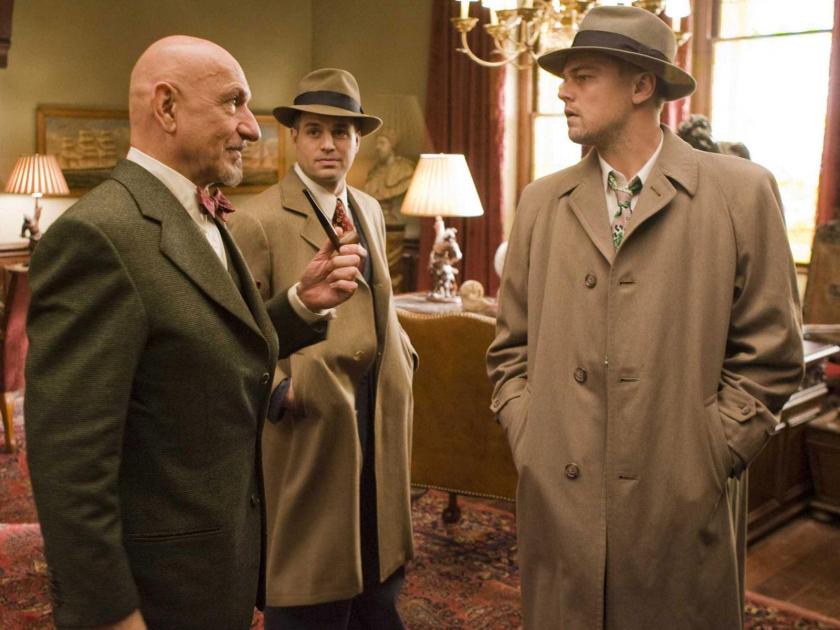
Creating a separation: The chemistry between DiCaprio and Ruffalo is very underrated here, in my opinion. It is obvious that the two are outstanding actors, which is once again apparent in this film, but they also work exceedingly well together, in turn creating a sense of disconnect between themselves and the rest of the residents of Shutter Island. This is essential to the story, and thus the performances from both DiCaprio and Ruffalo (and also Ben Kingsley to be fair, who plays Dr. John Cawley) are a key part to the success of Shutter Island.
“We have no wi-fi here.”
Shudder Island: There is an eerie and unnerving atmosphere generated throughout this film, and the creep factor increases as the film delves further and further into the mysterious happenings on the island. The film switches for brief moments to an almost comedic tone, but that tone is swept away by dread almost as soon as it begins. The unnerving atmosphere is aided, of course, by the sense that the two U.S. Marshals, although called to island by those on it, are alone and not wanted.
Musical mayhem: Another major player in the eerie atmosphere, the musical involvement in Shutter Island is as close to perfect as possible. From the foghorn sounding booming interludes throughout, to the seemingly out-of-place uplifting belts of opera (which completely add to the intentional confusion and lack of transparency during the film), the score is outrageous-yet-brilliant.
Final Words
I am a big fan of when DiCaprio and Scorsese work together because they always deliver, and Shutter Island is no different — in fact, it is my personal favourite output produced by the combination of the two.
The Prestige (2006)
From the man who brought us The Dark Knight trilogy and Inception, comes The Prestige, starring Hugh Jackman, Christian Bale and Scarlett Johansson. Jackman and Bale play two previously partnering magicians who have turned fierce rivals after an accident split the pair up. It is the ultimate battle of wit and nerve as each magician aims to better the other by creating and performing the greatest illusion of all time.
Where The Mystery Lies
It is a film about magic, right? Well, not entirely. Although a mystery element does exists and runs throughout — just how did he do it? (Again, that is all you are getting — I really cannot give too much away here!)
Three Top Five Clinching Reasons
Coming full circle: It would be a crime for me to sit here and write about what happens during the climax, because it is masterfully accomplished on-screen in my eyes. Everything from the beginning through to the main act (pun sort of intended), to the dialogue during the film build up to a quite extraordinary revelation, and one which I got nowhere near figuring out. I do not want to overhype the ending so much so that it will be an inevitable let down no matter what, but trust me, it is very good and it perfectly polishes off the non-linear plot the film possesses.
“Heads, i win. Tails, you lose.”
Caring about characters: Nolan allows each character to breathe (much like he does in the majority of his other films) and this allows each actor — even those whose characters only play a minor role — to fully develop their role and ensure the audience can become emotionally invested in them. The dynamic between the two duelling magicians, Robert Angier (Hugh Jackman) and Alfred Borden (Christian Bale) is electric at times, and the lengths they go in order to get one up on each other become believable due to the hatred Jackman and Bale successfully generate. Less prominent characters such as Michael Caine’s stage engineer, John Cutter, and Rebecca Hall’s Sarah Borden, Alfred’s wife, add further layers to the main duo, whilst Scarlett Johnasson’s Olivia Wenscombe acts as a spanner in the works.
More than just magic: As I mentioned above, although The Prestige contains a lot of magic, that is not the primary focus of the film. For me, the primary focus is the tumultuous relationship between two men and all that their relationship embodies, in terms of trust (or lack thereof), deceit and jealousy. Using magic as a background their relationship and these characteristics bolsters the overall plot, but it is the three aforementioned factors which give The Prestige substance.
Final Words
When talking about mystery the first destination is always magic, and The Prestige is Christopher Nolan’s way of pulling a rabbit out of the hat — just when you think he is being slightly over-ambitious, he absolutely nails it.
So there you have it, five excellent mystery films. Here are some honourable mentions:
Final Destination (2000) — Okay, this one is a bit of a cheat (pun intended). But in all seriousness, although Final Destination is technically a gross-out horror, it does have that mystery element to it ensuring that it does not just become a gore-fest. Which is basically does anyway. I tried.
Phone Booth (2002) — Similar to Exam in the sense that it is primarily set in one location, Phone Booth is intense and pacey, with a decent lead performance from Colin Farrell and an extra creepy voice-only performance from Kiefer Sutherland.
The Da Vinci Code (2006) — At approaching three hours long, The Da Vinci Code had a fair amount of people almost sleeping, but I enjoyed it quite a bit. Tom Hanks is a guy I could watch acting all day long.
A Perfect Getaway (2009) — This is about an hour of really disconcerting build-up surrounding three couples, one of which has a murderous streak. Then it goes a bit too action-like and loses some momentum. Regardless, a solid whodunit outing.
Devil (2010) — The mystery genre does tend to attract those single-location films, and we have another here, in Devil. Five people, one elevator and one devil… but who? A rare M. Night Shyamalan appearance in my blog.
Today I am focusing on some of my favourite films in the thriller genre. Just before I begin, I would like to be clear on how I make the distinction between thriller and action, because sometimes they seem to mesh into one. This is just my own personal way of telling both genres apart and there really is no right or wrong answer here — you may think something completely different!
Firstly, the main similarities between the two genres are the typically a fast-paced plot and, more often than not, a heroic character fighting off a villainous one in one way or another. For me, the separation tends to occur in the tone of the film. For example, a thriller seeks out suspense and jeopardy as the driving force, whereas an action film is all about excitement and liveliness. Also — and again this is just the way I see it — action films tend to be more light-hearted than thrillers (not always, but generally).
Anyway, on to five greats!
Skyfall (2012)
The newest film on the list, Skyfall was released in October 2012 and declared instantly by the vast majority of viewers to be the best Bond film ever. Helmed by Sam Mendes and with Daniel Craig reprising his role as James Bond, the film follows Bond’s relationship with M (Judi Dench) throughout his investigation of a violent attack on MI6 at the hands of former agent Raoul Silva (Javier Bardem) who is out for revenge.
“Looks like it’s gonna rain.”
As I mentioned earlier, Skyfall has been touted as the best Bond film ever by audiences and critics alike, and has now grossed well over $1 billion which makes it — as of writing — the eighth highest grossing film of all time. That tells you that Sam Mendes done something right. In fact, he done just about everything right in this emotional roller coaster ride. For the first time, the audience is invited into the ins and outs of the relationship between Bond and M which makes this instalment more weighty and heartfelt, yet it still maintains that slickness that has always been associated with the franchise. Mendes has a stellar cast at his disposal — joining Daniel Craig (who plays his best Bond to date opposite Judi Dench, in my opinion) in Skyfall are newcomers to the franchise Ralph Fiennes, Ben Wishaw and Naomie Harris who each add their own nuances to the film (Wishaw is particularly good as Q). However, the star of the show is Javier Bardem with his charismatic, extravagant portrayal of villain Raoul Silva. On a par with Mads Mikkelsen in Casino Royale (we will just ignore Quantum of Solace for now) Bardem is hugely effective opposite Craig and the two flourish as a result.
Although Bond has become a genre on its own essentially, Skyfall claims a spot in my top thriller films for its crisp, free-flowing script and interesting characters.
No Country For Old Men (2007)
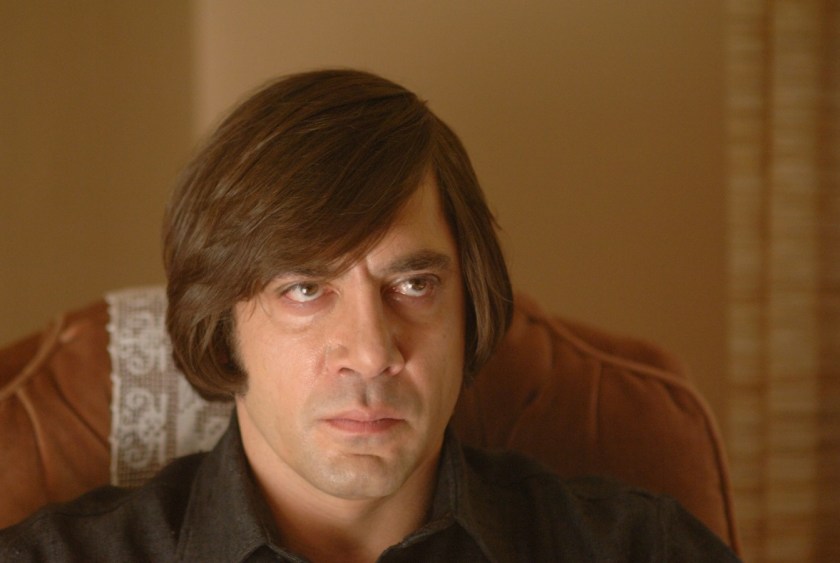
“Do not insult my hair again.”
No Country For Old Men is an Academy Award winning 2007 film directed by Joel and Ethan Coen (or just the Coen brothers). The plot surrounds Josh Brolin’s character, hunter Llewelyn Moss after he uncovers over $2 million worth of cash at a drug deal gone wrong and is pursued as a result by vicious hitman Anton Chigurh (Javier Bardem) who has been hired to recover the stolen cash. Meanwhile, almost retired sheriff, Ed Tom Bell (Tommy Lee Jones) finds himself thrust directly into the cat-and-mouse chase between the two.
It is not often the Coen Brothers get it wrong and, true to form, No Country For Old Men is a knockout. This marks Javier Bardem’s second appearance on my list, and for the second time he steals the show. Bardem is excellent at portraying a psychotic, emotionless killer and his aura throughout the film adds to the creepy, on-the-edge, thriller-ish atmosphere. Both Josh Brolin and Tommy Lee Jones are terrific in their depictions of a desperate war veteran and a straight-to-the-point county sheriff respectively. The 1980s Texas setting truly adds to the grit (wink) and once again proves just how good a pair of eyes the Coen Brothers have at selecting locations for their films — have a look at Fargo and O Brother, Where Art Thou? if you do not believe me.
No Country For Old Men is captivating and intense, just two of the many characteristics which make it a very enjoyable thriller.
Argo (2012)
“Screw the Oscars, man”
Ben Affleck’s third directorial feature, political thriller Argo, opened in cinemas a few weeks before Skyfall in October 2012 and stars Affleck, Alan Arkin and Bryan Cranston. The film is a dramatisation of the Iranian hostage crisis in the 1980s where six fugitive American diplomats require assistance in the form of extraction out of Iran from CIA specialist Tony Mendez (Ben Affleck).
I cannot wait for Affleck’s next film, because this one is absolutely outstanding. Argo defines the thriller genre — every characteristic required to make this film a success is in there. Gripping, intense, polished and stylish, Argo delivers on all fronts. For a political thriller, the plot is not difficult to follow, yet it remains shrewd and without any glaring mishaps. One of the more surprising elements here, particularly following the terrifying opening sequence, are the pockets of dark comedy splattered throughout the film which by no means feel out of place. Affleck manages to equate the frantic goings-on with enough dark humour to ensure the film does not become too lifeless or overbearing. Each of the performances from the cast are solid, with Alan Arkin standing out in particular, but the constantly flowing nature of the plot is the key to this film’s success.
How Ben Affleck was snubbed by the Oscars (he did not receive a nod in the Best Director category) is beyond me. Argo is a must-see film and definitely one of the best released in 2012.
Inception (2010)
Directed by Christopher Nolan, the summer blockbuster of 2010, Inception, stars a jam-packed ensemble cast lead by Leonardo DiCaprio, who receives his support from the likes of Ellen Page, Tom Hardy, Joseph Gordon-Levitt, Cillian Murphy and Marion Cotillard (the list goes on). DiCaprio plays Dom Cobb, an extractor — or plainer terms, a thief — who enters his subject’s dreams in order to carry out an extraction. When he is offered the chance to see his children again, Cobb must assemble a team of specialists together in order to plant an idea into his target’s (Cillian Murphy) subconscious — a process known as inception.
“My bad.”
I am probably going be referring to film critic Mark Kermode a lot during this next paragraph, because his review of Inception is one of the best I have heard. Massive summer blockbusters are sometimes tarred (often justifiably) as being big money-making schemes with very little for their audience, who have become accustomed to seeing films where absolutely nothing happens other than some pointless, soulless action sequences (I am looking at you Michael Bay). Kermode attributes this to a small percentage of filmmakers perhaps assuming their audience is too ‘dumb’ to be able to watch a film and at the same time… think. Yes, think. It really is absurd, but it does appear to happen. Look at Transformers for example: the whole franchise is nothing more than robots hitting each other, which is fine once (I suppose), but not over and over again until it becomes so intolerable it hurts to watch. Inception, however, is a perfect example of a massive blockbuster that provides enough action and thrills to appease everyone, but also makes its audience think during the film — and it worked, because the film has taken over $825 million. Why? Because people appreciate that Christopher Nolan is looking out for his audience and making films that will challenge them, but that are also highly enjoyable (The Dark Knight trilogy being another example). Also, because Inception had a number of different layers to it (both literally and figuratively) and because people enjoyed it, some then had to go back and see it again in order for them to fully understand it! That does not mean those people are dumb, quite the opposite in fact: it means they are thinking.
But I digress. Inception is a show-stopping thriller stuffed full of ideas, great performances, amazing visual effects, comedic moments and even some emotion (look it up, Bay).
Blood Diamond (2006)
“Is my accent really that bad?”
The oldest film on my list (albeit not very old), Blood Diamond is another political thriller starring Leonardo DiCaprio. This time he accompanied by Djimon Hounsou and Jennifer Connelly in a Sierra Leone setting. At the height of the Sierra Leone civil war (1996-2001), smuggler Danny Archer (DiCaprio) teams with a local fisherman (Hounsou) and a reporter (Connelly) in an attempt to seek out and gain possession of a large diamond, with each of the three boasting different motives.
Leonardo DiCaprio (incidentally, my favourite actor) gets a bad rap for his South African accent in this film — it sounds great to me, but maybe I am touch biased. I doubt that. The performances are very strong, with all three protagonists providing a combination of fury, optimism, emotion and anguish to accompany the desperate situation they find themselves in (particularly DiCaprio and Hounsou). The story moves at greater-than-steady pace which provides the thriller-ish aspect which the film has in abundance, with Edward Zwick’s narrative ensuring the audience remains grasped throughout. Part of the formula which contributes to Blood Diamond’s success in my eyes, is its realism as it depicts some of the hardships most civilians staying in Sierra Leone (and elsewhere) were going through during the civil war. A few of the scenes are harrowing, not in a particularly gory way, but because they dramatise atrocities occurring around the world. I would say, however, that Zwick does not make these scenes exploitative in away way — they are an essential part of the story. On a last note, the African setting is absolutely stunning and almost becomes a character itself during the film.
Blood Diamond really hits home in its realistic nature, and at the same time serves up a gripping tale of two very different men with one common goal.
And now for some honourable mentions:
Se7en (1995) — This is a very accomplished horror story about two men tracking down a serial killer who leaves them clues in the form of the Seven Deadly Sins… only, with people involved. Morgan Freeman and a young Brad Pitt excel in their roles.
The Talented Mr. Ripley (1999) — At times you get obsession, then you get Matt Damon in The Talented Mr. Ripley. What opens as a fairly innocent thriller closes with just enough menace to fill anyone for a day. Or a lifetime.
Inside Man (2006) — A very underrated film in my opinion, Inside Man sees the charismatic Denzel Washington tasked with rescuing a bunch of civilians caught up in a bank robbery masterminded by Clive Owen. Very intriguing action with a wonderful twist.
Taken (2008) — I think just about everybody has seen Taken — it’s on the TV at least once every week (and weirdly, it costs exactly three pounds in just about every shop in Scotland). Often brutal, always entertaining and the birth Liam Neeson: action star.
Wrecked (2010) — A small, independent thriller starring Adrien Brody as a man who wakes up in the middle of a forest after a car accident he cannot remember anything about. Interesting, dramatic and unique.
Source Code (2011) — This may make an appearance on another list, but as a thriller it just about misses out my top five. Therefore, I will refrain from saying much more for now (but it is very, very good).
What are some of your favourite thriller films?
(Note: Mark Kermode reviews each week’s new film releases between 2-4pm on Fridays with Simon Mayo on BBC Radio 5live, so check them out if you like films, or flappy hands. You will not regret it.)
 Director: Baz Luhrmann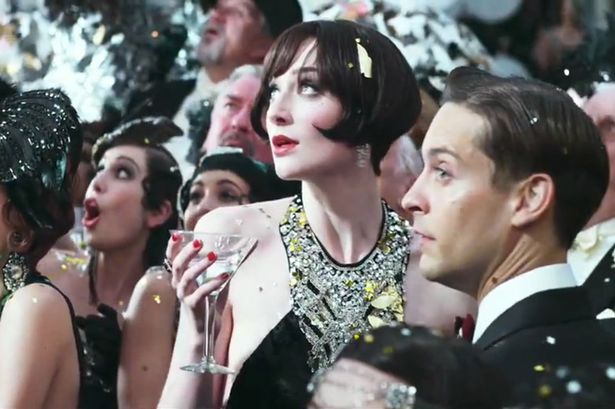







 Consumed By Film