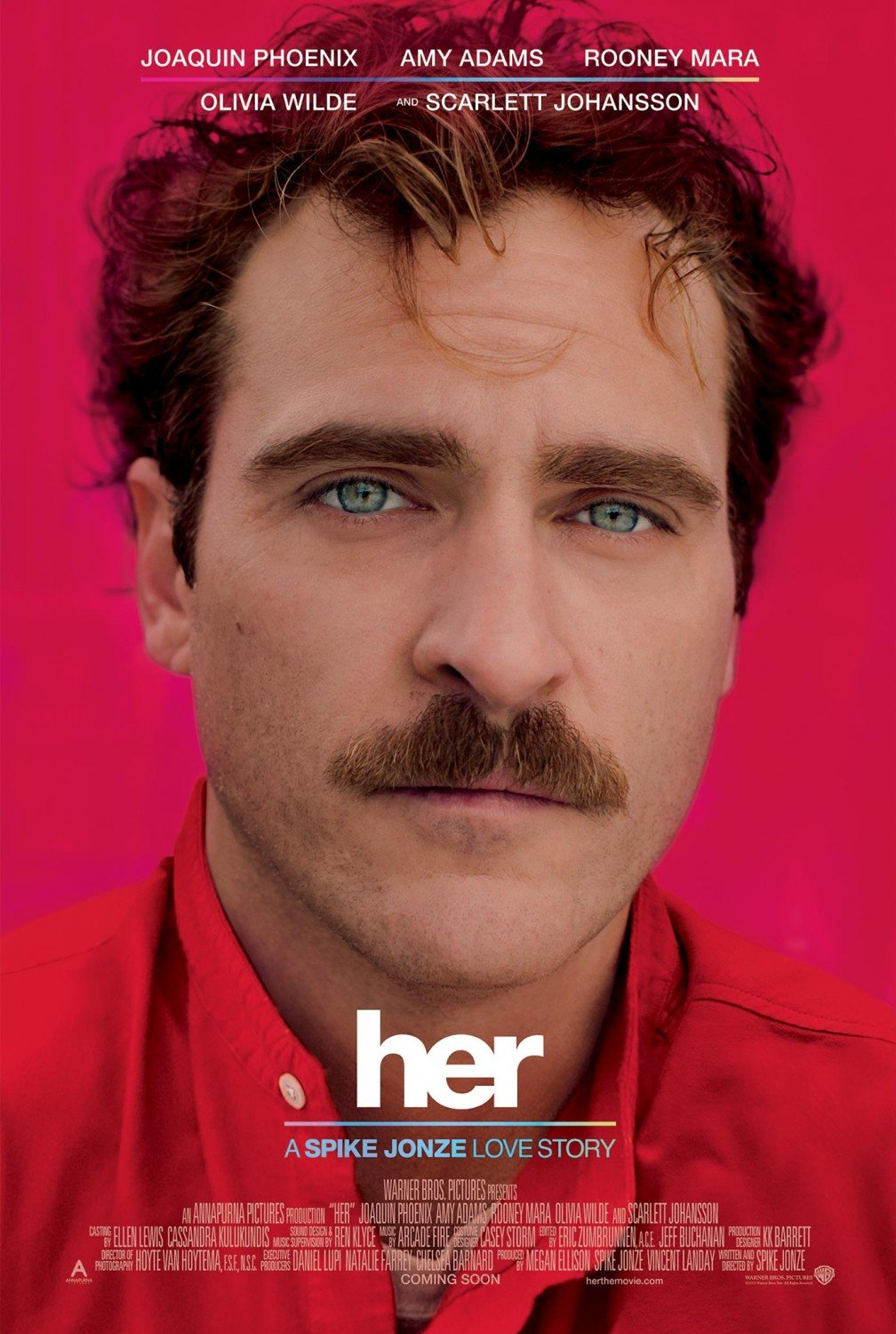
Her (2014)

★★★

Director: Spike Jonze

Release Date: January 10th, 2014 (US); February 14th, 2014 (UK)

Genre: Drama; Romance; Science fiction

Starring: Joaquin Phoenix, Amy Adams, Scarlett Johansson

The last time Joaquin Phoenix and Amy Adams acted side-by-side they were components of an enigmatic collective, including the late Philip Seymour Hoffman, in an enigmatic film, The Master. Perhaps Scarlett Johansson’s most well-regarded stint in-front of camera was as part of Lost in Translation, and there are echoes here of that wayward soul in a hasty world mantra. Surprisingly then — given Phoenix, Adams and Johansson’s presence — Her somewhat ambles along uncertainly. Unlike The Master, it never reaches the pinnacle of engrossment, and it doesn’t quite have that admirable ambience of Lost in Translation. There is something delicate and charming though, admittedly often deriving from the performances of our fair trio. Yet aside from its lively textures, there’s a lacking sharpness, a missing clarity. Sometimes it’s all in the name, and the world in which Theodore Twombly exists is all a bit, well, wibbly-twombly.

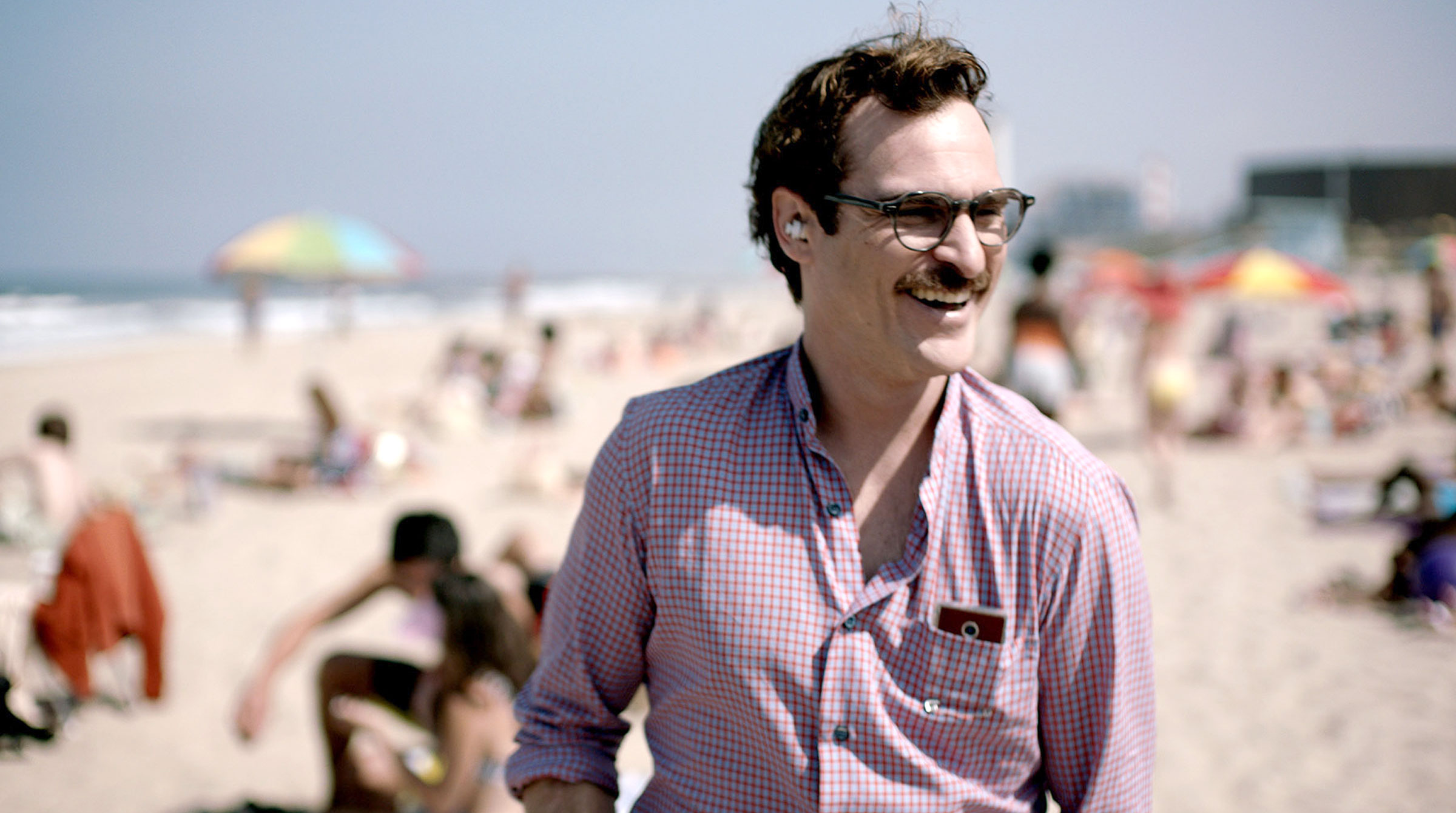
It’s 2025 and Theodore Twombly (Joaquin Phoenix) splits his time between love letter composition for those unable to elaborate on their feelings, engaging in virtual gaming, and moping about his impending divorce. Given his own stuttering when it comes to expressing emotions, it’s miraculous that Theodore succeeds in his paraphrasing-mediation job. Inward and suitably unnoticeable among the masses of technology consumed beings, Theodore decides to invest in a brand new OS system, shortly thereafter named Samantha (Scarlett Johansson). At first he’s unsure, but still awkwardly encapsulated; by the impossibly sophisticated technology, the presence of something new in his life, and more than anything, Samantha’s sultry voice.

A voice that absolutely entices. Scarlett Johansson delivers a pitch perfect audio performance that rings both affectionate and strong-willed, increasingly growing in knowledge and pseudo-humanity. As viewers, we know of Johansson’s actual beauty and picture her as the OS system exhales airwaves, therefore it is easier to grasp on to her allure and, ultimately, understand why Theodore is becoming more and more infatuated with those wispy tones. Essentially, we see what he hears. On the empirical side of things, Joaquin Phoenix amiably bumbles as the lead. In reality Phoenix has a tough job, considering many of his conversations take place without the presence of another human being, and there’s no central location for him to direct speech towards. In evading this obstacle, Phoenix creates a flailing uncertainty that, even in direct conversation with another body, would probably still have him glancing from ceiling to floor. Theodore’s fidgety, glasses-adjusting unsettled social existence works well, in turn ensuring another successful acting outing for Phoenix.

Aptly, women are the order of the day in Her and another three effectively contribute, only in smaller doses. Olivia Wilde manifests as Theodore’s date, spiky in exterior yet personifying that lack of assurance that runs throughout the film. Soon-to-be ex-wife Catherine is played by Rooney Mara, appearing in a few montages and even fewer real-time scenes. Mara is fine, but doesn’t really see enough light of day to develop character-wise. Amy Adams gets a lot more screen time as Theodore’s childhood friend Amy and, much like her mate, is adoringly awkward. Which raises the first issue – the pair are so alike, seemingly very close and totally get on, so why are they not together? When we meet Theodore he is recently removed from a committed relationship, and Amy’s collapsing love life isn’t far behind. The premise obviously demands that there be an absorbing connection between its characters and their technologies, but the narrative still seems far-fetched in that neither Theodore nor Amy ever raise the issue of a potential relationship between the pair, which considering all the evidence, would be a flourishing escapade. Perhaps Amy’s human-on-human romance exfoliating with negativity subsequently forces Theodore’s mechanical-driven desire.

The insistence, then, on contemplating and evoking a social commentary on how civilisation is becoming enslaved by technology, starts edging towards overbearing status. Constantly, the screen cuts from unfolding events to convey the number of humans seen aimlessly wandering with an electronic voice in one ear. Yet a number of these techno-captives — not all — still convey surprise when Theodore details his rapport with an OS system (“You’re dating your computer?”). The notion is weird for the viewer, of course, but in the context of a future world driven by the machine, Theodore’s budding romance doesn’t really seem all that peculiar. To get around this, writer-director Spike Jonze delves further into the land of philosophical thought, encountering Samantha as she raises her own moral dichotomy. “Are these feelings real, or are they just programming?” she wonders worriedly. Is she even a she? Instead of Her, would Thing be a more suitable title? For a while, this dilemma sort of works as it becomes more about the creation of a new, potentially dominant artificial intelligence, rather than a human-computer relationship. Inevitably though, it wears.

Once Jonze gets past the schmaltz and hit-or-miss musings (“The past is just a story we tell ourselves” — guess I don’t need to return that television I stole yesterday then) and focuses on purely simplicity, Her really hits its stride. When Theodore and Samantha are having banterous, funny conversations, that’s when the film oozes charm and good-natured infectiousness. Moments of energy reign supreme over soliloquies of sad reflection. The film is encased in vibrancy, a future world that somehow gleams with a retro feel, almost as if we’ve returned to the inception of computers rather than their sovereignty. Theodore’s moustache is as welcome as his bright orange shirt and the multicoloured glass windows his office. This glossy texture, coupled with a hypnotic soundtrack not dissimilar to that of Lost in Translation, aids in capturing a setting that you wouldn’t mind spending hours encapsulated in.

Strong performances provide Spike Jonze’s Her with a required dose of oomph, as often the director’s relentless societal ponderings become too much or increasingly repetitive. Having said that, the film is entirely watchable and probably just as rewatchable, given its wonderful cinematography and generous atmosphere. Despite a few significant misgivings, Her is actually pretty good fun.
2001: A Space Odyssey (1968)

★★★★★

Director: Stanley Kubrick

Release Date: April 3rd, 1968 (US limited)

Genre: Adventure; Mystery; Science-fiction

Starring: Keir Dullea, Gary Lockwood, William Sylvester, Douglas Rain

Where to begin?

The beginning of time, apparently. A group of apes, shepherded by an apparent leader, are growled at and hounded from their waterhole having already lost a member via the scissor-like teeth of a leopard. It appears; seemingly from nowhere, from nothing: a large and brooding object, known as the monolith. The beasts shriek, cower and then gain strength in its presence. Shortly thereafter, the now tactical, abrasive early hominids have reclaimed their waterhole. Clutching a bone, envisioning a tool, the leader tosses his symbol of construction, destruction and all else into air.

We’re floating in space.

It truly is a remarkable opening sequence, Stanley Kubrick’s depiction of premature life dissolving into an achievement-driven existence, an existence embodied by the amazing feat of spatial prosperity. By squashing life’s inception all the way through to thriving humanity into only a few minutes, is Kubrick trivialising said time period? Is he playing down the importance of thousands of years in anticipation of what is to come next? Perhaps. Yet it is the black structure, the monolith that is most intriguing. So odd in its appearance, the edged object turns ominous; what of its instantly empowering effect on the apes? Stanley Kubrick’s 2001: A Space Odyssey is one of the most influential pieces of cinema, of art, to be born out of the last century, and in less than 10 minutes it pillages viewers with more questions than answers. Over a two hour and 40 minute run-time these questions double, treble, as Kubrick raises issue after issue including our reliance on machines, mechanical manipulation, the significance of alien existence, of shapes even. He does all of this whilst celebrating humankind and our limitless prerogative. It’s wonderful.

Zarathustra, speak. Cue the brass…

Across four far-reaching periods of time, each one linked existentially and thematically to the next, 2001: A Space Odyssey engages in a tale — the tale — of life. After encountering the early hominid creatures, we ascend over the horizon into space and join Dr. Heywood R. Floyd (William Sylvester) are he prepares for a mission to Clavius Base in the midst of some abnormal goings-on. The narrative sprints ahead thereafter, to the Jupiter Mission, doctors Frank Poole (Gary Lockwood) and David Bowman (Keir Dullea), and their increasingly claustrophobic relationship with ship computer HAL 9000 (Douglas Rain). Finally, Kubrick takes us on a peculiar and tantalising journey across, through and around the cosmos, blanketed in an array of magnificent cosmological phenomena.

This collection of chronological mini-movies, although odd at first glance, succeeds two-fold: in compounding the monumental story being told, and in detailing the development of mindful curiosity, technological prowess and emotional manipulation. The first strand — the only section to be located on land — portrays everything primitive. The ape, soon to become man. The waterhole, soon to become territory. The bone, soon to become a sword, and a sceptre, and a hammer. It’s smart, cunning almost, as the sequence sets your brain clogs in motion. And the viewer’s mind is certainly going to need to be switched on, as the black vacuum above plays host to everything that follows.

An iconic image: the bone thrown and subsequently plummeting through the air, snappily followed by a space shuttle harnessed by gravity. Perhaps an indication of humankind’s selfishly perceived stability all these years later. Selfish in their control over nature, and negligence of mechanical reliance. Machines that seemingly have a “dependence on people,” at least that’s the view of Heywood, and later both Frank and David. Kubrick switches his line of questioning, batting that now aged-old ‘man versus machine’ adage that was gaining prominence around the film’s release in 1968. The internal AI system, HAL, is essentially the ticking heart of Discovery One, Frank and David’s space liner — HAL’s physical appearance burns a bright reddish-orange, symbolising the sun. Yet the system is almost secondary to the humans on board, simply a part of their routine; machinery assists in cooking food (unlike the raw meat off the slain bone eaten by apes), in steering the ship, providing entertainment (HAL wins at a game of chess), and almost all else.

This notion of machine-driven consumption prevails throughout the film, climaxing in HAL’s eventual devilishness and therefore implying both that machine has absolute rule over man, and that it is perhaps the next stage in the evolution of life. Douglas Rain is deadpan as the system’s voice, verbalising in an incredibly unassuming-turned-condescending manner (“Without your space helmet, Dave, you’re going to find that rather difficult”). Coincidentally, this converging relationship between man and machine has once again reared its societal hand recently, in Spike Jonze’s Her, a story about a man who falls in love with his AI system. The topic is an intriguing one, and Stanley Kubrick tackles it as well as anybody has done (or will do).

There are also other subtexts rummaging around, including our intrinsic attraction to the search for alien existence, conveyed by how characters interact with the menacing monoliths scattered throughout. Another irregular data byte comes by way of shapes — the sphere: HAL, the ship’s centre, and planet Earth indicating a form of coming full circle; the rectangle: those brooding and dangerous monoliths, offering no leeway; and the picturesque octagon: part of Discovery One’s walkway, an uncommon shape signalling strange happenings.

Interspersed within this ocean of thought-provoking query is a soundtrack as wide-ranging as the eon covered, yet one that maintains a common brassy undertone. Celebratory and grandiose, Richard Strauss’ “Thus Spoke Zarathustra” blares as a triumphant recognition of achievement. Conversely, scores of haunting, ghostly tones wail out like human souls in fear of extraterrestrials; it’s the ambience of the unknown. Geoffrey Unsworth has a whole universe to work with, and his cinematography is marvellous. The special effects, though obviously not up to present day standards, are admirable in their imagination — the influence of the camera work on show here can be seen propelling modern movies like Gravity. Performances from Keir Dullea, Gary Lockwood, and William Sylvester are by no means the centrepiece of proceedings, but Dullea in particularly stands out depicting of the authority-battling and bearings-losing Dr. David Bowman.

Stanley Kubrick films are renowned for offering more questions than answers. This potentially problematic mantra shows no sign of miss-deployment here, instead thriving in tandem with 2001: A Space Odyssey, a film that encompasses all of time and that debates the multitude of lives lived throughout.

Images copyright (©): Metro-Goldwyn-Mayer

The Blogscars!

Well that pithy attempt at a punny title went awry.

Don’t worry, this is not a post on injured bloggers, or deformed blogs for that matter.

Credit: Oscars.org

Hey! It’s award season, and I’ve been nominated for my first blog award…

The Liebster Award!

I feel like I’ve just starred in Jerry Maguire and won Best Supporting Actor, only the Blog Gods have given me more than two minutes to exclaim my thank yous. Or perhaps that’s just down to my lack of being constrained by a rapidly flowing, live three hour televised window.

This is all very suave. I don’t really know what I’m doing, a bit like Jacqueline Bisset at this year’s Golden Globes. Okay, maybe not that bad. Or externally influenced. I digress, taking my lead from the business’ best and most bumbling in doing so; this isn’t about me, this is about all of you brilliant people – and occasional spam-bots – who read my film ramblings. Particularly, a huge thanks to the wonderful Cara over at Silver Screen Serenade whose insightful, funny and positively effervescent blog is a must read for film fans, television nuts and life folks in general! Check it out now if you haven’t already done so (though I’m sure you have). I’m also following Cara’s awards blog layout, because it’s far too nifty to ignore.

The Liebster Award rules, then:

  • Nominated bloggers must link back to the blogger who nominated them.
  • Nominees must answer the eleven questions set out by their nominator.
  • Nominated bloggers must also select eleven other terrific blogs with less than 200 followers – though a few of mine are a little above that figure – nominate, and then prescribe them eleven tantalising questions (or, make up some head-shakingly unimaginative queries, as I have done).
  • If nominated, you cannot nominate the person who originally nominated you.

Anyone else starting to verbally trip over that nonimate, err, nominate word?

Enough about rules, down with the machine! etc.

Let’s get going with Cara’s questions, all about FAVOURITES:

1. Vacation spot?

Being Scottish, I’ve spent many a holiday abroad over in Spain (we’re very particular, apparently). I did go to America a few years back though, when I played football (soccer), and absolutely loved it. The whole team went over; we paired off and lived with American families for most of the trip, and I was based in a wooded, pristine Pennsylvania neighbourhood. After spending a day in New York, I eulogise over returning.

2. Color?

Red, as you can probably tell looking at my blog’s header and logo!

3. Dessert?

Shockingly, I’m not a big dessert guy (or a big guy in general, so it’s not really that shocking after all) but I do enjoy vanilla ice-cream stacked on top of a warm chocolate fudge cake every now and again.

4. Black-and-white movie?

It’s a Wonderful Life, without question. That film is delightful.

5. Superhero?

I’ve never read a comic book, so purely based on films and television shows, Batman. Chris Nolan made Batman cool again. Don’t ruin it Snyder.

6. TV show?

This is a tough one. I watch far too much TV, and often have upwards of ten different series’ recorded and ready to watch. I’m gonna have three, because ‘down with the machine!’ etc., remember? Two that aren’t on anymore but are crazily different and therefore I cannot separate: Friends and LOST. I got into Friends over in the States actually. We watched it almost every night and I became glued, such a smartly humorous, charming show. LOST, I watched from start to finish as it aired on the tele. It gets a bad rap for the finale, but it absolutely had me going. A truly stupendous first season. Of the current shows on air, it’s gonna have to be The Walking Dead. I’m intrigued by the whole zombie/apocalypse (and zombie apocalypse) genre. Having said all of that, True Detective begins over here tomorrow and I’m big on Matt McCon at the moment – we’re on a nickname basis.

7. Book?

I don’t read as much as I should, but off the top of my head I’m going to pick The Hobbit. It’s all very adventurous, and funny, and good-natured.

8. Beatles song?

“Let It Be”. Sorry for being so generic!

9. Dog breed?

Labrador, like the little guy in those Andrex adverts!

10. Beverage?

I’m a sucker for Citrus Oasis, or any other orangey drink. Alcohol-wise, I’ve only really ever tried Budweiser, and haven’t consumed alcohol since!

11. Nerdy franchise (Harry Potter, Lord of the Rings, Marvel, etc.)?

Nerdy franchise? Hmm, evidently I’m quite a nerd when it comes to anything in the film (and television) Milky Way, but The Lord of the Rings is my favourite film trilogy/franchise so I’ll go with that!

Now, here are the magnificent 11 I’d like to give a shout-out to!

Since I’m all about the big screen, I’m going to compile a completely random, totally unserious list of film questions. Now then, should you guys choose to accept them (and please don’t feel the need to if it’s not your thing, or you’ve already been nominated!) here are my 11 quick-fire questions:

  1. Name one film that you have yet to see, but should’ve seen by now.
  2. Do you keep a list of every film you watch, and when?
  3. What is the first film that comes to mind when you read the following word: Guitar?
  4. What is your favourite Leo DiCaprio film?
  5. Name a film that you personally dislike, but that everyone else seems to love.
  6. What is your first film-related memory?
  7. Do you listen to any film podcasts, or radio shows, or watch any television review shows?
  8. Does the phrase “Hello to Jason Isaacs” mean anything to you?
  9. Was The Phantom Menace really THAT bad?
  10. What is your favourite film that is underappreciated elsewhere?
  11. When you hear the name Shia LaBeouf, what type of meat springs to mind? 

Have fun!

Oh, and if I’ve utterly messed all of this up and ruined the award-chain, I will repent at the feet of the Blog Gods for the rest of eternity.

12 Years a Slave (2014)

★★★★★

Director: Steve McQueen

Release Date: November 8th, 2013 (US); January 10th, 2014 (UK)

Genre: Biography; Drama; History

Starring: Chiwetel Ejiofor, Michael Fassbender, Lupita Nyong’o

“I will not fall into despair till freedom is opportune!”

Those purposeful words, you will have heard over the last few months in trailers, adverts and previews. They are strong-willed; in one sense uplifting, yet in another more visceral sense, haunted by humanity’s most evil endeavours. Despair and freedom, traits inversely diverging in the life, rather, the existence of Solomon Norfolk. Steve McQueen challenges us to consider and then reconsider as his depiction of the animalistic slave trade hammers with shock, but does not rely on it. For the most part, the moments of solitude and silence profoundly exhibit a monstrous reality lived by those such as the remorseless slave owner Edwin Epps. There are no punches pulled, no whippings recoiled; McQueen’s 12 Years a Slave is a harrowing watch without question. More than that though, it is a necessary watch. Not to reassure a cultural ridding that hasn’t fully been expunged. Rather, to condemn what should never have occurred, and to shed a flicker of true resilience on a truly despicable time.

A well-off and considerate skilled carpenter, Solomon Norfolk (Chiwetel Ejiofor) tends to the every need of his young family. It’s 1841 and the slave trade is rife with wealthy disregard. Approached by two not noticeably iffy gentlemen, Solomon — a fiddle player at heart — is offered an extended musical job, an offer greeted with appreciative acceptance. After a drunken night, he awakens in chains, stripped of his identity and mercilessly pawned. 12 Years a Slave tells Solomon’s harrowing story, as he is traded from a would-be sympathetic slave owner (that is, if such a juxtaposition exists) to the vile, despicable Edwin Epps (Michael Fassbender) who has abomination clenched in his fists and the abyss peering through his eyes.

This is an intense watch, no doubt. Not necessarily because it’s another retelling of a horrible time — though that alone warrants attention and denouncing. Rather, it comes down to how Steve McQueen unflinchingly tells the story. His directorial application is admirable in that no disservice is done to those who fell victim to slavery, this isn’t in any remote sense a Hollywood-esque drama bloated full of riveting set pieces or manipulative tones. Nor is it buoyed by a somewhat ironic, semi-exploitative raft akin to that of Quentin Tarantino’s Django Unchained, a cinematic spectacle in every sense. 12 Years a Slave is real life, a reflection of events not so long gone. You may judge success on ticket sales, or audience reception, or even personal affirmation, but there’s also a genuine feeling abound that McQueen’s priorities are and would always have been aligned alongside authentic storytelling regardless. His straightforward devotion to re-imagining the unimaginable is admirable, and it’s this wholeheartedness that enables the viewer to watch with an only just an ounce of ease, but an ounce nonetheless.

From the point of his wrongful capture, Solomon wrestles with a tragic dignity-driven dilemma: does he succumb to hate to become bastion of support for his helpless compatriots already grappled by despair, or does he stoutly, fearlessly stare directly into the heartlessness of one of humanity’s worst episodes? Initially, Solomon is disbelieving, perhaps as much of slavery’s existence as of his own forced manoeuvre into it. “They were not kidnappers, they were artists… fellow performers,” he wrongly assures, detailing those absolutely iffy gentlemen. Maybe if he can convince someone, anyone, they’ll see sense. But there is no sense, not in the racist pits of Southern USA. Everywhere Solomon glances there is a monster in human skin. The slave-trader, auctioning off people like watches (“My sentimentality stretches the length of a coin”). The plantation owner, who treats his slaves fairly well — but to treat a slave well would be to treat a slave as a human, not an object, therefore not to treat a slave at all. His empathy is misguided. The hired carpenter, a white pre-Nazi figure teaming with abhorrent spew. Yet through these early trials, Solomon remains resilient and hopeful — freedom is still vaguely in sight.

Wholly, 12 Years a Slave is mighty, but a number of moments stand out in their contrasting potency. As a twenty-first century audience, we’ve sponged it all, and have resultantly become immune to most atrocities displayed in film or any other art-form. There’s something to be said, then, for an act of depicted violence that leaves you mouth gaping, eyes watering and mind searching. In a sickening whipping display not far removed from The Passion of the Christ, the film emphatically compounds its horrors. Yet it remains realistic, and that rankles the stomach. Conversely, a scene of isolation is striking. Surrounded by an audibly hissing nature, pupils dark and eclipsing, Solomon slowly stares right and left before catching the camera’s lens. Profound, absolutely. Painful, worryingly. You wonder whether Solomon has approached the point of no return, the despair, and assume thereafter that he has seen no end. It’s an extraordinary piece of filmmaking, perhaps the most poignant all both in delivery and meaning.

Chiwetel Ejiofor’s depiction of Solomon is utterly remarkable. He is defiant in hope, upsetting in pain and compelling throughout, embodying this range in absolute earnest. The role is a difficult one; Ejiofor must reign in grief and disperse it invariably at the correct moments, or risk devaluing the man. At the same time, Solomon’s sympathetic nature cannot restrain, and instead Ejiofor has to symbolise at least partial hope where there is none. Ejiofor masterfully accomplishes all of this, and more — every strained note from his mouth rings with plea, and his eyes bulge with emotion. As diabolical slave-owner Edwin Epps, Michael Fassbender demonstrably bewitches himself in a spell of pure evil. At one point Epps falls flat on his face, yet you cannot muster up the slightest node of joy because it’s obvious that his repulsive mindset enjoyed the discomfort.

Newcomer Lupita Nyong’o is also incredible. She plays Patsey, a young female slave whom Epps fantasies over and hates himself for it. Nyong’o displays an air of vulnerability, whilst at the same time commanding the screen with her undeniably astute presence. Paul Giamatti has a minor role as the aforementioned slave-trader, excelling in cruelty, the same uncaring sensibility as Paul Dano, the aforementioned hired carpenter. Brad Pitt oddly appears as a different carpenter, Amish beard and all. His random arrival is slightly off-putting, though the co-producer of the film (ah, that’s why) is solid enough. Benedict Cumberbatch is William Ford, the empathetic plantation owner whose sentences begin with an English accent and end in a southern drawl. Having said that, Cumberbatch is an excellent choice to play the role, that much-loved real life personality giving the character some small semblance of decency.

Sean Bobbitt’s cinematography is exquisite, offering a pristine vehicle for the film to vibrantly beam out of. A contagious scent of excellence must’ve attached itself to each component on set, and Hans Zimmer’s score is no different. Moving and soaring, Zimmer’s orchestral harmonies wrap around events on screen as if to comfort the forsaken humans. This contrasts with the weighty Roll Jordan Roll, a roar of solidarity that you don’t want Solomon to contribute to for fear of his own confirmation of plight.

If not the best film of the year, 12 Years a Slave is certainly the most important and probably the least comfortable to watch. Steve McQueen powerfully unravels a horrific period lived mercilessly by those far wickeder than any revised history suggests, and endured harrowingly by those whose suffering is unrelenting in its depiction. It’s stark and honest, so much so that you’ll exit the cinema, mind image-strewn, wishing the film never had to be made.

Philomena (2013)

★★★★

Director: Stephen Frears

Release Date: November 1st, 2013 (UK); November 27th, 2013 (US)

Genre: Drama

Starring: Judi Dench, Steve Coogan

It’s not often you watch a drama about the culmination of a woman’s fifty year search for her long lost son, and end up spending a significant amount of time laughing in the wake of an odd comedy duo. Settle down at the mercy of Stephen Frears’ Philomena though, and that’s exactly what’ll happen. At its heartiest the film flows with a sense of uncertain determination embodied in diverging ways by the two lead characters, but in between these moments of bottled up emotion, at its most organic, Philomena charms in tone and entertains by way of a banterous dynamic. This incredible story pitched excellently is often funny, occasionally shocking and always peculiar in believability, even if it does lose some legitimacy at its conclusion.

Philomena Lee (Judi Dench) stares wholesomely into the eyes of a young gentleman pictured inside a piece of jewellery. It’s her son, Anthony, taken fifty years earlier and placed in the care of an American family. Philomena spent her younger years as part of an Irish Abbey, sent there by her disapproving father in a rebuttal to pregnancy. By chance, recently fired Labour government adviser Martin Sixsmith (Steve Coogan) is in attendance at a party where he is approached by Philomena’s daughter who pleas to have her mother’s tragic tale exposed to the world. It’s a “human interest story”, or for Martin, a way back into the positive glares of journalistic limelight, and so he embarks on a journey of discovery and hope with Philomena.

At the centre of the film is this weird dynamic shared between Philomena and Martin, one driven by religion and faith (or, in Martin’s case, the lack thereof). Having been forcibly separated from her child in an act of apparent punishment, Philomena retains a staunch belief in God and moreover, treats the present day nuns — of which still includes the prominent Sister Hildegard, who was instrumental in said previous events — with respect and without any incrimination. The horrendous actions undertaken in 1951 are presented in a unsavoury manner, as they should be, by both the film itself and just about every character, from tainted journalist to boisterous pub owner (“What about the evil nuns, what’s happening with them?”). Yet Philomena valiantly, admirably, stands by her beliefs and wholly practices the forgiving teachings, ensuring the narrative never plumbs over into anti-Catholic territory.

On the other hand, Martin embodies the typical cynical reporter. He spends half of the time answering his elderly associate’s questions about believing in God (“No”) and the other half truly puzzled by Philomena’s strong-willed demeanour. The journalist, who experiences a moral realignment himself as the film canters on, publicly denounces Philomena’s inbuilt faith having never sincerely lived it — although he was an alter boy once upon a time.

These quizzical debates between the pair provide the catalyst for the film’s good-humoured underbelly. That, in tow with the chuckle-worthy “little old Irish lady” and business-like, trying-to-reignite-him-career journalist, together in America, heralds a jesty atmosphere. The pair are outwardly mismatched, yet they share an intrinsic desire to reclaim a significant loss in their respective lives. For Philomena it’s her son, whereas for Martin it’s his dignity and journalistic aura, which is probably why he constantly contemplates writing a book about Russian history, a cultivated topic if there ever was. His initial detachment broods a condescending resonance towards Philomena, whose fickleness in the face of sarcasm offers a few comedic titbits. While Martin discusses how to approach divulging the story with his callous editor, Philomena amazes over the “the size of the portions!” in America, claiming she always worried about her son’s weight. While fully endorsing laughter, director Stephen Frears never marginalises his at times serious approach to the subject matter, without which the film would lose authenticity given the harrowing happenings occurred in real life, as part of Philomena Lee’s actual existence. A healthy balance is essential, and Frears achieves one.

Our two main protagonists are, in essence, conventional characters — a dour, disenfranchised reporter and an energetic-yet-inconstant wee Irish lady — but given the film is based on a true story, on genuine people, it is right that these characters should be conventional to a degree. That way they are recognisable and relatable, in turn evoking emotion from the audience. Judi Dench is wonderful as Philomena, humming the full dramatic spectrum in the process. She exhibits an ardent perseverance, the same kind that any mother would typify in a search for her child. However, at the same time she always carries that homely quality, a charming awkwardness in a world far bigger than and increasingly alien to her. As Martin Sixsmith, Steve Coogan is the perfect folly, boasting a very valid ‘been there, done that’ attitude. Unlike Dench whose character is a straight-shooter from the off, Coogan often has to reign in his thoughts (probably for fear of a skelp from his elder) as he gradually warms towards Philomena, instantaneously to the audience directing a growing fondness in the direction of Martin and his changing intentions.

Along with Jeff Pope, Steve Coogan brilliantly co-wrote the screenplay based on Martin Sixsmith’s book The Long Lost Child of Philomena Lee. The duo do an exemplary job in adapting book to the screen, a traverse that facilitates this witty, emotionally-tugging film. Nevertheless, there is a problem that arises near the very climax, one captured and dragged by the notion of dramatic licence. Dramatic licence, a function utilised by the industry’s best, creates tension where there may be none, or sprinkles a share of humour if it sorely lacks. In the case of Philomena, the dramatic licence becomes problematic because it goes beyond these constructed trivialities. There is a fabricated scene approaching the conclusion that is designed specifically to be a blow-off moment for Martin, but that resultantly, sadly, envisions a significant falsity. In a way the film takes an emotional liberty, the same kind that it spends ninety minutes preaching against. A disappointing blemish, but arguably the only one.

Martin Sixsmith, worried about his health, is told to run. This same deed is adhered to by Steve Coogan and Judi Dench, who collectively grab hold of Coogan’s delightful — if a tad tainted towards the end — script and run with it, creating waves of charm and seemingly incompatible comedy in the process. First and foremost though, this is a serious and harrowing story, and Frears ensures that it is treated as such. If you journey purely alongside the happenings on screen, not investigative of the climactic authenticity, Philomena might just tinge those emotions; the laughs and the cries.

The Wolf of Wall Street (2014)

★★★★

Director: Martin Scorsese

Release Date: December 25th, 2013 (US); January 17th 2014 (UK)

Genre: Biography; Comedy; Crime

Starring: Leonardo DiCaprio, Jonah Hill, Margot Robbie

It’s their fifth director/actor collaboration and The Wolf of Wall Street may well be Martin Scorsese and Leonardo DiCaprio at their most exuberant. This maniacal tale of excess drowns in a flood of alcohol, showers in a plethora of drugs and embezzles in enough debauchery, sex and controversy to last a lifetime, although probably not a Jordan Belfort lifetime. Yet, in spite of the countless unsavouries on display, there’s a hint of caution lingering. A moment of thought, of silent consideration. It’s only a whisper though, nothing more — caution is perhaps the only trait lacking throughout the film.

Is The Wolf of Wall Street, then, glorifying a repulsive glut-based culture? Perhaps for over two and a half hours, yes. You laugh, guffaw even, when a damning head shake should suffice. That is until a line of blood trickles down one character’s forehead, when perspective and sense reign supreme. Maybe not from Jordan Belfort or any other money-gorging lackey at his disposal. Rather, from Scorsese himself, who subtly denounces the previously lauded mounds of greed and subsequently, masterfully, ties this disastrous party in a bow of warning.

Jordan Belfort (Leonardo DiCaprio) is the kind of guy who would strut into a room full of more experienced heads and immediately present himself as bigger and as better. In fact, shortly after a Black Monday layoff, Belfort does exactly that as he aggressively and successfully makes an impressive sale in his new job as part of a small brokerage firm. This sale, or in layman’s terms customer manipulation, is the catalyst for Belfort’s booming career, one that sees himself and partner Donnie Azoff (Jonah Hill) set up their own financial consultancy business that, funded by immorality, skyrockets the pair to monetary heaven.

From the outset, The Wolf of Wall Street positions itself as relentless and indulgent, maintaining those tonal traits throughout, effectively, its entirety. Excess is the mantra, limits are ostracised. Belfort narrates in a gloating manner not too far removed from, “Hey, look at all this crazy, hilarious shit we got up to!” Animals are paraded, devoured. Women are either reduced to objects solely to aid the male desire, or are rendered forever in debt to their gender opposites. At one point Belfort bellows, “I want you to deal with your problems by becoming rich!” absolutely believing his own deplorable motto. Yet, in all its apparent glorification of the obscene — a glorification that has attracted waves of controversy in some parts — the film never dawns a disguise. Scorsese, and perhaps he has earned to right to do so, goes that bit further. Of course there’s distaste galore, how could there not be given we are seeing the world through Belfort’s eyes? The film is not a bait-and-switch — this isn’t a narrative presently neutrally, one which then props up one or two flailing dubious remarks. Far from it. The cards are on the table from the off, boisterous cards without question, but the only cards possible.

What then, of the unadulterated humour that often floods the screen? If these obscenities playing out before us are so hideous, uncaring and self-centred, why are they presented comically — or better yet, why are we laughing along? Primarily, you laugh because it’s difficult not to get caught up in it all; in the madness, the chaos, the highs… and that’s the point. Belfort’s story is a journey of ever increasing lavishness (if his sewage ran dollar-full, nobody would bat an eyelid) and there is so much surplus residue that realistic comprehension becomes ridiculous — “It was a madhouse,” says the ringleader, and it most certainly was. Quaalude binges at work. Customer misguidance at work. Chimpanzees at work. Less-romantic-than-animalistic group interactions at work. We meet FBI agent Patrick Denham investigating the dodgy dealings on Wall Street, and sure enough our disbelieving minds are served another shocking reminder, one that puts beyond doubt the main reason why we are recession-hit. These insanities are just that, yet they’re quickly glossed either with a witty one-liner that you chuckle at, or an utterly hilarious hum ritual simultaneously employed by everyone in a crowded room. Terrence Winter’s screenplay is at times uncompromisingly funny, often because it adheres to Belfort’s drastic lifestyle and blends vibrantly with Scorsese’s scoping direction.

Significantly though, the film does not condone its characters’ actions. Without giving too much away, Belfort’s status during the final twenty minutes ensures that his previous shenanigans are not to be heralded triumphantly, perhaps not even by the man himself. After loudly depicting his life of riches and numerous abnormal behaviours, the screen displays Belfort’s resultantly crippled existence. Yet it’s worth noting that the film refrains from divulging an absolute stance in its final scene; after two and a half hours incessantly shoving overabundance down your throat, Scorsese rightly lets the audience take for themselves that which they so desire — incidentally, the film is an 18 certificate, and surely any sensible adult would regard the on screen depictions as probably funny in the moment, but then even more wrong in reflection.

Matthew McConaughey looks set to pick up the Best Actor gong at this year’s Academy Awards for an incredible performance in Dallas Buyers Club, and he has a cameo here where the Texan gives an eccentric diatribe so oddly humorous that its seven and a half minute length races by. The speech sets the scene for what is to come, crudely summed up in three words: “Fuck the clients.” On the other end of said speech is the man McConaughey is likely to trump at the Oscars, Jordan Belfort himself, Leonardo DiCaprio. DiCaprio’s portrayal is awards-worthy, without doubt. From that first rampant manipulative sell he has the audience in the palm of his hands, unwittingly eating and then repentantly spitting out his soup of excess. Belfort is a dick; nuances such as talking down to the phone and beaming at the camera confirm exactly that. Somewhat surprisingly then, DiCaprio manages to keep you engaged in his aura just enough. It’s not that you ever like him, or that you feel sorry for him at any point. Yet DiCaprio ensures that there would be never any doubting a pleading second helping from the audience, even if Belfort sold you an initial injustice.

Jonah Hill’s acting stock ascends further up the ladder (no pun intended) as he once again proves his dramatic and comedic worth. The opposite of Belfort’s slick demeanour, Donnie is brash and instantly uncontrollable. If it weren’t for his gleaming teeth, you’d be certain that he’d kissed a few asses in his day. Hill is even better here than in Moneyball, where his underplayed wit is substituted for full on abrasion. Margot Robbie is Naomi, Belfort’s mistress and later wife, and she holds her own in a display of smutty elegance. As Swiss banking extraordinaire Jean-Jacques Saurel, Jean Dujardin combats Belfort’s booming ego with an even more pompously narcissistic mindset. Kyle Chandler solidly plays aforementioned FBI agent Patrick Denham and the narrative flirts with this idea that, on another day, Denham could’ve been a Jordan Belfort. However, this intriguing notion is regrettably gobbled up by the monstrous endeavours on show when, on another day, it might’ve played a bigger role.

Denham’s undervaluation is slightly disappointing, although like many other potential complications, his infrequent presence in a way adds to the overbearing message of excess. For example, problems such as the finance-driven plot becoming too difficult to consume and to follow, along with the superfluous length of the film, both drive home the exuberant attitude on display. Even the series of infomercials (Jordan Belfort’s Straight Line) all add to this inherently consumerist ideology. Another nit-picky annoyance that occasionally rears centres on editing. In particular, one glaringly obvious mishap occurs during the now notoriously funny Quaalude-incapacitating scene, where a set of stairs intermittently grows and shrinks in size. Maybe noticing that kind of sparing mistake is an indication that the action on screen has lost you which, for once, is accurate. The joke isn’t all that funny and this is a shame considering how well DiCaprio frustratingly manoeuvres.

The controversy surrounding this latest Martin Scorsese romp is unjust, or at least unnecessary. While the film does, to a degree, glorify the antics of its morally hideous protagonist played exceptionally well by Leonardo DiCaprio, the final few scenes denounce rather than herald all that has come before. Funny, rapturous, and although hampered by one or two problems of over excessiveness, the film delivers with punch. If The Wolf of Wall Street was a pen ready for sale, Scorsese would have me buying paper. Lots of it.

The Lego Movie (2014)

★★★★

Directors: Phil Lord & Chris Miller

Release Date: February 7th, 2014 (US); February 14th, 2014

(UK) Genre: Animation; Action; Comedy

Starring: Chris Pratt, Will Ferrell, Elizabeth Banks, Morgan Freeman

“Everything is awesome!”

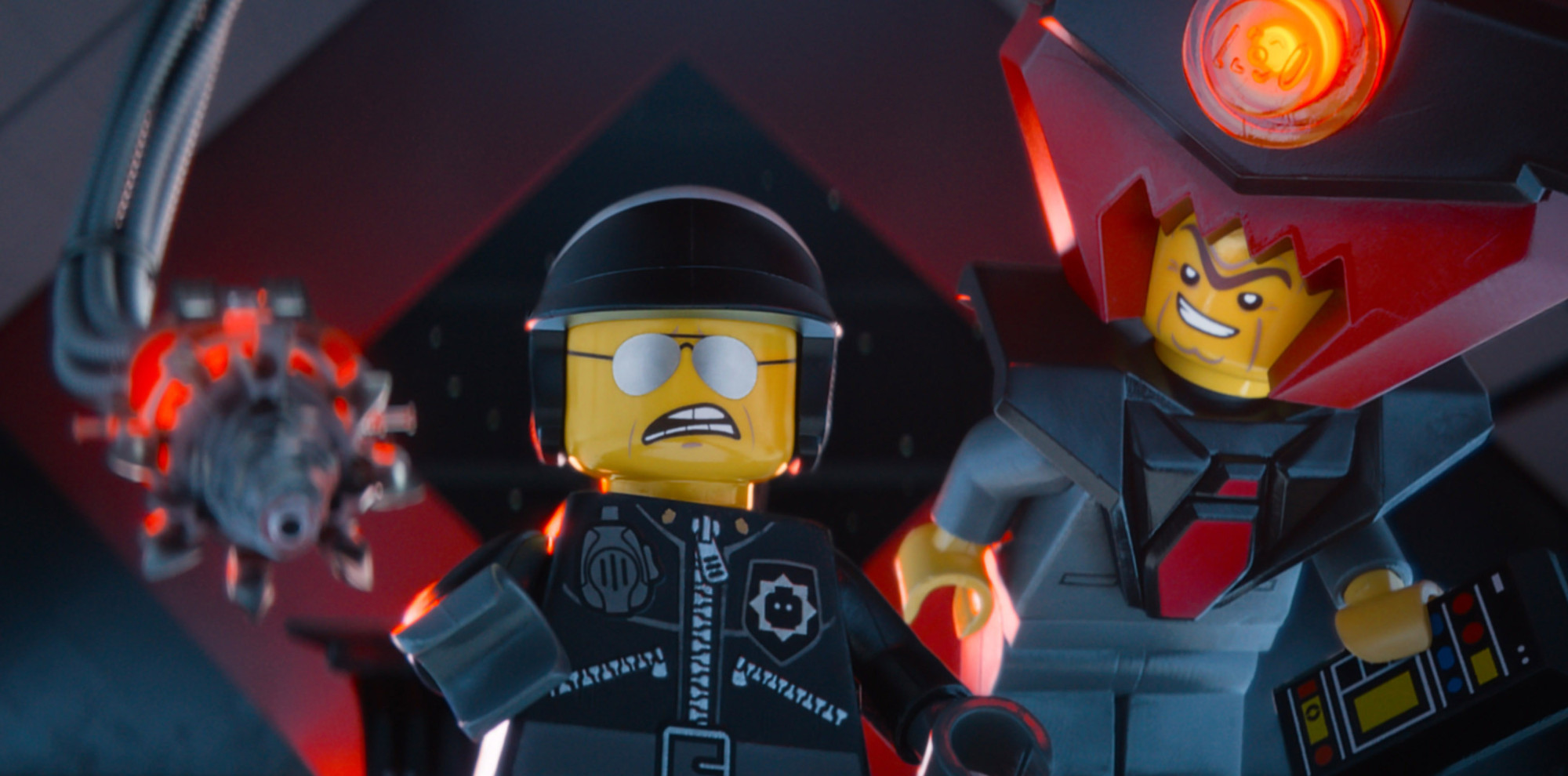
Everything is also chaotic, bonkers and pretty hilarious too. The Lego Movie doesn’t hold back. It cracks the obvious gags when they’re hovering around. There’s a lot of shouting, screeching and wailing, and that’s not just from the children watching in the same screening as you. Engines are set to full-throttle from the off and remain that way. What’s left then, is this gigantic ball of merriment that sees it origins in a whole host of previous box office-busting successes, but one that also conjures up a few smart quips of its own. Truly abiding by its ‘Universal’ rating, The Lego Movie builds on the colourfulness, catchy riffs and outright pandemonium aimed at the young’uns, and ends up also divulging a witty, often reminiscent backbone for the oldies. So yes, everything is awesome.

Emmet Brickowski (Chris Pratt) is a middling construction worker who blends into his job and surrounding world as much as the next Lego figure. He abides by the bustling code of Lego life, a step-by-step process meticulously ticked off by everyone, a job designed to assist progress, and an anthem heralding President Business’s (Will Ferrell) seemingly glorious society. On the periphery though, there’s a menace, an evil at work. President Business has devious intentions, with sights set on using the ‘Kragle’ to glue the world motionless. Only the MasterBuilder can stop him, and maybe Emmet isn’t as ordinary as first perceived.

Unlike the mechanical and simple block-by-block creation style, The Lego Movie manages to deliver a well-rounded story with unimaginable scope. We’re bumbling around a fairly stagnant period of animation on the big screen, a time far removed from the Lion King’s and Shrek’s of cinema, films that combined humour and joy with underlying strands declaring positive living. The Lego Movie teeters on the verge of getting back there. For all its energetic prowess and funny moments, the film motions along a deeper, more satirical platform. One that denounces a lack of intuition and promotes difference. President Business — aptly named — embodies the proverbial symbol of power-hungry, corrupt domination. The addictive song “Everything is Awesome”, sung everyday all-day by the civilians of Bricksburg, is a means to an end for the evil overlord. It’s catchy for a reason, constructed by President Business to brainwash the masses. Yet there are those aware few fighting against the autocratic system, a misfit band of special, talented Lego warriors. This narrative works; it has meaning, evokes emotion and demands investment, even amongst all the surface madness and hilarity. The film trumpets variety against monotony and should be admired and applauded for doing so, perhaps even more so than for its many other accomplishments. Having said all that, it is interesting to consider how much authenticity this prevalent notion of non-corporate domination holds, when you take into account the film’s basis: a multinational, mega-encompassing, money-gorging branded toy.

Snappy comedy is one of the films main triumphs. A lot of the time you find yourself laughing not just on the back of current pop culture references (when Batman refers to Bruce Wayne as a “cool guy”), but also at the expense of historic political blunders — voting machines, for example. The gags are constant, relentless even, but their respective foundations are juggled around allowing a freshness to circulate throughout the film’s progression. On the odd occasion that a consistently fielded joke does become wearisome, writer and director duo Chris Miller and Phil Lord work hastily to replace staleness with another funny wisecrack, and very often that wisecrack is another jaw ache-er.

The dialogue is an audible sea of movie-innuendos, for the experienced and the novice. Aside from bountiful puns and hidden humours rewarded to tickle the quick-eyed (“Bob’s Kabob” is outstanding), we also get hilarious Star Wars absurdities and are showered with a number of popular superheroes — at one point proceedings take on a very Avengers’ Battle-of-New-York-like manifestation, with portals and whizzing machinery aplenty. Batman plays a significant role all through the film, and is probably the only running joke that slightly wears towards the end, which is a shame because Will Arnett does a tremendous job with the raspy Bat-voice, even if you’re throwing honey at the screen by the time the credits roll.

In fact, all of the voice-acting sounds terrific. Chris Pratt provides that exuberant bravado as Emmet, one that gradually pitches more assuredly as the film progresses. Emmet strikingly resembles another animated hero, Flick, both in characterisation and story arc. Similar to the A Bug’s Life protagonist, Emmet is an over-eager-yet-normal guy who possesses the willpower to do the extraordinary. Much like Flick, his apparently crazy, useless ideas are those that turn out to be crucial and imperative — the double-decker couch, for instance. On the contrary to Flick though, who was originally a spanner in the ant hole, Emmet tends to blend into his surroundings and therefore must ascend more than an echelon of innovation to save the day. Elizabeth Banks is zesty and strong as the voice of Wyldstyle, Emmet’s partner-in-heinous-prevention, a wickedness perfectly sounded loud and nastily by Will Ferrell as President Business. Liam Neeson is arguably the best of the lot though, his distinct raspiness toned down (or up) a tad to combat any Batman correlations. Neeson voices Bad Cop/Good Cop, but mainly Bad Cop, and provides a fair helping of humour as the Lego police officer carrying out President Business’s gluey work. A whole host of other names — from Morgan Freeman to Jonah Hill, and Channing Tatum to Cobie Smulders — add their choral airwaves to the very fun and easy-listening vocal front.

Visually, for the most part, the film succeeds too. It runs into a bit of a problem as events set sail across before diving under water. Up until this point, we’re fully engrossed in Lego-land where everything is constructed wonderfully of Lego pieces. The landscape accommodates those ever-noticeable spherical cogs, ready as always to ground an attached brick (a notion that goes over nobody’s head). Water, then, also runs and sprays as Lego parts, until the crew of saviours find themselves underneath the substance which then turns into a non-Lego, standard computer-animated sea. It’s a bit odd, and for a moment removes the viewer from the plastic world. In all fairness though, that’s nit-picking at its crudest and as a whole, the visual output explodes with colour, fluidity and life.

Based on a toy that encourages creativity and imagination, The Lego Movie upholds and listens to its own traditions rather than decimating them (à la the poor-tasting Transformers franchise). The film is controlled, uncontrolled chaos, a rapidly advancing and visually accomplished offering that sparks life into the animation genre. For over an hour and a half you won’t be able to keep the smile off your face, unless it’s to exhale another round of laughter.

World War Z (2013)

★★★

Director: Marc Forster

Release Date: June 21st, 2013 (UK and US)

Genre: Action; Adventure; Horror

Starring: Brad Pitt, Mireille Enos

As Brad Pitt’s UN investigator Gerry Lane swoops over the city of Jerusalem encased in an enormous fortified wall, you are reminded of all that is wrong with World War Z. There’s a lingering generic-ism abound, one that stockily lumbers around without promise nor priority. When Drew Goddard, Damon Lindelof, Matthew Michael Carnahan and whoever else’s script this is attempts to overcome these commonalities, the film struggles to successfully juggle its grandiose ideas and instead is blighted by one or two gaping plot holes. Yet, before Gerry’s helicopter settles on the dusty plains below, you’re also privy to World War Z’s great elements. The magnificent visual landscapes on show. A sense of urgency that not only ensures problems are swiftly left hanging far behind, but also relents in tandem with the film’s menacing creatures. And also Brad Pitt himself, whose screen presence is a welcome, wholly capable one supported robustly by Mireille Enos. Occasionally frustrating, often energetic; World War Z ain’t all that bad actually.

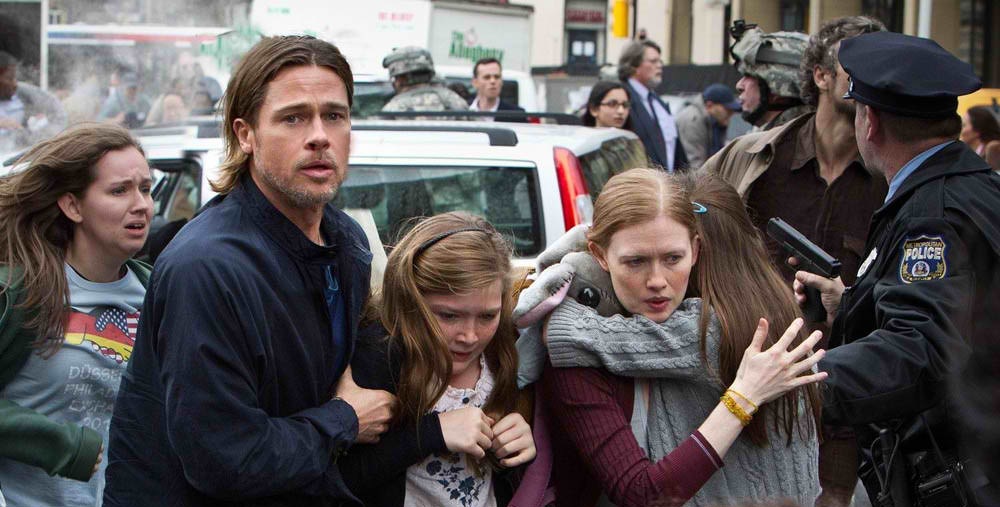
Having allayed his United Nations requisites in order to spend quality time with his family, a commute-turned-zombie attack must be the last thing on Gerry Lane’s (Brad Pitt) mind as he drives his wife Karin (Mireille Enos) and two daughters through a busy Philadelphia street. You get the sense he misses his old investigative job though, therefore it’s unsurprising that Gerry is speedily roped back into a life of danger and heroism, recruited by UN Deputy Secretary-General Thierry Umutoni (Fana Mokoena) to find the origins of the harrowing virus. Where did it come from? How can it be harnessed? These are apt, important questions demanding rapid answers in the narrative context, but questions that don’t quite elevate the film to any significant height.

World War Z, then, suffers two-fold. One on hand its familiar formula reeks of a sterility, whilst characters and plot advancements are constrained by the formalities of the pandemic sub-genre. Instantly, the screen reels off a variety of intertwined media, life, death, disease images in a montage designed to propel the likelihood of ecological threat in a shrinking world. It’s quite clichéd, but just about works as a warning (or confirmation) detailing the film you’re about to watch. Then a hair-strewn Brad Pitt appears, assuring his daughter that he’s done with the ‘leaving home’ business and is now employed solely in the confines of his own four walls — of course those busy, reminiscing eyes say something a little different. And after five minutes, you know exactly what you’re going to get: a rampant, solid action flick. This isn’t necessarily a negative, a ‘rampant, solid action flick’ will often conveniently fill up a few hours. What works, works, right? At times though, there’s an inherent over-predictability that, shuffled in lesser hands, could be construed as laziness (a taped arm will probably get bitten; a family left behind will more than likely come off worse for wear; a semi-retired family man will leave loved ones in the time of need).

These oh-so-common nuances do not affirm laziness though, because it’s evident that the conglomerate of director Marc Forster, actors and writers do care about the film they’re unstably constructing. Here’s the second problem then. In caring, and in striving to cast aside generic formulae, the film unwittingly jumps around, up, down and all over. Big surface ideas fall foul of gaping discrepancies, and there isn’t really a specific overarching tone, rather a number of intermittent murmurings. As a tormented, abrasive group of zombie-humans trample through the streets of Jerusalem, you’re watching (and probably enjoying) that ‘rampant, solid action flick’. But later, when Doctor Who appears and, stopping short at TARDIS-ing back in time, signals an atmospheric switch to one attempting Danny Boyle-esque tension. That’s not forgetting the splatterings of humour (the “Mother Nature is a serial killer” diatribe is oddly built on comic undertones) and misplaced masculine camaraderie throughout. Individually these tonal constructs are more hit than miss, but collectively the mishmash is a tad sloppy.

There’s also a significant plot-contrivance that perhaps stems from this rewrite plague that the film suffers from. The whole of Jerusalem is surrounded and protected by a gigantic wall, the idea being that Israeli officials were aware of the forthcoming viral attack and therefore planned ahead. The reason we are given explaining their premature knowledge is that these officials worked on the basis of a ’10th Man’ theory — where the assumption is that this 10th man (of a consistent group of 10, obviously) would always disagree with every unanimous decision agreed upon by the other nine, and then work to prevent the seemingly unpredictable. Essentially, this time the 10th man came across the virus, and that’s how Israel was alerted early. The issue then is, firstly, are we to believe that this earth-shattering discovery was successfully kept secret from the rest of the world? Secondly, if the 10th man always goes against the grain harvested by the other nine, wouldn’t his subsequent research always uncover (and thus prevent) past tragedies, therefore no global, human-based, disaster would ever have happened? Come on.

I digress. This is not a bad film, it’s only because the plot could’ve been tighter and the tone could’ve been structured and therefore the film could’ve been far better, that its weaknesses divulge frustration. For it looks incredible. Each visual is well-developed and astutely executed. In particular, there’s a tidal wave attack scene that’s ominous, turbulent and exceedingly well done. There’s also a sizeable amount of looking down at burnt, destroyed cities going on, although the terrific special effects anoint this a positive rather than a negative trait. And all of the fast-paced, energetic actions sequences deliver. In fact, Forster makes a point to move away from the early stereotypical set-up by quickly flashing the aforementioned disaster-threatening montage and then driving head-first into a bellowing helping of action.

These popcorn scenes do provide the majority of the film’s strengths, however on a few occasions there is a sense that Forster et al are striving to do more with the morality of said pandemic. A dancing moral stance that could’ve gone further, but one that flickers intelligently ever so often. This virus has spread worldwide, but what happens to civilizations in areas without sufficient protection, areas not ready and alert in their security measures? At one point we’re told “[it’s] pretty obvious nobody back home read it” in response to questioning over an email that circulated eleven days prior with the word “zombie” embedded. Is this a thinly veiled reference towards prior real-life mistreatment of threatening politically-bound documents? And are these creatures really zombies, or affected, compromised humans? They still wear human features, only now are assisted by growling eyes.

In an interview, Brad Pitt recalled his reasoning for seeking out the source material (of which his production company Plan B Entertainment secured the screen rights to). Effectively, something for his younger sons to watch and enjoy — apparently they like zombies. World War Z suffers from a number of faults, but it also boasts a few excellent aspects too and, at the end of the day, has been made with good intentions.

Hey, I’ll have whatever Brad Pitt’s children are having.

Sixteen Candles (1984)

★★★★

Director: John Hughes

Release Date: May 4th, 1984 (US)

Genre: Comedy; Romance

Starring: Molly Ringwald, Anthony Michael Hall, Michael Schoeffling

John Hughes got it. The teenage ‘life, the universe and everything else is against me’ phenomena that grabs hold in those years of early adolescence. Hughes captured it, twisted it, humourised it, but never demonised it. In a society which often bemoans the pre-adult demographic, where an internet driven social media age embarks primarily on straining relationships between old and young, films such as The Breakfast Club, Ferris Bueller’s Day Off and Sixteen Candles hold even more reverence. There’s no cynicism here, only joyfully glum appreciation. Of life lessons and abridged maturity. John Hughes reminds us that teenage years are not tepid, far from it, and that teenagers are not turbulent. Most of all, he reminds us to laugh and to cherish a generous time lived in all our lives.

Waking up on the morning of her 16th birthday, Sam (Molly Ringwald) is frustrated by the lack of overnight bodily development. Exacerbating matters, her entire family are too caught up in the hysteria of her sister’s impending wedding that Sam’s landmark day of celebration has been shunned far from the forefront of any of their minds. School treats her with the same apparent disinterest too; Sam only has eyes for senior student Jake Ryan (Michael Schoeffling) who she believes is unaware of her own existence. Enter witty, geeky Ted (Anthony Michael Hall) and let the chaotic, humorous and well-meaning love maze commence.

Sixteen Candles was John Hughes’ first outing in the director’s chair, so it would be conceivable to forgive a sprinkling of over-eagerness on his part, or even stout rigidity. Forget that. Hughes sinks the nostalgic, adolescent lobe of his creativity-centre into the plundering paranoia of teenage high school life and comes up with a thriving, fun piece of filmmaking that doesn’t take itself too seriously — which at the end of the day is kind of the point considering his characters do take ultra-seriously a time in their lives that should be driven by inhibition. Subsequently though, importantly, it never boils over into caricature territory. You always get the feeling that these people on screen could be real people in real life, and that their self-aware predicaments are similarly scattered throughout schools all over the empirical world. In this sense, there’s an intrinsic personal attraction present, one that encapsulates the viewer because he or she knows that they have been where Sam’s emotions currently reside, or that they are even still living there.

And the thing is, as Sam worries over-dramatically about a missing sex quiz, or her inert awkwardness at the mercy of the love of her life Jake, it’s obvious that none of this really matters: “You know? Neither one of us is gonna die if it doesn’t happen for us.” This epitomises the opposite mentality which is prevalent throughout the film, an important one yes, but not a mentality based on set-in-stone principles. High-school life exists in a strange, disconnected bubble separated from the rest of civilisation. From when the bell rings at nine o’clock until it resounds six or seven hours later, you’re only focused on inter-class gossip or what’s on the lunch menu, far removed of the outside world. Hughes generates this introverted atmosphere exceedingly well, and mirrors it with the unimportant struggles of the teenager. It’s because Sam’s misgivings are heralded by herself and her peers as the worst problems (or best solutions) on earth that a natural hilarity ensues.

Central to many of the funny goings-on is Anthony Michael Hall, whose freshman Ted is fuelled by a bet made amongst his pals prompting a need to sleep with Sam. Ted’s youthful insecurities are often hidden under a surface sheen of semi-arrogance and energy. He’s a bit of a chancer, not least when making a second move on his target merely moments after being forgiven for the first eager attempt. Hall’s portrayal of this youngster unsure of his convictions is often witty as he snaps back many of the funniest lines. His persistence in the face of staunch rebuttals — mainly from Molly Ringwald’s Sam — is chuckle-laden, and the pair share a flourishing dynamic. Ringwald has much of the film resting on her premature shoulders as her various plots and non-successes are the basis of the amusing proceedings, and she does a tremendous job as the blissfully suffering lead. Both Hall and Ringwald would go on to work more as part of Hughes’ teenage parable series of movies, and their respective primitive deliveries here, plumb, full of comedy and wholehearted, offer only a few reasons why.

Perhaps when all is said and done there’s really not much difference between the material struggles of a teenage-existence and adulthood. Alcohol-drowned parties remain alcohol-drowned parties no matter how old you get. Relationships are still relationships until the knot has been tied. Sixteen Candles alludes to this continuity, embodied by way of the utterly chaotic preparation and execution of Sam’s sister’s wedding — a tumultuous pandemonium succeeded by no other. There’s no biased cynicism towards an age or demographic superfluous in the grand scheme of things because in the grand scheme of things, the trials of adulthood can be just as nonsensical and anarchic, yet sweet in nature (look out for a wedding commandeered by muscle-relaxant) as those teenage years.

Sixteen Candles is the first in a line of emotive comedies that paved the way for films from the Judd Apatow’s and Richard Linklater’s of this world. It’s not difficult to comprehend why John Hughes movies (his early work in particular) are so affectionately regarded these days. Relatable characters, charming mindfulness and funny screenplays are just three of the key proponents for present-day recognition, and are certainly three boastful characteristics on display here.