Boyhood (2014)

★★★★★

Boyhood PosterDirector: Richard Linklater

Release Date: July 11th, 2014 (UK); August 15th, 2014 (US)

Genre: Drama

Starring: Ellar Coltrane, Lorelei Linklater, Ethan Hawke, Patricia Arquette

For many, Boyhood is the latest film to define a generation. They’re right, but it doesn’t hold fort at just one generation. The beauty in Richard Linklater’s 12-year undertaking is its accessibility, its exclusivity. This is a film that will surely speak to many different people from many different age groups. It could have easily been named Girlhood, or Fatherhood, or Motherhood because it is all of those things. As an early-90s kid myself, Linklater’s piece plays like the ultimate reflection of growing up, and clocking in at 165 minutes it feels like one of cinema’s finest works.

It’s 2002 and six-year-old Mason Jnr (Ellar Coltrane) is living with his older sister Samantha (Lorelei Linklater) and their mother Olivia (Patricia Arquette). While the siblings annoy each other with Britney Spears renditions and blame games, mum is actively striving to open up new avenues and offer them a better life. We watch the family move (a frequent occurrence) across Texas to accommodate Olivia’s studies, at which point dad Mason Snr (Ethan Hawke) reappears.

This manoeuvring of people and place is what drives Boyhood. Every character is jockeying for something and even though the piece spans 12 years and a variety of locations, that something often remains constant. From the moment we meet little Mason staring ponderously at the sky, it is apparent that we’re in the presence of a youngster not entirely resolved on which path he wants to take in life. He’s just a child at this point but Mason’s lack of enlightenment soon evolves into indecision as relates to the future; photography does take prominence, but it is tough to tell if his heart is truly in picture-taking. As the years roll on, Coltrane carries Mason’s ambiguity with increasing fervour. It’s just enough to generate intrigue and mirror reality — a darkroom chat in school highlights that angsty unmoved-yet-not-entirely-disengaged trait common in teenagers — but not so much as to push us or those around him away.

His sister Samantha is different. Despite the camera’s fondness for Mason Jnr, Samantha gets ample screen time to evolve and as a result her desire for independence gains more clarity. She is the older of the two and therefore tends to champion a greater degree of worldly awareness over her brother; one of the most cringeworthy scenes is also one of the most endearing, where Mason Snr communicates strategies to avoid teenage pregnancy. Lorelei Linklater sells the awkwardness brilliantly, though in truth her chat with Ethan Hawke was probably just as embarrassing in real life.

Hawke is stellar as dad Mason Snr, embodying the character whose behaviour differs most between the opening and closing frames. That’s not to say he becomes the antithesis of his younger self, but rather a more seasoned version with the same emotional clout. One of Linklater’s greatest triumphs in making Boyhood is affording his characters a robust sense of identity across the 12 years. Above anything else, Mason Snr simply wishes to be a good father and it is such a joy watching him thrive in the role. He is never a bad father per se but the underlying guilt harpooned to him as a result of his separation from Olivia is palpable, so much so that he makes humorous yet immature jokes in front of his children to dodge the subject (“Your mother is a piece of work, I think you know that by now”).

Olivia, on the other hand, is wound up fairly tightly, she fulfilling most of the parenting duties whilst her ex-husband works away in Alaska, frozen from reality. Unlike with the others, we need to wait until Olivia’s final words to really grasp hold of what she has been pursuing over the years. Patricia Arquette delivers those last few lines with the utmost sincerity and pain, and at that point we realise her character’s embedded desire has always been for something more. Having lived a life for her children, it becomes clear to Olivia that she wants to live for herself, at least just a little. It is the most heartbreaking point in a film roused by heartfelt moments, one that poignantly captures parenthood for the uninitiated such as myself.

Each of the aforementioned characteristics and motivations are universal, the kind that we can all relate to either personally or in passing. Appropriately, in a film about relationships it is the interactions between individuals that really inject spark and vitality. Linklater always means to coax emotion from the scenes he creates, be it in the form of infectious laughter, genuine solemnity or, as is often the case, foolproof charm. We get as much out of Olivia’s longing for normality as she watches her children drive away for the weekend as we do from a car-set conversation where the siblings reverse their father’s parental diatribe back onto him. The chemistry between all four main actors is indelible.

One thing that Boyhood ain’t is heavy. The filmmakers’ efforts — greatly aided by Sandra Adair’s fluent editing — encourage a true sense of lightness. When we’re not chuckling at the absurdity of now outdated pop culture trends (I’ll take Harry Potter over Soulja Boy any day of the week), wit comes in the form of almost caper-ish humour; the sneaky removal of a pro-McCain signpost wouldn’t look out of place in a Coen brothers comedy, nor would the appearance of a staunch Republican neighbour just seconds before: “Do I look like a Barack Hussein Obama supporter?”

I watched Boyhood at home on Blu-ray. After the credits finished rolling, the disc reverted back to its main menu where the option to view a special feature was supplemented by a montage of Mason growing up, Family of the Year’s song “Hero” playing in tandem. It was like watching the film all over again, tear-jerking and life-affirming. Boyhood is bigger than any perceived gimmick. It’s a film for all the family about all the family. It’s proper cinema.

Boyhood - Ethan Hawke Ellar Coltrane & Lorelei Linklater

Images credit: IMP Awards, Collider

Images copyright (©): ICF Films

The Purge (2013)

★★★

The Purge PosterDirector: James DeMonaco

Release Date: May 31st, 2013 (UK); June 7th, 2013 (UK)

Genre: Horror; Science-fiction; Thriller

Starring: Ethan Hawke, Lena Headey, Adelaide Kane, Max Burkholder

The Purge opens promisingly: a cascade of slowly enveloping surveillance feeds show a timeline of violence, both unadulterated and raw. It sets the scene, year 2022, the images depicting acts of inhumanity committed on the one night that they’re legal. The feed hints at a lack of security, infusing a sense of realism and close proximity to home whilst also suggesting what we’re about to see is 21st century brutality. But that’s not quite what follows. Despite a promising start, James DeMonaco’s film, although mindfully suggestive and thoroughly polished, never really fulfils the ambitions towards which it initially embarks.

With crime rates and unemployment figures astonishingly low, the United States is seemingly in good hands under the New Founding Fathers of America. It’s not these results that are worrying though, rather, that the country’s social achievements have come by way of a demonstrably violent method: the Purge. The Sandin family are amongst those who financially benefit from the twelve hour anything goes societal melee, father James (Ethan Hawke) having struck gold with his house security system. When his son Charlie (Max Burkholder) lets in a wounded Purge victim things start to go wrong; the latter’s pursuing attackers are led straight to the family home carrying spiteful demands.

The moral jousting embodied by Charlie is one that the film looks to delve into from the beginning, doing so with true intentions if not true conviction. The Sandin’s are a rich family who discuss carb intake at the dinner table and live in a lavish house that represents the prosperity of James’ sales pitches. Essentially, the Purge funds them. Individually they’re fairly affable folk, but collectively the Sandin’s aren’t exactly an authentic reflection of life. Instead, the quartet are like the gloss over a scratched surface. Even though the allotted night of crime has ushered in decreasing unemployment and a reduction in year round violence, the poor are still those who suffer when suffering occurs — take Charlie’s wounded invitee, for instance.

The ambiguity over whether or not we should root for, or even like, the Sandin family unfurls disorderly as the film progresses, but this initial notion of papering over the cracks stays rooted firmly within the narrative, indicating an inbuilt societal prerogative that is advantageous to wealth. In a way events displayed throughout The Purge are merely a continuation of the world today and DeMonaco — who also wrote the screenplay — tries to shill this allegorical pursuit, however is eventually overruled by a lack of vigour. The twisted morality emitted from our central family resonates with the trials and tribulations of Macon Blair’s Dwight in Blue Ruin. For both he and James Sandin, it boils down to an age-old dilemma: how far would you go to protect your family? Whereas Blue Ruin effectively portrayed a blunt and grisly reality, The Purge doesn’t quite have the same stark intensity. Although it simmers like a fine broth, the end product isn’t all that satisfying.

Yet, intrinsically linked to the moral juggling are the makings of a successful look at post-contemporary crime and violence. Proceedings have a familiar Hunger Games-esque tinge to them; one night of inhumanity for the apparent sake of all humanity. The idea of a 12-hour law-free zone is absolutely ridiculous, but there’s something perversely plausible about it. We listen along with wife Mary as news commentaries discuss the logistical need for the Purge, while “have a safe night” is common neighbourhood lingo. Disorder is the norm, at least for a brief period of time, a concept that the film profitably depicts as eerily recognisable. DeMonaco also adds creepiness though discomforting erudite imagery (upper class young adults unorthodoxly peering up at a peephole), given this is paraded as a horror film after all — though it’s far more confident in the thriller aspect. There’s also a relentless murmuring sound that carefully ratchets up the tension as events advance.

In the end, alongside a lack of should-be applicable harshness, the film succumbs to being far too unrealistic. The improbable main plot point isn’t an issue — we’re along for the ride from the get-go — however there’s an incredible influx of coincidence going on. For one, the attackers outside are undisturbed for a significant amount of time despite being exposed to the crime-ridden streets. Also, people just so happen to walk directly into the line of fire on a number of occasions. (Listen out for where daughter Zoe’s decides to hide.) “Things like this are not supposed to happen in our neighbourhood,” chimes one character who seemingly never received the bleak tonal memo, opting for cheap black humour instead.

Notwithstanding some shoddy dialogue, the performances are universally well-oiled. Lena Headey is the best of the bunch as wife Mary, never coming across as unlikeable despite playing a character who could have towed the swanky line. Headey even manages to channel the purposeful poise she heeds in Westeros. As her husband James, Ethan Hawke holds up his end of the bargain. His reliability does outbid any ingenuity, though in truth he’s not given an awful lot to work with other than convention. Adelaide Kane and Max Burkholder are engaging as the duo’s children Zoe and Max, and Rhys Wakefield does his best impression of a peculiar, skin-crawling villain.

The Purge is better than just cheap thrills and jumpy scare-tactics. Director James DeMonaco attempts to inject the increasingly fledgling horror genre with a degree of thought-provocation, and success up until a point. High in concept and high in potential value, this doesn’t quite muster up the strength to be high in quality, but it shouldn’t be shunned for trying.

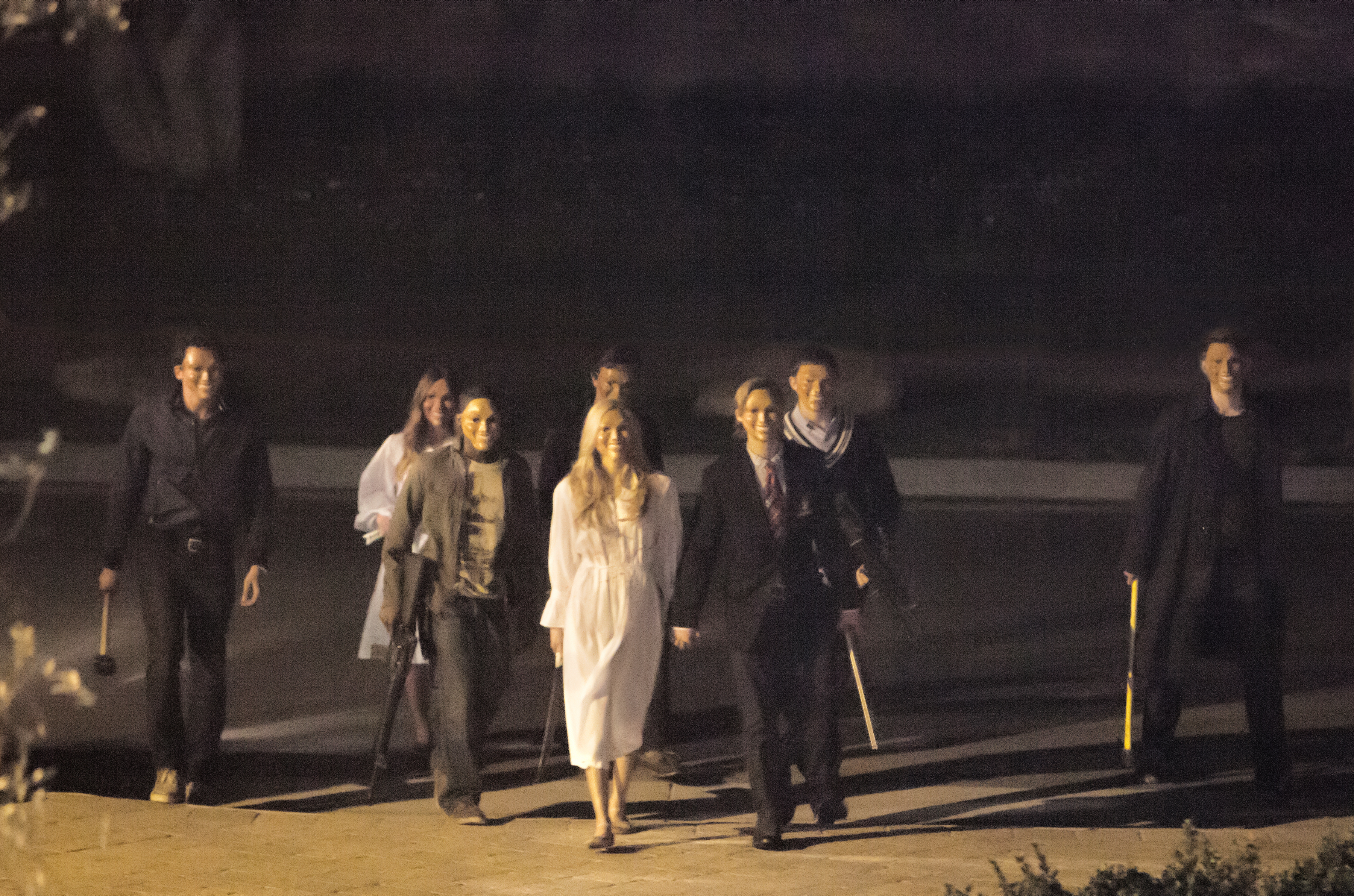
The Purge - Mob

Images credit: IMP Awards, Collider

Images copyright (©): Universal Pictures

Daybreakers (2010)

★★★

Directors: Michael and Peter Spierig

Release Date: January 6th, 2010 (UK); January 8th, 2010 (US)

Genre: Action; Drama; Horror

Starring: Ethan Hawke, Willem Dafoe, Sam Neill, Claudia Karvan

As a commentary on modern-day civilisation and western domination, Daybreakers is very good. As a scattered action romp where humans are pitted against vampires, Daybreakers is not too bad either. Where the film does fall on flat on its face though, is when it tries too hard to combine the two without properly answering all of the questions or delivering the most exhilarating action. In the end, there is just far too much going on.

Daybreakers is set a decade in the future, in 2019, where the human race is almost entirely extinct and the world is primarily inhabited by vampires. As the number of remaining human beings diminishes, so too does the amount of blood, the vampire’s means of function. A dominant vampiric corporation headed by owner Charles Bromley (Sam Neill) sets out to find an adequate blood substitute, while researcher and reluctant vampire Edward Dalton (a vampire named Edward? that will never work), played by Ethan Hawke, aligns with a group of humans in order to find a cure and save mankind.

From the get-go, Daybreakers develops a collection of parallel analogies with life in the present day, and all of the social, environmental and political problems the world currently faces. For example, the rapid depletion of human blood and local conflicts over obtaining the substance can be understood as a reference to the imminent decrease in water levels around the globe, along with the ‘water wars’ going on in many third world countries. In Daybreakers, cities are controlled and domineered over by a ruthless police force, much akin to the security forces inhabiting dictatorship regimes in varies reaches of the planet, where many civilians are wrongfully oppressed (in the case of Daybreakers, the humans). These are only two of a whole host of succinct and well established connections that writers and directors, the Spierig brothers, obviously had in mind when creating the film. The directors’ thematic inclusions are stimulating, as their representation of modern society works very well throughout. When attempting to incorporate select societal elements into a film it is important to ensure that the piece does not become too overawed with commentaries, and that it does not become a parody of modern existence. The film successfully steers clear of any such dangers for the time it spends on-screen. If part of the job of cinema is to get its audience thinking about issues relevant to them, then Daybreakers hits a home run.

However, where the film begins to lose its way is when the narrative itself becomes to over-run by plot points and sub-plots. The directors do so well in keeping the societal analogies in check that they seemingly forget about the actual events of the film, and the sheer volume of goings-on. Not only is the set-up to the main story confusing and does not really make much sense (Ethan Hawke’s character works for a corporation dealing in blood harvesting, yet he is opposed to drinking human blood and is sympathetic towards humanity), but before any of the main plot-points can be concluded, more and more sub-plots are added to proceedings. Along with the group of humans and Hawke attempting to find a cure and Neill’s corporation making inroads into discovering a blood substitute both playing out on-screen, so too does Hawke’s tumultuous relationship with his brother, Neill’s battle with the remorse he holds over the disappearance of his daughter and an underlying problem with subsiders around the city (vampires who feed on themselves, subsequently turning rogue). With all of these separate events divulging information at the same time for the audience to attempt to soak in, matters quickly become overbearing. The absence of many of the sub-plots would not have made the slightest difference to the outcome of the film.

Daybreakers also runs into trouble as it progresses along the cure story-line. A key event in the narrative takes place mid-way through the film which is intended to have harrowing connotations with what came before it and what comes later on. Unfortunately, the reveal goes the other way and comes across as a tad lazy and nonsensical. With that being said, this problem does sort itself to a degree as Daybreakers nears its conclusion, and to the Spierig brothers’ credit, the final few scenes are very smart and well thought-out. The film looks tremendous, with everything from the metallic, sharp city-scape to the visceral, gory horror elements mesh together to create a diverse-yet-encapsulating visual offering. Sam Neill is wonderfully wicked as the rich, oligarchical business leader who shares one or two similar characteristics with Mads Mikkelsen’s Hannibal Lecter. The rest of the film is efficiently cast, as Ethan Hawke (who has a vampire-like quality to his look in general) is effective in his role as the well-meaning protagonist. Willem Dafoe’s charismatic turn as “Elvis” Cormac is a far cry from his usual outings, and he is slightly underutilised here.

Running at just over an hour and a half, Daybreakers does not overstay its welcome as it brims with ideas and comments on modern society, successfully posing questions to its audience and generating the mind. However it simultaneously loses focus on the meat of events, as too many things are going on at once when a simpler narrative would have been the perfect accompaniment to the thought-provoking themes which the film boasts.