Transformers (2007)

★★

Transformers PosterDirector: Michael Bay

Release Date: July 3rd, 2007 (US); July 27th, 2007 (UK)

Genre: Action; Adventure; Science-fiction

Starring: Shia LaBeouf, Megan Fox, Josh Duhamel

It’s Transformers week everybody! Indeed, unlike you lucky people across the Atlantic who’ve had a whole seven days to digest Michael Bay’s latest installment of metal mayhem, for us cinema folk here in the UK Transformers: Age of Extinction is hot off the press. I’ve not seen it yet. (Admittedly, the robustness of the word “yet” in that sentence is questionable.) To tell you the truth, I’m not a great admirer of Bay’s adopted franchise. It all started in 2007.

Sam Witwicky (Shia LaBeouf) is a stereotypical boy teenager. He’s into cars, girls and late-19th century exploration. Perhaps that last attribute isn’t the most applicable to a male adolescent, but it’s part of an eccentric mosaic that sets Sam apart from the rest. It could simply be a feeble plot point, but who am I to judge. Certainly, Sam has a crush on his classmate Mikaela Banes (Megan Fox) but the only way he’s going to get her attention is with an engine.

Turns out his new car is a Transformer. There’s a multitude of other stuff going on — political struggles, technological misfire, a band of surviving soldiers in Qatar (that’s in the Middle East, by the way), the arrival of evil Decepticons, the arrival of friendly Autobots — but at its most basic, and this film is rather basic, Transformers is about giant robots punching and kicking and wheeling each other.

Director Michael Bay cannot contain himself. His immaturity spills out across the screen from the get-go: a gravelly, deep voice kicks off proceedings ushering in the overly macho tone; an array of snazzy camera angles each act as a sales pitch for the next military helicopter; it only takes six and half minutes for the first (and second, third, fourth) explosion to shake the screen. Bay absolutely has a way with visuality. He’s able to create carnage that looks impressive and that sounds impressive. But it’s all very movie trailer-esque, as if we’re watching a feature length advert for the next blockbuster only it’s stuck on a loud, grating loop.

Substance would take a back seat if the back seat still existed — Megatron probably crushed it. He, or it, is the villain. Adversary of the human-appreciating Optimus Prime who arrives promptly with his band of misfit car pretenders to save the day. They’re robots though, and they’re not blanketed in enough development to make us care. Nor are the human characters and, although the likes of Shia LaBeouf and Megan Fox (she’s far from the worst thing in this film) amass their very best collective effort to generate some sort of viewer connection, one doesn’t exist.

It could be that goings-on shimmer with an unhealthy sheen of artifice. The CGI looks good but ultimately acts as a momentary veil over the real problem: shallowness. There are four female characters dotted throughout the almost two and a half hour runtime. That’s about one for every six male. (At least, males with lines.) We’ve got two mothers who seldom appear, a smart analyst played efficiently by Rachael Taylor who’s treated as though she’s dumb despite being the smartest of the pack, and Megan Fox whose role is almost entirely based on her cosmetic allure. The US President doesn’t make a full-body appearance but we do hear him mutter some chauvinist line to a flight attendant — oops, there’s a fifth female.

There’s arguably an even larger issue at hand here and it’s to do with us, the audience. But what audience? It’s eternally tough to care about giant car shape-shifters because they do little else but fight, so in that sense Transformers might not be for me. I’m not into meaningless vehicular smackdown, that’s fine. It’s a film for kids then, one for the younger boys and girls who do get a genuine kick out of that sort of thing. Only there’s Megan Fox bending over car bonnets. And hold on a minute, those child-friendly robots have started swearing now. It’s only mild here, but the defamation of what once was a children’s 80s cartoon flick and toy line is catapulted into the next stratosphere in Transformers 2 and 3. There obviously is an audience for the franchise, it’s already made over two billion dollars worldwide, but the respect between filmmaker and his viewership is seemingly only half-mutual. (Come on Michael, we know Qatar is in the Middle East).

The aforementioned runtime is also unnecessary, particularly when scenes involving irrelevant clothes removal and lamppost handcuffing take up five minutes of screen time. This is the director at optimum indulgence. It’s more boring than annoying. In Michael Bay’s material world where only good-looking people exist and big booming fireballs carry more weight than sturdy narrative, Transformers is probably a masterpiece. In the real world, it’s a film that alienates the young audience it should be targeting in favour of a guaranteed cash prize.

Early on Mikaela’s jock boyfriend says, “Oh no, this is not a toy”. He’s talking about a car and he’s completely right. Transformers ain’t a toy anymore. The innocence is gone.

Note: This was originally posted over at Movie Pilot, where you’ll find more articles and reviews from myself, plus the occasional poll. We all love polls, right?

Transformers - Michael Bay

Images credit: IMP Awards, Collider

Images copyright (©): DreamWorks, Paramount Pictures

Annie Hall (1977)

★★★★★

Annie Hall PosterDirector: Woody Allen

Release Date: April 20th, 1977 (US)

Genre: Comedy; Drama; Romance

Starring: Woody Allen, Diane Keaton

Films are often categorised under the “escape” section of our everyday lives. We watch to disassociate with reality for short bursts of time, to be present only within the context of the tedious romcom playing out on screen. Or the spectacular science-fiction trek that hurtles us towards another planet. Or the not-so-scary slasher flick we’ve seen a hundred times yet whose economical frights we still get a kick out of. Every so often though, there’s a film that commands our attention and refrains from releasing its grasp even long after the credits have finished rolling. Woody Allen’s infectious romantic dramedy is that film. Presented in a simple-yet-effective manner, it’s the delivery of the piece that approaches astounding. Annie Hall truly is a hallmark of American cinema.

Alvy Singer (Woody Allen) is an ardent New Yorker with a panache for eccentricity and a motor mouth to back it up. He’s also a comedian who plays doubles tennis every so often, and it’s on one of these sporting jaunts that Alvy meets Annie Hall (Diane Keaton). The connection between the pair is palpable from the moment they first awkwardly converse.

This isn’t a complicated film. Sure, it gets caught up in a barrage of intellectually stimulated dialogues echoed by apparently complex characters but that’s wholeheartedly where the fun lies. And it really is fun. Alvy is an erratic guy who just about holds it together by way of his methodological consistency. He wants to know the who, what, where, when, and why about everything because this allows him to pick apart and challenge. (“Everything our parents said was good is bad: sun, milk, red meat, college.”) Maybe it’s the comedian in him, but one gets the sense that his mannerisms have been ingrained since childhood — Alvy alludes to the adolescent trauma enforced by the roller coaster that often rattled above his house.

On the other hand there’s Annie. Not quite carefree but certainly free-spirited, Annie is bubbly and bumbling. The chipper lass ain’t entirely sure of herself when we first meet, though she steadily gains resolve and direction alongside the spitfire that is Alvy. They’re quite different people and share a relationship that invariably teeters between effusive and choppy. She’s Los Angeles, he’s New York. Certainly, their premier interaction post-tennis match embodies the joyous authenticity of the couple. The scene is awkward and endearing and hilarious, and from then we can’t take our eyes off of pair’s dynamic nor remove our permanent smile induced as a result of their witty banter. The film is all about them, fortunately. In some ways we feel unduly cut short at 93 minutes, but in others the hour and a half feels like a perfect summation of director Woody Allen’s vision. For a film so focused on two people — it does flirt with a variety of issues, but hones in on their relationship — Alvy and Annie are perpetually watchable.

Aided by semi-prominent collaborator Marshall Brickman, Allen’s original screenplay ensures his characters’ long-term watchability is a certainty. It’s outstanding. The film is bookended by two Woody Allen (or Alvy, but we get the sense they’re the same person) monologues, both of which represent the writer — and actor and director — at his most prosperous. Endlessly quotable (“Joey Nichols. See? Nichols. See? Nichols!”) and unafraid to tackle a whole range of affairs from 70s New York culture to drug use to the US East/West divide, Allen and Brickman’s screenplay rightly bagged an Academy Award at the organisation’s semicentennial ceremony. The narrative never suffocates its characters; even on the odd occasion when an overly vague cultural reference escapes Allen’s cerebral pen, the film skips along unscathed, our viewing experience likewise resilient.

This might also be one of the filmmaker’s funniest outings. With light-hearted subtlety often capitalised on by Allen and his acting partner Diane Keaton, Annie Hall never stops short at provoking laughter. Whether it’s a character living up to expectations — in the case of psychiatric results, it’s two characters — or a swivel away from narrative convention, humour is always lying in wait and we’re eternally willing to guzzle. The latter of these two examples sees Alvy accuse a pompous cinemagoer of being too indulgent. Allen, in this instance himself a quasi-critic evaluating the pretentious kind, is also poking fun at himself and the plethora of ‘don’t sneeze or you’ll miss the point’ diatribes he has written into the film.

As previously alluded to, the piece is shot abiding by a mantra of simplicity that serves to position the spotlight on its characters and accentuate their presence. The camera lingers on conversations for a long period of time because it knows it’s peering into aural gold. Richard Linklater’s Before trilogy springs to mind, a romantic moment in time that shares many intricacies with Annie Hall and was undoubtedly influence by Allen’s effective candour. Periodically we do see a few neat tricks play out, such as Alvy and company breaking the third wall or random subtitles translating small-talk for real thoughts, but these aren’t just pithy inclusions. Rather, they serve a purpose, be that to inject amusement or make a specific point about life.

The performances from Diane Keaton and Woody Allen ought to speak for themselves, but it’s worth noting that they’re wonderful. Annie Hall plays out in a non-chronological fashion. We already know the ending because it’s also the beginning, but that doesn’t matter one jot. It’s the journey that counts, and this journey is one of the very best.

Annie Hall - Woody and Diane

Images credit: IMP Awards, Total Film

Images copyright (©): United Artists

Texas Chainsaw (2013)

Texas Chainsaw PosterDirector: John Luessenhop

Release Date: January 4th, 2013 (UK and US)

Genre: Horror; Thriller

Starring: Alexandra Daddario, Tania Raymonde, Trey Songz, Scott Eastwood

Talk about shooting yourself in the foot. Texas Chainsaw, the latest cynically-driven reboot/rehash/retread of Tobe Hooper’s masterful massacre, opens with a montage showing a series of short clips taken from its cinematic elder. We see 1974 Leatherface in all of his gritty glory, revving that infamous metal engine and thrusting it towards a rabble of victims without inducing so much as sliced finger. Ironically, John Luessenhop’s newest creation never exceeds the heights set by its introductory mosaic. The moment simply reminds us of the original’s greatness, a success that was never going to be on the cards for Texas Chainsaw. After all, this is nothing more than another cash ploy exploiting the historical coffers of the ailing franchise.

Upon hearing about the death of a grandmother she didn’t know existed, Heather (Alexandra Daddario) and her mates pack into a minivan and venture over to Texas to pick up her inheritance. The trip conjures up a fifth wheel but other than that nothing of note arises. That is, until they reach Heather’s newly acquired mansion, a place that houses more than just expensive cutlery and creepy family portraits.

Despite expunging a budget of around $20 million, Texas Chainsaw does its absolute best to parade as an amateur visual (mis)treat. Blood splatters imported from the 300 school of imagery are unrealistic and out of sync with the surrounding picture. It’s a struggle not to chuckle awkwardly at Leatherface’s body-chopping skills, or maybe the fault lies not with our masked murderer but with the overworked visuals department. Luessenhop should really have learned from the gory restraint championed by the original — at least that way any potential embarrassments on the CGI front would’ve been kept to a minimum. Besides, a substantial decrease in violence for the sake of violence might actually have equipped the film with a sense of mature purpose, and also saved those sweat-dripping studio bosses a wad of cash. Given the amount spent and available contemporary technology, there’s really no excuse for this 2013 horror film to lazily produce cheap gore.

Even worse than the visual continuity issues at hand are a whole heap of character continuity problems. There’s no avoiding the awfulness of those whose story we’re watching unfold. To phrase it justifiably bluntly, every single person on show is an idiot: the family lawyer who hands Heather her new house keys quite obviously knows there’s something iffy about the place, yet decides to bite his tongue; a police detective follows a trail of blood and wanders directly into mismatched danger, when halting five minutes for back-up would probably have been the more sensible action; whilst attempting to escape, the group decide waiting it out in a minivan that’s on its last wheels is a better idea than high-tailing it on foot. Watching the characters is painfully infuriating, even for a horror flick. Though it should be noted that “it’s a horror movie, what d’you expect?” isn’t a good enough excuse for poor characterisation. There is no excuse. People and plot, cinema’s most basic foundations, both crumbling here.

Texas Chainsaw bursts at the seams with so many genre clichés that we begin to wonder if the screenplay has been written by an actual human being with a subjective mind, or a horror slot machine that lands on cherry every spin. In fact the commonalities can be as local as they come on occasion; on their minivan travels the friends pick up a wanderer. Sound familiar? The symbolism doesn’t necessarily lie in the ‘what’ of this moment, but rather the ‘who’. From an eerily disconcerting hitchhiker 40 years ago, to an insane runaway three decades later, we’ve now been landed with a Calvin Klein model. A sign of the times, perhaps. Ultimately the narrative leans towards a phoning — or cashing — it in attitude and, given the film’s title was rounded off with ‘3D’ during its cinematic run, cashing it in feels like quite an apt description. To give the filmmakers’ some credit, there is an attempt to sever conventional ties in regard to the franchise, but this come across as desperate rather than inspired. Truthfully, the angle only succeeds in tarnishing the authentically terrifying mantra laid out in The Texas Chain Saw Massacre.

Rounding off the dismal outing is a handful of performances each lacking the same inspiration that those behind the camera are devoid of. The material might not be any good, but nobody manages to ascend the steps of unsullied. Alexandra Daddario is Heather and probably comes out less burnt than the others, but her talent far exceeds her display. Watch Daddario in True Detective to see a potential superstar. Heck she even gives a better account of herself in Percy Jackson and the Lightning Thief. Tania Raymonde likely wishes she’d stayed Lost. The only noteworthy point to make about her appearance is the inclusions of an incredibly gratuitous low-from-behind shot that’s only possible because her character ‘chooses’ to walk alongside a moving vehicle. (As opposed to travelling in it, like most normal folk do when they’re headed somewhere.) Trey Songz also shows up but doesn’t do any singing.

Texas Chainsaw is a project driven by financial gain and very little else. It shows, and in just about every aspect too. The film’s execution is sloppy, the narrative is terminally uninspired and most of the characters are borderline abhorrent. We don’t care at the beginning, and we care even less by the end. The only reason we don’t celebrate anyone’s demise is because that’d make us just as bad as them.

Texas Chainsaw - Leatherface

Images credit: IMP Awards, Collider

Images copyright (©): Lionsgate

White House Down (2013)

★★★

White House Down PosterDirector: Roland Emmerich

Release Date: June 28th, 2013 (US); September 13th, 2013 (UK)

Genre: Action; Drama; Thriller

Starring: Channing Tatum, Jamie Foxx, Maggie Gyllenhaal

White House Down is bonkers. The President of the United States wears white trainers; kids can get through security with an easily obtainable Chocolate-Factory-esque ticket; Channing Tatum has an 11-year-old daughter. Madness. Indeed, profusely fun madness. Roland Emmerich’s film will never win an Oscar for Best Original Screenplay — or anything, truthfully — but at no point does it set out to. Unlike the director’s genre-relevant 1998 attempt at Godzilla, a film still languishing in a pit of sheer idiocy, his most recent action-packed attempt promotes an infectious need to have fun. Spearheaded by a pair of goofy opposites, White House Down is more thumbs up.

In the midst of a tour of the White House set up to appease his politics-loving daughter Emily (Joey King), John Cale (Channing Tatum) suddenly finds himself as the sole agent against a group of terrorist insurgents. The Capitol police officer, fresh off an unsuccessful job interview, must formulate a plan to shield the President (Jamie Foxx) from intended harm whilst also saving the many hostages in danger, one of whom is Emily.

Perhaps unsurprisingly, this big budget summer popcorn bonanza is flawed. The screenplay written by James Vanderbilt sorely misses narrative intuition. During its predictably mellow opening act we can pretty much piece together the various components as the make themselves known on screen. In that dimly lit room over there is a shifty-looking group of janitors. Our lead has just been scorched for an insufficiency in trustworthiness. He missed his daughter’s recent talent show too. (She’s just popped off to the toilet alone.) Man, if only there was a way he could redeem himself. Wait, what is that sweaty, nervous chap doing with a concealed trolley? Those are only a handful of the film’s commonplace elements. This might be perfectly fine escapism, but it wouldn’t hurt to add a slither of acumen occasionally.

Its unwillingness to deviate from the cookie-cutter norm aside, there are other issues. The fact that characters aren’t well-defined in general is likely a factor, but it should be noted that females don’t necessarily get a fair swing at things. Yes, Joey King’s youngster Emily is a girl who, on more than one occasion, displays intellect far greater than many of her male compatriots — Joey is great, by the way — but the significance is that she’s a child rather than a female. Maggie Gyllenhaal plays one of the President’s assistants and early on looks like she might be thrown into the action, but is told to go home before impact. (“And that’s an order.”) Two others are fodder for Tatum’s macho-cool father: Rachelle Leferve, criminally underused as Cale’s ex-wife, and Jackie Greary as his current partner, or something. It’s not brilliant, but then, character development takes a universal back seat.

On a more positive note, White House Down is a heck of a good time. Foxx and Tatum are together throughout the vast majority of goings-on, their companionship a comedic revelation. The two couldn’t be more unbelievable as President Sawyer and would-be service agent, but the lack of realism is their collective selling point. In truth, Foxx plays Sawyer as a bit of a bumbling idiot who makes smoking jokes in a time of crisis and doesn’t know what YouTube is. It’s exceedingly difficult not to laugh out loud as he sticks his head out of a moving limousine, rocket launcher in hand. Often, Cale manifests as the saner of the pair, but he too gets in a helping of humorous quips. Both actors succeed at elevating the lazy script, at least in terms of its comical output. Their dynamic is utterly absurd but wholly endearing. Unlike its White House disaster counterpart Olympus Has Fallen, which fails because it takes itself too seriously, Emmerich’s piece is far more audaciously light-hearted.

Discretion isn’t on the menu. We nod knowingly at Independence Day references, guffaw fully aware at pictures of a flaming White House and are reminded that bombs are dangerous by their accompanying rapidly booming theme song. But it’s easy to accept these inclusions that would otherwise incur a barrage of sighs, because Emmerich directs with energy and a carefree nature that is sort of charming. At over two hours the film bustles by fairly quickly and the director should be commended for ensuring that proceedings consistently retain a sense of alluring anarchy. One of the funniest moments sees a character throw the phrase “military-industrial complex” into the bubbling cauldron of crazy. Its flippancy is ironic and probably intentionally so.

Though coated in numerous explosions — of which the film insists on singling each out, as if in confession — White House Down actually looks rather splendid. The visual palette is both impressive and excessive; fireballs erupt skywards from grandiose helicopter crashes, whereas on ground level Tatum and company fight it out in clashes layered with grittiness. It’s a testament to special effects team that high ocular consistency is obtained. Like Michael Bay, but entertaining.

Roland Emmerich wins the 2013 big screen battle of American homeland threat by quite some distance. His film certainly struggles to engage in fresh ideas and lacks far too much in the depth department to be considered as anything more than surface splendour, but it’s never boring. There’s no high-and-mighty movement going on here; this is popcorn-chewing, Coke-Zero-slurping cinema at its tastiest.

White House Down - Channing Tatum

Images credit: IMP Awards, Collider

Images copyright (©): Columbia Pictures

Bowling for Columbine (2002)

★★★★

Bowling for Columbine PosterDirector: Michael Moore

Release Date: October 11th, 2002 (US limited); November 15th, 2002 (UK)

Genre: Documentary; History

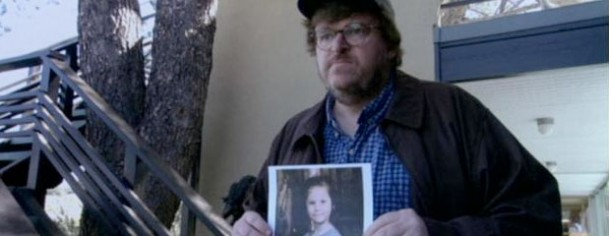
Michael Moore’s 2002 documentary, somewhat pithily christened Bowling for Columbine, is undoubtedly a seminal piece. For Moore personally, it gained the director an Academy Award and the chance to extend some sentiments splashed throughout his film to a plush Hollywood crowd in LA’s Kodak Theatre. (Some booed, some cheered, Tommy Lee Jones probably sat stone-faced.) It also smashed international box office records in places such as the United Kingdom upon release, becoming the financial brass ring to which other documentaries aspired — ironically, Moore would go on to eclipse himself with Fahrenheit 9/11.

Though, carrying more importance than these aforementioned amenities, Bowling for Columbine debates unavoidable issues that are still firmly rooted in the bricks and mortar of society. And Moore frequently wins. His film is a bit of ego-trip, but that’s not necessarily a bad thing. On the contrary, the chief’s unwavering histrionics often inject a tragically informative piece with a comedic edge. That being said, his manifesto is never relinquished in favour of entertainment. Notwithstanding the occasional needless tactic, Bowling for Columbine successfully eradicates the clouds that surround its thought-provoking themes. What’s presented, in turn, rains with disquieting reality.

Moore targets gun crime and, in doing so, uses the 1999 Columbine High School massacre as the seed from which each of his arguments grow. The film is a generally political, sporadically cultural and universally societal look at trigger-happy violence in America and its central question is: Why? Why did thirteen innocent people die at school? And why is America’s gun crime resoundingly higher than the rest of the world’s?

Each argument is an extension of the last, and his agents of remonstration spread fairly far. We begin down a bowling alley and conclude in the company of Charlton Heston. Moore strives to maintain a potent arc along his two hour discussion and more or less accomplishes this. He links each chapter well — the revolver road-trip stops off at a variety of places, from a rifle-offering bank to the house of a man whose participation in the Oklahoma City bombing was once in question — and, in doing so, implements a solid narrative structure. There are a few rocky detours that see some less-effective moments; an interview with a Lockheed Martin spokesperson is a bit flimsy. Moore disguises any unsatisfactory points though. He shrewdly converses with the right people as a means to substantiate his own agenda. Which is fine, it doesn’t negatively affect the arguments presented because an authentic base is already in place.

That base is Columbine. Although the film isn’t about the actual shooting — Moore’s decision not to stray down what would have been an easily rewarding path, in terms of emotional gravitas, is admirable — the tragedy is always lingering in the background. In fact, the director actually references the location of Columbine High School at one point, indicating that its direct centrality amongst discussion involving guns, bombs and violence isn’t simply metaphorical. Given the very real presence of the atrocity, notions of disgust and negativity towards gun culture are already firmly embedded in our minds. Moore’s numerous assertions against said culture, therefore, are instantly credible.

A particular sequence intended to give an overview of Columbine is inherently powerful, but not exploitative. There’s no argument-shilling at this point, only a picture of humankind at its most despicable. It’s so disgruntling that the subsequent scene might implore the viewer to detest one of cinema’s most iconic figures in a swift rifle-raising action and four contextually chilling words (“Over my dead body”) — just one example of Kurt Engfehr’s wholly astute editing that motions proceedings along at an engaging pace.

Music is also effectively enforced. The now infamous “What a Wonderful World” montage would be quite amusing if it weren’t steeped in such fraught subject matter. Indeed, Bowling for Columbine thrives on destitute comedy. One of the earliest examples sets the darkly humorous prerogative; Moore enters a bank and opens an account in order to obtain a free gun. After a few minutes where the staff aren’t paraded in a particularly flattering light, Moore exits, rifle aloft. The scene is too outrageous to fully comprehend — its authenticity has been disputed in one of many controversies since release — but the filmmaker doesn’t pass up an opportunity for funny. (“D’you think it’s a little dangerous handing out guns in a bank?”)

The climate of fear is a prominent thread throughout. Does Moore blame guns? Not entirely. It’s the gun culture. The media scaremongering. Even the US government’s foreign policy hailing a bomb as a solution, according to Moore. These collectively add up to the main source of gun-related disaster in America. Today, over a decade later, Moore still flaunts this strongly asserted claim: “Guns don’t kill people — Americans kill people.” One of the film’s most compelling parts is an interview with Marilyn Manson, whose well-formed explanation in regards to media exploitation is practical and persuasive. (We hear that crime is down by 20%, but television coverage is up by 600%.)

It’s all going swimmingly until a K-Mart segment towards the film’s conclusion. Shadowed by two victims of Columbine, Moore leads his verbal assault against the store. It almost comes around in the end, but by then Moore’s ego is edging towards the spotlight. Only, rather than positively affecting proceedings, this time his overly aggressive personality is distracting. However it should be noted that the stunt’s positive outcome absolutely justifies the slightly crass piece of filmmaking from which it spawns.

Overall, Moore completes a stellar job of informing and convincing. Despite sporadically venturing down peripheral avenues, the film holds together tightly and is even genuinely funny at times. Ultimately though, this is a damning indictment on not just America but society as a whole, exposing us at our very worst. If Bowling for Columbine was evidence in humanity’s trial, we’d be guilty as charged.

Bowling for Columbine - Moore

Images credit: IMP Awards, WhatCulture

Images (©): United Artists

Dear Zachary: A Letter to a Son About His Father (2008)

★★★★

Dear Zachary PosterDirector: Kurt Kuenne

Release Date: January, 2008 (Slamdance Film Festival); February 22nd, 2010 (UK)

Genre: Documentary; Crime; Drama

How does one review a terribly sad personal visual tribute? It’s somewhat ironic that Kurt Kuenne’s diary of tragedy is such a labour of love, the filmmaker having traversed across the United States, Canada and even the United Kingdom to create his piece. But perhaps the irony is misplaced. Undoubtedly, Dear Zachary is profusely powerful and heart-wrenching, but it’s also a story about living. About loving.

Kuenne’s efforts are splashed across every frame (and every videotape stashed inside a box in the back of his vehicle) and it’s apt that by injecting so much passion Kuenne receives even more in return. The man at the centre of events is Andrew Bagby, the director’s dear friend and a victim of inhumanity, but someone who seemingly revelled in quite the opposite.

In early November 2001, Andrew Bagby was murdered. A medical student from California, the reach of his inherent popularity is made evident through the filmmaker’s interviews with a whole host of friends, family and colleagues. We’re informed that the collection of life recollections are for Zachary, Andrew’s unborn son at the time of his death.

There’s no real urgency to critique this film. Nor, truthfully, is there a need. But in a pithily vain attempt, here goes anyway. Technically, it serves a purpose: to clearly and concisely recount a story. We’re plunged into a moment in time, information about the person and subsequent criminal investigation gallivanting left and right. It’s difficult to chew on all of the data first time around which is why Kuenne navigates a narrative roundabout once or twice. The thing is, what we’re learning about is not simply narrative. It’s real life, and that’s why critically assessing events feels a tad unwarranted.

We’re taken completely aback because the story is shocking. We’re overcome by emotion because the account is upsetting. We’re rendered unequivocally resentful because the tragedy is unjust. Kuenne’s direction (in fact his everything: he’s also editor, cinematographer, writer and more) is deft; though we’ve a lot to consume, the presentation is done in such a way that we’re willing to engage and become attached to those on screen. We enter familial homes either side of the Atlantic and feel totally welcome, as if individually invited into them for a brief period of time. While the content is personal, the way in which it’s displayed is personable and therefore, at just over an hour and a half, proceedings seem to fly by.

Rumbling like a pitch black storm cloud alongside both the hearty family memoirs and some joyous and often amusing archive footage that shows Andrew’s attempts at acting for his best friend’s home-made short films, is the harrowing topic of Andrew’s untimely death. Though it feels rather flippant to discuss such a tragedy using obsolete language, this part of the documentary plays out like a fictitious crime-drama. It’s unbelievable. As the minutes tick away each discomforting revelation trumps the one preceding until the film reaches breaking point. If you watch the outing armed with prior knowledge of events, hearing them being discussed by Andrew’s loved ones will undoubtedly be disconcerting. Viewing Dear Zachary without any previous awareness of the subject though, is truly distressing. There’s no hiding that. This is a tough ninety minutes.

Criticising Kurt Kuenne’s intimate gift is not something on the agenda, nor should it be. Having said that, it’d be disingenuous not to point out a specific section that might sit uneasily with some. (As it does with me.) There is one moment that doesn’t altogether mesh well with what surrounds it, given how lovingly the remainder of the film is relayed. A particularly brash montage showing certain images and bolstered by grunge-like music is quite confrontational. Though, perhaps it should be. And there’s no arguing against the fact that its inclusion is absolutely with the filmmaker’s best intentions. Indeed, on the contrary, it represents the contextual horrors aptly.

As the film proceeds, it becomes drastically obvious just how wide Andrew’s web of affection had — and still does — stretch. From his parents, to a former fiancée, to English cousins, to criminal lawyers, a great number of people offer their own universally earnest and affectionate experiences shared with the medical student. The interviews, naturally, have a two-fold effect. In one of the film’s most chilling moments, Andrew’s justifiably distraught father explodes in a fit of sheer loathing and it is in this action, more than any, that we get a stark sense of just how much the tragedy and all resultant enquiries have affected those close to him.

You can’t put a price on a family heirloom and, in essence, Dear Zachary is a preemptive visual legacy. Thus assigning stars almost seems unnecessary. The film is rate-less. It’s Andrew Bagby’s story told by one of his closest friends, and it’s a troublesome watch. Hopefully, rightfully, the positive aspects prevail.

Dear Zachary - Kurt and Andrew

Images credit: IMP Awards, Collider

Images copyright (©): Oscilloscope Laboratories

22 Jump Street (2014)

★★★

22 Jump Street PosterDirectors: Phil Lord & Christopher Miller

Release Date: June 6th, 2014 (UK); June 13th, 2014 (US)

Genre: Action; Comedy; Crime

Starring: Channing Tatum, Jonah Hill

As simply a comedy film, 22 Jump Street lands its fair share of guffaws. And this is primarily offspring of the humour genre: from acting upon the comedic strengths of its leading pair to unwaveringly owning up to sequel-dom, Phil Lord and Christopher Miller’s second trek down Jump Street fulfils many a Mark Kermode six laugh test. Yet, albeit competently amusing and even occasionally side-splitting, the outing ceases to be complete. Though the directors’ panache for funny bellows through, their film isn’t consistently hilarious. Not many are. Necessary then, is another anchor to steady the ship when proceedings aren’t quite as raucous; a sturdy narrative perhaps. Sadly, the one presented to us is rather flimsy when it comes to chapters that aren’t laden with jokes.

The final bell having rung on their undercover high school lives, Schmidt (Jonah Hill) and Jenko (Channing Tatum) now find themselves caught up in a whole new world: college. Their location is the only difference though, given the partners are once again involved in a narcotics mystery. The new drug is called WHYPHY and has already seen to one student’s untimely demise. Whilst attempting to sideline nostalgic football dreams and romantic engagements, Schmidt and Jenko must also overcome any strains in their own relationship in order to solve the criminal dealings before things get any further out of hand.

Opting for humongous sign-waving as opposed to measly eye-winking, 22 Jump Street isn’t exactly flippant in self-referential deliberation. After an opening montage that takes us through the key scenes of its predecessor — Previously, on 21 Jump Street… — we soon find ourselves camped alongside Schmidt and Jenko in Nick Offerman’s office where Offerman’s Chief Deputy Hardy is openly counteracting the potential pitfalls of sequel syndrome by facing the fact head on. (“Do the same thing as last time, everyone’s happy.”) It’s back to the old headquarters for our two agents then, though the base has conveniently moved across the road. In the background preparations are under way for the construction of 23 Jump Street.

There aren’t any thoughtless attempts to evolve the Jump Street apple cart and the film vociferously makes us aware of that. Though in doing so, Phil Lord and Christopher Miller’s creation (or recreation) takes on a disguise of irony that is inherently funny. It uses this self-referential prerogative as a weapon, to cut through any sequel-related audience apprehensions and subsequently endear itself to us. We are constantly reminded that our expectations should be low, or at least no higher than last time around, for what’s about to come is a mirror image. The ruse works; we’re too busy laughing at the source’s jokes — driving through a cash machine — to fully consider the mechanics of the source itself. Essentially, by admitting the sequel is going to be much the same as the original, 22 Jump Street is a more engaging proposition because it serves and then effectively manipulates our preconceptions.

That’s just one running gag. The film motions forward in its prejudicial tirade by tapping into assumed college culture too. The volatile drug is aptly named WHYPHY, pronounced Wi-Fi, and it’s no coincidence that the side effects are a temporary buzz followed by likely danger. Notions surrounding internet addiction are vaguely pertinent but never wholly realised. We discover that the student majoring in art is unlikely to make any money when she graduates (who knew?) and there are also an obscene amount of “Bros” and “Dudes” verbally volleyed between the football players. College satire isn’t the film’s strongest comical outlet.

Indeed, the funniest moments throughout 22 Jump Street are delivered by the two leads. Both Jonah Hill and Channing Tatum are comfortable in their roles and the duo’s dynamic prevails as a result. It’s refreshing to see Hill continue along a path that he obviously loves navigating despite having tasted the golden allure of critical success. The peaks of his dramatic work — most of those roles are infused with humour anyway — would suggest that he’s probably a highly sought after fellow, but he seemingly still has much to offer in this genre.

Hill plays the socially awkward Schmidt across from Tatum’s Jenko, whose smarts are inversely proportional to his skill at football. The two funniest scenes involve each man without the other; it’s Schmidt’s slam poem versus Jenko’s slowly simmering realisation, and the difficulty in picking a winner is an indication of how funny both actors are in equal measure. Ice Cube, who returns as Captain Dickson, should also be noted for his hugely enjoyable turn as their always animated boss. Ride Along might have crashed and burned, but the man of many trades has shown he can be infectiously amusing when delivering superior material.

Unfortunately, the dramatic narrative between Schmidt and Jenko is a problem. Unlike the smart use of self-reference, there’s nothing shrewd about the less than budding brotherly developments between the two. Their collective arc is annoyingly mundane and, although this could be construed as another of the film’s this-is-a-sequel-so-don’t-expect-much contributions, it falls far short of the entertainment mark. The troll-like concept is funny in its manifestation as a running gag with frequent pit stops, but it fails to reward when blending into an overly schmaltzy and all too familiar story. In this instance there aren’t any jokes to veil Schmidt and Jenko’s generic bond and when attempted wisecracks are communicated, they fall on deaf ears. (The open investigation malarkey is a bit cringe-inducing due to its lack of invention and continued implementation.)

Two-hour-long gags aside, was it worth creating a sequel? I’d say so. Though not nearly as snappy or galvanising as The Lego Movie, Lord and Miller’s latest offering does trump their first visit to Jump Street. The deliberation now centres on where the franchise is headed next, if anywhere. It looks like the filmmakers have shot themselves in the foot regarding the prospect of a third film. (That sequel quip won’t work twice.) We’ll just have to wait and see.

There’s no uncertainty here. If this review of 22 Jump Street is at least moderately successful, I’ll consider writing another one. Fair warning: It’ll be exactly the same.

22 Jump Street - Hill, Tatum, Cube

Images credit: IMP Awards, Collider

Images copyright (©): Columbia Pictures, Metro-Goldwyn-Mayer

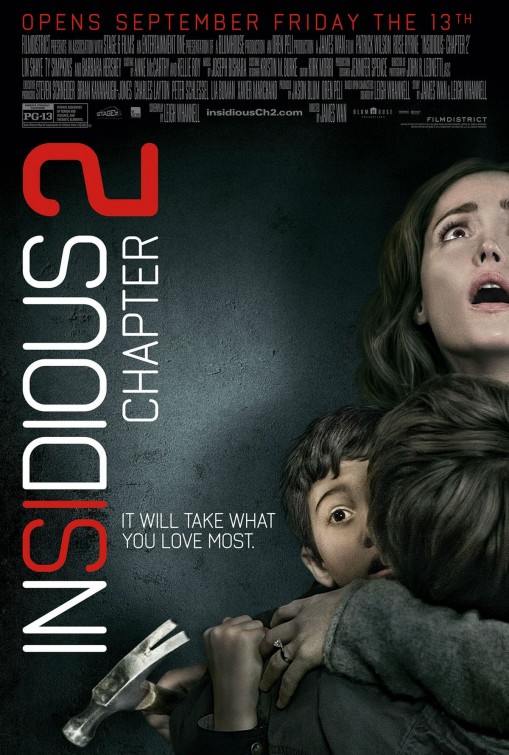
Insidious: Chapter 2 (2013)

★★

Insidious Chapter 2 PosterDirector: James Wan

Release Date: September 13th, 2013 (UK and US)

Genre: Horror; Thriller

Starring: Rose Bryne, Patrick Wilson, Ty Simpkins

The second instalment in James Wan’s scary adventure opens with a game of ‘Hot and Cold’, where Participant A uses temperature to gauge Participant B’s closeness to a particular destination. Only, it should be rechristened ‘Manufacturing Scares’ because that’s exactly what the game is implemented for. In fact, the moment is indicative of Insidious: Chapter 2 as a whole, a film that lacks invention and overly relies on horror commonalities. Before the final credits roll we watch as characters partake in a Ouija circle, find a ghostly videotape and visit an abandoned hospital. (Guess what? It’s haunted). Discounting the occasional splurge of genuinely creep imagery, Chapter 2 is much the same as the first chapter but without the benefit of a new-born shine.

After a brief venture down memory lane — the origin of Josh Lambert’s (Patrick Wilson) uncanny ability is relayed — we realign with the present where the Lambert household isn’t exactly settled. The grizzly death of paranormal investigator Elise (Lin Shaye) has caused a stir, and Renai’s (Rose Bryne) subsequent questioning by a police detective in regards to her husband Josh’s potential involvement in Elise’s demise is also inducing internal strain; he seems different, evidently cockier. Her beau’s strange demeanour ain’t even the worst of it: the evil spirits are back and once again preying on Renai’s family.

If retreading old ground was an Olympic sport, Insidious: Chapter 2 would be blaring out the US national anthem with a gold medal hanging not-so-proudly around its camera lens. The title sequence is a carbon copy of what came before; aided by a congregation of piercing strings, blood red letters boom on screen and form the once foreboding INSIDIOUS inscription. It is sort of scary but the impact is far lesser here than was felt at the beginning of the premier output. Said string instrumental is part of the same score as before and, again, might have been quite unsettling if not for its overuse.

The familiarities aren’t simply local though, they arrive from afar. Chapter 2 has a number of its hands in a number of stagnant terror traits — James Wan meshes together haunted houses, desolate hospitals, alarming photographs and more in a hodgepodge horror pie that more resembles eight undercooked slices than a well-done whole. We’ve seen it all before, just one film ago in fact, and Chapter 2 struggles to stand upright on its own as a result.

The various elements don’t converse fluently either. If the first half is often predictable, the second is occasionally undecipherable. It’s a mess, really. Leigh Whannell’s screenplay devolves into a plethora of timelines and various existences. The writer dusts off his acting chops when a singular focus might have served proceedings better. Older and younger selves meet, but they don’t really. (Or do they?) Jocelin Donahue joins in at this point but her previous genre achievements fail to rub off this time around. Indeed, as far as haunted house epidemics go, The House of the Devil is in another league. Some effort is made to tie up loose ends, it’s just a shame that these loose ends end up in a tangle. As far as the film’s predictability goes, we tend to know the plan before the characters do: “If only Elise were here to help us.” If only. Watch out for two tin cans and a string as well. Something spooky oughta happen there.

Given the film carries a tone that pangs with dishevelled nostalgia, it’s probably to nobody’s surprise that some of the acting is camp. Patrick Wilson plays Josh Lambert but with a noticeable sprinkle of added aplomb to his voice, so much so that you’d think something was wrong with the father/husband. Despite his attempt to be eerie and serious, Wilson’s allure edges ever closer to humorous as the film progresses. It’s not meant to be funny, but it is. Rose Byrne is always reliable and provides a solid anchor for the uninspired narrative. Ty Simpkins also has more to offer than first time around, though admittedly he did spent the previous instalment almost entirely in a coma. Leigh Whannell and Angus Simpson’s comedic duo is a completely jarring inclusion. Unlike Wilson’s turn as Josh, the pair are supposed to funny but spend their time on screen spouting cringe-worthy material.

Though infrequent, James Wan does unveil some of the well-furnished horror magic that he has deftly applied in the past. Much like in The Conjuring, Wan finds prosperity in some seriously disturbing imagery. Hairs raise as menacing-eyed, widely-grinning faces flash before us for only a split second, but it’s enough to leave a dent in our previously unscathed fright-barometer. Moments such as this one catch us off-guard, however unlike the inferior jump scares that consume the rest of Chapter 2, these images are themselves intrinsically ominous and therefore contextually justified. The film actually bares a well-oiled look and one of its better moments comes near the beginning: a slow pan from pitch black into a moody, dark room. Lugging a plot that can barely hold itself together without succumbing to old ways and characters that don’t really command our attention, Wan’s dexterity when it comes to imagery is at least one spooky success.

Insidious: Chapter 2 spends an hour playing with second-hand toys before it takes to doodling with permanent markers and resultant mess-making. Aside from teaching us not to have babies (they’re a real nuisance when ghouls attack) and treating us to one or two authentic frights by way of scary visuals, Wan’s outing is purposeless.

At one point Josh says, “All you have to do is ignore them and they’ll go away”. I’ve stopped listening.

Insidious Chapter 2 - Ty

Images credit: IMP Awards, Collider

Images copyright (©): FilmDistrict, Stage 6 Films

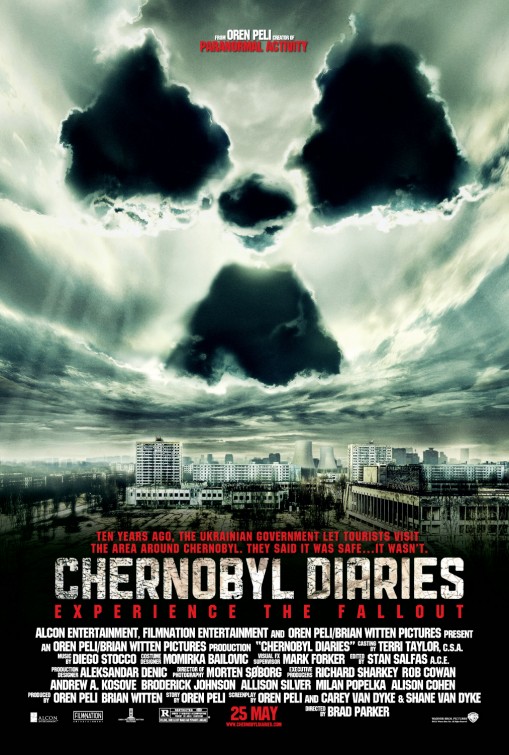
Chernobyl Diaries (2012)

★★

Chernobyl Diaries PosterDirector: Bradley Parker

Release Date: May 25th, 2012 (US); June 22nd, 2012 (UK)

Genre: Horror; Thriller

Starring: Devin Kelly, Olivia Taylor Dudley, Jesse McCartney, Jonathan Sadowski

When does the term ‘B movie’ become an excuse rather than a justification? Somewhere, surrounded by low-budgets and gooey prosthetics, Roger Corman has an answer to that particular musing. Chernobyl Diaries veils itself as a B movie with its microscopic financials and horror genre tidings, yet it relents from purveying the ingenious soul of said cinematic crop. Director Bradley Parker manages to conjure up an ominous mood — the setting, if you hadn’t already guessed, is Chernobyl — and his primarily indie cast run with the creep-factor for a while, however they ultimately can’t overcome a dreary screenplay that succumbs to the generic scare code. Radiation levels might be increasing, but imagination is struggling to level out from a downward spiral.

Midway through their travels across Europe, Chris (Jesse McCartney), his girlfriend Natalie (Olivia Taylor Dudley) and tag-along Amanda (Devin Kelly) decide to stop off in Kiev to congregate with Chris’ brother Paul (Jonathan Sadowski). Living up to his brash reputation, Paul suggests that the group should take up some extreme venturing, to Pripyat, an abandoned village on the edge of the radiation-infested Chernobyl nuclear reactor. Upon arrival though, it appears that their ghost town is anything but.

It’s this particular setting from which all of the film’s success emits. Though events aren’t shot on actual location — production took to Hungary and Serbia due to the issues posed by surrounding levels of radiation in Chernobyl — Morten Søborg’s cinematography still manages to capture the inevitable haunting of a post-disaster scene. Makeshift Pripyat is like an eerie still-life painting without the life as it languishes in a wonderfully spooky state of urban decay. Hand print markings are shown painted on walls, created by urgent escape and presumably made of blood. Shattered picture frames represent lost livelihoods, the town having emptied in just two days.

Before we reach our destination there’s enough time for a stop off at an exclusion zone checkpoint where the travelling group incur the scathing stare of an intimidating military man as he circles their van to the sound of piercing strings. Not to mention, the occasional sighting of a radiation warning sign. What we see might not be the real Pripyat in the shadow of Chernobyl, but it sure feels that way; the landscape appears genuine, the remnants of nuclear disaster still lingering in the air and therefore, as our bunch of explorers begin their tour, an authentic sense of danger exudes. The horror narrative is armed with instant credibility, edgy and real, but this sadly turns out to be only the film’s only credibility.

Suggestion is often worse than implementation. Implying that something terrible is about to happen or that there could be a spectre lurking in the wings can, and regularly does, induce a great deal of fear. The faux-Chernobyl location provides a disquieting assist that isn’t capitalised on, much to chagrin of the audience, we being an expectant mob after the film’s promising start. Instead of revving the already unsettling mood, Bradley Parker encourages a steadfast meandering towards convention. People are chased by hungry dogs and figures appear in windows, but it’s nothing that hasn’t failed to scare us before. Proceedings never leave ground level and, with the exception of a rumbling animal appearance, fail to truly frighten. Sure you might jump once or twice, but these heart-racing moments have a lazy source. Shattering silence with a loud noise will always naturally create a cheap reaction. Doing so on film is eternally unimaginative and a problem in modern horror.

Speaking of contemporary cracks in the genre, Chernobyl Diaries is as guilty as any when it comes to less-than-average characterisation. The screenplay, written by Paranormal Activity architect Oren Peli and brothers Shane and Carey Van Dyke (of that bloodline), parades characters who collectively boast less of a dimension than a horizontal line. There’s the sensible one Chris, played by musician Jesse McCartney, whose wariness about the Pripyat expedition is an apprehensive foreshadowing of what is to come. His brother Paul is the inciter of mischief, and it just so happens that he manages to get his sibling into yet more trouble — this time though, it might be terminal, so best get some moral repenting done, eh?

Paul is played by Jonathan Sadoswki and both he and McCartney do a decent job at handling their poorly-written characters. In fact most of the remaining cast members are also fine, but they’re also forced to join the aforementioned duo in shilling a dead horse. An exception could be made for Dimitri Diatchenko who plays iffy outing guide Yuri, and who rattles off every line as if he’s reading directly from an exposition-laden script: “We’re now entering the exclusion zone.” It’s highly probable that Diatchenko is indeed an extreme tour leader moonlighting as an actor for one time only. (Turns out he’s been in everything from Indiana Jones to Family Guy.)

Chernobyl Diaries wishes to garner the cult notoriety of a B movie but, in the end, its foundations aren’t sufficiently durable. The set-up arouses an eerie mood prompted by location and is promising. However, this is merely a superficial canvas that fails to disguise the remaining descent into a lack of ingenuity. Truthfully there ain’t a whole lot to say about this, which is the fundamental problem.

It tries to combine the rubble of a fairly recent disaster and postmodern nuclear stigma with slasher scares and atmospheric nip, and it should simply be better.

Chernobyl Diaries - Devin Kelley

Images credit: IMP Awards, Collider

Images copyright (©): Warner Bros.