Oscars 2014 — Final Predictions

Hollywood’s favourite night of the year is once again upon us. Stars have campaigned. Odds have shortened. Dresses have been selected. Cinema trips have come thick and fast. Jared Leto’s hair has been straightened.

And, now that I’ve seen all the nominated films in all the most talked about categories, here are my final predictions for the 86th Academy Awards.

If you want to know a bit more about why I picked what/who, there are a few ponderings towards the end. For my review of each Best Picture nominee, click on the respective title.

Best Picture

American Hustle

Captain Phillips

Dallas Buyers Club

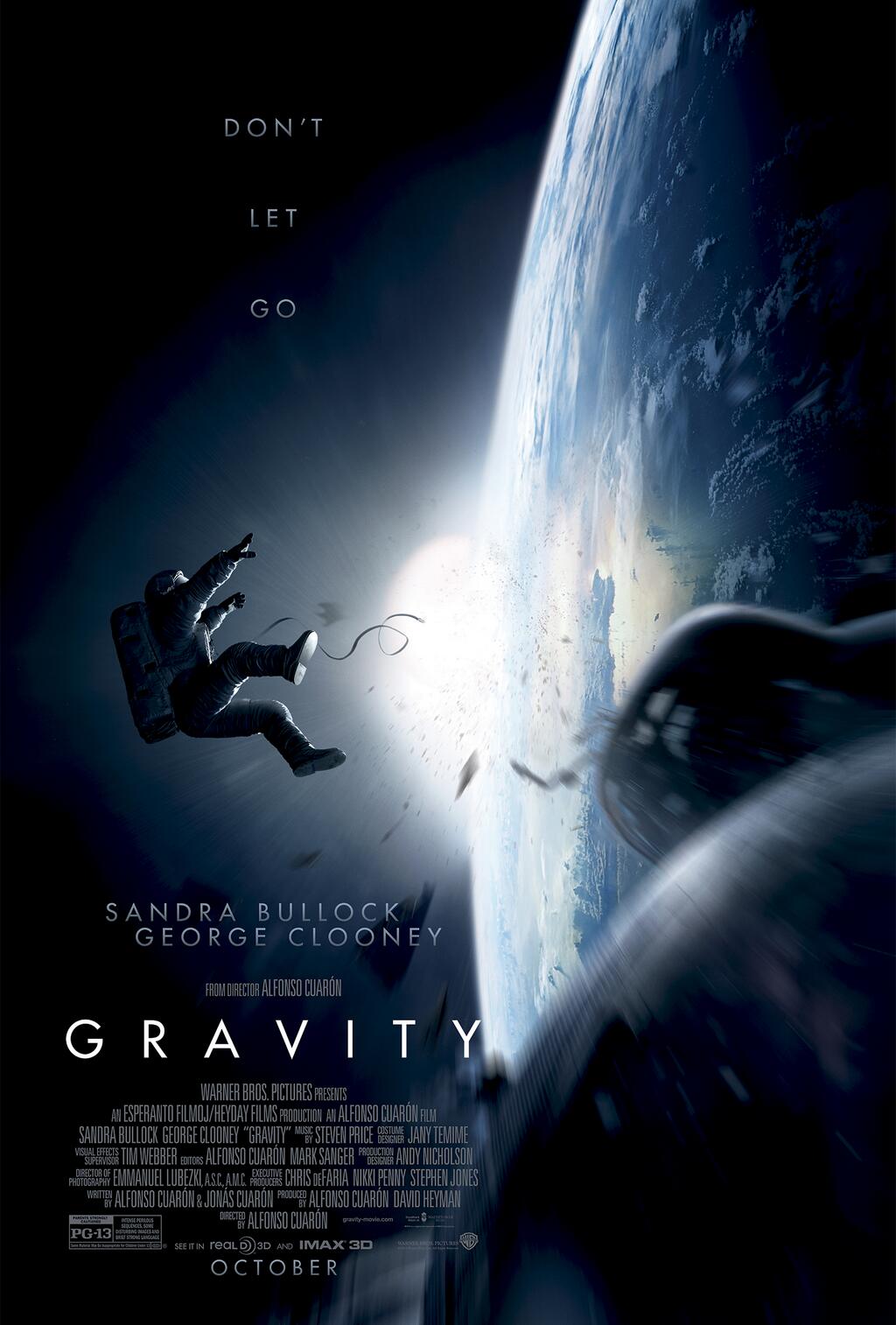
Gravity

Her

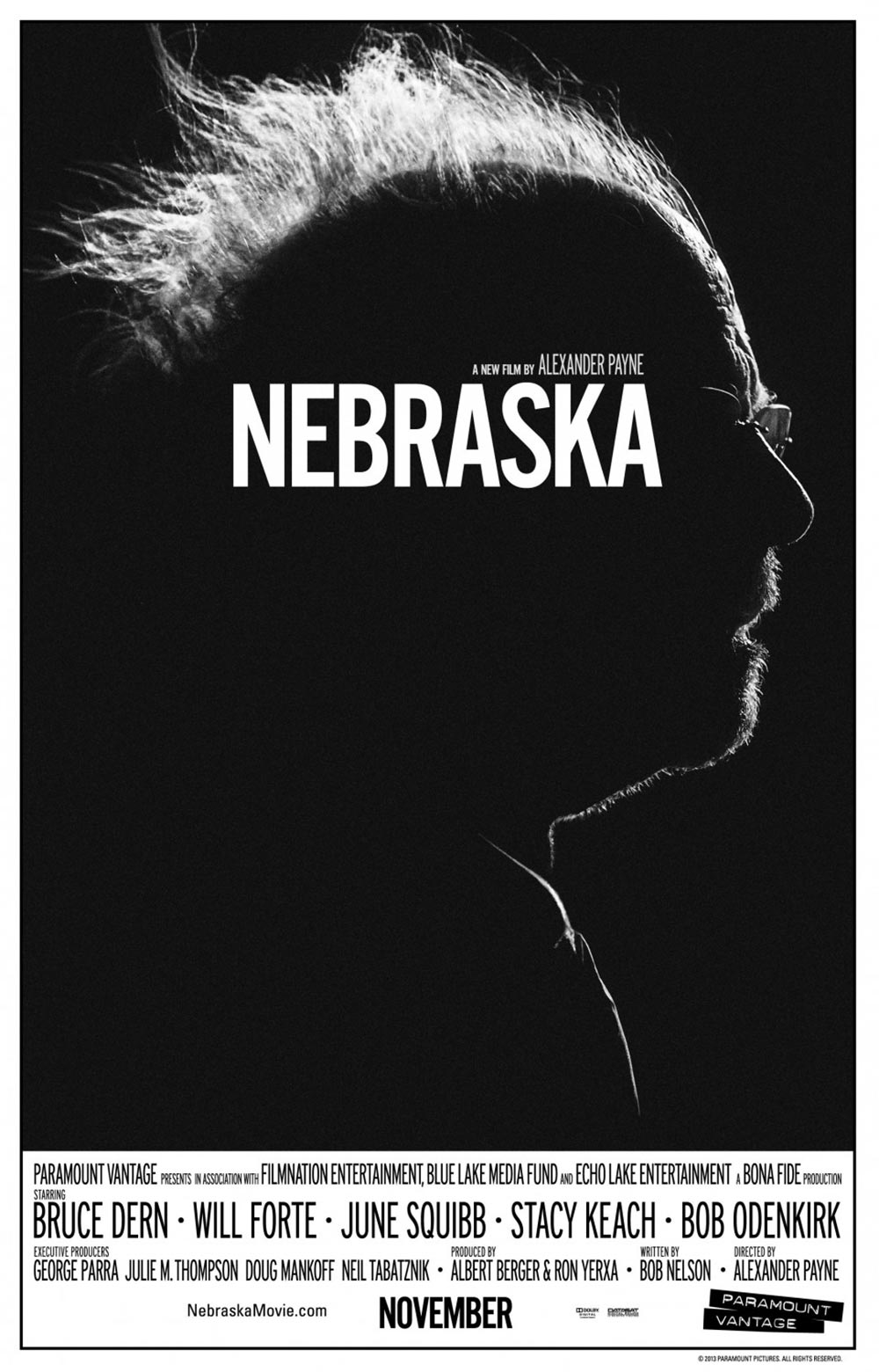
Nebraska

Philomena

12 Years a Slave

The Wolf of Wall Street

– What will win: 12 Years a Slave

– What I want to win: 12 Years a Slave

– What should’ve been nominated: Blue is the Warmest Colour

Best Actor

Christian Bale

Bruce Dern

Leonardo DiCaprio

Chiwetel Ejiofor

Matthew McConaughey

– Who will win: Matthew McConaughey

– Who I want to win: Leonardo DiCaprio

– Who should’ve been nominated: Tom Hanks (Captain Phillips)

Best Actress

Amy Adams

Cate Blanchett

Sandra Bullock

Judi Dench

Meryl Streep

– Who will win: Cate Blanchett

– Who I want to win: Cate Blanchett

– Who should’ve been nominatedAdèle Exarchopoulos (Blue is the Warmest Colour)

Best Supporting Actor

Barkhad Abdi

Bradley Cooper

Michael Fassbender

Jonah Hill

Jared Leto

– Who will win: Jared Leto

– Who I want to win: Barkhad Abdi

Who should’ve been nominated: N/A

Best Supporting Actress

Sally Hawkins

Jennifer Lawrence

Lupita Nyong’o

Julia Roberts

June Squibb

– Who will win: Jennifer Lawrence

– Who I want to win: Lupita Nyong’o

Who should’ve been nominated: Scarlett Johansson (Her)

Best Director

David O. Russell

Alfonso Cuarón

Alexander Payne

Steve McQueen

Martin Scorsese

– Who will winAlfonso Cuarón

– Who I want to win: Steve McQueen

Who should’ve been nominated: Joel and Ethan Coen (Inside Llewyn Davis)
Best Original Screenplay

American Hustle

Blue Jasmine

Dallas Buyers Club

Her

Nebraska

– What will win: American Hustle

– What I want to win: American Hustle

– What should’ve been nominated: Inside Llewyn Davis

Best Adapted Screenplay

Before Midnight

Captain Phillips

Philomena

12 Years a Slave

The Wolf of Wall Street

– What will win: 12 Years a Slave

– What I want to win: 12 Years a Slave

What should’ve been nominated: Blue is the Warmest Colour
Best Documentary Feature

The Act of Killing

Cutie and the Boxer

Dirty Wars

The Square

20 Feet From Stardom

– What will win: The Act of Killing

– What I want to win: The Act of Killing

– What should’ve been nominated: Blackfish

Additional Quick-hits

With the exception of a few glaring errors, The Academy has more or less come up trumps this year, at least nominations-wise. Time will tell whether the industry congregation get it right on the night, but until then, let’s take a look at some of the unfortunate snubbees (in a personal snub, I’ve opted not to include my Best Foreign Language picks above as, for whatever reason, i haven’t seen enough of the nominated films).

Inside Llewyn Davis, what is going on? Only up for Best Cinematography and Best Sound Mixing, my personal favourite film of the year has strummed a valiant strum, only to be waived by another Bud Grossman. As unlucky as Llewyn himself (irony eh?) the film should be up for a lot more.

Tom Hanks delivers the performance of a lifetime in the final moments of Captain Phillips, but his name is nowhere to be seen. I’m a fan of Christian Bale, and thought he was really good in American Hustle, but no phony wig can hide the travesty that places his performance ahead of Hanks’. Having said that, old Tom’s already won a couple, so he might not be that bothered.

Another disappointingly shunned near-masterpiece, the folks behind Blue is the Warmest Colour must feel hard done by. Adèle Exarchopoulos’ raw, enchanting portrayal is criminally ignored. The film was ineligible for a Best Foreign Language nomination, but Best Director, Best Supporting Actress and Best Film nods should’ve been calling. It’s almost as if some of those hardened Americana execs don’t fancy reading subtitles…

On to the actual bunch clambering for awards, and it seems Best Actor, Best Actress and Best Supporting Actor are all pretty much sown up. I’d love Leo DiCaprio to finally receive the adulation he deserves in the form of a golden statuette, but McConaughey is the favourite and a worthy winner. Barkhad Abdi surprised at the BAFTAs, but won’t here. Cate Blanchett is the definitive stick on.

Jennifer Lawrence and Lupita Nyong’o have been tussling for Best Supporting Actress throughout this awards season, the former having come out on top more often. Nyong’o delivers the more powerful and wholly better performance, thus should win the gong. Gravity is up for a lot, but outwith the technical categories, might only win Best Director for Alfonso Cuarón.

What then, of the top prize? Best Film. It appears to be a three-way jostle between the important 12 Years a Slave, the glitzy American Hustle, and the floaty Gravity. Apparently, some Academy members find 12 Years a Slave too tough a watch – which is absurd – and Gravity ain’t exactly at its best on a laptop screen (most voters see the films at home), therefore a shock could be on the cards which would see American Hustle hustle its way to the top. I don’t think so. For me, there’s no looking past Steve McQueen’s haunting 12 Years a Slave.

There we have it.

After a fairly lacklustre spring/summer, the arrival of that typical awards scent in late autumn summoned a plethora of very good to great films. From Captain Phillips to The Wolf of Wall Street, and many others in between, we’ve seen a mixture of high intensity drama, awe-inspiring visuals, harrowing story-telling and debaucherous eccentricity. All in all, I reckon it’s been a pretty good year.

Here’s to another!

Nebraska (2013)

★★★★

Director: Alexander Payne

Release Date: December 6th, 2013 (UK); January 24th, 2014 (US)

Genre: Adventure; Drama

Starring: Bruce Dern, Will Forte, June Squibb

Alexander Payne truly has a knack for relaying the road story on screen. You need more than an echelon of soul, characters whose individual hearts collectively beat in time with the narrative, and a narrative that quips comically, evolves raucously and affirms genuinely. In Sideways, he created a cinematic Everest, a pinnacle that will require something pretty spectacular to reach. And although Nebraska — Payne’s latest venture into the genre that sees characters finding their way around town before finding themselves — doesn’t quite reach the Sideways summit, it’s still a comforting, humorous and reminiscing ride.

Absolutely dead-cert he’s stumbled upon a one million dollar sweepstakes letter, getting to Lincoln, Nebraska is the first, last and only thing on Woody Grant’s (Bruce Dern) torpedoing mind. If it weren’t for highway patrol, he’d have walked there. His end goal momentarily scuppered by the confines of a police station and a sigh-fully approaching son, Woody mentally prepares a case for action. Because in his eyes, there’s a mound of cash crying out to him at the end of a Nebraskan road. Son David (Will Forte) believes the letter is a scam, and initially denounces Woody’s nonsensical intentions. However, after a number of persistence-driven incidents, David agrees to chauffeur his father towards the elder’s prescribed destination; probably not out of curiosity, rather, in order to spend time with his ageing old man.

From its elegant cinematography to a perfectly poised story, Nebraska evokes a sense of accomplishment and craftsmanship. Of course, the road-trip mantra will always centre on character study, and it’s no different here. However to not acknowledge the technical prowess on display would be doing the film a disservice. The black-and-white scape works both as a visual appeasement and as a narrative cog, as it represents not only the blunt tone, but also Woody’s depreciating mind and somewhat selfish outlook. In composing a curtain of sound, Mark Orton infuses proceedings with a Wild West twang, harking connotations of the primitive western ‘every man for themselves’ adage. Technically, the film is better than proficient. It is wholly engaging.

Having communicated the industrial superlatives, I ought to focus on the film as a depiction of characters, because without doubt Nebraska is about people and family and relationships. Those, and the subsequent pile of complex baggage associated with such humanistic tendencies. Although Woody isn’t the most amiable chap — his monetary determination prevails above all else — the viewer still sympathises with him to the point where you are subliminally rooting for the lead to walk away with a heap of cash, if only to see him smile. Bruce Dern embodies the retired Woody in all his stout manliness (“I served my country, I paid my taxes”), a portrayal that in many other hands would sway towards generic, yet Dern emits realism. But he’s also frail and his exuberance is quenched before it really gets going, demanding many a refuelling tavern trip.

Will Forte is the caring son David, who stands by his father through thick and thin. Forte must act as a sufficient bumper against all of Woody’s grouchy impulses, a challenging task if there ever was. The duo are essentially a two-man act, strained as a pairing but valiant against any external threat (much like Miles and Jack in Sideways). Enter June Squibb as mother Kate, the experienced firecracker of the family, whose hilarious opening statement sets the tone for her appearance: “You dumb cluck!” The withered status of Kate and Woody’s relationship is prevalent throughout, but it’s a natural abrasion brought on through years of being together, rather than simply a clash of personalities. Squibb impeccably channels her character’s outspoken demeanour into one of protection over Woody.

Bob Nelson’s screenplay is terrific, and Alexander Payne coats an affirming lesson with crude comedy. As father and son settle down at a family gathering alongside a ramshackle troupe of wordless Woodys and ditsy Davids, we watch that familiar social awkwardness at its most humorous. Cousins Cole and Bart insist on mundane car conversations, but at least someone is trying to cover over the cracks of silence. “Cole here did some jail”… maybe silence was the way to go after all. And it’s that tonal take-no-prisoners style that the film thrives on. Yet, there is a dramatic strand running throughout, one that takes its subject matter seriously. Woody is old. His senses are dwindling; he walks along motorways and unwittingly unveils his perceived monetary gain to strangers and enemies. This melancholic exercise on advancing years and losing oneself is relatable — everybody gets old, and many of us have spent time with elderly loved ones. Whilst Woody’s millionaire claims are momentarily amusing, they’re also sad in reflection as we see judgement fail him. At one point, you question Woody’s actual intentions: to chase a false dream, or to live and relive a reminiscent present? For David, the road-trip is a touching venture of discovery about the wholesome life endured by his father, a man you don’t get the impression David knows all that well, despite their familial ties.

Nebraska is another successful excursion for its director. Suitable in its simplicity and subtle in its sensitivity, the film is spearheaded by three admirably relatable performances. At the end of it all, Payne reflects on trust, on bonding, and on seizing the moment. It’s nothing groundbreaking, but it is, to quote Woody himself, “Pretty good”.

The Blogscars!

Well that pithy attempt at a punny title went awry.

Don’t worry, this is not a post on injured bloggers, or deformed blogs for that matter.

Credit: Oscars.org

Hey! It’s award season, and I’ve been nominated for my first blog award…

The Liebster Award!

I feel like I’ve just starred in Jerry Maguire and won Best Supporting Actor, only the Blog Gods have given me more than two minutes to exclaim my thank yous. Or perhaps that’s just down to my lack of being constrained by a rapidly flowing, live three hour televised window.

This is all very suave. I don’t really know what I’m doing, a bit like Jacqueline Bisset at this year’s Golden Globes. Okay, maybe not that bad. Or externally influenced. I digress, taking my lead from the business’ best and most bumbling in doing so; this isn’t about me, this is about all of you brilliant people – and occasional spam-bots – who read my film ramblings. Particularly, a huge thanks to the wonderful Cara over at Silver Screen Serenade whose insightful, funny and positively effervescent blog is a must read for film fans, television nuts and life folks in general! Check it out now if you haven’t already done so (though I’m sure you have). I’m also following Cara’s awards blog layout, because it’s far too nifty to ignore.

The Liebster Award rules, then:

  • Nominated bloggers must link back to the blogger who nominated them.
  • Nominees must answer the eleven questions set out by their nominator.
  • Nominated bloggers must also select eleven other terrific blogs with less than 200 followers – though a few of mine are a little above that figure – nominate, and then prescribe them eleven tantalising questions (or, make up some head-shakingly unimaginative queries, as I have done).
  • If nominated, you cannot nominate the person who originally nominated you.

Anyone else starting to verbally trip over that nonimate, err, nominate word?

Enough about rules, down with the machine! etc.

Let’s get going with Cara’s questions, all about FAVOURITES:

1. Vacation spot?

Being Scottish, I’ve spent many a holiday abroad over in Spain (we’re very particular, apparently). I did go to America a few years back though, when I played football (soccer), and absolutely loved it. The whole team went over; we paired off and lived with American families for most of the trip, and I was based in a wooded, pristine Pennsylvania neighbourhood. After spending a day in New York, I eulogise over returning.

2. Color?

Red, as you can probably tell looking at my blog’s header and logo!

3. Dessert?

Shockingly, I’m not a big dessert guy (or a big guy in general, so it’s not really that shocking after all) but I do enjoy vanilla ice-cream stacked on top of a warm chocolate fudge cake every now and again.

4. Black-and-white movie?

It’s a Wonderful Life, without question. That film is delightful.

5. Superhero?

I’ve never read a comic book, so purely based on films and television shows, Batman. Chris Nolan made Batman cool again. Don’t ruin it Snyder.

6. TV show?

This is a tough one. I watch far too much TV, and often have upwards of ten different series’ recorded and ready to watch. I’m gonna have three, because ‘down with the machine!’ etc., remember? Two that aren’t on anymore but are crazily different and therefore I cannot separate: Friends and LOST. I got into Friends over in the States actually. We watched it almost every night and I became glued, such a smartly humorous, charming show. LOST, I watched from start to finish as it aired on the tele. It gets a bad rap for the finale, but it absolutely had me going. A truly stupendous first season. Of the current shows on air, it’s gonna have to be The Walking Dead. I’m intrigued by the whole zombie/apocalypse (and zombie apocalypse) genre. Having said all of that, True Detective begins over here tomorrow and I’m big on Matt McCon at the moment – we’re on a nickname basis.

7. Book?

I don’t read as much as I should, but off the top of my head I’m going to pick The Hobbit. It’s all very adventurous, and funny, and good-natured.

8. Beatles song?

“Let It Be”. Sorry for being so generic!

9. Dog breed?

Labrador, like the little guy in those Andrex adverts!

10. Beverage?

I’m a sucker for Citrus Oasis, or any other orangey drink. Alcohol-wise, I’ve only really ever tried Budweiser, and haven’t consumed alcohol since!

11. Nerdy franchise (Harry Potter, Lord of the Rings, Marvel, etc.)?

Nerdy franchise? Hmm, evidently I’m quite a nerd when it comes to anything in the film (and television) Milky Way, but The Lord of the Rings is my favourite film trilogy/franchise so I’ll go with that!

Now, here are the magnificent 11 I’d like to give a shout-out to!

Since I’m all about the big screen, I’m going to compile a completely random, totally unserious list of film questions. Now then, should you guys choose to accept them (and please don’t feel the need to if it’s not your thing, or you’ve already been nominated!) here are my 11 quick-fire questions:

  1. Name one film that you have yet to see, but should’ve seen by now.
  2. Do you keep a list of every film you watch, and when?
  3. What is the first film that comes to mind when you read the following word: Guitar?
  4. What is your favourite Leo DiCaprio film?
  5. Name a film that you personally dislike, but that everyone else seems to love.
  6. What is your first film-related memory?
  7. Do you listen to any film podcasts, or radio shows, or watch any television review shows?
  8. Does the phrase “Hello to Jason Isaacs” mean anything to you?
  9. Was The Phantom Menace really THAT bad?
  10. What is your favourite film that is underappreciated elsewhere?
  11. When you hear the name Shia LaBeouf, what type of meat springs to mind? 

Have fun!

Oh, and if I’ve utterly messed all of this up and ruined the award-chain, I will repent at the feet of the Blog Gods for the rest of eternity.

Philomena (2013)

★★★★

Director: Stephen Frears

Release Date: November 1st, 2013 (UK); November 27th, 2013 (US)

Genre: Drama

Starring: Judi Dench, Steve Coogan

It’s not often you watch a drama about the culmination of a woman’s fifty year search for her long lost son, and end up spending a significant amount of time laughing in the wake of an odd comedy duo. Settle down at the mercy of Stephen Frears’ Philomena though, and that’s exactly what’ll happen. At its heartiest the film flows with a sense of uncertain determination embodied in diverging ways by the two lead characters, but in between these moments of bottled up emotion, at its most organic, Philomena charms in tone and entertains by way of a banterous dynamic. This incredible story pitched excellently is often funny, occasionally shocking and always peculiar in believability, even if it does lose some legitimacy at its conclusion.

Philomena Lee (Judi Dench) stares wholesomely into the eyes of a young gentleman pictured inside a piece of jewellery. It’s her son, Anthony, taken fifty years earlier and placed in the care of an American family. Philomena spent her younger years as part of an Irish Abbey, sent there by her disapproving father in a rebuttal to pregnancy. By chance, recently fired Labour government adviser Martin Sixsmith (Steve Coogan) is in attendance at a party where he is approached by Philomena’s daughter who pleas to have her mother’s tragic tale exposed to the world. It’s a “human interest story”, or for Martin, a way back into the positive glares of journalistic limelight, and so he embarks on a journey of discovery and hope with Philomena.

At the centre of the film is this weird dynamic shared between Philomena and Martin, one driven by religion and faith (or, in Martin’s case, the lack thereof). Having been forcibly separated from her child in an act of apparent punishment, Philomena retains a staunch belief in God and moreover, treats the present day nuns — of which still includes the prominent Sister Hildegard, who was instrumental in said previous events — with respect and without any incrimination. The horrendous actions undertaken in 1951 are presented in a unsavoury manner, as they should be, by both the film itself and just about every character, from tainted journalist to boisterous pub owner (“What about the evil nuns, what’s happening with them?”). Yet Philomena valiantly, admirably, stands by her beliefs and wholly practices the forgiving teachings, ensuring the narrative never plumbs over into anti-Catholic territory.

On the other hand, Martin embodies the typical cynical reporter. He spends half of the time answering his elderly associate’s questions about believing in God (“No”) and the other half truly puzzled by Philomena’s strong-willed demeanour. The journalist, who experiences a moral realignment himself as the film canters on, publicly denounces Philomena’s inbuilt faith having never sincerely lived it — although he was an alter boy once upon a time.

These quizzical debates between the pair provide the catalyst for the film’s good-humoured underbelly. That, in tow with the chuckle-worthy “little old Irish lady” and business-like, trying-to-reignite-him-career journalist, together in America, heralds a jesty atmosphere. The pair are outwardly mismatched, yet they share an intrinsic desire to reclaim a significant loss in their respective lives. For Philomena it’s her son, whereas for Martin it’s his dignity and journalistic aura, which is probably why he constantly contemplates writing a book about Russian history, a cultivated topic if there ever was. His initial detachment broods a condescending resonance towards Philomena, whose fickleness in the face of sarcasm offers a few comedic titbits. While Martin discusses how to approach divulging the story with his callous editor, Philomena amazes over the “the size of the portions!” in America, claiming she always worried about her son’s weight. While fully endorsing laughter, director Stephen Frears never marginalises his at times serious approach to the subject matter, without which the film would lose authenticity given the harrowing happenings occurred in real life, as part of Philomena Lee’s actual existence. A healthy balance is essential, and Frears achieves one.

Our two main protagonists are, in essence, conventional characters — a dour, disenfranchised reporter and an energetic-yet-inconstant wee Irish lady — but given the film is based on a true story, on genuine people, it is right that these characters should be conventional to a degree. That way they are recognisable and relatable, in turn evoking emotion from the audience. Judi Dench is wonderful as Philomena, humming the full dramatic spectrum in the process. She exhibits an ardent perseverance, the same kind that any mother would typify in a search for her child. However, at the same time she always carries that homely quality, a charming awkwardness in a world far bigger than and increasingly alien to her. As Martin Sixsmith, Steve Coogan is the perfect folly, boasting a very valid ‘been there, done that’ attitude. Unlike Dench whose character is a straight-shooter from the off, Coogan often has to reign in his thoughts (probably for fear of a skelp from his elder) as he gradually warms towards Philomena, instantaneously to the audience directing a growing fondness in the direction of Martin and his changing intentions.

Along with Jeff Pope, Steve Coogan brilliantly co-wrote the screenplay based on Martin Sixsmith’s book The Long Lost Child of Philomena Lee. The duo do an exemplary job in adapting book to the screen, a traverse that facilitates this witty, emotionally-tugging film. Nevertheless, there is a problem that arises near the very climax, one captured and dragged by the notion of dramatic licence. Dramatic licence, a function utilised by the industry’s best, creates tension where there may be none, or sprinkles a share of humour if it sorely lacks. In the case of Philomena, the dramatic licence becomes problematic because it goes beyond these constructed trivialities. There is a fabricated scene approaching the conclusion that is designed specifically to be a blow-off moment for Martin, but that resultantly, sadly, envisions a significant falsity. In a way the film takes an emotional liberty, the same kind that it spends ninety minutes preaching against. A disappointing blemish, but arguably the only one.

Martin Sixsmith, worried about his health, is told to run. This same deed is adhered to by Steve Coogan and Judi Dench, who collectively grab hold of Coogan’s delightful — if a tad tainted towards the end — script and run with it, creating waves of charm and seemingly incompatible comedy in the process. First and foremost though, this is a serious and harrowing story, and Frears ensures that it is treated as such. If you journey purely alongside the happenings on screen, not investigative of the climactic authenticity, Philomena might just tinge those emotions; the laughs and the cries.

World War Z (2013)

★★★

Director: Marc Forster

Release Date: June 21st, 2013 (UK and US)

Genre: Action; Adventure; Horror

Starring: Brad Pitt, Mireille Enos

As Brad Pitt’s UN investigator Gerry Lane swoops over the city of Jerusalem encased in an enormous fortified wall, you are reminded of all that is wrong with World War Z. There’s a lingering generic-ism abound, one that stockily lumbers around without promise nor priority. When Drew Goddard, Damon Lindelof, Matthew Michael Carnahan and whoever else’s script this is attempts to overcome these commonalities, the film struggles to successfully juggle its grandiose ideas and instead is blighted by one or two gaping plot holes. Yet, before Gerry’s helicopter settles on the dusty plains below, you’re also privy to World War Z’s great elements. The magnificent visual landscapes on show. A sense of urgency that not only ensures problems are swiftly left hanging far behind, but also relents in tandem with the film’s menacing creatures. And also Brad Pitt himself, whose screen presence is a welcome, wholly capable one supported robustly by Mireille Enos. Occasionally frustrating, often energetic; World War Z ain’t all that bad actually.

Having allayed his United Nations requisites in order to spend quality time with his family, a commute-turned-zombie attack must be the last thing on Gerry Lane’s (Brad Pitt) mind as he drives his wife Karin (Mireille Enos) and two daughters through a busy Philadelphia street. You get the sense he misses his old investigative job though, therefore it’s unsurprising that Gerry is speedily roped back into a life of danger and heroism, recruited by UN Deputy Secretary-General Thierry Umutoni (Fana Mokoena) to find the origins of the harrowing virus. Where did it come from? How can it be harnessed? These are apt, important questions demanding rapid answers in the narrative context, but questions that don’t quite elevate the film to any significant height.

World War Z, then, suffers two-fold. One on hand its familiar formula reeks of a sterility, whilst characters and plot advancements are constrained by the formalities of the pandemic sub-genre. Instantly, the screen reels off a variety of intertwined media, life, death, disease images in a montage designed to propel the likelihood of ecological threat in a shrinking world. It’s quite clichéd, but just about works as a warning (or confirmation) detailing the film you’re about to watch. Then a hair-strewn Brad Pitt appears, assuring his daughter that he’s done with the ‘leaving home’ business and is now employed solely in the confines of his own four walls — of course those busy, reminiscing eyes say something a little different. And after five minutes, you know exactly what you’re going to get: a rampant, solid action flick. This isn’t necessarily a negative, a ‘rampant, solid action flick’ will often conveniently fill up a few hours. What works, works, right? At times though, there’s an inherent over-predictability that, shuffled in lesser hands, could be construed as laziness (a taped arm will probably get bitten; a family left behind will more than likely come off worse for wear; a semi-retired family man will leave loved ones in the time of need).

These oh-so-common nuances do not affirm laziness though, because it’s evident that the conglomerate of director Marc Forster, actors and writers do care about the film they’re unstably constructing. Here’s the second problem then. In caring, and in striving to cast aside generic formulae, the film unwittingly jumps around, up, down and all over. Big surface ideas fall foul of gaping discrepancies, and there isn’t really a specific overarching tone, rather a number of intermittent murmurings. As a tormented, abrasive group of zombie-humans trample through the streets of Jerusalem, you’re watching (and probably enjoying) that ‘rampant, solid action flick’. But later, when Doctor Who appears and, stopping short at TARDIS-ing back in time, signals an atmospheric switch to one attempting Danny Boyle-esque tension. That’s not forgetting the splatterings of humour (the “Mother Nature is a serial killer” diatribe is oddly built on comic undertones) and misplaced masculine camaraderie throughout. Individually these tonal constructs are more hit than miss, but collectively the mishmash is a tad sloppy.

There’s also a significant plot-contrivance that perhaps stems from this rewrite plague that the film suffers from. The whole of Jerusalem is surrounded and protected by a gigantic wall, the idea being that Israeli officials were aware of the forthcoming viral attack and therefore planned ahead. The reason we are given explaining their premature knowledge is that these officials worked on the basis of a ’10th Man’ theory — where the assumption is that this 10th man (of a consistent group of 10, obviously) would always disagree with every unanimous decision agreed upon by the other nine, and then work to prevent the seemingly unpredictable. Essentially, this time the 10th man came across the virus, and that’s how Israel was alerted early. The issue then is, firstly, are we to believe that this earth-shattering discovery was successfully kept secret from the rest of the world? Secondly, if the 10th man always goes against the grain harvested by the other nine, wouldn’t his subsequent research always uncover (and thus prevent) past tragedies, therefore no global, human-based, disaster would ever have happened? Come on.

I digress. This is not a bad film, it’s only because the plot could’ve been tighter and the tone could’ve been structured and therefore the film could’ve been far better, that its weaknesses divulge frustration. For it looks incredible. Each visual is well-developed and astutely executed. In particular, there’s a tidal wave attack scene that’s ominous, turbulent and exceedingly well done. There’s also a sizeable amount of looking down at burnt, destroyed cities going on, although the terrific special effects anoint this a positive rather than a negative trait. And all of the fast-paced, energetic actions sequences deliver. In fact, Forster makes a point to move away from the early stereotypical set-up by quickly flashing the aforementioned disaster-threatening montage and then driving head-first into a bellowing helping of action.

These popcorn scenes do provide the majority of the film’s strengths, however on a few occasions there is a sense that Forster et al are striving to do more with the morality of said pandemic. A dancing moral stance that could’ve gone further, but one that flickers intelligently ever so often. This virus has spread worldwide, but what happens to civilizations in areas without sufficient protection, areas not ready and alert in their security measures? At one point we’re told “[it’s] pretty obvious nobody back home read it” in response to questioning over an email that circulated eleven days prior with the word “zombie” embedded. Is this a thinly veiled reference towards prior real-life mistreatment of threatening politically-bound documents? And are these creatures really zombies, or affected, compromised humans? They still wear human features, only now are assisted by growling eyes.

In an interview, Brad Pitt recalled his reasoning for seeking out the source material (of which his production company Plan B Entertainment secured the screen rights to). Effectively, something for his younger sons to watch and enjoy — apparently they like zombies. World War Z suffers from a number of faults, but it also boasts a few excellent aspects too and, at the end of the day, has been made with good intentions.

Hey, I’ll have whatever Brad Pitt’s children are having.

Elysium (2013)

★★★

Director: Neill Blomkamp

Release Date: August 9th, 2013 (US); August 21st, 2013 (UK)

Genre: Action; Drama; Science-fiction

Starring: Matt Damon, Jodie Foster, Sharlto Copley, Alice Braga

Acquiring aesthetic influence from director Neill Blomkamp’s District 9, and combining that with a story inspired by Total Recall, Elysium takes its time as it slowly burns through its first hour — asking many of the same questions as those proposed in District 9 and Total Recall. However, with 40 minutes remaining and a more prominent role for Sharlto Copley developed, Elysium explodes into life with sci-fi action as entertaining and engrossing as much that has gone before it this summer.

Much like Total Recall, Elysium is set in a future where the wealthy live idyllic lives and the poor are left to fend for themselves. This time around, an enormous manufactured space station called Elysium plays host to those whose class and money outbid most others’. The Earth has been over-worked and over-populated, housing the vast majority of humanity — most of whom are poor and without essentials such as health care and shelter.

Elysium was hyped up fairly extensively throughout a summer dominated by science-fiction. Perhaps this was down to a combination of being directed by sci-fi extraordinaire Neill Blomkamp and boasting a juicy plot set to ignite many a discussion amongst viewers. For the most part, Elysium does hold up its end of the bargain and meets the high standards set beforehand. The film is not too dissimilar visually to Blomkamp’s District 9, which portrayed some of the Earth as extremely run-down and over-saturated by people, rubbish and rot. This obvious likeness is not a problem as the film certainly needs and benefits from the landscape it is primarily set in, with the contrast between Earth and the fresh, artificial Elysium comprehensively mirroring the gap between the rich and the poor. The film begins by scoping across the worn city of Los Angeles, projecting visuals which would not be out of place in a post-nuclear disaster. The camera then pans up towards the gleaming Elysium, signalling the overall objective of the film — to explore the results of mass-immigration and its impact on class divide.

Blomkamp appears to take significant inspiration from Total Recall, as Elysium incorporates two geographically and internally separate habitats into its story: a wealthy and a poor one. The film also sparks up many of the same questions asked in District 9, and the combination of these two somewhat recycled elements act as a small constraint against the piece. For example, just as District 9 is an analogy of oppression against ‘outsiders’ (the prawns), so too does Elysium focus on a lack of acceptance of ‘outsiders’ (the poor). Another key element which makes its way into Elysium much like it did District 9 is the lack of adequate health care offered to those who are in need of it. Installing similar themes to the extent Blomkamp does here runs the risk of being too referential in nature, however Elysium manages to overcome such an obstacle by way of an interesting (albeit slightly predictable) narrative and, in particular, a storming second-half.

After an hour comprised of plot points designed to set-up the main act of the film, Elysium bursts into life with the more prominent, speech-driven arrival of Sharlto Copley’s character, Kruger. A mercenary who works in an unofficial capacity for the Elysium Secretary of Defence, Jessica Delacourt (Jodie Foster), Kruger’s primary objective is to prevent any immigrants from escaping Earth and establishing themselves on Elysium. Copley — who also starred in District 9 — is tremendously vicious in the role, giving off the impression that his character is so unhinged he could snap at any given moment. Interestingly, Kruger’s dishevelled, vile look indicates that he has spent his life living off of scraps along with the rest of the poor on Earth, which adds another dimension to his relationship with the pristine Delacourt — it is likely that he does not want to see any form of success or joy amongst his peers on Earth and in order to ensure misery, he must ensure nobody can migrate to Elysium.

Matt Damon stars as an ex-convict named Max Da Costa who is trying to turn his life around and who finds himself, through a variety of circumstances, as the head of a mini-rebellion against the corporate Elyisians. There is a wonderful scene between Damon’s Da Costa and a robot near the beginning of the film (robots control the Earth as most upper-class humans deem the landscape unworthy and too polluted to exist on themselves). Da Costa becomes increasingly frustrated by the machine’s lack of care or understanding in regards to what he is saying to it. This essentially sums up the whole film, as Da Costa represents the poor and their struggle to be noticed and aided, against a discriminatory, emotionally unavailable upper-class. Both Damon and Foster are thoroughly convincing in their respective roles, however Copley’s effortless attempts at vulgarity ensure he is loathed universally, therefore he demands most of the plaudits. The final 40 minutes of Elysium are well worth the ticket price, as the drama evolves into hard-hitting action whilst maintaining an enveloping aura, much of which is to do with the uncertainty surrounding Kruger.

Even though the early stages of Elysium are slow-burning and a little nonsensical in parts, the film eventually hits full throttle as it meshes together awesome visuals, good performances and exhilarating action. The Total RecallDistrict 9 hybrid poses a number of recycled-yet-relevant questions to the audience, assuring its intentions are in the correct place.

Credit: The Location Guide

Star Trek Into Darkness (2013)

★★★★★

Director: J.J. Abrams

Release Date: May 9th, 2013 (UK); May 16th, 2013 (US)

Genre: Science fiction; Action

Starring: Chris Pine, Zachary Quinto, Benedict Cumberbatch, Zoe Saldana

Following on from Abrams’ 2009 reboot of the Star Trek franchise, Star Trek Into Darkness follows the exploits of Captain James Kirk (Pine) and his crew on the USS Enterprise as they find themselves in a battle to prevent terror from being unleashed by a powerful fellow Starfleet agent who has recently defected, John Harrison (Cumberbatch). With Spock (Quinto) and Uhura (Saldana) having troubles, a domineering Admiral (Peter Weller) monitoring Kirk’s every move, and the biggest threat to Starfleet to date brooding, a seemingly inexperienced Kirk must regain the control and retain the trust of his crew and journey into dangerous territory in order to put an end to the violence.

I think it is safe to say J.J. Abrams is on a role at the moment. Without getting into his television portfolio (which includes the worldwide TV hit Lost), Abrams’ four directorial outputs have ranged from solid to sensational. Beginning with Mission Impossible III — incidentally, Tom Cruise phoned Abrams while the latter was in the middle of shooting one of the final scenes of Lost season one to offer him the job — Abrams served up an action-packed Cruise-fest which was fairly well received financially and in terms of enjoyment.

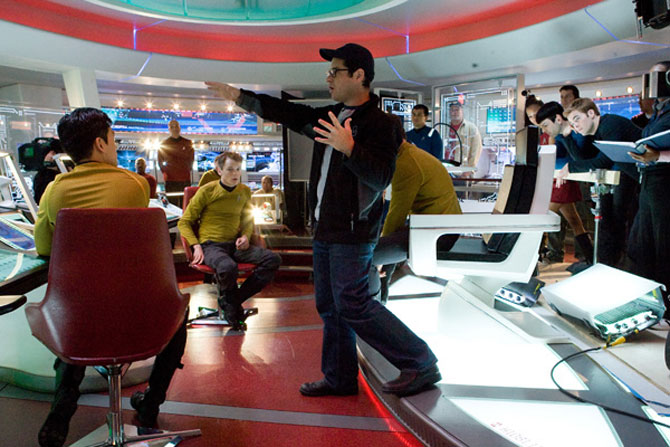
“I told you guys I was good at musical chairs.”

Up next was his take on Star Trek, a franchise that Abrams has often said he never showed any interest in as a child whereas all of his friends did. Perhaps that benefited the film, as it romped through the Box Office and reinvigorated moviegoers’ love for it. Working with Steven Spielberg had always been a dream for Abrams, and that dream was realised through making the wonderful Super 8 in 2011, another goldmine of adventure and reminiscence.

And now Star Trek Into Darkness. The first thing to say about Into Darkness is that this is a film created not just for long-time Star Trek fans, but also for new admirers (like me). By simultaneously directing an origin story retaining all that has already happened and establishing a brand new ‘parallel timeline’ in the previous instalment, Abrams has given himself and his audience a whole universe to explore vicariously through the crew of the Enterprise. We are thrust into the action straight away this time around (who has time to wait around?) in a riveting and enjoyable sequence full of danger, awesome visuals and witty dialogue — and these characteristics are maintained throughout the whole two hours and seven minutes.

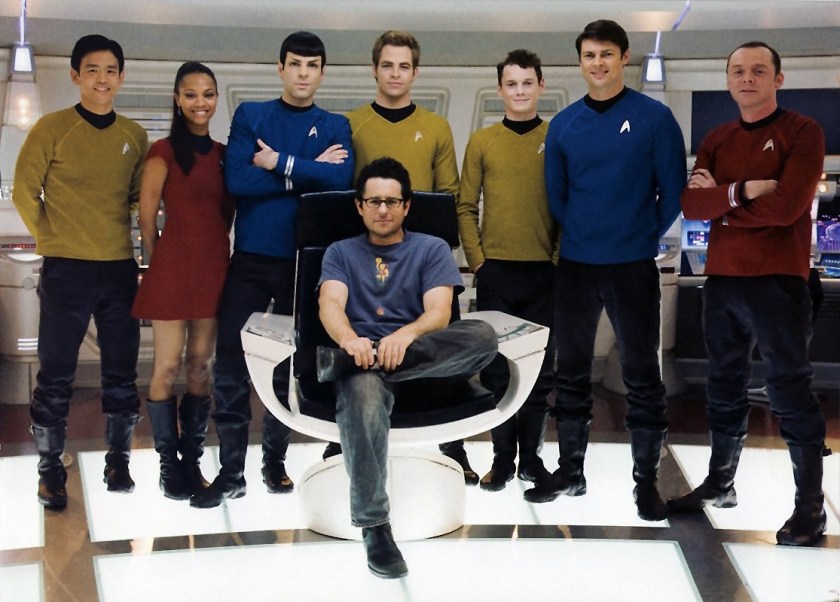
“Hey Zach, look. JJ is doing the dance again.”

Admittedly, having not been a Star Trek fan (or ‘Trekkie’) before Abrams took the reins I am not well versed in the franchise and nor do I wish to pretend that I am (for fear of getting something wrong, mainly). Therefore I did not know of the significance of the different otherworldly beings that the crew encounter or the varying levels of ship on the Admiral’s desk — but the beauty of Abrams filmmaking here is that I did not need to know these things. All that I had to do was pay attention, sit back and enjoy picture. By no means am I saying that Into Darkness is merely a ‘dumb film’ focusing on big thrills and CGI effects to generate income, rather I’m saying the opposite: it is a smart film because it focuses on thrilling the audience and concocting characters to care about. The majority of thinking required from the viewer was required in the first film of the reboot — which Abrams handled supremely well — and this time around the focus seemed to be all about putting on a show for Star Trek fans old and new. And, of course, to successfully further the story of the Enterprise crew while retaining a degree of loyalty to the past.

“I’m in a glass case of emotion.”

Talking about entertaining audiences, Benedict Cumberbatch is cast impeccably well as the evil John Harrison and is the stand out performer. Even though he is used to playing ‘good guys’ like Sherlock Holmes in the self-titled BBC drama, Cumberbatch thrives in this new role, utilising everything from piercingly devilish facial expressions to a demonic-yet-educated voice level to create a tremendous villain to go up against Starfleet. Chris Pine is just as charismatic as he was in the previous film, though a little more serious and contained at the appropriate moments. Zachary Quinto can do no wrong as Spock who he was born to portray, and the likes of Zoe Saldana, Simon Pegg and Karl Urban are all effective in their roles, maximising their screen time to create a connection with the audience (when I say “the audience” I really just mean me as I can only speak for myself).

Normally at this point I would give my views on specific parts of the film and write about spoilers, but I really do not think I need to for Star Trek Into Darkness. There was nothing that I significantly disliked about the film and I think all of the main plot points were handled excellently. Moreover, I would genuinely rather not spoil any part of the film because it does not deserve to be spoiled.

I will end by saying that, regardless if you are a Star Trek fan or a science fiction geek or neither of the two, you should see Abrams’ latest offering. Star Trek Into Darkness is a film for all movie lovers who just want to go the cinema and be engrossed in a tremendous spectacle. It is a testament to J.J. Abrams’ ability in filmmaking that myself who, just like Abrams, was never really into Star Trek before, is now a big fan.

Gravity (Out November 7th, 2013)

He’s been there once and he enjoyed it so much that he has decided to return. That is right, George Clooney is back on the big screen this autumn — in space. Unlike Steven Soderbergh’s 2002 film Solaris starring Clooney, Gravity is a brand new script written and directed by Alfonso Cuarón, his first film in seven years.

Set in space, Gravity follows the progress of astronaut Matt Kowalsky (Clooney) — a veteran serving his last mission — and medical engineer Dr. Ryan Stone (Sandra Bullock) — a rookie on her first Space Shuttle outing. The film is set for release on October 4th in the Unites States, therefore we do not know much about the plot at the time of writing other that what is shown in the recently unveiled teaser trailer (below): whilst carrying out a spacewalk — activities conducted by an astronaut outside his/her spacecraft — Kowalsky and Stone’s shuttle explodes leaving both space inhabitants stranded.

There have been countless films creates depicting helpless individuals trapped in space — either on a planet or in a shuttle. Recently, Apollo 18 graced our screens: a fictional portrayal of events after the cancelled Apollo 18 mission. Before that, Duncan Jones’ impeccable debut film Moon starring Sam Rockwell carried the mystique and tension of the stuck in space scenario. Going even further back, Event Horizon, Silent Running and Alien are all examples that the stranded in space genre — although still intriguing — is not a new one.

“Ten across, four letters, ‘to unveil one’s buttocks’ — any ideas?”

However, the commonality between all of the aforementioned films with which Gravity does not appear to share is that the helpless characters were trapped in a spaceship or on a planet, whereas Cuarón has delivered Clooney and Bullock to us suspended and floating in space. All signs point towards this being the case for the vast majority of the motion picture, which is something I personally have not seen before.

The trailer offers very little in the way of plot development, but a whole lot in regards to visuals, which are simply stunning. This should not come as a surprise to those who have seen Cuarón’s last outing in the director’s chair, Children of Men, which encapsulated and illustrated a dystopian Earth both effortlessly and beautifully. He was also the mastermind behind the highly regarded third act in the Harry Potter film franchise: Prisoner of Azkaban.

Alfonso Cuaron
“This is so heavy, stupid gravity!”

With a similar budget to Children of Men (Children of Men came in at around $76 million and Gravity has hit the $80 million mark) and with two very accomplished and impressive actors at the helm (albeit after a number of cast changes — Robert Downey Jr and Natalie Portman were once the leading candidates), Gravity has the potential to blow audiences away. Having originally been scheduled for a 2012 release and been pushed back a year to 2013, I think it is about time the Gravity shuttle was grounded so that we can all witness Alfonso Cuarón at work once again.

Iron Man 3 (2013)

★★★

Director: Shane Black

Release Date: April 25th, 2013 (UK); May 3rd, 2013 (US)

Genre: Superhero

Starring: Robert Downey Jr, Gwyneth Paltrow, Ben Kingsley, Guy Pearce

The third instalment in the Iron Man franchise takes place sometime after the events of The Avengers. Tony Stark/Iron Man (Downey Jr) finds himself suffering from nightmares and panic attacks as a result of his experiences in New York with the Avengers. An increasingly apprehensive ‘Pepper’ Potts (Paltrow), Stark’s girlfriend and CEO of Stark Industries, struggles to maintain Stark’s attention due to his obsession with building countless Iron Man suits. Meanwhile, a series of bombings orchestrated by an uncontrollable and decisive terrorist known as the Mandarin (Ben Kingsley) has left the world in panic. Stark must find a way juggle his personal life with Pepper, whilst protecting her, with fighting back against the Mandarin and the path of destruction he has left behind.

The very first thing I would like to say about this film is that — despite its shortcomings — it is very entertaining. Shane Black has recaptured the fireworks that Iron Man 2 had lost, providing a fast-paced plot. The huge set pieces such as the plane (shown in the trailer) and the dock sequence are hugely impressive, with engrossing action that never at any point lost my attention. As a matter of fact, the action in this film is equally as good as the action on display in Iron Man. Shane Black obviously not only has an eye for amazing visuals, but also an ear for wit as Iron Man 3 produces the best comedy of the three films — primarily from the on form Downey Jr, displaying his usual acting tendencies. The success of the witty, smart script is most likely a product of Black’s work with Downey Jr in Kiss Kiss Bang Bang. The cast are also solid, with actors such as the dependable Don Cheadle contributing genuine performances.

“I must be losing my mind.”

Having said all of that, I do not believe that Iron Man 3 quite met the lofty heights of Iron Man. The plot, while fun and entertaining, was not as intriguing, and any intrigue it did have in the first half of the film was lost after a key plot development that I will discuss in the spoilers section of this review. The most disappointing aspect of this film for me though, was the misuse of two of its characters. Rebecca Hall — who plays former love interest of Stark and botanist, Maya Hansen — undergoes more attitude changes than Jack Nicholson in The Shining! Whilst she plays the role absolutely fine, the role itself is flawed and might have benefited from a little more screen time, or, in a perfect world, more development.

SPOILERS FOLLOW

I have seen many character twists in numerous different films in my fairly short existence, but I cannot remember being more disappointed than by the development of Ben Kingsley’s Mandarin in Iron Man 3. For an hour or so, the Mandarin is depicted as a merciless, creepy, fearful villain — perhaps the best villain of the Iron Man franchise so far. Then, out of nowhere, we discover he is merely an actor (how ironic) hired by Guy Pearce’s Aldrich Killian to be the face of a new terrorist plot — shielding Killian from any suspicion and allowing him to develop and undertake a plan to capture Pepper Potts and inject her with his Extremis virus (which regenerates body parts) in order to gain Stark’s attention and force him to fix the faults in the virus — or risk losing Potts. Killian is a decent, sly villain however he is nothing compared to the Mandarin and the potential Shane Black had created with that character in the film’s opening hour. I would have much preferred it if Killian turned out to be a sidekick to the Mandarin and not the actual Mandarin himself.

“I am the Batman.”

Finally, the last few scenes were also slightly problematic to me. We are to understand that after all off the ordeals Stark and Potts have gone through, that Stark is now putting Iron Man on the back-burner (which obviously cannot be true anyway) to rekindle his relationship with Potts. But then, after having the shrapnel removed from his heart and after destroying his Iron Man costumes, Stark visits the location of his former home and collects part of the machinery controlled by JARVIS — perhaps indicating that he is not done with Iron Man. Where the problem lies for me is that if he did plan on recovering such machinery (the same machinery he uses to create Iron Man suits) why did he destroy all of his Iron Man suits in the first place?

SPOILERS FINISHED

Despite its shortcomings, Shane Black succeeds in creating a fun, entertaining and hugely enjoyable third part to the Iron Man franchise which is funniest instalment to date.