Maze Runner: The Scorch Trials (2015)

★★★

Maze Runner The Scorch Trials PosterDirector: Wes Ball

Release Date: September 10th, 2015 (UK); September 18th, 2015 (US)

Genre: Action; Science fiction; Thriller

Starring: Dylan O’Brien, Kaya Scodelario, Thomas Brodie-Sangster, Patricia Clarkson, Aiden Gillen

As a direct follow up to The Maze Runner, Maze Runner: The Scorch Trials grants director Wes Ball an opportunity to throw us straight out of the frying pan and into the fire. There is no time to catch up, no dialogue wasted on refresher exposition. You could stitch the final reel of the former onto the first reel of the latter and the flow would be seamless. It’s an approach that respects up-to-date viewers but also risks alienating franchise newbies; unlike the Divergent series, the lingo in this mid-franchise outing is harder to grasp — we suddenly learn of a virus called the Flare, a mountain-based faction who go by The Right Arm, and more about the horribly named corporate wrongdoers WCKD.

Aiden Gillen’s Janson, a facility head with an iffy demeanour, sets the scene: “The world out there’s in a precarious situation”. Perhaps the only thing less stable than civilisation is Gillen’s vacillating accent, though in fairness he does fund the film’s early uneasy air. Having escaped the maze, the Gladers — including Thomas (Dylan O’Brien), Teresa (Kaya Scodelario), Newt (Thomas Brodie-Sangster), and Minho (Ki Hong Lee) — find themselves holed up in a bunker eerily similar to the one run by Ava Paige (Patricia Clarkson) in the last film. Free from seclusion, freshly cooked food, their own bunk beds. It’s as if everything is too good to be true.

Only, in reality, nothing’s good anymore. The world outside, aptly rechristened the Scorch, has been ravaged by heat and disease. Zombie-like creatures called Cranks roam freely in search of flesh to chew on. A step up from the maze beasts, these clambering speedsters evoke a 28 Weeks Later vibe, especially as they are positioned within a climate of militant command and clinical action. Thomas, in spite of all this misery, manages to muster up some rebellious positivity. He is the eternal optimist in a pessimistic world.

Maybe they see a ray of hope radiating from Thomas in the wake of his stubborn idealism, but people do trust him too easily and this undermines the credibility of the story. Aris (Jacob Lofland), a loner who spent time in another maze before the bunker round-up, opts to collude with Thomas despite not knowing him. It is a theme throughout: our hero is heralded as a morally, physically, and mentally infallible being. When the group come across a refuge disguised as a dumping ground for old garments and rusty equipment, they all take the opportunity to dawn suitable Scorch clothing. Apart from Thomas, who discovers a suave jacket among the dross, something that could have graced Ryan Gosling in better times.

It’s as if all the others know he is the film’s central star. Fortunately none of this canonisation really matters because Dylan O’Brien is such a charismatic and inviting screen presence (a less capable frontman might’ve been insufferable given the circumstances). The film is arguably at its most compelling during those rare moments when Thomas does have to confront vulnerability. There’s an animosity at the fore, driven particularly by Teresa who begins to question her counterpart’s role in bringing about rebellion. Are they doing the correct thing by evading WCKD? Was the Glade as good as it was ever going to get?

Regardless, we know WCKD boasts an immoral underbelly. Towards the beginning, Thomas and Aris find out that Janson’s apparently safe retreat is actually a giant-shrimp-breeding-cum-human-blood-harvesting factory controlled by the aforementioned organisation. It may be a source material problem, or an issue with mainstream popcorn fiction in general, but the narrative occasionally lacks plausibility. Aside from the Thomas trust issue, even more blatantly obvious coincidences rear with jarring nonchalance: a revealing crisis conversation between Janson and Ava just so happens to occur in the company of Thomas and Aris on the night they break into the secret facility.

The message is clearly anti-corporation and anti-oppression, and T.S. Nowlin’s screenplay not-so-subtly channels that message via Thomas’ middle finger. These mature themes are matched by a horror-inspired underbelly that teeters right on the edge of a 12A UK rating. Fans of the Fallout video game series might mistake certain set pieces for similar looking locations in said game’s nuclear-torn Washington D.C. (an abandoned subway station springs to mind). Cinematographer Gyula Pados has more to play with here and the wider scope benefits Ball’s film greatly. Broken cities incite awe and wariness as they resemble the urban desolation shown at the end of Inception, while seemingly endless storm-strewn deserts echo Peter Weir’s The Way Back.

Giancarlo Esposito is one of a plethora of effective secondary characters — casting director Denise Chamain deserves credit for employing so many actors willing to maximise the potential of their bit part statuses. As leader of a ragtag stowaway group, Esposito purveys a mystery that keeps you on your toes (like Rick from The Walking Dead, he also always greets newcomers with three inquisitive questions). There’s an exquisitely queasy turn from Firefly favourite Alan Tudyk — who could do with a wash — though he is part of an unnecessary sideshow plot. Game of Thrones’ Nathalie Emmanuel turns up as a Scorch survivor alongside Rosa Salazar’s strong-willed Brenda.

Having run the maze in sufficient time, they’ve now passed the trials with a splash of merit. It has been an entertaining if unspectacular effort so far. Let’s hope when part three — The Death Cure — rolls into the Scorch, SuperTom and co. finish with aplomb.

Maze Runner The Scorch Trials - Cast

Images credit: IMP Awards, Collider

Images copyright (©): 20th Century Fox
Metropolis (1927)

★★★★★

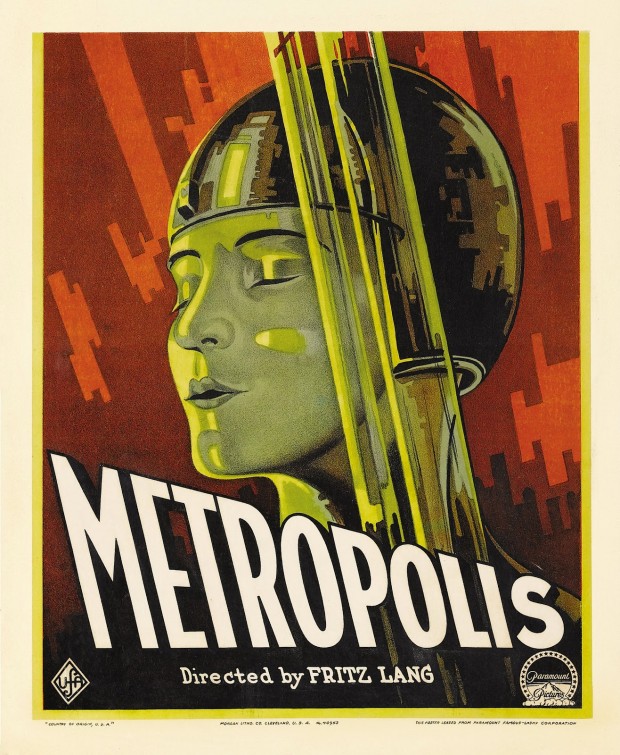
Metropolis PosterDirector: Fritz Lang

Release Date: March 13th, 1927 (US)

Genre: Drama; Science fiction

Starring: Gustav Fröhlich, Brigitte Helm, Rudolf Klein-Rogge, Alfred Abel

Lost for 80 years until its miraculous 2008 rediscovery in an Argentinian museum, Fritz Lang’s original version of Metropolis astonishes in both its visionary aesthetic and also its societal relevance almost a century after release. The film’s opening montage depicts brassy, metallic equipment chinking away as steam spurts out without prejudice, and it is clear from the off — the machines have taken over. Workers solemnly shuffle in and out of tunnels for their latest totalitarian inspired shift, shoulders hunched, heads drooped. “Deep below the surface lay the workers’ city,” a cue card informs us.

The ‘Club of the Sons’ lies above, hosting libraries and lecture halls and lush gardens. Inhabitants all wear bright, expensive garments that haven’t been dirtied by the plumes of ash below. They scurry around dazzling water fountains seemingly oblivious to burden, their nonchalance heightened by the fact that those doing all the hard graft underneath probably don’t see much in the way of H2O replenishment. Lang is introducing us to a clear class order, where those on the lower end of the scale are compelled to fund their loftier counterparts’ serene lifestyle.

The first literal clash of class occurs shortly thereafter: worn, muddled children seemingly escape into the land of luxury, leaving the socialites frozen in anger. Or perhaps it is fear. All except Freder (Gustav Fröhlich), offspring of the Master of Metropolis Joh Fredersen (Alfred Abel) — the latter resides in the even grander Tower of Babel, one of many religious references laced throughout. The film primarily follows Freder as he goes in search of Maria (Brigitte Helm), a young Mother Teresa-esque figure from the workers’ city.

He ventures into a world of capitalist mechanisation where everything is procedural and methodological, and where a single deviation from structure entails disaster; we see men fall, likely tragically, after a large machine providing power to the city above malfunctions. It is here that Freder realises these labourers are essentially slaves to the system, and that his father is complicit in promoting their hardships. “What if one day those in the depths rise up against you?” says son despondently to father as the film not-so-subtly anticipates events to come.

From the beginning, it is made apparent that our protagonist considers all humans to be his brothers and sisters. It could come across as forced characterisation, but Gustav Fröhlich subsequently spends two hours justifying his persona’s caring mentality through empathetic expression. Freder’s not the only aristocrat with a conscience; we also have Joh’s trusty-cum-not-so-trusty assistant Josaphat (Theodor Loos), whose job security anxieties capture in a nutshell the power his boss has over the city.

Joh’s other sidekick — you could say he is the devil to Josaphat’s angel — is known only as The Thin Man (Fritz Rasp): a slender-faced and baggy-eyed detective who is tasked with stalking Freder. He is pre-transformation Nosferatu. There is also Rotwang (Rudolf Klein-Rogge), an Einstein-like inventor who dwells in a Gothic house that looks distinctly out of place amongst the grandeur of Metropolis. At one point Rotwang ambles maniacally towards the camera, his outstretched arms poised to grapple. Werner Herzog would employ a similarly eerie shot in his interpretation of Nosferatu the Vampyre years later in 1979.

Towing frazzled hair and a forlorn gaze, the scientist reckons he can bring back his deceased ex-wife (Joh’s eventual partner and Freder’s mother) in machine form. The film plunders this intersection between life, currency and machinery for all it is worth, decrying the amalgamation of prosperity and power as something that’ll almost certainly lead to immorality. Rotwang claims nobody will be able to tell the difference between man and his Machine-Man creation. But the workers, the people, are already powerless machines.

By design silent films have a far-reaching interpretative wingspan and this can confuse viewers, or at the very least distract us from events actively playing out on screen. That is not the case here — you can translate the film as you please, and the more thematic mining you do the more fascinating it is. Thea von Harbou’s screenplay evolves into a game of pseudo-AI deception, where life’s more positive aspects (such as love) are warped and used against our central protagonist.

Even revolts, which are often stimulated by underdog collectives seeking to rise up against injustice, are inverted through artifice in Metropolis — the workers’ revolt is manufactured without their knowledge by Joh, another instance of the overseer using his influence to puppeteer society. Said uprising unveils some Titanic-esque disaster imagery involving, again, water, and you being to wonder if James Cameron was influenced by the class crisis on display here when writing his record-breaking flick.

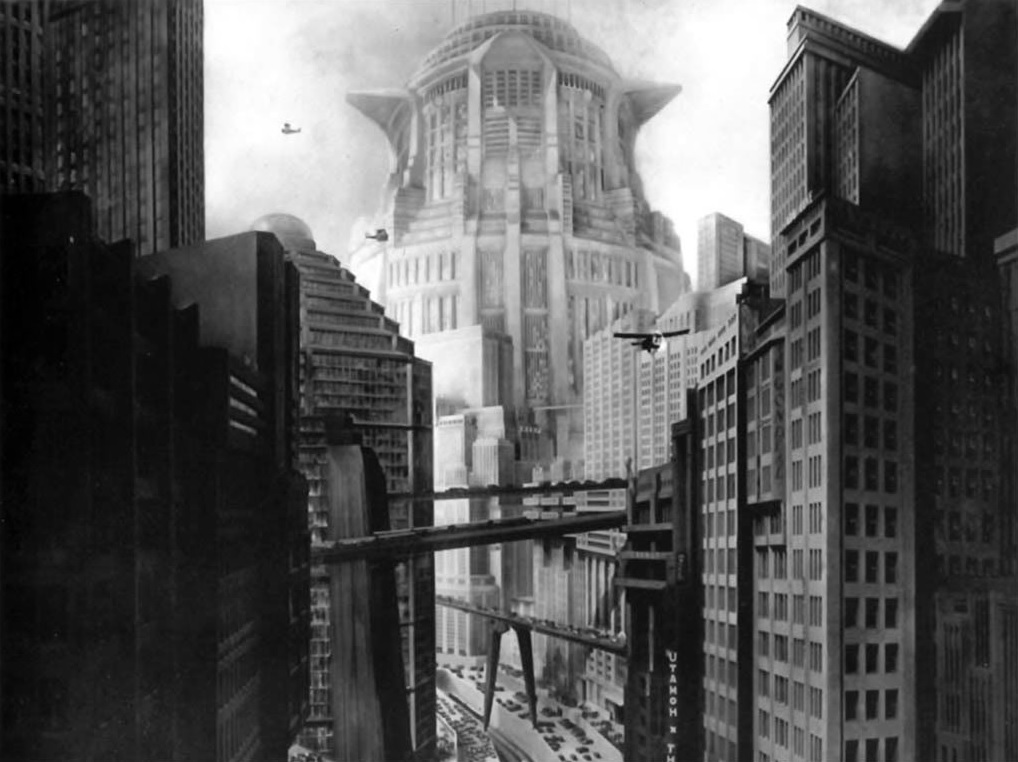
The piece’s appearance is something to behold, particularly given it is almost a century old. It is plain to see how other filmmakers were visually galvanised: Ridley Scott and Blade Runner’s neo-noir cityscape; Luc Besson and The Fifth Element’s futuristic allure; George Lucas and Star Wars’ hovercraft network. Utilising miniatures, effects master Eugen Schüfftan created an urban locale resembling New York (director Lang was inspired by the concrete jungle during a visit).

But the smaller details stand out as much as the larger ones — glowing science fiction spirals sit atop desks and hang beneath ceilings, their ascending-descending design mirroring Metropolis’ upper and lower class system. A wonderfully shot elevator scene sees Freder sink with hope gleaming from his eyes as the menacing Thin Man rises, the pair just missing each other. Silent movie performances are about body movements and facial expressions, and this sequence captures that imperative notion perhaps more than any other.

Time has afforded Metropolis even greater substance. Terrifyingly so, given its underlying message — that centralised sovereignty shouldn’t prevail — is still a widely problematic phenomenon at large in various parts of the world today. The movie is a bit long and some might find its war on capitalism too one-sided (Netflix is great after all), but this is pioneering filmmaking.

Metropolis - City

Images credit: IMP Awards, Film 110

Images copyright (©): UFA, Paramount Pictures

Ant-Man (2015)

★★★★

Ant-Man PosterDirector: Peyton Reed

Release Date: July 17th, 2015 (UK)

Genre: Action; Science fiction

Starring: Paul Rudd, Evangeline Lilly, Michael Douglas, Corey Stoll

Superhero movies are more popular than ever. They are financial juggernauts, crowd pleasers, cinema monopolisers. Since 2008, when Marvel gave unabashed life to the genre via Iron Man, venues have been awash with new crusaders donning new suits and old crusaders challenging old enemies. The average annual production rate is at least four outings per year — if we’re only counting those bearing Marvel or DC comic heritage — with only a handful of monetary flops to date.

In some quarters, inevitable suggestions of superhero fatigue are beginning to sound out (not over here, admittedly). Good thing, then, that Phase Two of the Marvel Cinematic Universe is closing with a refreshing injection of sardonicism and locality. Despite the size-adjusting suit and Avengers references, Ant-Man sidesteps many of its predecessors’ elements. A good guy with peculiar powers does set out to stop a bad guy who lives for greed, but everything occurs within a grounded framework. If Ant-Man is a superhero film, it’s not quintessential Marvel.

When Dr. Hank Pym’s (Michael Douglas) game-changing technology is replicated by his former protégé Darren Cross (Corey Stoll), the former S.H.I.E.L.D. employee recruits moral ex-con Scott Lang (Paul Rudd) in an attempt to scupper any mischief. It’s the classic origin plot and, as such, characters engage in quite a lot of backstory explanation. Hank and his daughter Hope, played by Evangeline Lilly, go through the verbal wringer in record time; from a seemingly amiable introduction, the pair quickly develop a fractious relationship which is apologetically resolved before the half-way mark.

As opposed to being the product of many pens — Edgar Wright, Joe Cornish, Adam McKay, and Paul Rudd all have screenplay credits — you get the sense that this overeagerness to explain histories and cement rapports is an origin movie problem. It leaves relationship arcs a little fragile, particularly when the barrage of audible exposition could have been conveyed less abrasively through ocular interactions.

Lilly and Michael Douglas slip into their respective roles with confidence. The former should have more do to, especially in the final act when the action amps up a notch, but her version of Hope van Dyne is smart, tough, composed and fiery. There’s undoubtedly more fleshing out to come. With seventy years under his belt and a frazzled exterior, Douglas is well cast as the ousted scientist with a chip on his shoulder. His early intentions are concrete (“As long as I’m alive, nobody will ever have the formula”) but Pym’s tragic past increasingly urges him to put his daughter ahead of the end goal.

For this is, more than anything, a film about familial care and compassion. Scott Lang’s previous criminal rightdoings — like a modern day Robin Hood, he illegally redistributed a lot of money to a lot of customers — get in the way of him seeing his daughter. There is desperation in Paul Rudd’s eyes, though nothing too melodramatic. He excels, relaying a brazen charm that is only bolstered by his principled thievery. His character could have been a psychopath and it wouldn’t have mattered; we were always going to root for Rudd anyway. The actor rewards that loyalty with one of the most likeable MCU performances so far: awkward and evasive, yet wholly endearing.

The humour is consistent throughout. It is a mellower first half, where Rudd’s pre-costume antics resemble his downbeat comedy roles (such as Role Models or This Is 40). Scott gets fired from his job for being an ex-con but his oddball boss allows him to nab a free Mango Fruit Blast before he leaves. Director Peyton Reed borrows some of Marvel’s wit and meshes that with Apatow-esque flippancy. As the film progresses occasional chuckles make way for frequent guffaws. A naive Michael Peña is tremendously amusing, similarly getting increasingly funnier: “Baaaack it up, back it up slowly,” is one of many comedic highpoints.

But Ant-Man opts for more than just plain wisecracks, poking fun at its genre — and, by definition, Marvel — too with loving cynicism. Edgar Wright, who vacated the directorial seat citing creative differences shortly before the start of filming, is still around in spirit. Any playful sarcasm is almost certainly his, low-key and delightfully devious, and the frequently zany score sounds like something out of his wheelhouse. Two Peña explanation montages have the same swooshy momentum as Simon Pegg’s zombie dodging plans in Shaun of the Dead (apparently those sequences are spawns of Reed and McKay). At one point Ant-Man sprints across a small-scale model city as pursuing bullets send cardboard splinters all over — a mini, tongue-in-cheek jab at the likes of Avengers Assemble and Man of Steel. We’re at a point now where the grandiose madness, the ridiculousness of superhero movies, can be the butt of the joke without consequence.

Far from a genre that lacks superior visual quality, it is still worth noting the brilliant technical work on display during Ant-Man. Our first insect adventure is exceedingly slick and inventive, shot in a way that somehow provokes genuine exhilaration from a tiny man getting stuck in a hoover and scampering away from a rat. The shrinking too provides a new avenue for action-drama; rather than lambasting us with shoot-outs, fun heists from the Mission: Impossible school of versatility prevail. Russell Carpenter’s colourful cinematography is also aided by Dan Lebental and Colby Parker, Jr.’s momentum-driving editing: our hero’s anti-Herculean training montage is funny, believable and moves the plot forward.

Only when someone mentions the Avengers — whose non-appearance is put down to Pym’s wariness of Tony Stark’s techno-autocrat sensibilities, and given Stark’s arc in Avengers: Age of Ultron we are inclined to side with Pym on this one — does it strike you that Ant-Man is part of their universe. The world doesn’t need saving here. Although there are Armageddon implications, the film’s disciplined approach localises any reverberations. Neither format is right or wrong, but the second is less worn out and that’s hugely beneficial. The silliness gets over more because characters are not surrounded by Norse Gods with flying hammers or angry green mutant beings — a scene showing ants juggling sugar cubes would probably get lost in those fantasies, but here it is odd and amusing.

This quasi-minimalist structure also adds weight to the villainous Darren Cross’ suggestion that his Ant-Man copycat suit will solve geopolitical tensions outwith plain sight. The idea reflects notions of surveillance and higher powers undermining their citizens’ privacy. Wright and company flirt with the Snowden effect but the movie probably isn’t as incisive as it wants to be, otherwise it might have made a compelling thematic companion piece to the more confident Captain America: The Winter Solider.

Ant-Man is a genre rebel though, a sneaky outcast doing its own sly thing. The very fact that it is less integral to the overarching MCU saga than any other film up until now is what makes the flick so attractive. Forget its bite-sized impact, this one has left a Hulking impression.

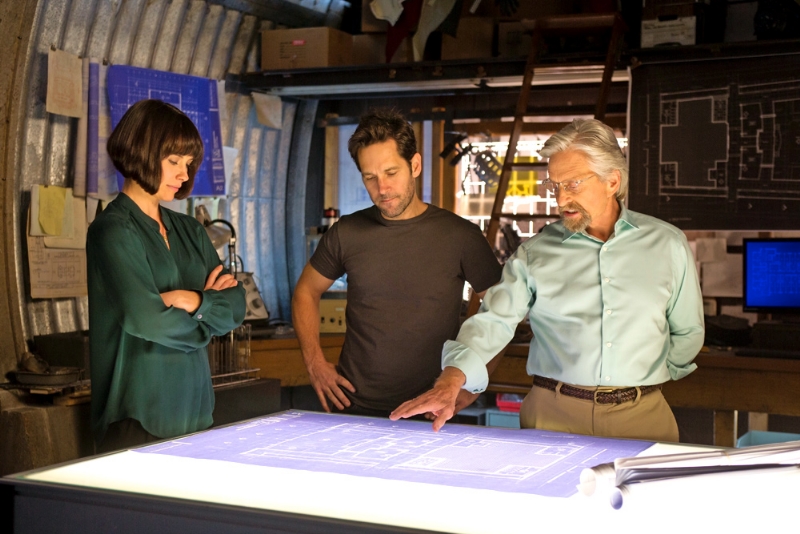
Ant-Man - Cast

Images credit: IMP Awards, Collider

Images copyright (©): Walt Disney Studios Motion Pictures

Terminator Genisys (2015)

★★

Terminator Genisys PosterDirector: Alan Taylor

Release Date: July 1st, 2015 (US); July 2nd, 2015 (UK)

Genre: Action; Adventure; Science fiction

Starring: Emilia Clarke, Jai Courtney, Arnold Schwarzenegger

Every once in a while, Terminator Genisys springs a countdown clock on us. Bad things will happen, we’re told, when it hits zero. If you are in any way familiar with how films work, you will know that countdowns often hit zero at the end of movies, and that is true again here. Suddenly those bad things look more appealing. For an hour and a half, Thor: The Dark World director Alan Taylor’s reboot is robotic in all the wrong ways. It’s frustrating, because the final act somewhat harkens back to the great action of past instalments. But by then it’s too late — time’s up.

In getting under way, we retread a backstory recognisable to viewers who have visited the franchise before. It goes on for ages, but Kyle Reese’s (Jai Courtney) words are at least visually supplemented by some advanced Star Wars-meets-Transformers combat. We’re then introduced to future John Connor (or current, semantics pending), played fairly well by Jason Clarke. Trying his best to conclude the exposition heavy prelude, Connor makes a big deal out of why it should be Reese he sends back in time to stop an evil Terminator, as opposed to any other schmuck. But his interrogation follows a scene in which the pair cement their infallible trust and comradeship. Why wouldn’t it be Reese?

This unnecessary friction exemplifies what soon becomes a full on screenplay pandemic — the creation of narrative falsehoods and conveniences lazily employed in order to move the plot forward (or sideways, or backwards, depending on which time zone or dreamscape we’re lost in). And it’s not just us who are confused. The characters do their fair share of head-scratching too: “That’s the kind of guy your son was… is… will be. Jesus!” bellows Reese as he attempts to tell Sarah Connor (Emilia Clarke) about her son who both has, and has not, been born yet.

The story is all over the place but it essentially boils down to Sarah, Reese and classic Terminator (Arnold Schwarzenegger) trying to save the world. Co-writers Laeta Kalogridis and Patrick Lussier seem hell-bent on expunging the franchise’s mythology entirely, though their efforts ultimately produce a convoluted product. The former had better luck penning the evasive Shutter Island, but the layers of plot are excessive here and the film misses seemingly obvious details as a result. For example, there are four different Skynet bots at large: two Arnies — one good, one bad — a T-1000 policeman whose existence in 1984 is never fully explained (though his sword-like arm is at least a nifty nod to Terminator 2: Judgment Day) and John Connor, sort of. Maybe.

Caught up in the myriad of goings-on are infrequent thematic throwbacks to classic Terminator lore; the increasingly intrusive threat posed by machines, humanity’s greed for untested technological advancement. However not enough time is afforded to any of this meaty material. It is possible that scenes containing Dayo Okeniyi’s Genisys-creating Danny Dyson, son of Judgment Day’s Miles Dyson who also appears, were cut. As things stand his lack of on screen engagement is quite embarrassing. We never really find out about the character’s mindset, or his motives for developing the technology. Apparently the answer to everything is ‘sequel’.

Resultantly, the Genisys program presents itself as nothing more than an iffy iCloud. “This is the world now. Plugged in. Logged on.” That’s as incisive as it gets. The dumbing down of this once prescient franchise is something we probably should have expected given Paramount’s willingness to trade middle act surprises for better marketing traction. If you’ve seen the trailer — and we all have, it has been everywhere — the John Connor revelation is no longer a shocker. Connor is involved in a shocking moment though: his declaration that it probably won’t matter if Sarah Connor dies essentially undermines the entire franchise. If Jurassic World was overly respectful towards its elders, Terminator Genisys couldn’t really give a toss.

Taylor’s direction puts more emphasis on comedy than before. The move is misjudged, but not without merit. You get the sense the film is trying to be too Marvel-esque, too witty, when both The Terminator and Judgment Day both succeeded by being rooted in apocalyptic reality. Snappy lines detract from weighty stakes. It can be quite funny — Clarke and Schwarzenegger have amusing chemistry — but the missed gags do occasionally stick out like a mechanical limb. These characters, unlike the Avengers, haven’t yet earned the right to be funny in a life or death situation.

Unfortunately, the characters simply don’t get by via their iconography. Arnie does because it’s the same actor playing the same role, and he’s actually good fun. The others wear iconic names but they carry unrecognisable attributes. We’re told this is a different Sarah Connor and it’s true. Just not a better one. She is too outgoing, too friendly, too accessible. Though Emilia Clarke makes a decent stab at invoking the steely-eyed persistence of Linda Hamilton, the character is generic. Very little of everything and nothing in particular.

At one point Reese informs Sarah, “Me unlocking your cuffs doesn’t make you less capable,” but neither of them are all that capable to begin with. Both Clarke and Jai Courtney are given virtually impossible tasks. Courtney in particular struggles to overcome the shoddiness of his bland action man. It would be nice to see him in something other than one of these wafer-thin gun-toting roles (Suicide Squad is a dice throw at present). Academy Award winner J.K. Simmons is good as the alcoholic, downtrodden detective, rising above another of the movie’s stock personas.

Despite this plethora of misgivings, Terminator Genisys does conjure up an entertaining final thirty minutes. The action never quite reaches the pulpy, adrenaline-fuelled antics of James Cameron’s outings, but there are welcome pockets of grit. Calling upon Speed — a single-decker bus, female driver, large bridge, inability to slow down — the film switches up the intensity with visual flair. By the final scenes, we are reluctantly along for the ride and the humour subsequently works, acting as a refreshing blast of energy between the hard and heavy battles. A Bad Boys mugshot sequence is inspired.

People applauded as the credits rolled in my screening, so somebody must have done something right. Maybe this is a super-smart critique of sluggish blockbuster reboots. T-3000 John Connor talks about the Sarah he remembers, and maybe he is referring to the Sarah of Judgment Day. Maybe this film is set in an alternate reality where all the characters are diluted on purpose, and the plot points are nonsensical by design. Probably not. Terminator Genisys is as messy as its calamitous title suggests.

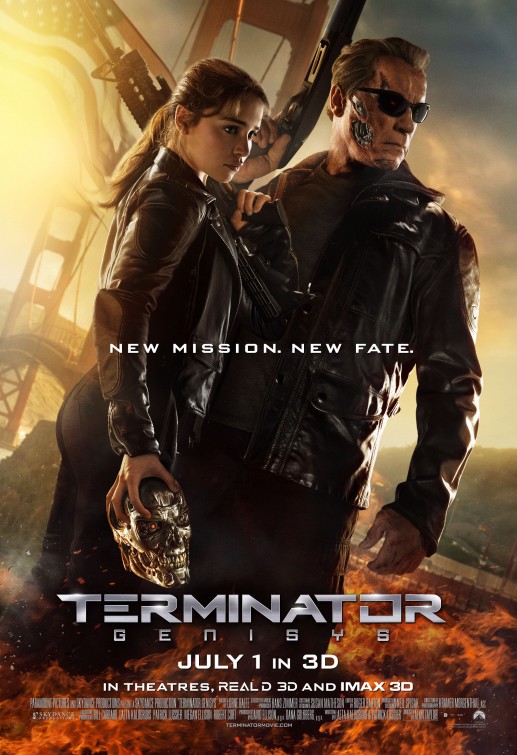
Terminator Genisys - Cast

Images credit: IMP Awards, Collider

Images copyright (©): Paramount Pictures

Jurassic World (2015)

★★★★

Jurassic World PosterDirector: Colin Trevorrow

Release Date: June 11th, 2015 (UK); June 12th, 2015 (US)

Genre: Action; Adventure; Science fiction

Starring: Chris Pratt, Bryce Dallas Howard, Nick Robinson, Ty Simpkins

They say imitation is the sincerest form of flattery. In the context of filmmaking, it’s very easy to construe that as nothing more than an excuse for lazy writing or a general lack of ideas. Mainstream horror comes to mind, movies that retread the same ground so often that the concrete slabs below are eroding into nothingness. Jurassic World similarly stomps over familiar tracks, the same ones paved back in 1993 by Steven Spielberg.

Yet there’s an authentic admiration afoot in Colin Trevorrow’s work. Moments so sincere that any semblance of cynicism will be expunged from your psyche. A lot of goodwill has clearly been poured into the making of this fourth dino instalment, a film that undoubtedly strives to capture the fantastical magic of the first. It probably gets there in the end. We see imitation in spades and it’s flat out splendid.

Some time after the tumultuous events of Jurassic Park, Isla Nublar has been transformed into the tourist-attracting dinosaur paradise originally envisioned by John Hammond. Operations manager Claire (Bryce Dallas Howard) invites her two nephews — gloomy Zach (Nick Robinson) and wide-eyed Gray (Ty Simpkins) — over to experience the park first-hand. When something inexplicably goes wrong, Claire and Velociraptor coach Owen (Chris Pratt) find themselves in a race to restore civility.

These characters are initially drawn rather whimsically. Chris Pratt’s Owen is the morally upright park hand who spends his time tucked away in a cabin fixing up motorcycles when he’s not training Velociraptors. Claire is work-obsessed, her penchant for sustainable order and satisfaction statistics often overruling any time spent with her nephews (both of whom also assume recognisable age-related traits). It’s all part of the writers’ plan though; imminent danger brings heroism and savviness to the fore, particularly in Claire whose transformation is punctuated in a scene where she literally rolls up her sleeves.

In fairness, there are early hints at this increasing character roundedness. Conversations about the new breed of dinosaur — Indominus Rex, a corporate attempt to freshen up the park — leave Claire flustered, suggesting she is somewhat torn by the possible consequences. “Indominus wasn’t bred, she was designed,” we hear ominously. Owen, despite treating his raptors with care and respect, is still holding them captive. The influence of corporations, poor animal welfare, and immoral science are all interesting themes that would have benefited from more breathing time in a film not contractually obliged to serve up grand bouts of action.

Occasionally, Trevorrow and his team of co-writers do return to the aforementioned themes — an exhilarating scene where Owen rides his bike among the raptors seems to suggest humans and dinosaurs are one in the same. But the moment of the movie, and a shoe-in for one of the moments of the entire year, belongs to Claire. It comes towards the conclusion, spine-tingling in delivery, and cements her place atop the annual cinematic table of quick-thinking badassery.

While Bryce Dallas Howard moulds into the cool aunt we always knew she could be — shooting errant dinosaurs and using her wily driving skills to protect her nephews — Chris Pratt remains impossibly cool throughout. He’s Indiana Jones, a surly customer not afraid to echo some juvenile Han Solo-esque one-liners. When he gets serious, he means it. The two actors appear effortless in their roles, and share an engaging, charmingly awkward chemistry.

An underfed yet sweet relationship plays out between brothers Zach and Gray too. Not helped by an unnecessary divorce plot strand, Nick Robinson and Ty Simpkins are fun to watch as the generic sibling duo who eventually, predictably, come to appreciate each other. Robinson, who excelled in The Kings of Summer, has natural charisma and could be a breakout role away from superstardom. Comparably younger, Simpkins defies the annoying kid curse and puts on an amiable show here.

Other members of a pleasingly diverse cast include Omar Sy, Jake Johnson, Lauren Lapkus, Vincent D’Onofrio, Irrfan Khan, and previous Jurassic survivor, BD Wong. Jimmy Fallon makes a hilarious cameo, striking a funny bone from which point the film gets gradually more amusing. Trevorrow manages to carefully balance light-hearted humour (which the franchise well known for) and rampaging action (which the franchise is also well known for). We see this during a dino football scene: the situation is terrifying in theory, but the visual of a marauding dinosaur thumping a giant glass ball around is humorous.

Action spots are aplenty, though never burdensome. Executed with boisterous energy, you willingly give into the air of childlike joy and genuine threat. One sequence sees the dinosaurs meet The Birds and we subsequently feel that film’s sense of impending, uncontrollable danger. A claustrophobic night vision routine looks like it has been lifted directly from the Zero Dark Thirty Abbottabad raid. These instigators of flickering emotion merge with John Schwartzman’s realistic-looking cinematography, and as such we constantly feel embedded in the story. This is, without doubt, a CGI masterstroke.

The same can’t be said for compelling dialogue, of which is there is very little. There are plenty of exposition-driven sound bites in first hour though, lines wrapped in a heightened dramatic effect, snippets that have an unfortunate made-for-trailer dynamic. The screenplay is ham-fisted, especially during the film’s opening third where the desire to induce peril overrides any airy character discussion. But the people and the sounds and the overall atmosphere collectively create a welcome distraction.

At its simplest — and it is often simple — Jurassic World is a nostalgic love letter to cinema. It is a wonderfully reminiscent piece bearing great admiration for Spielberg’s original, and is able to duplicate Jurassic Park’s most memorable moments without plunging into mawkish territory. We hear John Williams’ famous track early on, during a perfectly handled island tour sequence celebrating the magnificent park facilities (Tomorrowland… pfft), before it hits a crescendo coated in cinematic glee.

Those sort of goosebump-inducing moments are the foundation of the cinematic experience. Jurassic World is not the complete package by any means, but as far as celebratory storytelling goes, it has serious bite.

Jurassic World - Pratt & Howard

Images credit: IMP Awards, Collider

Images copyright (©): Universal Pictures

Mad Max 2: The Road Warrior (1981)

★★★★

Mad Max The Road Warrior PosterDirector: George Miller

Release Date: January 19th, 1982 (UK); May 21st, 1982 (US)

Genre: Action; Adventure; Science fiction

Starring: Mel Gibson

When it comes to writing, you get the sense George Miller (and co-writers Terry Hayes and Brian Hannant) can’t wait to put pen to paper. It is an eagerness that translates across the whole Mad Max franchise, one that permeates each film from the word go. The Road Warrior begins in much the same vein as its predecessor, with lots of revving and car acrobatics and dodging and crashing.

Only this time Max (Mel Gibson) is the hunted and not the hunter. Nightrider has nothing on Max’s new curtain-jerking nemesis — a sign of crazier things to come. The red-Mohicaned Wez (Vernon Wells) and Max race to a stalemate (there’s that western influence again), which sees the former pull an arrow from his injured arm and evoke an unmoved screech.

This local impasse is indicative of a much grander one to which the film builds. The world has emerged from its process of environmental, political and economic degradation and is now in a state of total desolation. Max, alone following the tragic events that went before, must decide whether or not to assist a similarly cut off community in their fight against an oil-hungry motorcycle cult.

The former patrol officer runs into another drifter after his aforementioned interaction. The drifter, therein known as the Gyro Captain (Bruce Spence), exclaims: “You’re quick, very quick! Never seen a man beat a snake.” That’s where Max is now, instinct fully developed, greatly skilled in the art of survival. He is the road warrior. Max’s only companion is a scruffy dog, who amusingly entrusts with the Gyro Captain’s life — a scene involving an errant rabbit is absurdly hilarious.

As opposed to phones or wallets, people carry around spoons in the hope that they will find some leftover food rotting away in a tin can. The enforced partnership between Max and the Gyro Captain — the latter’s existence in exchange for direction — offers a bout of light relief from this demoralising and harsh landscape. Spence’s character is a sort of Ragetti figure (or perhaps Ragetti is more of a Gyro Captain), which is a welcome contrast to Max’s more sombre, uptight self.

Miller incessantly plays up his anti-hero’s transformation. Later in the film, Michael Preston’s settlement leader Pappagallo laments Max’s lone wolf status: “You think you’re the only one who’s suffered? We’re still human beings with dignity. You? You’re out there with the garbage. You’re nothing.” While his words ring with truth, we still feel compelled to sympathise with Max given his unfortunate past. The character’s evolution, or devolution, from a wholesome upholder of law to a lawless, fractured outcast is believable not only in accordance with society’s lack of structure, but more so because both Gibson and Miller consistently afford the character thoughtful consideration.

Marauding car sequences come with extra bite. At one point we see Max and the Gyro Captain peer through a telescope at a grisly runaway attempt. We become part of their distance spying, which adds a sense of realism to an otherwise unrecognisable world. The telescopic view carries the same rawness as modern amateur news reporting. In a way there is more at stake now that the landscape is completely barren; everyone is out for themselves, there is no more justice via the Main Force Patrol and instead barbarity is fought with barbarity. This shift towards more brutal action is a lot like shift in tone from The Terminator to Terminator 2: Judgement Day.

Classic genre tropes are at large, including a classic Mexican standoff that sees an invading army attack the resource-rich town where Max ends up stranded. When guns are unavailable, blunt arrows and skull-cracking headbutts take centre stage, emphasising civilisation’s retreat back towards more archaic times. A finger-slicing boomerang finds its way into a brilliant scene, compounding the unadulterated madness of Miller’s film which, despite his no-nonsense approach, is thankfully still around.

Lord Humungus (obviously) is Max’s new nemesis. He dons a Jason-esque hockey mask and exudes the soothing pitch of an experience cult leader. “There has been too much violence, too much pain… just walk away and there will be an end to the horror,” Humungus decrees to the people defending their refinery. Kjell Nilsson is great to watch, sounding like an enigmatic overseer who has all the answers and looking like a monster who could do serious damage. He adopts Hugh Keays-Byrne’s intellectual Toecutter vibe but matches that with brute strength and sense of imminent physical threat.

One of The Road Warrior’s more abstract moments is a distorted scene which resembles something out of a Cecil B. DeMille horror flick: a loud brassy score with shots overlapping one another as enemy characters wail and gesture violently. There are aesthetic echoes of Charlton Heston’s Moses presenting the stone tablet to his followers in The Ten Commandments, oddly. Here, Humungus appears to take on the mantra of Hades, vehemently spouting threats as he stands before what appears to be the fiery pits of hell. It’s a bizarre scene, but the film’s genuine self-awareness justifies its inclusion.

Since release, The Road Warrior’s many admirers have catapulted the film into cult status. It is more aloof and less predictable than Mad Max. But it also favours simplicity in the right areas, affording more time for the development of its central character who is now a very different person. Just as Max has changed through circumstance, the world has changed with him. The symmetry is admirable, if expected. The execution is expectedly excellent.

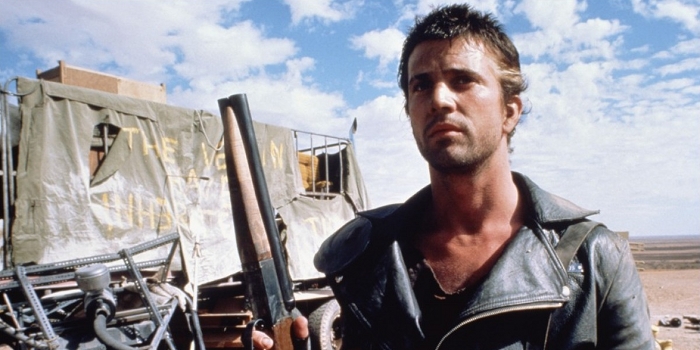
Mad Max The Road Warrior - Max

Images credit: IMP Awards

Images copyright (©): Warner Bros.

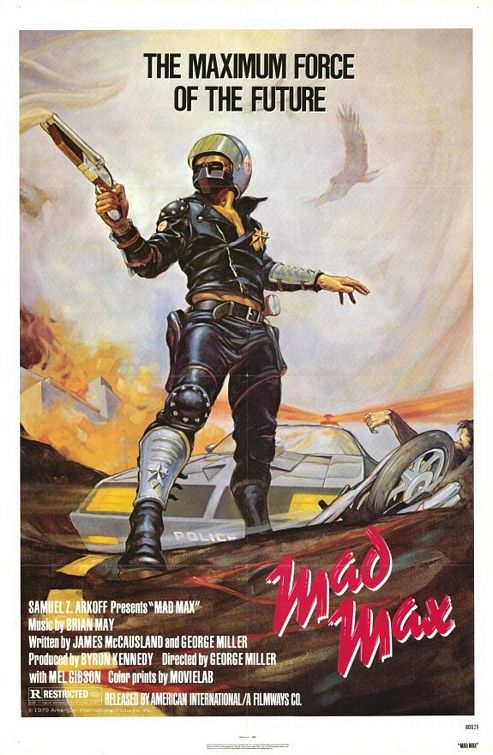
Mad Max (1979)

★★★★

Mad Max PosterDirector: George Miller

Release Date: December 10th, 1979 (UK)

Genre: Action; Adventure; Science fiction

Starring: Mel Gibson

Mad Max roars into life in the midst of an increasingly tumultuous car chase. Nightrider, a crazed gang member, is on the run from a group of police officers seeking justice for the murder of one of their own. The cops — or Main Force Patrol (MFP) — aren’t the most skilled highway cruisers, bumbling in nature and even more so in execution. All except one. Max Rockatansky (Mel Gibson), the definition of poise, is the key player in a rather lousy team. We only see his grazed cowboy boots and chiselled chin to start with.

Max enters the vehicular fray, rampaging down an otherwise barren motorway — George Miller took inspiration from the 1973 Australian oil crisis, and this certainly looks like a region in need of basic resources. The director acknowledges the absurdity in what is occurring, and in what is set to occur, by introducing a plethora of slapstick obstacles: a stranded caravan, a barrage of road works, and a road-crossing baby. The pursuers crash, but the maniacal Nightrider cackles his way past each distraction in his “fuel-injected suicide machine”. Of course, Nightrider eventually crumbles at the sight of cool Max. He should have frenzied at dusk instead.

The screenplay never really deviates from the antics relayed above. It turns out Nightrider was part of The Acolytes, a motorcycle gang cut from the same cloth as Alex and his droogs. Their ultraviolence really is ultra-violent; from smashing up towns to off-camera rape to fiery murder, The Acolytes are a bad bunch. In line with Miller’s preferred tone there’s also an unconventional aura to the troupe, whose members would rather roly-poly back to their vehicles than walk.

Droogs they may be but unlike Kubrick, who liked to slow events down to a thoughtful meander, Miller takes an all over the place approach, with David Eggby’s cinematography zipping around and refusing to linger. This unholstered style greatly heightens the film’s prevailing intensity. The closest we get to an extended shot is during car chase scenes, at least when vehicles aren’t flipping on their head or exploding into pieces.

An apt description of the film might be ‘western on motorcycles’. But instead of galloping into town, characters rev. Said towns are often dusty, laid back communities where every day is Sunday. We are privy to a world where civilisation is in the process of falling, where chaos is a wrongdoer’s prime weapon and justice is in tatters (the latter, visually represented by the worn-out Halls of Justice sign). Trial attendance is low thus criminals walk free, devoid of lawful comeuppance, leaving only one form of comeuppance left to dish out. It doesn’t resemble the dystopian landscapes prominent in modern outings such as The Hunger Games or Oblivion, but instead a future that still bears familiarity, in that sense more aligned with a Blade Runner.

Droves of faceless characters are the product of a relentless mindset, and as such it can be difficult to clearly distinguish who stands on which side and why. Toecutter (Hugh Keays-Byrne), leader of The Acolytes and definite villain, is how you would imagine Russell Brand if Russell Brand was the leader of a post-apocalyptic motorcycle gang: speaker of intellectual gibberish; British accent; hair all over the place; wearing a lot of leather. Keays-Bryne successfully balances oddness with menace and is particularly effective when conversing. “That man is Cundalini and Cundalini wants his hand back,” is one of his numerous uncouth and brilliantly delivered lines. Every time he appears on screen the film instantly spruces up. Toecutter is a bit like Heath Ledger’s Joker in that sense — irresistible to watch, utterly deranged yet eternally composed.

Gibson’s Max isn’t a hard-nosed or rugged vigilante, but in fact baby-faced and emotive. He spends his evenings listening to soothing saxophone melodies and having his hair washed by his wife Jessie (Joanne Samuel). At one point the job becomes too much for him and he opts to spend more time with his family, which means lying in wheat fields and Tarzan-ing into springs. But Max is “a winner”, he’s “on the top shelf” according to his MFP overseer, Captain Fifi (Fifi in name only), portrayed solidly by Roger Ward.

This overly righteous version of Max works because it highlights the character’s purity in a bad world, and underscores the endpoint of his arc. Miller’s decision to purposefully emphasise the familial side of Max — the side pre-Mad — before entering into the final act is a simple-yet-effective ploy that makes us sympathise with greater heft.

Miller spreads his OTT prerogative across all aspects of the story, not stopping short simply at action sequences. Corny music plays over loved-up scenes between Max and Jessie. Brassy cacophonies of sound are present during dramatic moments too — for example, a gruesome hospital bed scene. Elsewhere the pillaging score is constant and somewhat overdone but, again, is a key part of the director’s ethos.

A middling lull is unfortunate, where contrivance seeps into the narrative (somehow Max and The Acolytes keep wheeling into each other) however proceedings soon pick up again and build to a gratifying conclusion. This isn’t Mad Max yet, not the iconic manifestation of the character as moviegoers know him, but it’s a superbly crafted worldbuilder.

Mad Max - Max

Images credit: IMP Awards

Images copyright (©): Warner Bros.

Mad Max: Fury Road (2015)

★★★★★

Mad Max Fury Road PosterDirector: George Miller

Release Day: May 14th, 2015 (UK)

Genre: Action; Adventure; Science fiction

Starring: Tom Hardy, Charlize Theron, Nicholas Hoult

Vehicles have always played a huge part in the Maxverse and veteran director George Miller decides to hammer this point home in Mad Max: Fury Road. Various characters are seen to cherish steering wheels, hauling them around in the same way Bruce Spence’s Gyro Captain clung onto a spoon in Mad Max 2. His spoon could pick at leftover tinned food, a novelty apparently long gone. Small-scale scavenging is out. This is a world dominated by distance, by grandeur, by gasoline. The spoon has become the steering wheel.

Or, maybe such pensiveness doesn’t exist within these characters. Maybe they just love to thunder across the desert. Maybe they can’t wait to get on the road. Miller certainly can’t.

After a brief prologue from Max explaining his post-apocalyptic mantra (“A man reduced to a single instinct: survive”) we hurtle into a half hour opening sequence that obliterates anything remotely resembling action we might have seen in previous films. These thirty minutes of total carnage, of collapsed worldbuilding, shoot past in an aluminium whirlwind, leaving your eyes watering and heart bellowing. It’s almost as if Miller has been waiting three decades to get something off his chest.

The plot is simple but by no means inadequate: Max (Tom Hardy) finds himself in an unlikely partnership alongside Imperator Furiosa (Charlize Theron) as the pair attempt to evade the monarchical clutches of Immortan Joe (Hugh Keays-Byrne), a slave-keeping cultish leader. The destination, or “Green Place”, dreamt up by the formerly shackled wives of Joe, is unknown. It is more or less a mystery, the characters unable to shed much light and, as such, we are left in the dark. This doesn’t matter, the journey does.

The best thing, unquestionably, about the franchise has always been Miller’s ingenious and realistic-looking action sequences. They are here in abundance, bearing the hallmarks of even greater ingenuity and somehow appearing just as authentic. Oil trucks are christened “War Rigs” and subsequently live up to the name. Amazingly, the majority of effects are practical, in line with the director’s penchant for traditional movie-making. As such, praise should be heaped upon the many stunt performers whose death-defying efforts play a key role in raising the stakes.

We are constantly reminded of the urgency facing Max, Furiosa and company: as the camera pans back towards the chasing pack, all we can see is an ominous mirage, a giant metallic silhouette in the distance. The threat is real and incoming, energised by a booming score that carries more than a hint of Brian May’s earlier franchise work. Other throwbacks to past films include: Master-Blaster-esque siblings (one of whom is former WWE wrestler Nathan Jones), and the occasional lower front bumper camera shot. There’s even that familiar feeling of disorientation, where the screen is so rammed full of carnage that deciphering who is fighting who becomes a task.

Of course, absurdity is tossed around like a hot potato. From vehicles in the form of mechanical hedgehogs, to an electric guitarist who looks like a cross between The Silence from Doctor Who and Klaus Kinski’s Nosferatu, Miller has all bases covered. This includes humour: “Of all the legs, you had to shoot the one that was attached to his favourite”. Nicholas Hoult’s Nux is the ideal amalgamation of odd and funny, his obsession with the Gates of Valhalla both amusing and touching. Hoult absolutely throws himself at the role, which is arguably the best of his career.

Probably for the first time, Max truly is mad. He’s no more than a splash of white body paint away from being one of Joe’s skeletal followers, growling incoherently and shifting his gun aim maniacally. Hardy sometimes deviates verbally back into Bane-mode, but he is mighty impressive as the iconic loner. The Welshman is gruff, a far cry from Mel Gibson’s portrayal in the inaugural instalment and possibly more interesting too.

Hugh Keays-Byrne, the man behind Gibson’s nemesis in Mad Max, returns as new villain Immortan Joe. Perhaps it is not by coincidence that Joe’s world-weary appearance could very well be that of Toecutter after toiling for decades in the scorching desert. Imagine the sunburn? “Do not, my friends, become addicted to water,” Joe preaches to the subservient crowds upon affording them momentary respite from thirst. His voice croaks like the Uruk-hai from The Lord of the Rings, and he is almost as scary too.

In a film overflowing with eccentric and domineering characters, Imperator Furiosa is two things: a warrior and a realist. She handles herself in battle while aiding the escape of five enslaved wives, who are also each pretty handy when it comes to fighting and smarts (and who all somehow manage to keep their white clothing miraculously clean). Rosie Huntington-Whiteley is especially good, steely and determined, as Joe’s pregnant prized possession. The women drive this movie; Max is along for the ride through coincidence, but it is the female characters who initiate the chase because they value life.

“Out here everything hurts,” Furiosa states bluntly. Crucially, Theron does not play her as totally wound up — she is reasonable, and willing to work in a team because it is the right course of action. As a result, the relationship between her, Max and the rest of their ragtag band imbues believability. Some might accuse these characters of being too cordial too soon. They are all survivors though, in a harsh world, with a common enemy.

Without trying to sound overly hyperbolic, Mad Max has hit a new stratosphere. You can just about see Beyond Thunderdome — a perfectly fine outing, by the way — squirming in the corner. The direction, how the film has been pieced meticulously together only to then be blown apart, is all a work of art (in many other genres this would likely demand awards recognition). John Seale’s cinematography is wonderful — a night assault has the dreading echo and gloomy manifestation of something straight from Saving Private Ryan.

A Furiosa moment towards the end should, in time, cement its place in action movie lore alongside the likes of “Yippee-ki-yay motherfucker” and “Hasta-la-vista baby”. This is seminal cinema. The 80s had Die Hard. The 90s, Terminator 2: Judgement Day. Give it 20 years and we’ll be talking about Mad Max: Fury Road as the go-to action jaunt of the early 21st century.

Mad Max Fury Road - Hardy and Theron

Images credit: IMP Awards, Collider

Images copyright (©): Warner Bros. Pictures

The Maze Runner (2014)

★★★

The Maze Runner PosterDirector: Wes Ball

Release Date: September 19th, 2014 (US); October 10th, 2014 (UK)

Genre: Action; Mystery; Science-fiction

Starring: Dylan O’Brien, Kaya Scodelario, Will Poulter, Thomas Brodie-Sangster

Twilight kick-started the craze only for it to ripen amongst the chaos of The Hunger Games’ Cornucopian anarchy. The young adult adaptation trend is sweeping cinema and its latest passenger, The Maze Runner, is certainly one of the better book to screen jobs. This latest jaunt owes a great debt to Suzanne Collins’ novels in particular, and manages to hold up stringently despite not sharing The Hunger Games’ politically infused backbone. It’s a solid film that will likely play better when pitted alongside the planned sequels, but for now Wes Ball’s directorial debut should be considered, at the very least, a steadfast success.

Devoid of his ability to remember, Thomas (Dylan O’Brien) awakens inside a noisy metal cage that is rapidly ascending skywards. It suddenly halts, opening to reveal bright sunlight and a group of grubby males. Thomas soon learns that about the Maze, an ever mobile entrapment monitored at night by dangerous spider-like Grievers. To make matters worse, the boys are stuck in the Glade — the grassy centre of the Maze — and there doesn’t appear to be any way out.

The rules: trust, run, return. Led by the longest serving inmate, Alby, the group of young males have systematically formed and subsequently cater to a subsistence society; some build bamboo prisons, some farm vegetables, some run the Maze. These Runners, we’re warned, must return from their exploration exploits before dark or else they’ll be trapped for the night and “no one has ever survived a night in the Maze”. The opening act is very pre-occupied with Basil Exposition. Launching us into this new, mysterious world without any briefing, the filmmakers do their damnedest to catch us up on happenings without giving too much away.

What we have, then, is a Lord of the Flies meets The Hunger Games narrative composite, and one that works rather well. Whilst thematic exploration is a tad frothy, the film definitely has the latter’s industry. It shows too. Visually, The Maze Runner dips into that familiar gloomy, metallic sheen before unravelling with energy and turbulence as characters enter the Maze. Perhaps too caught up in the action, the camera itself becomes overly-eager on occasion but cinematographer Enrique Chediak ultimately reflects the disparate tone of proceedings. It is worth pointing out John Paesano’s brooding score also, one that spikes in moments of danger and gets the heart racing.

And it’s not just in these areas of technicality that the film resembles its older cousin, but also in plot make-up. The Maze, it turns out, is split into eight sections much like games’ twelve in Catching Fire. The cage that elevates Thomas into the Glades at the start is essentially the glass pod that drops Katniss off at the Cornucopia. Although the piece doesn’t resonate thematically — at least not with the same rigour — there are interesting momentary flares. At its heart, The Maze Runner is an analysis of defeatism, of struggle and acceptance. Thomas’ arrival signals a resurgence in moral determination for some Gladers (“I don’t know if [Thomas] is brave or stupid but I think we should make him a Runner”) whereas others, such as the group’s perennial enforcer Gally, seem somewhat content with their chained destiny. We can almost empathise with him too, given the Glades isn’t really all that horrifying a place.

The aforementioned element of mystery — amplified when Kaya Scodelario’s sole female Teresa shows up — helps us relate to the characters as a collective; essentially, we know as much as they do and vice versa. By the same token, Wes Ball is faced with the task of balancing the integral build of tension with restraint when it comes to use of the Maze. He almost achieves this unity too and that simmering atmosphere is nearly there — the brutalist appearance of the snaring stone structure combined with hardly any knowledge, a sense of dissolution and a lack of someone to villainise all coalesce together into a medium-sized wave of carpeting tension.

We do get the sense that Ball and company have been sold down the river when it comes to matching the tone with on screen events. Put simply, the film needs to be a little more violent. Instead the audience can just about smell the stench of studio-implemented pandering at the expense of storytelling. Sequences in the Maze are effective yet never totally capture the risk that would normally be glaring from the screen, and it’s because of this sterilised approach. The Griever monsters, all hybrids of the Xenomorph, the Predator and Shelob, look like they could do some hefty damage but we never really feel the brunt of their potential capacity.

As is often the case in this genre these days, the cast do well. Dylan O’Brien leads the way as the “curious” Thomas and manages to garner a feeling of hard-to-pinpoint inner turmoil whilst also coming across as capable, as someone fuelled by purpose. The arrival of Teresa does prescribe in tandem worries over a clichéd romance between the pair, but love takes a back seat as it should under the circumstances. Kaya Scodelario is also effective in her role, but she’s the one who draws the shortest straw in terms of character development. More to come, I suspect.

Two other stand-outs are Will Poulter, who seems to be carving out a niche for himself as a promising big screen talent, and Thomas Brodie-Sangster. Game of Thrones fans will recognise Brodie-Sangster, here playing second in command Newt who is arguably the most accessible of the bunch. Despite his role as the most remonstrative resident, Poulter ensures that Gally retains an understandable righteousness. Friction-causing notwithstanding, Gally’s thoughts are always practical and occasionally hold greater verve than the riskier doings of others.

The inconclusive ending does hurt the film. Revelations arrive a tad too easily before concluding abruptly, and it is clear that those in charge have at least one eye on the sequel by the time the final act rolls around. It is also true that during the two hour runtime, there ought to have been a warrant for deeper examination into societal codes between the boys. Having said that, opting to engage with The Hunger Games over Lord of the Flies is probably a wise decision in 2014.

The Maze Runner is a very good three star film that could, given time and triumphant sequels, become a laudable four star franchise opener.

The Maze Runner - Dylan O'Brien and Will Poulter

Images credit: IMP Awards, Collider

Images copyright (©): 20th Century Fox