The East (2013)

★★★

The East PosterDirector: Zal Batmanglij

Release Date: June 28th, 2013 (UK)

Genre: Drama; Thriller

Starring: Brit Marling, Alexander Skarsgård, Ellen Page, Toby Kebbell

“You put your first choice in the middle, because putting it last is expected,” asserts private intelligence boss Sharon. The line is intended as a foreshadowing of upcoming covert antics, but unfortunately ultimately applies to The East in a more fundamental manner. After a strong opening compounded by some tense half-way happenings, the film conforms to conjecture as it nears conclusion. Tonally, we spend a lot of time in the right place. There’s a significant plot issue though, one that tows the line between too obvious and too presumptuous and that never really finds a happy medium. It’s a notable flaw, but one that isn’t terminal thanks to Brit Marling’s glue-like principal performance and an ever bubbling cauldron of questions.

With anti-corruption and pro-repercussion faction The East dishing out their own brand of justice on corporations that they deem highly unethical, undercover agent Jane (Brit Marling) finds herself dawning disguise in order to infiltrate and impede. Now known as Sarah — she is working covertly after all — the intelligence officer finds herself almost immediately drawn to the cult’s in-house authentic methods, not to mention the diverse personnel on show; from curious leader Benji (Alexander Skarsgård), to the well-meaning Doc (Toby Kebbell). Questions arise baring inconclusive answers and a mist of uncertainty soon shrouds notions of right or wrong.

It’s clear that director Zal Batmanglij and Brit Marling (they co-wrote the screenplay together) are both invested in spouting a nuanced rhetoric and raising contemporary queries here. And for around fifty minutes, the duo are fruitful in their efforts. From polished corporate desks to some gritty journeying inside a dark carriage, Sarah’s initial intrusion attempts land her amidst the unknown. She is unknown too; apart from determination and smarts, we don’t have much of inclination as to where the dial on her moral compass points. Far from east, presumably. There’s not an awful lot of dialogue in the opening act, further funding a disorienting sensation that often aligns itself with the cult-seeking occupation. This means plot exposition is at a premium which, for those well-versed in the surveillance-thriller genre, is flattering. Though, the average movie-goer mightn’t take too kindly towards the film’s preconceived expectation that its audience’s knowledge berth refutes narrative explanation.

Dilemmas spark early on, presenting a mind map of questions that spawn from one central musing: who are the real bad guys? In an age where recycling is embedded into the domestic environment, where we instantly charge multinational suits with having a financially-driven ethos and where our opinions clash murkily over Twitter hashtags, The East’s main inquest floats around a pool of ambiguity. For a while, this creates an uneasy atmosphere where trust is difficult to assert. We are inclined to vote for Sarah because she is the main persona, unorthodoxly charming, a do-gooder working for a company whose motto is to defend us. Yet it’s a private firm, Hiller Brood, the exact kind targeted by The East.

The East, a group of rebels whose incentives on the surface are valiant and contemporary, aimed at exposing corruption: Doc informs those who will listen about deceitful loopholes such as side-effects printed on drugs, the text we barely ever read, warnings that exist solely as a mechanism to deflect blame from manufacturer to consumer (“That’s how they rape you, in broad daylight”). But the cult’s methods are dubious and they carry the idiom of terrorism, a word we are programmed to vehemently oppose. Undoubtedly, Batmanglij and company are on to something; a modern hoodish thriller supported by an infusion of geopolitics and cult behaviour. Sarah’s experiences within the group consume most of the overly-long runtime and, unsurprisingly, the best interactions are those displayed during the film’s better early half. A family dinner is particularly creepy — leader Benji resembles Jesus with his scruffy beard and long brown hair as he sits at the head of the table, his disciples scattered around waiting to comply, candles flickering and fighting off darkness.

Despite a promising inception, The East eventually disposes of its affecting restraint and increasingly succumbs to a please-the-masses mindset. From beaming an off-kilter aura akin to that of Batmanglij’s previous outing Sound of My Voice, proceedings undergo an unnecessary tonal shift and begin to closer resemble the slick blueprints of something like 21. Instead of seeing odd rituals, we watch The East group cohesively strategise and execute plans that become progressively silly as goings-on advance. A polished and shrewd heist-like presentation often carries dangerous affection — we tend to revel in well-executed wrong-doing (think Ocean’s trilogy). This is certainly not the type of admiration that should be associated with secretive and brooding cults, yet it’s the kind seeking approval here. After establishing a plethora of ambiguous players, it’s almost as if the film is trying to make our mind up for us by attempting to manufacture likeability, even though The East aren’t a particularly amiable bunch.

Worse than that, searing plot-holes begin to undermine the cult’s mystic air: they don’t do any significant background checks on new members and allow people to leave base for extended periods of time, two missteps that do not align with the meticulous planning that goes on prior to delivering their threats. Very early on a member finds out that Sarah is not who she claims to be, yet said person places more trust in the threatening stranger than her pseudo-family. How the clan has survived without being unmasked, either publicly or at least to the authorities, is anyone’s guess. Answers evade me.

Notwithstanding these shortcomings, the film is held together by an excellent central performance from Brit Marling. Unlike in Sound of My Voice, Marling portrays the afflicted rather the allusive and does so with some gusto (she practised freeganism before filming in order to gain a more realistic character perspective). The actor always transmits an enchanting scent and always seems at home when working with a degree or two of obscurity. Throughout, she must juggle two different personalities — the investigative agent and the cogent clique comrade — and manages to do so while evolving Sarah’s outlook rather than sacrificing her continuity. The narrative may jar, but Marling’s character definitely does not. Ellen Page plays Izzy, who is most affected by the plot’s occasionally far-fetched demeanour. Alexander Skarsgård is good as Benji, injecting an eerie charisma that, inevitably, cannot be sustained. Doc is the most genial cult member, and it is to Toby Kebbell’s credit that we don’t feel relentless sympathy for him — in spite of his predicament, Doc comes across as strong rather than weak.

Zal Batmanglij and Brit Marling try in vein to recapture the ritualistic mystique that reverberated through their previous collaboration, Sound of My Voice. The duo get too caught up in plot endeavours though, birthing a disconcerting genre mishmash. Nonetheless, The East remains a solid outing thanks to Marling’s engaging performance and a handful of relevant societal reflections.

The East - Brit Marling

Images credit: IMP Awards, Collider

Images copyright (©): Fox Searchlight Pictures

Locke (2014)

★★★★

Locke PosterDirector: Steven Knight

Release Date: April 18th, 2014 (UK); April 25th (US)

Genre: Drama; Thriller

Starring: Tom Hardy

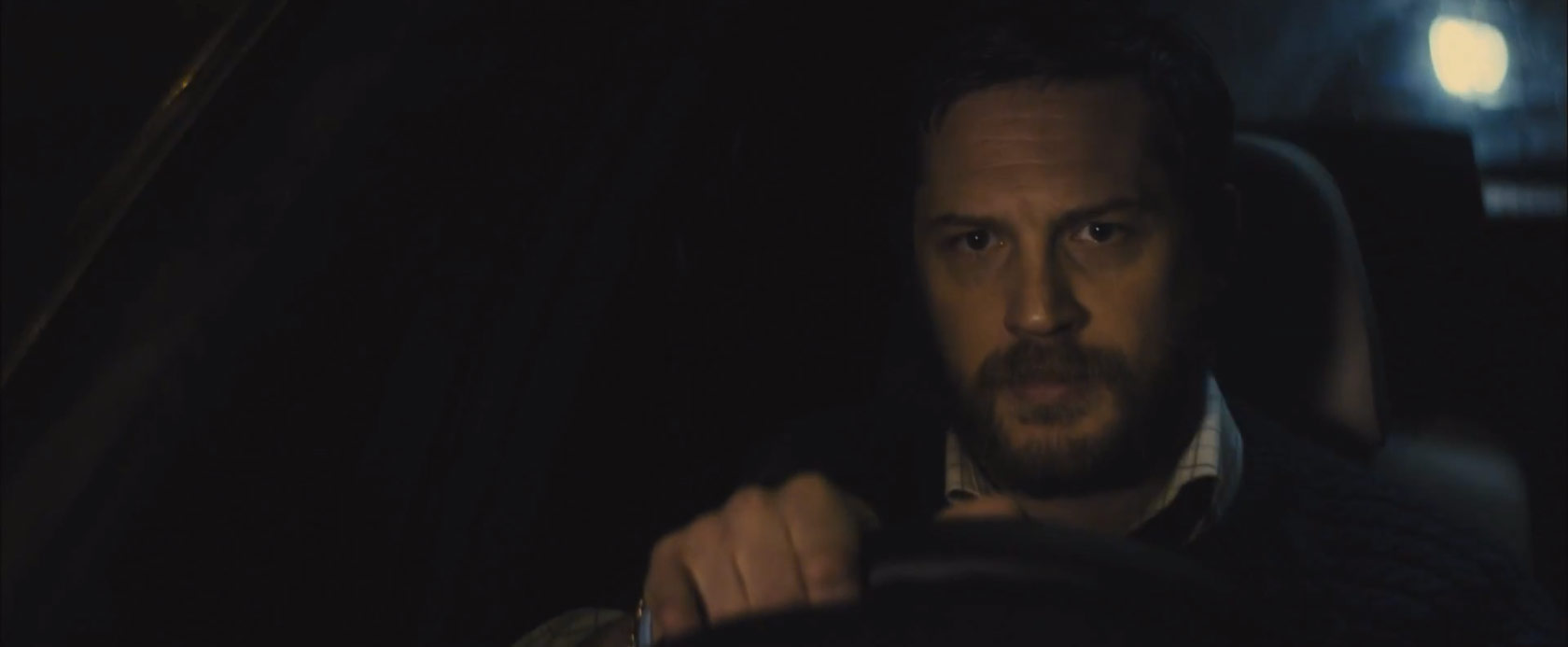
For Ivan, every bump in the road signifies another life collision. As he gazes through the car window, eyes lamenting, a struggling reflection cast before us, we recognise him as a decent human being in the midst of self-inflicted calamity. Phone calls offer a moment of salvation: relief, anger, humour, misery. But still, salvation from lawless thought. Often, Ivan — a man of structure — joins up the dots in his own life by relating an ingrained knowledge and valuing of cement and stability to the current unsavoury predicament in which he finds himself, and occasionally the driver turns to an empty back seat in order to converse with his deceased father. It’s in these moments of spiritual bartering that Locke struggles to maintain order. Remember, Ivan is a man of structure and the film thrives not through obvious semiotic links, but by way of his empirical, rubble-gathering conversations. Not to mention an exceptional solo performance.

As the night’s misty ambience shrouds his car, construction boss Ivan Locke (Tom Hardy) finds himself driving away from a highly imperative job at work through circumstances stemming from a past action that was not at all beyond his control. From home, his son continues to phone and commentate the latest football match, and from work, higher-ups and lower-downs transmit more bad than good news. But it is a situation on the periphery of his normal day-to-day existence that has Ivan abandoning domestic and occupational ship tonight. A birth — one primed to send a stake through his life.

Locke is about as ambitious as any film can get within the confines of a car and boasting a solitary character hampered by a snivel-inducing cold. Plot doesn’t really exist, at least not in its customary tangible form that encourages the camera to follow the actions of different people, to different places, in order to relay new actions. Rather here, any quintessential plot twist or narrative advancement lies at the mouth of Tom Hardy, whose words and facial expressions both have a defining hand in dictating every element of the film. At its core then, in order to be a success Locke perilously relies on a compelling central performance. And it certainly gets one.

At no point does the cinematic spotlight retreat from Tom Hardy. The Londoner has nowhere to hide — just like the man he is portraying, the car is his temporary prison; a voluntary prison, one that both Hardy and Ivan choose to enter. (His name, Locke, hints at confinement.) Further complicating matters, the actor must relay a rich Welsh accent for film’s entirety. It’s put up or shut up time and at no point are we crying out for Hardy to shut up. His dialogues caressed by a wonderfully thick cadence, the man behind the wheel not only garners audience sympathy, but also demands a degree of exasperation by way of an incessant need to fix everything (not to mention a prior noteworthy error in judgement). When Ivan converses with his son Eddie, voiced by Tom Holland, we can hear the compatible trust and loyalty between the pair. Misguided trust? No, not all. Ivan is too genuine in repentance. Yet when we ear-drop in on a discussion between Ivan and Donal, a colleague, it is obvious that the former’s practical desire to amend is being dispersed in the wrong direction. (“I want to talk about a practical next step,” he repeats.) That is, towards his job and not his family.

In establishing Ivan as an ambiguous sort, Hardy leaves it up each individual eavesdropper on his journey to decide whether or not his moral compass is shattered, cracked or still intact. Writer/director Steven Knight plays a role in formulating the character, of course, but Hardy’s delivery must be spot on otherwise the film is doomed. The lead is wearing so many different hats too: father, husband, son, consulter, instructor, peace-keeper. There’s not a single moment of respite in sight, not until he reaches his destination and by then, we’ll be gone. Hardy must relentlessly alter appearance without taking a breath. His character Ivan says it himself: “I have a list of things I have to do tonight when I’m driving.” Carrying wholesale weight on his shoulders, the actor remains poised throughout. If he hadn’t already appeared as Eames in Inception, or as Bane in The Dark Knight Rises, this is the type of performance that would’ve propelled Tom Hardy up an acting echelon or two. Instead, it’ll simply cement his lofty place.

In a film as minimally scoping as Locke, a slow and effective plot that builds towards an emotive, tense crescendo is necessary to go alongside a commanding central performance. When Ivan converses with air over his own mistakes and resultantly flip-flops between placing blame on his father and on himself, the outing loses some tension-building momentum. The character is one stimulated by integrity — a structurally damaging change in cement for his building enrages him, and he is left disheartened by a self-generated misdemeanour, two varying instances of corrupt integrity that affect Ivan. Whenever a phone call ends, the car dashboard re-manifests as an electronic satnav, telling us all we need to know about Ivan’s life and where it is headed: straight ahead, approaching isolation, dictated by others. Simple aesthetic insights such as the one offered by said satnav are alluring, unlike the occasional obvious and over-egged metaphysical spiels that don’t do Locke any favours.

Unlike Buried, a film that spends its runtime trapped within a coffin alongside Ryan Reynolds, there’s ultimately no concrete pay-off. Perhaps this has something to do with the aforementioned philosophical interceptions in narrative, jarring much pressure-building. It is also conceivable that Knight writes himself into a tricky conclusion, where there is no justification for an unambiguous ending. This isn’t necessarily a negative — credit must go to Knight for sticking his neck on the line and making a film as experimental as Locke, particularly in an era pillaged by financial behemoths where even low-budget productions cough up allocations of around £10 million. (Locke was made for less than £2 million.) At heart, it is the typical redemption story, only without any typical advantageous factors apart from dialogue — no emphatic score, or distressed damsel, or soaring visual palette. Not even an outright hero. The closest we get to unbridled tension comes during conversations between Locke and any other voice, rather than an empty back seat. Confusion rears and urgency arises, compounded by the screeching sound of sirens and flashing lights from police cars that intermittently race past in the outside world.

Ivan’s journey to London is an exercise in personal demon exorcism, and you are the judge in this tale of uncertainty. One thing is for certain though — Locke is a damn good attempt at something different. Narratively-speaking, the film doesn’t scintillate as much as it wishes to. Performance-wise, it just might.

Locke - Hardy

Images credit: IMP Awards, Vulture

Images copyright (©): A24

Captain America: The Winter Soldier (2014)

★★★★

Captain America: The Winter Solider PosterDirectors: Anthony and Joe Russo

Release Date: March 26th, 2014 (UK); April 4th, 2014 (US)

Genre: Action; Adventure; Science fiction

Starring: Chris Evans, Scarlett Johansson, Samuel L. Jackson, Anthony Mackie

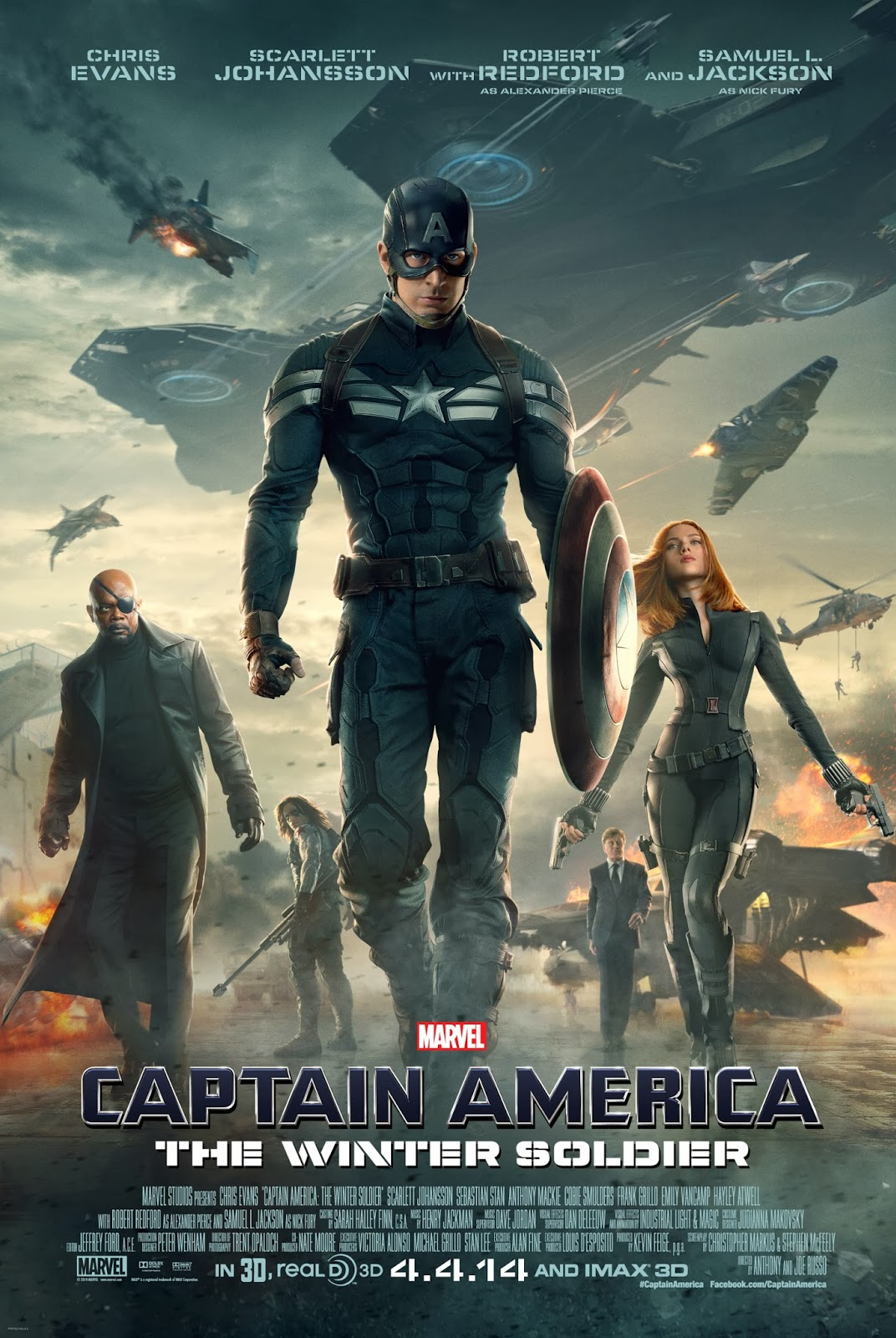
Anthony Mackie’s aerial hero Sam Wilson clarifies his role in combat: “I’m more of a soldier than a spy.” It’s a statement that undoubtedly applies to the all guns blazing Falcon, but not one that echoes alongside Captain America: The Winter Soldier. In a bolder move than perhaps initially perceived, brothers Anthony and Joe Russo decide to direct this latest Marvel instalment down a noticeably unrecognisable runway, one without the usual witty pizazz or golden godly attire. Instead, we find ourselves immersed in a more familiar world where threats come from secretive suits and moral ambiguity challenges heat of the moment decision-making. An ever-increasing commonality on the annual cinematic calendar, superhero jaunts must beware genericism. Captain America: The Winter Soldier heeds this notion by placing storytelling on a pedestal, and the result is the genre’s best outing since The Avengers.

Having traded barbershop quartets for iPhones, Steve Rogers (Chris Evans) is struggling to comprehend modern society. Shield in hand and other hand in the enemy’s face, as Captain America, Rogers is unwavering — if there’s a mission to be done, it’s his job to carry out the orders without fail. However, when the star-spangled armour is removed and his protection against life and its cynicisms subsequently foiled, Rogers finds himself at odds with not only those close to him, but also at his own inherent ideals too. With the walls of surveillance closing in and S.H.I.E.L.D. director Nick Fury’s (Samuel L. Jackson) warning to trust nobody a prominent klaxon bellowing around his mind, the bastion of righteousness must suddenly contend with another menace: the aptly named Winter Soldier (Sebastian Stan).

Unlike most other Marvel epics, The Winter Soldier adheres to a distinctly retro vibe; in execution, in tone and in narrative. Of course the same could be said of The First Avenger but, unlike the film set amidst World War II, Captain America’s second sole venture onto the big screen sees him fiddle around in a 2014 that is rife with wisps of the past. Phrases such as “nuclear war” are tossed around and it’s not long before the technical beat of Bourne sounds off. Rather than bombastic CGI gorging, the film shuttles forth through subtle tension. It has the basis of a spy thriller, an espionage tale pitting foes against each other in a semiotic battle where the meaning behind a threat holds as much reverence as its actual implementation.

The filmmakers astutely conjure up an air of uncertainty that sees hostile clouds slowly gather as a plethora of characters interact with each other. We know only to trust Cap, who is suffering the same principle-related dichotomy that any of us would succumb to if thrown in a similar situation. At heart he’s still the same scrawny chap from 1942, and is entirely relatable in that sense (his normality rather than his age). This amalgamation of Cold-War-esque strain is emphasised at no better moment than during a lift scene where, as more gun-wielding combatants enter and the number of suspects grows, one single trickle of sweat represents a hazy downpour from those aforementioned clouds of hostility. The overriding tonal shift works because it is different from what we normally see at the reels of Marvel (and normally enjoy too). In actual fact, The Winter Soldier is of similar mould to Christopher Nolan’s Dark Knight trilogy, as gritty realism effectively grounds and familiarises proceedings.

In an interesting twist, though the Cold War vibe presents an encapsulating avenue into the film for viewers, said time period absolutely remains a modern one for Captain America. The unethical derivative of modernity combined with fears over infiltration acts as an almost tumultuous double whammy for Steve Rogers, who is experiencing the worst of two eras. A lot of emphasis is placed on character development which means the audience is able to develop a sincere connection towards Rogers who, in the previous film, was a bit of a one-trick pony. This time around, Captain America is the perfect foil for the narrative in question, one hoisted aloft by defection and deception. He’s the symbol of freedom and justice, but how can one be fair in a morally jarring modern society? Rogers walks through a museum, showing signs of still living in the past much like his seemingly outdated moral attitude (“It’s just not the same”). One recognisable element though, is conflict, and The Winter Soldier himself reflects the soulless nature of contemporary life. As a villain he’s solid, if not a tad uninspired, though Sebastian Stan does occasionally stimulate an aura of peril.

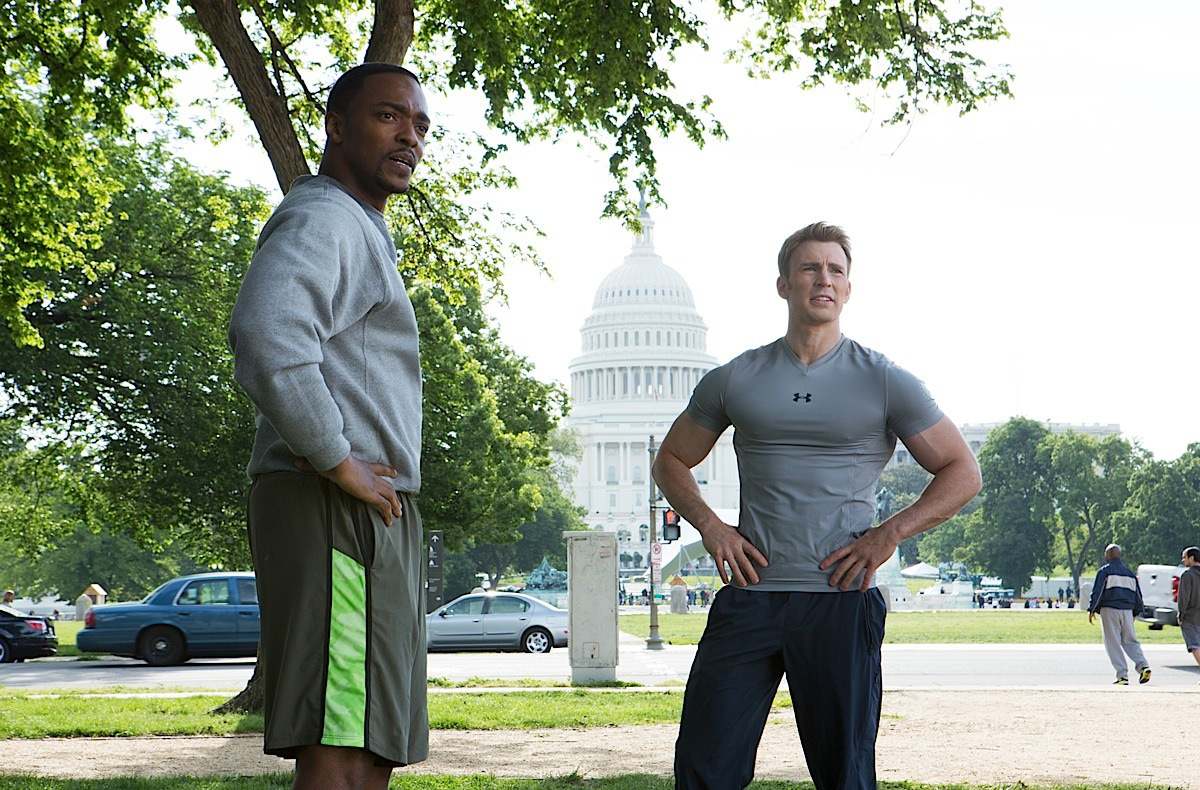
The mind-strewn superhero himself, Chris Evans emits an authentic sense of noble disenfranchisement, but refrains from thrusting his character too far in the wrong direction. Unlike S.H.I.E.L.D., his stance is never compromised. Evans is a very watchable presence, much akin to Scarlett Johansson whose skilled spy Black Widow is a peculiarly compliant foil to Captain America. Johansson’s poise suits her ruthless agent, and here she is given a wider emotional spectrum to hit. Though originally introduced as part of the Iron Man thread, Black Widow is better suited to Captain America. Robert Redford shows up as S.H.I.E.L.D. seniority, a tangible throwback to those 1970s political war outings from which the film finds inspiration. His role not quite as physically tormenting as in All Is Lost, Redford appears to be enjoying the healthier hands-in-pockets approach here. Other noteworthy faces include Anthony Mackie, who injects humour and energy as Falcon, and Samuel L. Jackson whose Nick Fury sees more action than ever before.

One or two issues do arise as the film trundles on, notably a moment of universal conformity against a particular someone displayed throughout the ranks of S.H.I.E.L.D., an instant acceptance that feels slightly inharmonious when considered in context with the cohesive events of previous Marvel films. Though The Winter Soldier upholds a down-to-earth narrative for most of its overly long runtime, the last 30 minutes do usher in a quintessentially grandiose superhero battle. Perhaps a more nuanced final act might have rocketed the film within touching distance of The Dark Knight territory in terms of quality, but the concluding action is exciting and does not overstay its welcome regardless. The anxiety-driven tone contributes to the film’s wholly apparent lack of humour, which is a slightly disappointing but likely unavoidable cost.

“I thought the punishment was supposed to come after the crime,” rebuffs Captain America upon hearing about S.H.I.E.L.D.’s new anti-criminality methods. Buoyed by connotations of yesteryear, Captain America: The Winter Soldier presents a pertinent rhetoric on modern society by placing its titular hero in a moral joust of ethics that are tainted at best. Admirable, different, and admirably different.

Captain America: The Winter Soldier - Chris Evans

Images credit: IMP Awards, Collider

Images copyright (©): Walt Disney Studios Motion Pictures

Olympus Has Fallen (2013)

★★

Director: Antoine Fuqua

Release Date: March 22nd, 2013 (US); April 17th, 2013 (UK)

Genre: Action; Thriller

Starring: Gerard Butler, Aaron Eckhart, Morgan Freeman, Dylan McDermott

As far as attacks on the White House go, Olympus Has Fallen trudges its way across the vast lawn with a disappointingly uninspired plod. Bluntly, it’s a film that just doesn’t get much right. Antoine Fuqua’s take on the internal threat to homeland and presidential security saga struggles in areas where it should thrive — notably notions of simplicity — before subsequently becoming entangled in a tonal muddle as it oddly tries to venture into the faux-documentary realm without any conviction. The latter, coupled alongside some shoddy looking CGI attempts, creates a distinctly undesirable televisual shimmer; for $70 million it all feels slightly cheap. Without the macho zest of Gerard Butler, this may very well have been a complete disaster.

The walking embodiment of a tragic evening in the life of both men, Secret Service agent Mike Banning (Gerard Butler) has been removed from Presidential protection duties as the mere sight of him rekindles harrowing memories in the fraught mind of President Asher (Aaron Eckhart). Now chained to a desk job in an office only a few blocks from the White House, the hardy soul is again summoned to defend nation and state as a result of terrorist infiltration. With the Leader of the Free World at the mercy of North Korean guerrilla forces and the very real prospect of US nuclear destruction on the table, Mike sees a chance not to simply become a hero — that’s not enough — but at redemption.

Sounds reasonably straightforward, right? The age-old tale of man (or woman), pride and mind wounded, given the opportunity to reclaim fortitude and settle a previous score. Mike Banning’s journey epitomises this narrative. Heck, he even has the inherently restorative wife in his corner (she’s a nurse); their relationship strained by past decisions and Mike’s resultant self-serving of personal blame when there really isn’t any to be gobbled. Adhering to a well-versed formula is not necessarily a bad thing as long as the adherence is sincere and peppered with an occasional murmuring of intuition. Only, you’re more likely to find a needle in haystack than intuition around these parts.

On one hand, the simplicity is executed sloppily, furnishing a sense of genericism over what could’ve been enjoyable modesty. Visual discrepancies bear the brunt of detriment here — the opening act is hampered by a flow of images that closer resemble the presentation of a video game than a Hollywood film. Later, drones waver around the sky without appearing fully embedded in the landscape, hinting at some sort of blending issue. The graphical inadequacies do sort themselves out when the action slows down and digital enhancement is dumped for more conventional techniques. Yet on the other hand, director Antoine Fuqua unveils vague ramblings of a documentary-style aesthetic. We often watch as labels appear inconspicuously beside characters on screen, each textual nugget informing us of the individual’s name and occupation. It chimes as an attempt to induce a sense of realism or to imply a degree of truth (because not much else is believable), but instead feels lazy. Boasting a portfolio of films including the likes of Training Day, Fuqua is evidently better than this.

Narratively, we don’t get off on the best foot. Driving in blizzard conditions as horrendous as those depicted in the opening act hints at senselessness, particularly given the President of the United States is a passenger. Instantly there arises a lingering anxiety that this will only be the first in a long line of foolish happenings and, true to form, shortly thereafter a conveyor belt of outrageous decision-making is set in motion (at one point the order is given to shoot down aircraft over a busy Washington DC). Nonsense often generates humour, but in a film that preposterously takes itself far too seriously nonsense wholly reduces any semblance of sympathy for the characters on-screen, which is a pretty significant problem given the horrendous predicament that many find themselves in.

A severe tonal struggle exists between the intended air of sobriety and seriousness, and a plot that reeks retro strands: North Korean bad guys, invading and controlling, targeting the President and threatening nuclear catastrophe. It’s a throwback and, to a degree, a fairly camp one. Unsurprisingly, a clear victor fails to emerge between the pair of duelling tones, as the serious ploy comes across as slightly over-egged and the nostalgic effect only exists in principle. As a result the film is devoid of both tension and giggles, unless you get a kick out of lines such as, “They’ve taken the White House!” (a greater helping of which certainly would not have negatively impacted proceedings.)

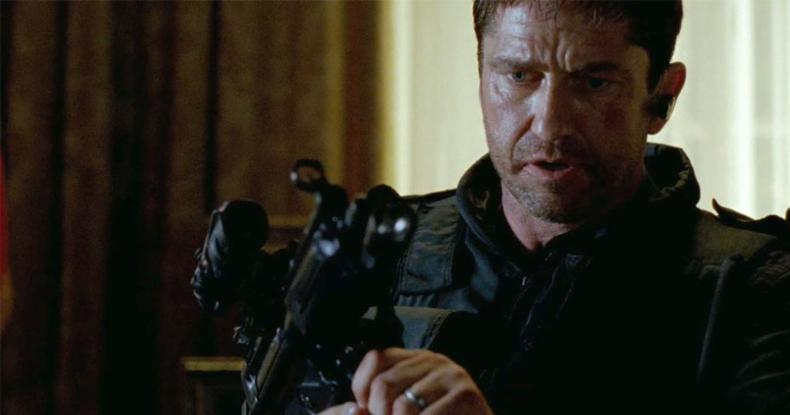
Performances are almost universally uninspired, with the exception of Gerard Butler’s effort. As Mike Banning, Butler manages to inject a small helping of gusto whenever he is present on-screen and also during breaks from under-his-breath muttering. The role is ultimately one-dimensional but that’s no more than required, fuelling the simplicity fire. It’s also a dimension more than most of the other deliveries. As President Asher, Aaron Eckhart has very little to do other than conjure the occasional grimace which, incidentally, looks the same irrespective of whether or not he’s missing out on ice-cream or being held hostage by terrorists. Perhaps the most problematic character is Dylan McDermott’s Secret Service agent Dave Forbes whose moral dynamic flip-flops around more than a fish out of water. Female persons are inexcusably shunted to background; the likes of Radha Mitchell, Ashley Judd and Melissa Leo are less than secondary factors. Morgan Freeman ought to get back to be being God.

Olympus Has Fallen unfortunately stumbles and falls from the get-go, struggling to regain any semblance of steady-footedness thenceforth. A decent Gerard Butler performance cannot prevent the inevitable stern wave of unnecessarily harsh undertones from washing away any potential puddles of fun. It’s not great.

Fargo (1996)

★★★★★

Directors: Joel and Ethan Coen

Release Date: April 5th, 1996 (US); May 31st, 1996 (UK)

Genre: Crime; Drama; Thriller

Starring: Frances McDormand, Steve Buscemi, William H. Macy

A jack of all trades, and perhaps one of the best. Shuttled forth by a bleakly comedic narrative, Fargo occasionally amps up the awkward, tie-loosening tension before ploughing right and left into a caveat of blunt criminality. There’s an inherently dramatic element too, the underbelly of bumbling luck and the ultimate tale of karma. The Coen brothers boast a unique style; precise in their crafting and often ironic in their delivery, a deliriously absorbing mantra that stretches far and wide here. Characters gargle seemingly innocuous lines of dialogue, yet a nonchalant poise often demands bouts of laughter. And therein lies the film’s most admirable quality: it makes you guffaw through moments of sadism, but never denounces you for doing so. The sibling duo at the helm aren’t overly serious in their direction (only when required), yet still manage to divulge a genuine sense of authentic story-telling. In Fargo, every scene holds a certain weight and although engagement with the particulars is at the viewer’s discretion, there’s never a sense of an overbearing burden. Yaaaa.

In Fargo, North Dakota, police chief Marge Gunderson (Frances McDormand) — a woman as cheerful as she is pregnant — is called to a road-side accident harbouring two casualties. Only it’s not an accident, and is instead part of a series of unfortunate events set alight by car salesman Gerry Lundegaard (William H. Macy) in an attempt to recoup much needed cash for his family. A master plan that would garner appreciation from the likes of John Kramer, Gerry hires a pair of quintessential henchmen to kidnap his wife and subsequently demand an $80,000 ransom, the spoils of which would be shared between the trio of plotters. Only Gerry is deviously untangling his own personal puppeteering strings, ready to juggle them against his father-in-law in an attempt to gain one million dollars from the extravaganza. In Gerry’s anxiety-plastered eyes, family comes first… and last.

There’s an ever-present aura that wilfully jaunts around any Coen film. It’s easy to spot, deliberate in implementation but astutely subtle as to never degrade proceedings. Drawing upon the experience of 16 previous films, seeing the words “Joel and Ethan Coen” sprawl across the screen nowadays prompts an intrinsic knowledge that meticulous sardonicism will soon be lingering. Released when their three-decade-old filmmaking odyssey was eighteen years younger, Fargo might just be the sibling duo’s most complete diamond of irony. Some films might be more wholesome in their flippant ideology, for example O Brother, Where Art Thou? and its caper-esque comedic quality, whereas others will undoubtedly offer greater absorbency through numerous interpretations and delightful tones, such as Inside Llewyn Davis. You’d be hard-pressed to come up with another Coen creation as genre-splicing as Fargo though, for this conglomeration of classification is what cinema is all about.

In a Minnesotan setting bitten by frost and populated with oddities constantly attempting to cover their innocuous tracks (“I don’t vouch for him”) the Coen brothers present and develop a number of wholly recognisable characters. Carl Showalter and Gaear Grimsrud are the absolute epitome of a caricature criminal partnership: the snivelling manipulator, out of his depth but armed with a motor mouth, and the dumb brute, purposeful only in violent outbursts or foul language. Gerry Lundegaard is the struggling businessman who ventures further into the ocean of uncertainty than he should, and is all the more blundering for it. His father-in-law Wade Gustafson has more money than patience, and decreases in accessibility when he knows his cash is at risk (“A lotta damn money” is one of the funniest gags). These characters are familiar, but they are also affectionately handled and escorted through a variety of tonal preoccupations, from comedy to crime to drama, constantly forging energy and slap-stick-like commotion. Our child-bearing detective Marge is the only figure who detours from the norm; noticeably pregnant, deliriously good-humoured and actively chasing murderers are three traits that do not often mesh together. This hodgepodge collection of characters coupled alongside a narrative that explodes with vibrancy, will refrain from giving you enough time to reflect on what just happened before it makes you ponder what’s going to happen next.

Yet, in spite of a growing sense of madness, the Coens always appear fully in control. Although the narrative is idiosyncratic — one minute a Steve Buscemi facial expression will have your jaw aching and the next a gunshot will leave you in shock — there is a point, a certain method, to all on-screen antics. The craziness of each character reflects the madness of his or her actions, prompting us to consider the length of a person’s sanity during tough times, whilst simultaneously sending out a nod towards the wondrous scope of cinema. Masterfully, the Coens develop a blunt and sadistic sense of realism amongst the hilarities. Fargo details karma as a rapid mule with more bite than the cold landscape from which it festers. In this tale of people playing people playing people, only the people face the consequences.

Shepherded by Roger Deakins’ icy cinematography, the arctic setting becomes a player of its own as it seeps into every other aspect of the film. Most characters endure cold minds. Lasting shots of mundaneness appear frozen to the screen. There’s a stiff lack of motivation, embodied emphatically by Marge’s police partner who can only conjure up phrases such as, “Watch your step Margie,” and, “You okay Margie?” as the heavily pregnant woman inspects dead bodies. Even the comedy is frosty — plotting and kidnapping is carried out in an atmosphere far more jovial than intense. Though, the funny buck stops at murder, an action presented more chillingly and viscerally than any other.

Regular Coen contributors Frances McDormand and Steve Buscemi are once again on hand and, alongside William H. Macy, deliver terrific performances. Humour is the common denominator for the trio, though the source varies. For McDormand, an incessant politeness in the face of violence and misnomer creates a peculiar dynamic. McDormand’s poise throughout sees Marge one step ahead of the game, even when she’s a day or two behind the others. Entirely the opposite, then, is Macy as the bumbling goof businessman Gerry. Gerry’s idiocy is built from a spectrum of nervous facial expressions and worried posturing; an unassured plight that sees no positive solution. He’s anxious to a T, but so dud-like that you sort of expect his ridiculous plan to come off in a spectacularly inadvertent fashion. The third of three great performances derives from the acting chops of Steve Buscemi, whose raging demeanour funds a big-mouthed little guy not far removed from Tommy DeVito. He relentlessly contradicts himself and thus withholds attracting seriousness, but it’s obvious that Buscemi is having a blast with the role and fun is infectious. It also helps that he gets many of the funniest quips.

The Coen brothers leave nothing to chance and inject Fargo with fastidious application — it’s no surprise that a wintry white landscape pronounces vivid red blood. The film will keep you guessing, is littered with humour and completely embraces the medium from which it thrives. In doing so, it even has the wherewithal to reflect on the outrageousness of its characters’ wrong-doings.

In the often correct words of Roger Ebert, “Films like Fargo are why I love the movies”.

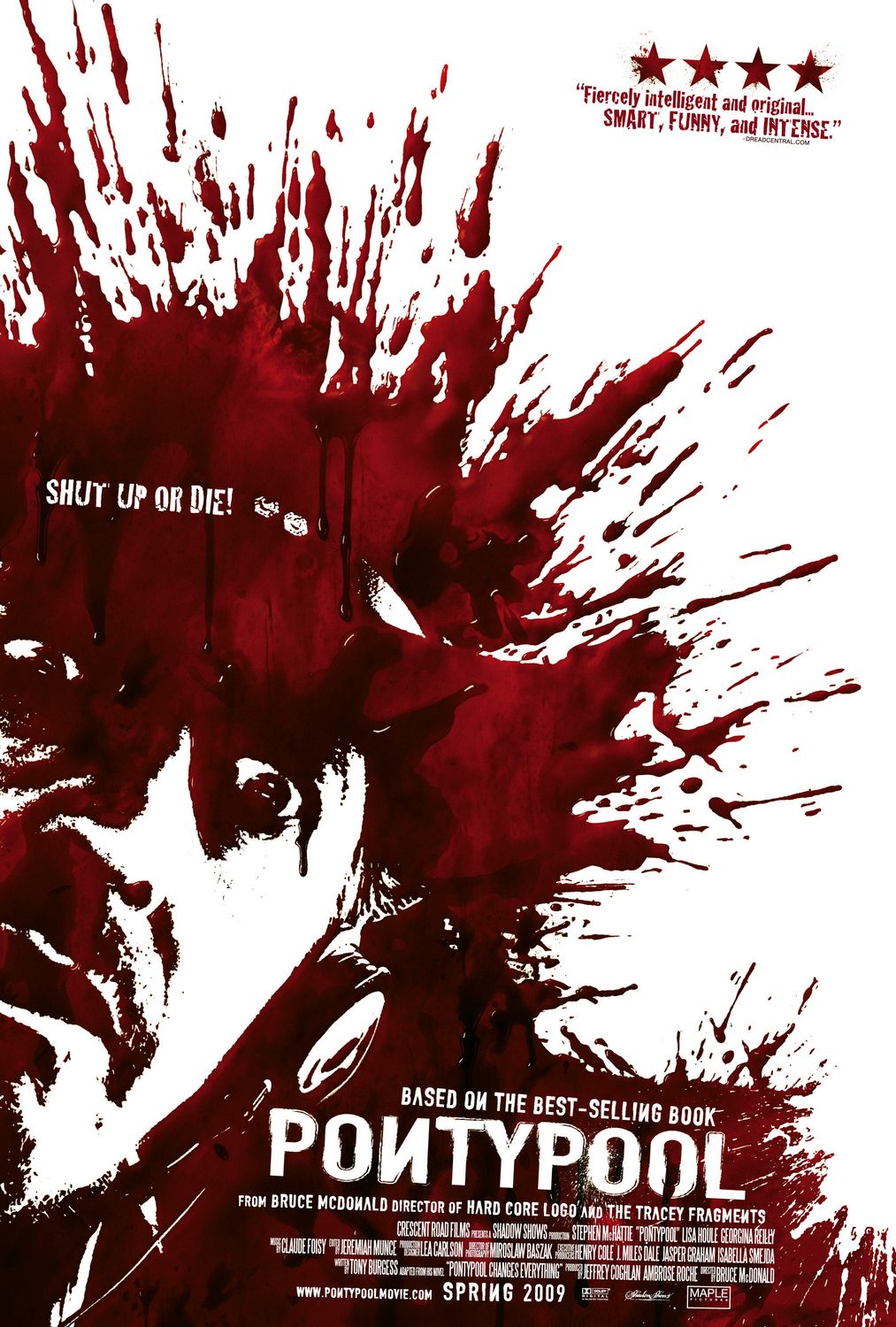
Pontypool (2008)

★★★★

Director: Bruce McDonald

Release Date: March 6th, 2009 (Canada); October 16th, 2009 (UK)

Genre: Horror; hriller

Starring: Stephen McHattie, Lisa Houle, Georgina Reilly

Set in the small town of Pontypool, Ontario, radio host Grant Mazzy (Stephen McHattie) drives through blizzard-like conditions to work and on the way has an odd encounter with a woman who repeats muffled sounds over and over. When he reaches his radio broadcasting station, he is joined by the station manager, Sydney Briar (Lisa Houle) and the technical assistant, Laurel-Ann Drummond (Georgina Reilly) before going about his day-to-day activities. After an average, less-than-noteworthy few hours of news, Grant receives information from the station’s helicopter reporter, Ken Loney (Rick Roberts) that an apparently violent mob has infiltrated the office of one of the town’s doctors. From then on, it becomes apparent to Grant and the others that something is not quite right with the ‘mob’ in question, and the radio employees’ situation quickly becomes one of doubt, fear and worry.

Originally screened at the Toronto International Film Festival in 2008, Pontypool is a completely different take on the zombie/post-apocalyptic genre. Whereas the focus of such films tend to be on gore and exhilarating action, Pontypool certainly is exhilarating, but far more in the psychological sense than in anything to do with flying body parts. The first thing to say about this film is that it is set, for the most part, in one location — the radio station — which benefits the film hugely. Director Bruce McDonald could very well have taken his cameras to various locations and opted for visual scares, but instead he centres the slow building and uneasy atmosphere on dialogue alone. Having the film play out in one location, and through the eyes of the three characters in the radio station, also places the viewer in the station with the characters — as opposed to he/she being repeatedly removed from film due to it jumping all over the place.

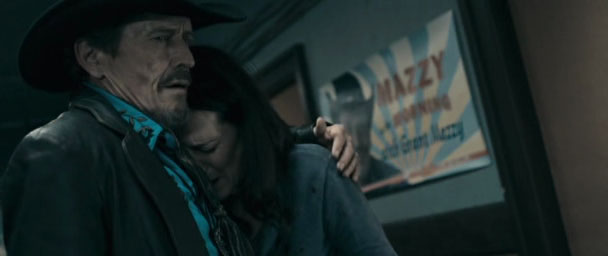
“Kevin, I told you not to watch ‘The Red Wedding’.”

Having shot the film in a single location, McDonald is able to fully develop his main characters and show off their every emotion while they receive word about various horrible events taking place elsewhere in the town. Stephen McHattie pulls out an over-the-top, yet thoroughly entertaining performance as a tiring radio presenter who seems to irritate more than anything else. The over-the-top element of McHattie’s performance ensures that the film does not slip completely into a downbeat, hopeless realm and even gives Pontypool a slightly humorous tone at times. His somewhat distant nature at the beginning quickly unravels as the situation dawns on McHattie and his colleagues. Lisa Houle is decent in her portrayal of a considerably controlling station manager. Her character grows as the plot develops, and for her first film role (she is married to McHattie, I wonder how she got this gig?) she puts in a solid effort which is sometimes let down by her less-than-believable attempts at displaying grief. Each of the supporting actors step up to the plate when called to do so meaning there really is no weak link in the cast.

“Let me guess, she watched it too?”

I am not entirely sure what McDonald had in mind when he was making Pontypool, in terms of what he wanted audiences to take from it, but I would love to know. For me, it is clearly a film about how we, as society and as individuals, are so wound up and led on by dialogue — regardless of who or what the source is. The film evokes connotations about how governments rule us and how the influence, and existence, of a global media order thrives on our reaction and acceptance of what they tell us. Throughout the film, our lead characters are relentlessly relayed news and it is their reaction to each snippet of news (one of acceptance over ignorance) that the film is built on — their lack of dismissal means the viewer goes on a journey of weariness, anxiety and fright alongside the radio trio. For all the viewer and characters know, the information they are receiving could be a hoax — again, the ploy by McDonald to keep the focus of the film in one location is essential here — but without seeing what is going on externally, they (and we) end up putting faith in unfounded knowledge. Sounds vaguely familiar, right?

“You all watched it? Brilliant.”

In terms of logistics: visually, at a budget of around one and half million dollars, Pontypool looks great and includes some neat gory, non-CG effects. I noted a few paragraphs prior that the film chooses atmosphere over gore for scares, but what is a zombie film without a few zombies and some blood and guts? Pontypool is far from loaded with the aforementioned though, which is a good thing because it certainly would have been easy for McDonald to set the film off in a clichéd zombie-fest direction during the last thirty minutes or so, but his avoidance to do so benefits the overall product greatly. The script is well written and smooth, particularly in the first half of the film where words are the primary purveyor of scares. The lack of drag (not that kind) during the film is a testament to the writers’ ability to keep their writing slick and interesting.

Just like in my Star Trek Into Darkness review, I am going to avoid giving away too much here (I reckon I should just get rid of the whole spoiler thing anyway, it is slightly disrespectful to the film industry I think), however I will say that the ending worked for me. I have no idea what was going on during the post-credits scene though, somebody will need to fill me in on that one.

Pontypool is a unique film in that it successfully combines the zombie genre with psychological horror, offering up a thought-provoking and generally gripping thriller in the process.

CBF’s Genre Toppers: Thriller

Today I am focusing on some of my favourite films in the thriller genre. Just before I begin, I would like to be clear on how I make the distinction between thriller and action, because sometimes they seem to mesh into one. This is just my own personal way of telling both genres apart and there really is no right or wrong answer here — you may think something completely different!

Firstly, the main similarities between the two genres are the typically a fast-paced plot and, more often than not, a heroic character fighting off a villainous one in one way or another. For me, the separation tends to occur in the tone of the film. For example, a thriller seeks out suspense and jeopardy as the driving force, whereas an action film is all about excitement and liveliness. Also — and again this is just the way I see it — action films tend to be more light-hearted than thrillers (not always, but generally).

Anyway, on to five greats!

Skyfall (2012)

The newest film on the list, Skyfall was released in October 2012 and declared instantly by the vast majority of viewers to be the best Bond film ever. Helmed by Sam Mendes and with Daniel Craig reprising his role as James Bond, the film follows Bond’s relationship with M (Judi Dench) throughout his investigation of a violent attack on MI6 at the hands of former agent Raoul Silva (Javier Bardem) who is out for revenge.

“Looks like it’s gonna rain.”

As I mentioned earlier, Skyfall has been touted as the best Bond film ever by audiences and critics alike, and has now grossed well over $1 billion which makes it — as of writing — the eighth highest grossing film of all time. That tells you that Sam Mendes done something right. In fact, he done just about everything right in this emotional roller coaster ride. For the first time, the audience is invited into the ins and outs of the relationship between Bond and M which makes this instalment more weighty and heartfelt, yet it still maintains that slickness that has always been associated with the franchise. Mendes has a stellar cast at his disposal — joining Daniel Craig (who plays his best Bond to date opposite Judi Dench, in my opinion) in Skyfall are newcomers to the franchise Ralph Fiennes, Ben Wishaw and Naomie Harris who each add their own nuances to the film (Wishaw is particularly good as Q). However, the star of the show is Javier Bardem with his charismatic, extravagant portrayal of villain Raoul Silva. On a par with Mads Mikkelsen in Casino Royale (we will just ignore Quantum of Solace for now) Bardem is hugely effective opposite Craig and the two flourish as a result.

Although Bond has become a genre on its own essentially, Skyfall claims a spot in my top thriller films for its crisp, free-flowing script and interesting characters.

No Country For Old Men (2007)

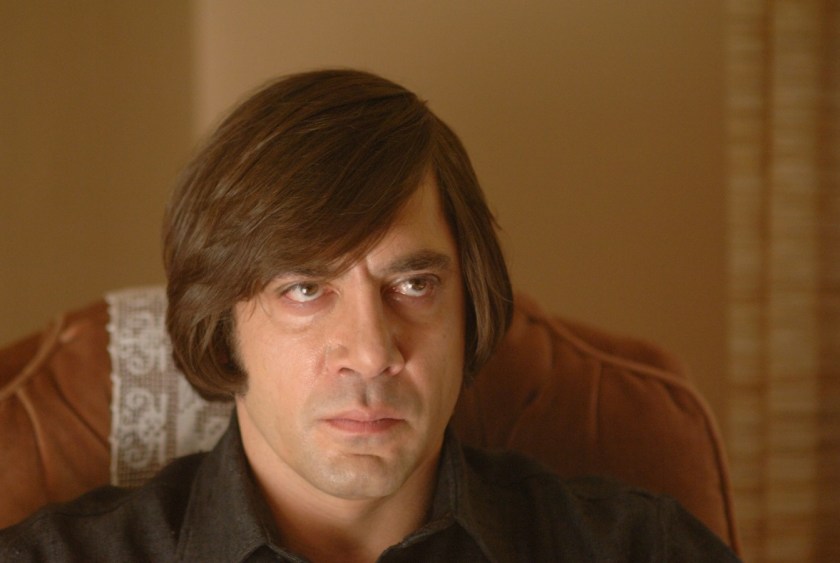
“Do not insult my hair again.”

No Country For Old Men is an Academy Award winning 2007 film directed by Joel and Ethan Coen (or just the Coen brothers). The plot surrounds Josh Brolin’s character, hunter Llewelyn Moss after he uncovers over $2 million worth of cash at a drug deal gone wrong and is pursued as a result by vicious hitman Anton Chigurh (Javier Bardem) who has been hired to recover the stolen cash. Meanwhile, almost retired sheriff, Ed Tom Bell (Tommy Lee Jones) finds himself thrust directly into the cat-and-mouse chase between the two.

It is not often the Coen Brothers get it wrong and, true to form, No Country For Old Men is a knockout. This marks Javier Bardem’s second appearance on my list, and for the second time he steals the show. Bardem is excellent at portraying a psychotic, emotionless killer and his aura throughout the film adds to the creepy, on-the-edge, thriller-ish atmosphere. Both Josh Brolin and Tommy Lee Jones are terrific in their depictions of a desperate war veteran and a straight-to-the-point county sheriff respectively. The 1980s Texas setting truly adds to the grit (wink) and once again proves just how good a pair of eyes the Coen Brothers have at selecting locations for their films — have a look at Fargo and O Brother, Where Art Thou? if you do not believe me.

No Country For Old Men is captivating and intense, just two of the many characteristics which make it a very enjoyable thriller.

Argo (2012)

“Screw the Oscars, man”

Ben Affleck’s third directorial feature, political thriller Argo, opened in cinemas a few weeks before Skyfall in October 2012 and stars Affleck, Alan Arkin and Bryan Cranston. The film is a dramatisation of the Iranian hostage crisis in the 1980s where six fugitive American diplomats require assistance in the form of extraction out of Iran from CIA specialist Tony Mendez (Ben Affleck).

I cannot wait for Affleck’s next film, because this one is absolutely outstanding. Argo defines the thriller genre — every characteristic required to make this film a success is in there. Gripping, intense, polished and stylish, Argo delivers on all fronts. For a political thriller, the plot is not difficult to follow, yet it remains shrewd and without any glaring mishaps. One of the more surprising elements here, particularly following the terrifying opening sequence, are the pockets of dark comedy splattered throughout the film which by no means feel out of place. Affleck manages to equate the frantic goings-on with enough dark humour to ensure the film does not become too lifeless or overbearing. Each of the performances from the cast are solid, with Alan Arkin standing out in particular, but the constantly flowing nature of the plot is the key to this film’s success.

How Ben Affleck was snubbed by the Oscars (he did not receive a nod in the Best Director category) is beyond me. Argo is a must-see film and definitely one of the best released in 2012.

Inception (2010)

Directed by Christopher Nolan, the summer blockbuster of 2010, Inception, stars a jam-packed ensemble cast lead by Leonardo DiCaprio, who receives his support from the likes of Ellen Page, Tom Hardy, Joseph Gordon-Levitt, Cillian Murphy and Marion Cotillard (the list goes on). DiCaprio plays Dom Cobb, an extractor — or plainer terms, a thief — who enters his subject’s dreams in order to carry out an extraction. When he is offered the chance to see his children again, Cobb must assemble a team of specialists together in order to plant an idea into his target’s (Cillian Murphy) subconscious — a process known as inception.

“My bad.”

I am probably going be referring to film critic Mark Kermode a lot during this next paragraph, because his review of Inception is one of the best I have heard. Massive summer blockbusters are sometimes tarred (often justifiably) as being big money-making schemes with very little for their audience, who have become accustomed to seeing films where absolutely nothing happens other than some pointless, soulless action sequences (I am looking at you Michael Bay). Kermode attributes this to a small percentage of filmmakers perhaps assuming their audience is too ‘dumb’ to be able to watch a film and at the same time… think. Yes, think. It really is absurd, but it does appear to happen. Look at Transformers for example: the whole franchise is nothing more than robots hitting each other, which is fine once (I suppose), but not over and over again until it becomes so intolerable it hurts to watch. Inception, however, is a perfect example of a massive blockbuster that provides enough action and thrills to appease everyone, but also makes its audience think during the film — and it worked, because the film has taken over $825 million. Why? Because people appreciate that Christopher Nolan is looking out for his audience and making films that will challenge them, but that are also highly enjoyable (The Dark Knight trilogy being another example). Also, because Inception had a number of different layers to it (both literally and figuratively) and because people enjoyed it, some then had to go back and see it again in order for them to fully understand it! That does not mean those people are dumb, quite the opposite in fact: it means they are thinking.

But I digress. Inception is a show-stopping thriller stuffed full of ideas, great performances, amazing visual effects, comedic moments and even some emotion (look it up, Bay).

Blood Diamond (2006)

“Is my accent really that bad?”

The oldest film on my list (albeit not very old), Blood Diamond is another political thriller starring Leonardo DiCaprio. This time he accompanied by Djimon Hounsou and Jennifer Connelly in a Sierra Leone setting. At the height of the Sierra Leone civil war (1996-2001), smuggler Danny Archer (DiCaprio) teams with a local fisherman (Hounsou) and a reporter (Connelly) in an attempt to seek out and gain possession of a large diamond, with each of the three boasting different motives.

Leonardo DiCaprio (incidentally, my favourite actor) gets a bad rap for his South African accent in this film — it sounds great to me, but maybe I am touch biased. I doubt that. The performances are very strong, with all three protagonists providing a combination of fury, optimism, emotion and anguish to accompany the desperate situation they find themselves in (particularly DiCaprio and Hounsou). The story moves at greater-than-steady pace which provides the thriller-ish aspect which the film has in abundance, with Edward Zwick’s narrative ensuring the audience remains grasped throughout. Part of the formula which contributes to Blood Diamond’s success in my eyes, is its realism as it depicts some of the hardships most civilians staying in Sierra Leone (and elsewhere) were going through during the civil war. A few of the scenes are harrowing, not in a particularly gory way, but because they dramatise atrocities occurring around the world. I would say, however, that Zwick does not make these scenes exploitative in away way — they are an essential part of the story. On a last note, the African setting is absolutely stunning and almost becomes a character itself during the film.

Blood Diamond really hits home in its realistic nature, and at the same time serves up a gripping tale of two very different men with one common goal.


And now for some honourable mentions:

Se7en (1995) — This is a very accomplished horror story about two men tracking down a serial killer who leaves them clues in the form of the Seven Deadly Sins… only, with people involved. Morgan Freeman and a young Brad Pitt excel in their roles.

The Talented Mr. Ripley (1999) — At times you get obsession, then you get Matt Damon in The Talented Mr. Ripley. What opens as a fairly innocent thriller closes with just enough menace to fill anyone for a day. Or a lifetime.

Inside Man (2006) — A very underrated film in my opinion, Inside Man sees the charismatic Denzel Washington tasked with rescuing a bunch of civilians caught up in a bank robbery masterminded by Clive Owen. Very intriguing action with a wonderful twist.

Taken (2008) — I think just about everybody has seen Taken — it’s on the TV at least once every week (and weirdly, it costs exactly three pounds in just about every shop in Scotland). Often brutal, always entertaining and the birth Liam Neeson: action star.

Wrecked (2010) — A small, independent thriller starring Adrien Brody as a man who wakes up in the middle of a forest after a car accident he cannot remember anything about. Interesting, dramatic and unique.

Source Code (2011) — This may make an appearance on another list, but as a thriller it just about misses out my top five. Therefore, I will refrain from saying much more for now (but it is very, very good).

What are some of your favourite thriller films?


(Note: Mark Kermode reviews each week’s new film releases between 2-4pm on Fridays with Simon Mayo on BBC Radio 5live, so check them out if you like films, or flappy hands. You will not regret it.)

Genre Toppers

Having spent the past few days thinking about different ideas and topics to write about, I have come up with a new ‘feature’, if you will.

Instead of primarily relaying new film announcements or reviewing recent film releases (which I will still do, obviously) I think it is time to write about my some of favourite films that I have had the pleasure of viewing throughout my nineteen years of existence.

However, rather than just creating a generic top ten list, I have decided to focus on particular genres and decipher my favourite films encompassed by each genre. I have yet to decide how many genres I will include, but you can count on the usual ones being in there (drama, horror, sci-fi, action, comedy and so on).

The plan is to lay out five top films in each genre and then give a sort of ‘mini-review’ of each film, basically outlining why I like the film so much.

Watch out for my first genre list which will be available to read either later today or tomorrow, and will be titled something like “CBF’s Genre Toppers: (insert genre)”. CBF stands for Consumed by Film, but you already knew that.

The word ‘genre’ is really getting on my nerves now.