The Lucky Ones (2008)

★★★

The Lucky Ones PosterDirector: Neil Burger

Release Date: September 26th, 2008 (US)

Genre: Comedy; Drama; War

Starring: Rachel McAdams, Tim Robbins, Michael Peña

In the upcoming season of True Detective, Rachel McAdams will play a prickly, stoical police sheriff (or if you’re reading this after August she already has, and rather brilliantly too, right?!). That sounds like quite the departure from her character in The Lucky Ones — a soldier, tough without doubt, but whose veins pulse with good-natured naivety. Her volcanic charm is the type that could turn a long road trip into a really, really long road trip. Not here though. Not on McAdams’ watch.

She is Private first class Colee Dunn, joined on a cross country excursion by Sergeant first class Fred Cheaver (Tim Robbins) and Staff sergeant T.K. Poole (Michael Peña). The trio meet at JFK airport having just finished their respective tours of duty, and opt to collectively hire a car since flights home are in short supply. What follows is a familiar voyage down the road movie genre, with periodic stops at comedic junctions and soul searching stations.

What this is not, is a war movie. The film has been criticised for not sufficiently addressing the complex issues of battle — but it simply isn’t a war movie. Certainly, the three main characters with whom we spent time are soldiers on leave, but that doesn’t mean the film has to ruminate about the war they’re presently separated from. Colee and company discuss it, sure. They feel the weight of its heavy baggage at times. But hey, maybe they’re just people. Two normal guys and one normal girl, each trying to reacclimatise to the real world. Struggling, often comically, sometimes painfully.

T.K. is the brash macho-type who subdues authenticity. We first see him inside a tank spouting tasteless jibes about women, before debris from an explosion renders him impotent. His lack of functionality becomes a recurring joke that eventually finds resolution in the film’s worst scene — a poorly executed tornado forces Colee and T.K. into a claustrophobic drain pipe, and it’s really cringe-worthy. Peña undercuts most of the unlikeable traits often attributed to those “macho-types” by delivering a fairly nuanced performance. At one point his character awakens suddenly in the middle of the night, clearly still troubled by the blast, and can only mutter a, “You know… sorry,” when questioned by Colee.

She is the most engaging of the three. McAdams has real presence, lighting up the screen every time she appears. Colee is the buffer between humour and emotion, her wide-eyed lack of cynicism both refreshingly authentic and solemnly disheartening. “That girl’s living in a dream world,” T.K. asserts, and it’s true. She lugs around the guitar of her close friend Randy who died on duty, aiming to return the instrument to his family in Las Vegas. Though Colee has never met them, she is driven by the hope that they’ll let her stay. She exudes so much positivity that we start to buy into her crazy plan. It’s the potential prize at the end of the rainbow, a treasure that differs from the materialistic hoards prevalent in other road trip movies such as O Brother, Where Art Thou? and Rat Race.

Quite the opposite is Tim Robbins’ Fred, or Cheaver, since he is the elder statesman of the group. A modest guy looking to get away from active combat, Cheaver rolls into family despair near the beginning of the journey. He is definitely the unluckiest — though the other two aren’t exactly wearing rabbit’s feet — and Robbins succinctly captures this turmoil. There are similarities to be drawn with Sam Jaeger’s Take Me Home as far as character relationships go, where petty squabbles inevitably evolve into admiration and understanding.

That film’s aimless quality is also apparent — the men constantly say they “don’t have time” to indulge Colee’s sight-seeing desires, but they’re not actually going anywhere. In a way they have all the time in the world, but the guys are too obsessed with achieving an end goal that probably doesn’t actually exist. Though their plot construction could be questioned, director Neil Burger (Limitless, Divergent) and co-writer Dirk Wittenborn’s character creation is effective. Just like in the army, the trio grow to rely upon each other — monetarily, emotionally, and intellectually — a conclusion arrived at with sincerity.

To the film’s credit it doesn’t spend two hours achingly debating the woes war. However, it opts not to ignore the pitfalls either. America becomes part of a clinical world that the army-goers aren’t used to (“You’re at a disadvantage if you don’t master your computer skills”). Bystanders and acquaintances constantly thank them for their efforts abroad, but it’s all platitudinal. Yet it doesn’t feel like The Lucky Ones is trying to emulate the rich verve of something like a Sideways. When the movie threatens too much seriousness it quickly scrambles back under its light-hearted comfort blanket, embodied in a scene where life reflections are interrupted by a penis balloon joke.

Nibbles of narrative stupidity are glibly accepted as a given by the screenwriters. A customer service employee grants the group a car due to their army credentials, even though the only vehicle remaining belongs to the employee’s airport boss. Problems that arise often bear very simple solutions, these problems too easily erected in the first place (Cheaver’s son gets accepted into Stanford University but needs to cough up $20,000 in tuition fees). The film chooses to manoeuvre its way around simple answers through comedy: Randy’s guitar would solve Cheaver’s monetary problems, but Colee amusingly decides to cry rather than oblige.

Though the actual trip part of The Lucky Ones does run into a few roadblocks — it’s not as funny as it should be, nor as emotionally-involving — the characters behind the wheel are wholly accommodating. Besides, who doesn’t want to watch a movie where Rachel McAdams plays an impulsive Southerner with more charm in one glance than a machine gun has bullets?
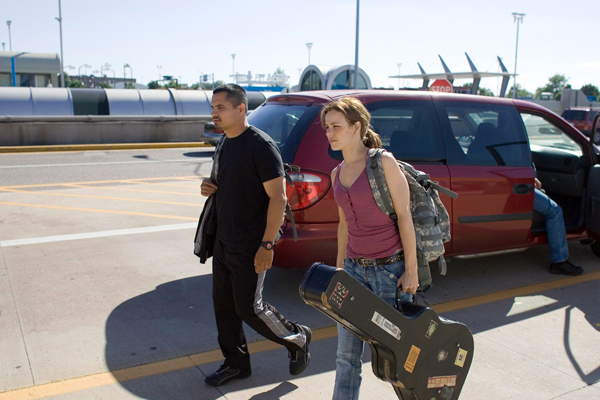
The Lucky Ones - McAdams & Pena

Images credit: IMP Awards, Collider

Images copyright (©): Lionsgate, Roadside Attractions

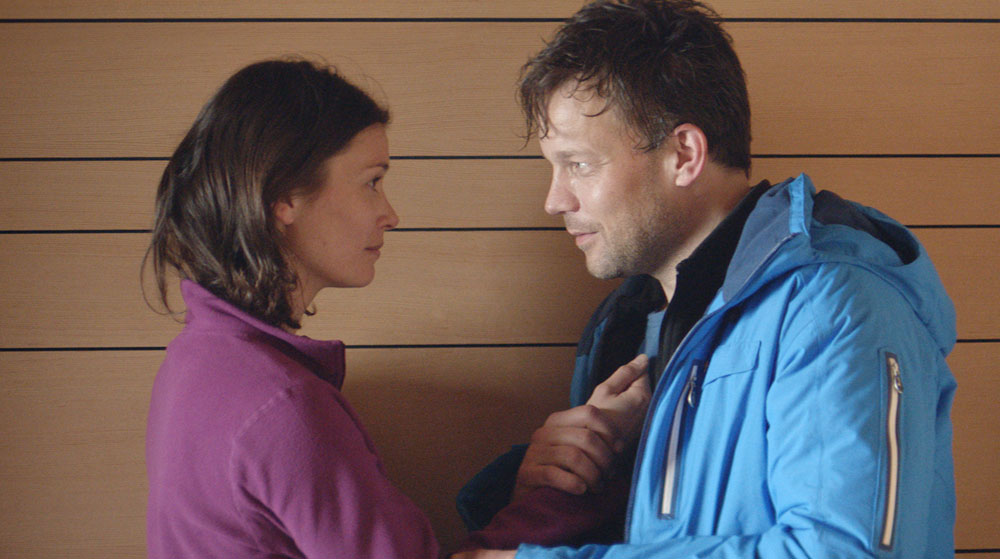
Force Majeure (2015)

★★★

Force Majeure PosterDirector: Ruben Östlund

Release Date: April 10th, 2015 (UK)

Genre: Drama

Starring: Johannes Bah Kuhnke, Lisa Loven Kongsli

As far as family vacations go, this is one for the ‘iffy’ pile. Force Majeure unfurls a day-by-day account of a couple’s wintry retreat to the French Alps where, as it turns out, avalanches are the least of their worries. We join Ebba (Lisa Loven Kongsli) and Tomas (Johannes Bah Kuhnke) as they ski with their two children atop vast snow ranges, surrounded by ominous looking mountains. An eerie atmosphere driven by the mechanical squawks of equipment dominates early, but it soon becomes clear that there isn’t anything conventionally disconcerting going on here.

The titular “superior force” indeed exists, but not exactly in the way you would think. Director Ruben Östlund delivers a bait-and-switch disaster piece, one entirely without action and instead built upon the perceived consequences of disaster. Had the Swede focused primarily on the drama element, Force Majeure would almost certainly be one of the year’s most suspenseful and unnerving films (it still manages to be both of those, to a lesser degree).

After a seemingly enjoyable first day, our spotlighted family sit down with other holiday-makers to enjoy an outdoor lunch. An innocuous explosion unsettles everyone and, despite Tomas’ insistence that nobody is in danger, mounds of snow begin pillaging towards the restaurant. The scene is intense, but it is the characters’ instinctive reactions to potential fatality that provides the pivot from which Östlund’s parable spins.

What we end up with thereafter is a sniping ninety minute liquidation of family life and patriarchal values, completely fuelled by this avalanche experience. It becomes an anecdotal reference point, recounted particularly by Ebba in awkward situations. Through her increasingly disturbed exterior, Lisa Loven Kongsli manages to rekindle much of the earlier scene’s tension when conversing with others. The topic is somewhat over-egged by the end of a discussion between Ebba, Tomas and two acquaintances (one of whom is Game of Thrones’ Kristofer Hivju, he in a somewhat familiar setting). It’s an unnecessarily long sequence that, resultantly, veers close to overdoing Östlund’s message. “I can’t take this seriously anymore, we’ve been going on for hours,” says one of the party. Touché.

The characters themselves are quite annoying, but they’re meant to be. Nobody exits with an outright air of self-preservation, though Ebba is clearly supposed to garner the most sympathy. Tomas, played well by Johannes Bah Kuhnke, manoeuvres from an apparently unfocused husband to a crumbling mess. Bearing tonal continuity, the various characters niggle away under your skin with the same irritation as the events unfolding around them. Wisely, screen time for the children is kept to a minimum.

Alongside this overtly sombre underbelly, Östlund opts to incorporate a satirical layer that serves only to butt helmets with the aforementioned seriousness. If you can forgive a wintry gag: it’s as if the director is trying to put on a pair of skis when he’s already wearing snowboard boots. The nudging comedy isn’t nearly as effective, instead often awkward and confused — an outpouring of emotion from Tomas seems like something that should be taken seriously, but the prevailing attempt at satire renders it somewhat amusing.

Force Majeure wanders into a tonal snowstorm on occasion: is it meant to be piercing and tough, or self-aware and playful? The accompanying subtitles are funnier than most of the attempts at humour, which is a blessing in disguise (though ultimately damning). It is worth noting a crowd-gathered-around-a-mobile scene that does successfully evade the tonal ambivalence, generating a chuckle or two.

In an attempt to bridge this gap between witty satire and ponderous drama, the film succumbs to some heavy-handed storytelling — a conversation between Ebba and her frivolous friend about the pros of an open relationship is too coincidental, then ends up going nowhere anyway. This clumsiness reaches a crescendo during the concluding moments, presenting an ending that is ridiculously on-the-nose. Any tonal reservations notwithstanding, Östlund shows throughout that he is a smart writer with interesting ideas related to perceived societal norms. Why the filmmaker choose to pen such a careless finale is baffling, as it completely undermines much of dramatic effect laid out in earlier scenes.

There is no disputing Fredrik Wenzel’s brilliantly engrossing cinematography, nor the equally impressive sound design. A sense of discomfort and discombobulation gradually grows from elements such as worrisome wooden creaks and an odd sci-fi night-scape. A Clockwork Orange is the obvious musical touchstone and Wenzel’s patient, scoping shots are certainly Kubrickian, though whether the famous director’s influence goes beyond style is up for debate.

Force Majeure is an intriguing film, perhaps on the cusp of something really biting. However, its tonal imbalance distracts a great deal from the thought-provoking drama on display. Anything the film might say about parenting, peer trust, and human instinct is left frozen by an oddly misfired ending. Much like Tomas, it seems Östlund shouldn’t have let his guard down.

Force Majeure - Lisa Loven Kongsli & Johannes Kuhnke

Images credit: IMP Awards, Collider

Images copyright (©): TriArt Film

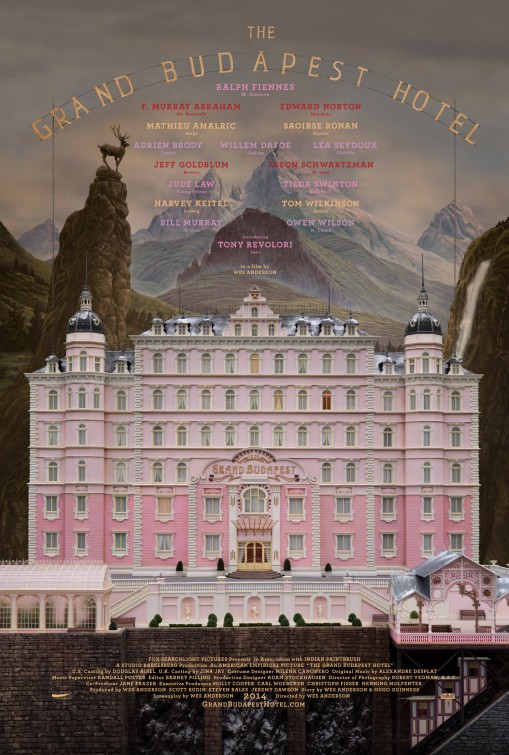
The Grand Budapest Hotel (2014)

★★★

TGBH PosterDirector: Wes Anderson

Release Date: March 7th, 2014 (UK); March 28th, 2014 (US)

Genre: Adventure; Comedy; Drama

Starring: Ralph Fiennes, Tony Revolori

It goes without saying that Wes Anderson rustles up his films to appease a desired taste and The Grand Budapest Hotel, despite its universal recognition on the awards circuit, is another fine delicacy. That’s not a bad thing, especially if you’ve previously been a fan of Anderson’s work. Cards on the table: I haven’t seen enough to really form a stalwart opinion on the director. Moonrise Kingdom was a charm-fest and although The Grand Budapest Hotel doesn’t quite match up for my inexperienced liking, it is still a fun one hundred minutes.

This is the story of a much admired hotel concierge and his invaluable lobby boy. Not for the first time we watch a Wes Anderson flick that is tremendously well crafted, with everyone from prolific cinematographer Robert Yeoman to those in the costume department really pulling up trees to make the outing a visual feast for the audience. It rattles on without so much as a chink, fluent and meticulous in full flow. Walls are painted the right shade of blonde or pink to suit the mood at any given moment, and we watch the madness unfold as if perched on a stand measured to a ninety degree angle with the utmost precision (at one point a character fixes a lopsided painting to maintain this custom).

The piece is a real gem to look at — you could easily spend the entire run-time focused on how minor details play out in the background without as much as a glance towards the immediate plot and still be pretty satisfied. Different aspect ratios are employed at different points in the film, from the older traditional 4:3 to current traditional 1.85:1. It’s fairly enjoyable watching hotel concierge Monsieur Gustave (Ralph Fiennes) and his young partner in crime Zero (Tony Revolori) scamper around, but the purpose of the varying ratios gets somewhat lost as time passes.

There is an almost slapstick element to the film, one that totally suits its colourful, comic-ey surroundings. Every movement is overly emphasised, from running with knees aloft to plate-setting. The characters are all sky high on the eccentric scale — Tilda Swinton appears as an elderly lover and we even get Harvey Keitel in especially nutty convict form. The sheer volume of famous faces that show up, many of whom only appear for a scene or two, is a testament to Anderson’s strongly regarded reputation around acting circles, as well as the jovial atmosphere apparently present on set. This star-studded Hollywood collective helps fund a comedic tone — funniest when it breaks the mould with common insults (“that little prick!”; “who’s got the throat-slitter?”) as opposed to long-winded monologues, some of which can be a tad egregious.

And The Grand Budapest Hotel can be difficult to get into, simply because the screenplay’s ferocious nature doesn’t offer as much as a breather for the audience to adjust and then readjust. It might be a personal thing, in fact it almost certainly is, but the constant velocity can be off-putting (despite it enabling much of the sharp humour). As a viewer, you’re either strapped in and along for the ride or still weighing up the height of the roller coaster. For me it’s a bit too tall.

Much of the film’s allure emanates from the charismatic Gustave, played brilliantly by Fiennes. Fairly short of previous comedy chops — he was part of In Bruges, though his performance in the Martin McDonagh piece was far darker — Fiennes is quite the surprise here. He gets the funniest gags (“you know the drill then? Zip it”) and the actor plays the popular Gustave with an amusing air of receptive non-discrimination; he engages with everyone equally, from jail mates to lobby boys to militant inspectors.

Tony Revolori is a fine assistant to Fiennes on screen, and the two strike up quite the odd chemistry. Members of Anderson’s large cast move in and out of shot as if through a revolving door — Edward Norton, Bill Murray, Saoirse Ronan, Adrien Brody, Willem Dafoe, Léa Seydoux all show face, to name but a few. The film isn’t as fun when we’re not watching Gustave and Zero in tandem, but thankfully they’re together for most of the piece.

The question remains: is there anything going on beneath the surface, or is it all just that — surface? The director doesn’t appear too fussed about incorporating deep meaning and there is nothing necessarily wrong with that. He is more than an aesthetic filmmaker, as evidenced by the humour on show here, but his approach does to an extent alienate those without wholesome affection for it. There isn’t really a plot, rather a whole host of five minute segments incorporating many different Hollywood stars.

As such The Grand Budapest Hotel is an enjoyable spectacle, rampantly good fun on occasion, but not much more than that.

TGBH - Fiennes and Revolori

Images credit: IMP Awards, Collider

Images copyright (©): Fox Searchlight Pictures

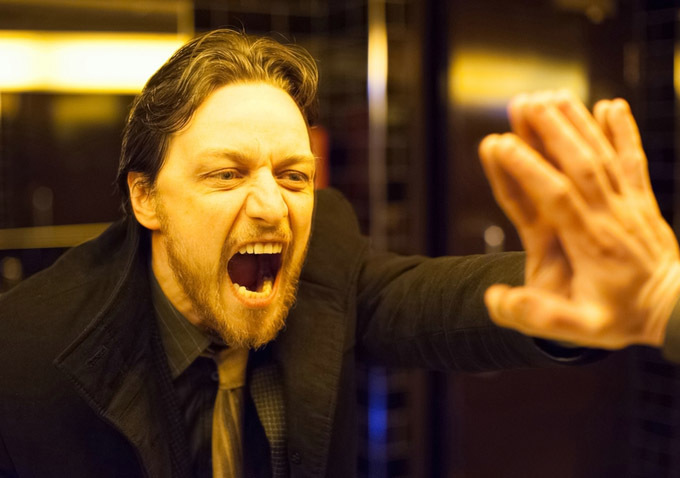
Filth (2013)

★★★

Flith PosterDirector: Jon S. Baird

Release Date: October 4th, 2013 (UK); May 30th, 2014 (US)

Genre: Comedy; Crime; Drama

Starring: James McAvoy

Filth might apply to the tumultuous antics of Jon S. Baird’s lead character, or it may simply be an indicator of Detective Bruce Robertson’s often questionable appearance. (And, likely, prevailing stench). Though, perhaps Filth’s title is a deeper reflection of one man and his increasingly deteriorating mental state; his conscious but not conscientious plummet down into the murky swallows of inhumanity.

James McAvoy is the star of the show, his portrayal of Bruce both admirable and disgusting in equal measure. But just as the (sort of) law man frequently gets sucked back and guzzled by the sewage of life during moments of potential rehabilitation, Baird’s film drowns in its own merits. Whereas individual factors are successful, the piece as a whole lacks continuity. It’s tough to hate a funny chap. It’s also tough to love a chap you hate.

Bruce Robertson (James McAvoy) is as corrupt as that virus ready to spring from the latest suspiciously titled email in your inbox. He is deceitful, devious and dishonest, but only he knows that. Which is a real plus, given Bruce has his eyes firmly glued to the new detective inspector position available. On the downside, the Scot’s relentless convolution of kindness has itself convoluted Bruce’s mental capacity. In other words, he could be on the verge of a massive breakdown.

Filth is one for those fond of the Trainspotting genre — heck, there is even a not so subtle nod towards said film. (When there is a toilet around, “Don’t fall in.”) It is based on another novel by Scottish author Irvine Welsh and retains the same out-to-offend sheen as was merrily paraded throughout Trainspotting; though one would imagine if you’re watching this you’re probably part of the target audience and therefore unlikely to be offended. Our lead character this time is a right git. Bruce’s morning cereal is a bowl of cocaine and vodka, and he’ll only sleep with someone if she’s the wife of a mate. His moral compass is infinitely spinning out of control. Most importantly, Bruce knows how to play the game. And we sort of morbidly appreciate him for that.

It helps that he is quite amusing. The first we see of Bruce is a baggy-eyed figure striding down an Edinburgh street, fingers pressed firmly in his ears as bagpipes sound. “There’s no place like home,” he retorts and from then we’re somewhat disagreeably cajoled under his unflattering spell. As the man wearing Bruce’s stinking clothes, you would inherently expect James McAvoy to play a huge part in that enticement and he absolutely does. He fits into Baird’s adopted world perfectly, lingo down to a tee. Moments shared with Jamie Bell veer close to hilarious with one particular spiel near the beginning particularly well executed, and the actor’s disparaging glances are especially sterling. McAvoy’s stock in Hollywood continues to rise and Filth is yet another effective vehicle shepherding his talents.

Almost as suddenly as they explode awkwardly on screen, the laughs are invariably substituted for a hodgepodge conglomeration of nonsensical dream sequences and scenes intended to be wrought with emotion. There is a wholly serious edge going on here, something more sinister, but these junctures of sincerity are undercut by the weirdness. Jim Broadbent shows up as an aloof psychiatrist armed with creepily elongated vowels and to the fanfare of A Clockwork Orange-esque melodies. His appearance is funny when it shouldn’t be as it represents Bruce’s mental implosion. Surface interactions with fellow officers and other sadistic actions are amusing because, at these precise points, we are only aware of Bruce as a dodgy fellow. As proceedings dissolve into his frail psychological state, laughter isn’t really applicable and subsequently the tone jars.

It is a shame too, because McAvoy makes these disturbing moments work to an extent. A scene between the actor and Imogen Poots is the most poignant, and best, of the film but there is a danger that some impact is lost due to this tonal inconsistency. It also becomes challenging to stick with Bruce. In one sense, his unrepentant demeanour when he knows his actions are driving him into the ground is quite tragic. But then we struggle to care because the guy is a dick. The character’s ambiguous moral standing feels more like an excuse than a justification. At one point he stares into a mirror and sees himself as a pig — Bruce knows he is a horrible person and the film should have played more on this rather than insisting on peculiarities.

The film is a conveyor belt of British screen savvy. Eddie Marsan gets the most time as part of a supporting cast accommodating the likes of Martin Compston, Shirley Henderson, Joanne Froggatt, Katie Dickie and Iain De Caestecker. Imogen Poots is criminally underused as one of Bruce’s promotion chasing enemies and, as Bunty, Shirley Henderson is essentially playing an X-rated Moaning Myrtle. It is a packed, if somewhat slightly ineffectively utilised, cast.

Bruce’s mantra is simple: “Because ah can’t fuckin’ help ma self.” In some ways director Jon S. Baird shares a similar sentiment, one that contributes as much to the film’s success as it does its downfall. Filth is funny, you’ll giggle often. However we’re also encouraged to chuckle at less appropriate moments and, despite the excellent efforts afforded by James McAvoy, this over-eagerness greatly hampers the piece.

Filth - McAvoy

Images credit: IMP Awards, Collider

Images copyright (©): Lionsgate

The Dirties (2013)

★★

The Dirties PosterDirector: Matt Johnson

Release Date: October 4th, 2013 (US limited)

Genre: Drama

Starring: Matt Johnson, Owen Williams

His intentions are clear. Director Matt Johnson wants to create a film that tackles one of society’s most abhorrent problems, school shootings, in a way that is both original and impactful. He presents his piece as a documentary within a documentary; he and co-star Owen Williams’ first names mirror those of their respective characters; Johnson even looks to include elements of comedy, perhaps hoping that these moments will divert our attention away from more pressing matters just long enough for the film to cushion itself with added shock. None of it works. The Dirties severely lacks coherence, but that’s not the primary nuisance. Johnson and company probably don’t set out to be insensitive. Unfortunately, their film teeters unceremoniously along that edge.

A couple of high school mates decide to make a documentary about The Dirties, a group of bullies who terrorise their school. Matt (Matt Johnson) and Owen (Owen Williams) bear the brunt of The Dirties’ abusive behaviour and, when their film is ridiculed in class, one of them resultantly gains a dangerous thirst for revenge. The other, though, becomes increasingly wary of and alienated by his friend’s behaviour.

There’s only one endgame here, and we know of it after five minutes. In truth, we’re fully aware before the film even starts. It doesn’t matter where Matt and Owen are — in class, at a secluded shooting range, around a bonfire — the only notion that consistently wears on our mind is gun violence. More specifically, gun violence in school. An at times imperiously weighty subject, school shootings have become one of humankind’s most despicable and perplexing habits. It’s a clichéd proclamation but, in an age when trolls linger all over the internet and online connectivity dominates our lives, school is supposed to be safest place for a child. There’s absolutely no getting away from the horrible concept, particularly when it’s regularly regurgitated on screen. The Dirties fails for that reason. The film takes something bluntly tragic and tries to be overly meta. Subsequently, plot holes appear quicker than a bee to honey, devouring any potential progress. There’s too much going on — are we supposed to take the film as just that, an overtly fictional piece based on true events, or is it attempting to be real life, paraded in a false documentary format?

Seemingly, Johnson endeavours to veil the piece as the latter. Shouldn’t it be a tad more serious then? Of course, its central topic is one riddled with sombre importance, but this is something The Dirties struggles to maintain. This absence of earnestness is down to how the film is presented, often flavoured by comedy and exotic normality. The cameraman — who we’re essentially meant to discard as a credible human being — follows Matt and Owen around persistently and becomes an agent of humour. At one point Matt passes over the popcorn in a scene that seeks to induce amusement but instead only serves to remind us of the film’s inconceivability and, therefore, crassness. When Johnson recalls the gravity of his material, he reverts to a gratuitous display of foreshadowing involving a Columbine book. We see this book more than once, its third appearance unsettling for all the wrong reasons.

Kevin Smith, whose production company was involved in the release, referred to this as “the most important movie you will see all year”. Smith owns and runs a comic book store in his spare time and his connection to The Dirties is apt given the film’s numerous movie buff references. I get a kick out of correctly identifying film trivia as much as the next nerd, but that sort of thing shouldn’t be on the menu here. By this point nobody really seems to care though: the filmmakers start adjusting rules to suit their own needs rather than those of the subject at hand. “Out of respect for the victims and their families, the footage has not been altered in any way,” reads a statement at the beginning. Numerous musical overlays suggest otherwise.

Having looked at it from a real life documentary perspective, let’s now consider The Dirties as a fictional account. Which it is, obviously. The screenplay is littered with inconsistencies, none more prevalent than our two main characters. Even though one of them eventually snaps, we never get into the nitty-gritty of his transformation. In reality, both boys relay fairly consistent characteristics throughout: quite cheery and upbeat despite the bullying. The biggest nonsense of all though, is the aforementioned cameraman’s role. (Or cameramen — it’s possible there are two males). Aside from getting away with always filming during classes, the operator(s) does absolutely nothing to prevent the inevitable atrocities. Devoid of explanation, this is completely unforgivable and lazy on the part of both Johnson and his co-writer Matthew Miller.

Besides, as simply a film, The Dirties is actually quite boring. For the most part the lives of our leading protagonists aren’t all that eventful. Interactions with girls turn out to be mellow rather than awkward, and they both get along amiably with the teachers at their school. Humorous injections reverberate out of rhythm too. There’s no air of disquieting callousness — the subject matter itself is intrinsically worrisome, but the way it’s communicated isn’t.

The Dirties tries too hard to be different when all its topic of debate warrants is precision. In the end, our feelings on school gun violence are exactly the same as they were when the runtime set off: shootings are horrifying and deeply unsettling. Our feelings on overly ambitious pseudo-documentaries shaped flimsily around said hard-hitting matter? In sharp decline.

Though there are better, more thought-provoking films out there, it is worth commending Matt Johnson for his willingness to engage in such a polarising and difficult issue, particularly given this is his first jab at directing.

The Dirties - Owen and Matt

Images credit: IMP Awards, JoBlo

Images copyright (©): Phase 4 Films

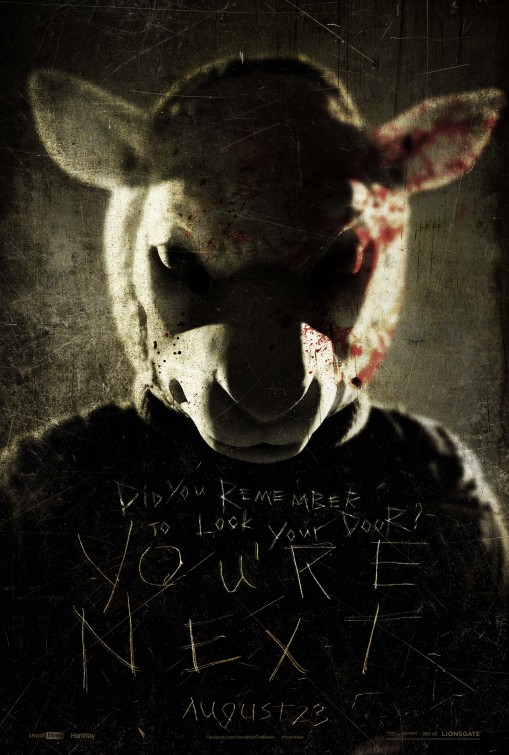
You’re Next (2013)

★★★

You're Next PosterDirector: Adam Wingard

Release Date: August 23rd, 2013 (US); August 28th, 2013 (UK)

Genre: Comedy; Horror; Thriller

Starring: Sharni Vinson, AJ Bowen, Joe Swanberg, Ti West

You’re Next is like a chocolate pizza: it’s propped up by two flavoursome ingredients, each one carrying a tenancy to be tasty without the other, but ultimately the hybrid doesn’t quite mesh together. And that’s not the only problem, given the pizza is also undercooked. Perhaps I ought to digress from food-related similes and start making sense. Adam Wingard takes scares and humour and crunches them together without unconditional success, in an attempt to make a witty horror film. He’s a smart director with a knack for the genre, which is why the creative funny parts work so well. But as he winks at us with satirical gags and rule bending, Wingard also slips in a helping of bewildered frights. The result is quite a confused outing, but it’s not without merit.

As far as family get-togethers go, the Davison clan aren’t having much luck. It’s mum and dad’s wedding anniversary therefore the whole crew have been invited over to celebrate. Erin (Sharni Vinson) tags along with her boyfriend Crispian (AJ Bowen), the latter hoping not to be outshined by his more successful kin this time. During dinner and an all too familiar serving of familial squabbling, a rouge arrow zips through the window. Chaos ensues. The Davisons are under attack.

Wingard casts his mate AJ Bowen in the main role opposite the fetching Aussie import Sharni Vinson. Bro points, eh? That’s unfair, because Bowen is actually fairly good at the personally insulted son and brother shtick, but it’s his in-movie partner who exits to the loudest ovation. Vinson is effortlessly charming and likeable, traits not always compatible with female leads in horror outings. Yet it’s her steely determination that convinces most of all; Vinson wears an air of intriguing mystique that coats her character in a bit more depth than is usually on display in these ventures. You’re Next isn’t just one of those ordinarily drab slasher flicks hell-bent on counting change over quality though. Captain Wingard is too canny for that.

The signs are plain to see from the get-go. Mother Aubrey Davison, on medication of course, exemplifies the OTT caricature of paranoia as she squeals and weeps her way through intruder anxiety. Others follow suit; from Joe Swanberg’s older brother Drake channelling his inner-Phil Dunphy (if the Modern Family keepsake was a douche), to the bubbly and seemingly spoilt Aimee played by Amy Seimetz. It’s the haunted house, the home invasion, the slasher. But it’s also the family dramedy wrapped in horror and, whilst the horror part flounders, Wingard’s amusing take on tribal bickering within a horror context truly succeeds. Erin epitomises the antithesis of both a drama-contained girlfriend and a scary movie chick. She’s the organiser, someone whose forward movements give her centre stage rather than a background stint. In way she’s us, shouting at every horror cliché there’s ever been. (Don’t go down to the basement, always carry a weapon, keep the windows boarded.) At one point Erin is informed, “I’ve never seen you act like this before”. “It’s a unique situation,” she replies, the interaction an indication of dissolving horror commonalities.

In some ways the film is a challenge to audiences, asking us to alter our perception and re-evaluate our willingness to accept and chew on genre staleness. A speech towards the end is a backhanded slap directed at those who gorge in genericism, who subsequently ignore the inventive pieces. Wingard has a palpable gripe. His first three films before this one — You’re Next is actually a 2011 piece — were all met with critical success, but aren’t at all well known. Home Sick? Pop Skull? A Horrible Way to Die? I’m certainly lost at sea. It’s time to rise from whatever rut we’re in and consider the hidden gems. Indeed, if they’re as perceptive as this ruby, Wingard has a point.

Unfortunately You’re Next falls flat on its morally-imbued face at times. It’s not scary yet it’s absolutely trying to be. The first attack scene around the dinner table wants desperately to be pulsating but ends up being too over-egged. We’re supposed to become enraptured in the immediacy of a horrifying ambush at home — shaky cam in full flow, drumming music beating emphatically, screams piercing — but it’s all too obvious. Comedy horror can work. An American Werewolf in London, for example, is as humorous as it is nerve-jangling. Here, exists a convolution of aim and execution. Wingard’s aim is valiant and he executes it with fifty percent triumph. The other half, the horror, is out of place. A case of the ‘quiet, quiet, quiet… BANG’ syndrome frequents proceedings. As characters are mercilessly slain we’re left in a state of flux: is this part of the satire, or a genuine attempt to frighten? Apparently the latter.

Having said that, the scare attempts do inevitably shower us with some moments of hearty gruesomeness. The film strikes as being a relative of Berberian Sound Studio, its audio effects as squelchy and excessive as they come. At some points the actors are quite literally swimming in pools of tomato-ey blood and guts. Throat slicing takes prominence, letting the soon-to-be deceased discover a cruel twist of fate in their final moment. It’s likely that the filmmakers are making a point about exorbitant amounts of red unfairly equating to disproportionate amounts of green. (That’s cash, as opposed to hash).

You’re Next fails to scare us because it leads us to believe that conventional horror simply isn’t scary. It’s a shame then that this falls on the conventional side of things when it’s not being astutely satirical. But Adam Wingard does a lot right and, even though his film mixes an incompatible broth too much, too often, it’s intelligent enough to warrant serious consideration. Who knows, this might even be the inaugural step in a new, smarter horror movement.

Maybe not.

You're Next - Baddie

Images credit: IMP Awards, Collider

Images copyright (©): Lionsgate, Icon Productions

Annie Hall (1977)

★★★★★

Annie Hall PosterDirector: Woody Allen

Release Date: April 20th, 1977 (US)

Genre: Comedy; Drama; Romance

Starring: Woody Allen, Diane Keaton

Films are often categorised under the “escape” section of our everyday lives. We watch to disassociate with reality for short bursts of time, to be present only within the context of the tedious romcom playing out on screen. Or the spectacular science-fiction trek that hurtles us towards another planet. Or the not-so-scary slasher flick we’ve seen a hundred times yet whose economical frights we still get a kick out of. Every so often though, there’s a film that commands our attention and refrains from releasing its grasp even long after the credits have finished rolling. Woody Allen’s infectious romantic dramedy is that film. Presented in a simple-yet-effective manner, it’s the delivery of the piece that approaches astounding. Annie Hall truly is a hallmark of American cinema.

Alvy Singer (Woody Allen) is an ardent New Yorker with a panache for eccentricity and a motor mouth to back it up. He’s also a comedian who plays doubles tennis every so often, and it’s on one of these sporting jaunts that Alvy meets Annie Hall (Diane Keaton). The connection between the pair is palpable from the moment they first awkwardly converse.

This isn’t a complicated film. Sure, it gets caught up in a barrage of intellectually stimulated dialogues echoed by apparently complex characters but that’s wholeheartedly where the fun lies. And it really is fun. Alvy is an erratic guy who just about holds it together by way of his methodological consistency. He wants to know the who, what, where, when, and why about everything because this allows him to pick apart and challenge. (“Everything our parents said was good is bad: sun, milk, red meat, college.”) Maybe it’s the comedian in him, but one gets the sense that his mannerisms have been ingrained since childhood — Alvy alludes to the adolescent trauma enforced by the roller coaster that often rattled above his house.

On the other hand there’s Annie. Not quite carefree but certainly free-spirited, Annie is bubbly and bumbling. The chipper lass ain’t entirely sure of herself when we first meet, though she steadily gains resolve and direction alongside the spitfire that is Alvy. They’re quite different people and share a relationship that invariably teeters between effusive and choppy. She’s Los Angeles, he’s New York. Certainly, their premier interaction post-tennis match embodies the joyous authenticity of the couple. The scene is awkward and endearing and hilarious, and from then we can’t take our eyes off of pair’s dynamic nor remove our permanent smile induced as a result of their witty banter. The film is all about them, fortunately. In some ways we feel unduly cut short at 93 minutes, but in others the hour and a half feels like a perfect summation of director Woody Allen’s vision. For a film so focused on two people — it does flirt with a variety of issues, but hones in on their relationship — Alvy and Annie are perpetually watchable.

Aided by semi-prominent collaborator Marshall Brickman, Allen’s original screenplay ensures his characters’ long-term watchability is a certainty. It’s outstanding. The film is bookended by two Woody Allen (or Alvy, but we get the sense they’re the same person) monologues, both of which represent the writer — and actor and director — at his most prosperous. Endlessly quotable (“Joey Nichols. See? Nichols. See? Nichols!”) and unafraid to tackle a whole range of affairs from 70s New York culture to drug use to the US East/West divide, Allen and Brickman’s screenplay rightly bagged an Academy Award at the organisation’s semicentennial ceremony. The narrative never suffocates its characters; even on the odd occasion when an overly vague cultural reference escapes Allen’s cerebral pen, the film skips along unscathed, our viewing experience likewise resilient.

This might also be one of the filmmaker’s funniest outings. With light-hearted subtlety often capitalised on by Allen and his acting partner Diane Keaton, Annie Hall never stops short at provoking laughter. Whether it’s a character living up to expectations — in the case of psychiatric results, it’s two characters — or a swivel away from narrative convention, humour is always lying in wait and we’re eternally willing to guzzle. The latter of these two examples sees Alvy accuse a pompous cinemagoer of being too indulgent. Allen, in this instance himself a quasi-critic evaluating the pretentious kind, is also poking fun at himself and the plethora of ‘don’t sneeze or you’ll miss the point’ diatribes he has written into the film.

As previously alluded to, the piece is shot abiding by a mantra of simplicity that serves to position the spotlight on its characters and accentuate their presence. The camera lingers on conversations for a long period of time because it knows it’s peering into aural gold. Richard Linklater’s Before trilogy springs to mind, a romantic moment in time that shares many intricacies with Annie Hall and was undoubtedly influence by Allen’s effective candour. Periodically we do see a few neat tricks play out, such as Alvy and company breaking the third wall or random subtitles translating small-talk for real thoughts, but these aren’t just pithy inclusions. Rather, they serve a purpose, be that to inject amusement or make a specific point about life.

The performances from Diane Keaton and Woody Allen ought to speak for themselves, but it’s worth noting that they’re wonderful. Annie Hall plays out in a non-chronological fashion. We already know the ending because it’s also the beginning, but that doesn’t matter one jot. It’s the journey that counts, and this journey is one of the very best.

Annie Hall - Woody and Diane

Images credit: IMP Awards, Total Film

Images copyright (©): United Artists

22 Jump Street (2014)

★★★

22 Jump Street PosterDirectors: Phil Lord & Christopher Miller

Release Date: June 6th, 2014 (UK); June 13th, 2014 (US)

Genre: Action; Comedy; Crime

Starring: Channing Tatum, Jonah Hill

As simply a comedy film, 22 Jump Street lands its fair share of guffaws. And this is primarily offspring of the humour genre: from acting upon the comedic strengths of its leading pair to unwaveringly owning up to sequel-dom, Phil Lord and Christopher Miller’s second trek down Jump Street fulfils many a Mark Kermode six laugh test. Yet, albeit competently amusing and even occasionally side-splitting, the outing ceases to be complete. Though the directors’ panache for funny bellows through, their film isn’t consistently hilarious. Not many are. Necessary then, is another anchor to steady the ship when proceedings aren’t quite as raucous; a sturdy narrative perhaps. Sadly, the one presented to us is rather flimsy when it comes to chapters that aren’t laden with jokes.

The final bell having rung on their undercover high school lives, Schmidt (Jonah Hill) and Jenko (Channing Tatum) now find themselves caught up in a whole new world: college. Their location is the only difference though, given the partners are once again involved in a narcotics mystery. The new drug is called WHYPHY and has already seen to one student’s untimely demise. Whilst attempting to sideline nostalgic football dreams and romantic engagements, Schmidt and Jenko must also overcome any strains in their own relationship in order to solve the criminal dealings before things get any further out of hand.

Opting for humongous sign-waving as opposed to measly eye-winking, 22 Jump Street isn’t exactly flippant in self-referential deliberation. After an opening montage that takes us through the key scenes of its predecessor — Previously, on 21 Jump Street… — we soon find ourselves camped alongside Schmidt and Jenko in Nick Offerman’s office where Offerman’s Chief Deputy Hardy is openly counteracting the potential pitfalls of sequel syndrome by facing the fact head on. (“Do the same thing as last time, everyone’s happy.”) It’s back to the old headquarters for our two agents then, though the base has conveniently moved across the road. In the background preparations are under way for the construction of 23 Jump Street.

There aren’t any thoughtless attempts to evolve the Jump Street apple cart and the film vociferously makes us aware of that. Though in doing so, Phil Lord and Christopher Miller’s creation (or recreation) takes on a disguise of irony that is inherently funny. It uses this self-referential prerogative as a weapon, to cut through any sequel-related audience apprehensions and subsequently endear itself to us. We are constantly reminded that our expectations should be low, or at least no higher than last time around, for what’s about to come is a mirror image. The ruse works; we’re too busy laughing at the source’s jokes — driving through a cash machine — to fully consider the mechanics of the source itself. Essentially, by admitting the sequel is going to be much the same as the original, 22 Jump Street is a more engaging proposition because it serves and then effectively manipulates our preconceptions.

That’s just one running gag. The film motions forward in its prejudicial tirade by tapping into assumed college culture too. The volatile drug is aptly named WHYPHY, pronounced Wi-Fi, and it’s no coincidence that the side effects are a temporary buzz followed by likely danger. Notions surrounding internet addiction are vaguely pertinent but never wholly realised. We discover that the student majoring in art is unlikely to make any money when she graduates (who knew?) and there are also an obscene amount of “Bros” and “Dudes” verbally volleyed between the football players. College satire isn’t the film’s strongest comical outlet.

Indeed, the funniest moments throughout 22 Jump Street are delivered by the two leads. Both Jonah Hill and Channing Tatum are comfortable in their roles and the duo’s dynamic prevails as a result. It’s refreshing to see Hill continue along a path that he obviously loves navigating despite having tasted the golden allure of critical success. The peaks of his dramatic work — most of those roles are infused with humour anyway — would suggest that he’s probably a highly sought after fellow, but he seemingly still has much to offer in this genre.

Hill plays the socially awkward Schmidt across from Tatum’s Jenko, whose smarts are inversely proportional to his skill at football. The two funniest scenes involve each man without the other; it’s Schmidt’s slam poem versus Jenko’s slowly simmering realisation, and the difficulty in picking a winner is an indication of how funny both actors are in equal measure. Ice Cube, who returns as Captain Dickson, should also be noted for his hugely enjoyable turn as their always animated boss. Ride Along might have crashed and burned, but the man of many trades has shown he can be infectiously amusing when delivering superior material.

Unfortunately, the dramatic narrative between Schmidt and Jenko is a problem. Unlike the smart use of self-reference, there’s nothing shrewd about the less than budding brotherly developments between the two. Their collective arc is annoyingly mundane and, although this could be construed as another of the film’s this-is-a-sequel-so-don’t-expect-much contributions, it falls far short of the entertainment mark. The troll-like concept is funny in its manifestation as a running gag with frequent pit stops, but it fails to reward when blending into an overly schmaltzy and all too familiar story. In this instance there aren’t any jokes to veil Schmidt and Jenko’s generic bond and when attempted wisecracks are communicated, they fall on deaf ears. (The open investigation malarkey is a bit cringe-inducing due to its lack of invention and continued implementation.)

Two-hour-long gags aside, was it worth creating a sequel? I’d say so. Though not nearly as snappy or galvanising as The Lego Movie, Lord and Miller’s latest offering does trump their first visit to Jump Street. The deliberation now centres on where the franchise is headed next, if anywhere. It looks like the filmmakers have shot themselves in the foot regarding the prospect of a third film. (That sequel quip won’t work twice.) We’ll just have to wait and see.

There’s no uncertainty here. If this review of 22 Jump Street is at least moderately successful, I’ll consider writing another one. Fair warning: It’ll be exactly the same.

22 Jump Street - Hill, Tatum, Cube

Images credit: IMP Awards, Collider

Images copyright (©): Columbia Pictures, Metro-Goldwyn-Mayer

Frank (2014)

★★★

Frank PosterDirector: Lenny Abrahamson

Release Date: May 9th, 2014 (UK); August 22nd, 2014 (US)

Genre: Comedy; Drama; Mystery

Starring: Michael Fassbender, Domhnall Gleeson, Maggie Gyllenhaal

As wannabe musician Jon strings together lines so monotonously hilarious in an attempt to spur lyrical inspiration, you get the sense that Frank is about to deliver (just ask the lady in the red coat). And it does deliver to a point. When it strikes a comical chord, the reverberating guffaws tend to be high in pitch and volume. Not to mention the outing’s headline act: a stupendous bodily performance from Michael Fassbender. But there’s something not quite right, a node of irony that occasionally jars indulgently. When wackiness overrules narrative, a handful of disengaging characters remain. Utterly bizarre beyond its frames, Lenny Abrahamson’s outing is as much Talk to Frank as it is Frank Sidebottom.

A keyboard player languishing in his own pit of disenfranchisement, Jon (Domhnall Gleeson) finds himself taking the faux-piano reigns as part of an eclectic band. Frank (Michael Fassbender) is the lead singer, his psychedelic sound usurped only by the group’s psychedelic demeanour and his own terminal cartoon-head. At first, Jon is perplexed by just about everything the band has to offer. However, as he is dragged further into their unorthodox make-up by manikin-loving manager Don (Scoot McNairy), the keyboardist remembers his toils as a struggling musician and engages in a game of manipulation and admiration.

Though the antics are told from Jon’s point of view, the titular Frank is wholeheartedly the film’s star and this is in no small part down to Michael Fassbender. Stripped of any ability to facially exhibit emotion (an element quickly acknowledged in a humorous manner) Fassbender suitably readjusts in a display of manoeuvres that are as admirable as they are chucklingly peculiar. Like bees to honey, the band whiz to Frank’s side in a constant plea for attention, particularly Jon and Maggie Gyllenhaal’s stern Clara. Frank is the cream of the crop to them, both of whom aspire to gain his level of musical insight and, in the same vein, we look to him as the central figure of goings-on.

Fassbender’s vocal expression is intentionally difficult to pinpoint, an element that bolsters the mystery surrounding Frank — it also adds verve to his singing which sees one scene towards the end particularly stand out. It’s not necessarily Fassbender’s face that garners any amount of intrigue — we already know what the Irishman looks like — rather, it’s his character’s motivations. (“What goes on inside that head, inside that head?”) Even then, the reason behind the lead singer’s mask-wearing becomes irrelevant as Fassbender’s actions whilst wearing the head gear become increasingly engaging and unpredictable. A man without a face, but not without allure. Face hidden by a large head, if we didn’t already know it was Michael Fassbender we’d be absolutely certain it was an actor of extraordinary talent anyway.

Despite being too whimsical in dramatic delivery, Jon Ronson and Peter Straughan’s screenplay is often very funny. From shoddy song creation, to blunt feedback, to hurling objects at one another, there is undoubtedly a plethora of laughs to be had. Though, whilst striving for humour the outing progressively trundles through a sea of perplex. In itself, a film without conventional boundaries is not necessarily a bad film — conversely, though innately different, Valhalla Rising is surreal and still very good — but Frank suffers as it dips in and out of madness, resultantly losing tonal focus. Unless it can be found obscured underneath a papier mâché head, there’s no real on display plot here, not one of intuitive significance anyway. This is the story of a band locked away in a cabin writing an album. The attachment must therefore lie with those on screen and, out-with Frank himself, there aren’t many hooks.

Jon is our mediator of mania; he’s the ‘normal one’ in an abnormal setting. Despite Domhnall Gleeson’s best efforts, the character isn’t all that interesting; an inevitable outcome given those in Jon’s immediate vicinity — a fake head wearer, a wrathful theremin player, a manikin admirer — but the keyboardist is just a tad too plain and subsequently sticks out like a sore thumb. Even when he does generate a semblance of interest, it’s at the expense of likeability: as Twitter followers increase, affinity decreases. Clara presents an even greater problem. She’s dismissive and abrasive and this isolates Maggie Gyllenhaal’s persona. Rather than becoming part of the crazy prerogative, Clara exists disparagingly on the outside. Between plods of hysteria, the film puts all of its eggs into Frank’s basket, a lot for a faceless anomaly to take on. When inadvertently the most amiable presence is one wearing a mask, something ain’t quite right.

On another problematic note, Frank attempts to juggle the trials and tribulations of modernity and music, before incorporating issues of mental health towards the conclusion. We often hear of musicians hiding away in isolation as they congregate ideas for the next album in an attempt to avoid the hyper-connected external world, and this is exactly the case here. Frank and company occupy the confines of a wilderness cabin for months on end, though ironically they’re concealing their music from a non-existent expectancy — nobody knows who they are. Heck, nobody knows how to pronounce the band’s name (Soronprfbs, if you want to have a go) highlighting their incessant need to stand out in an overpopulated industry. The lead singer adopting a giant fake head is probably enough regardless. Jon invariably narrates proceedings via Twitter, a nuance that sears as an unneeded attempt by the filmmakers to make Frank more current. Perhaps those like myself without much musical inclination, other than downloading the latest hit from The Killers or Katy Perry, will struggle to relate to Frank’s attempt at industry irony. Abrahamson’s late bid to relate Frank’s concealment and musical idiosyncrasy with mental instability, though well-meaning, is pillaged by a lack of cohesion.

In response to Jon’s apparent anguish, a bystander confesses, “I thought it was supposed to be funny”. This retortion reflects Frank, a film that is inherently humorous yet unsuccessfully aims for melancholic satire. Are we meant to laugh or cry? I’m not entirely sure. The song plays boldly and certainly hits an occasional high note, but unfortunately suffers from a muddled beat in the long run.

Frank - Frank

Images credit: Movie Review World, Guardian

Images copyright (©): Magnolia Pictures