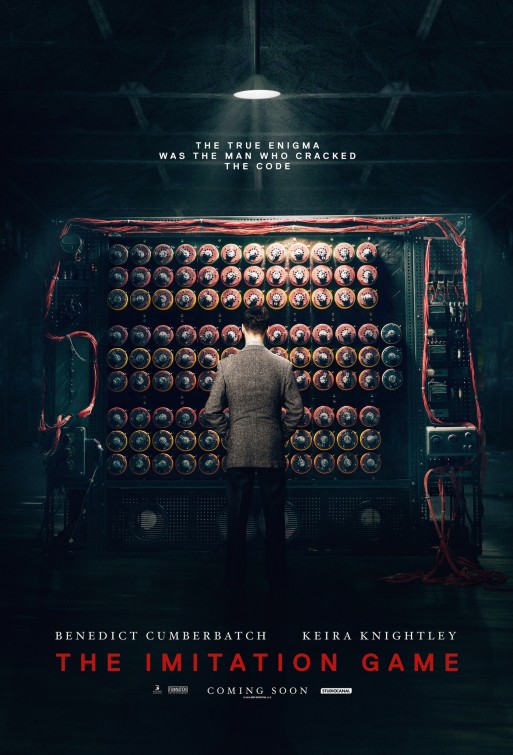
The Imitation Game (2014)

★★★

The Imitation Game PosterDirector: Morten Tyldum

Release Date: November 14th, 2014 (UK); December 25th, 2014 (US)

Genre: Biography; Drama; Thriller

Starring: Benedict Cumberbatch, Keira Knightley

I saw The Imitation Game last year and was too caught up in other work to jot down some thoughts in a semi-coherent manner. This review, then, comes significantly later than it should have and, despite still possessing a few pages of notes designed to jog the memory, I’m now struggling to recall much of the film. That’s the main problem here. The Imitation Game is just unmemorable. It’s not a time issue either — the piece left as much to be desired back in December as it does now. Of course, the story of Alan Turing is an incredibly memorable one but that has nothing to do with this film per se (rather, it’s because his life actually happened and was shocking in and of itself).

Benedict Cumberbatch plays Turing, a British mathematician and cryptanalyst courted by his country to solve the seemingly impenetrable Nazi Enigma code. The film takes place at the peak of World War II, but you wouldn’t have guessed it if not for the occasional reference. At one point, problem solving team member Peter (Matthew Beard) refers to that big battle thing happening far from the otherwise serene Bletchley Park: “There are actual soldiers out there trying to win an actual war.” We don’t see enough, or at the very least feel enough, of this supposed ongoing war. It’s as if all the events on-screen are unfolding on a remote island as opposed to an island entrenched in a horrendous, deadly human struggle.

Returning to more local matters, we watch as a whole host of obstacles are thrown in front of Turing — those well-known ones related to his private life, but also professional obstacles that simply do not make sense. Charles Dance’s Commander Alistair Denniston, who is overseeing the operation at Bletchley Park, essentially becomes a less brutal version of Tywin Lannister as he dishes out ultimatums to Turing and his team, threatening to shut down their potentially life-saving efforts. “Our patience has expired,” he groans. But why? Surely it’d be wise to keep the process going irrespective of how long success is taking. The film doesn’t address this awkward stance enough, and as such we’re left with a weird sense of internal squabbling that doesn’t chime well given the war climate.

For the most part, emotionally devastating moments — at least, that’s what they should be — are presented in a fairly generic manner. Graham Moore’s screenplay lacks imagination. A ship sinking debate is one of the more morally dubious scenes but you can see the ambiguity coming from a mile off. Since the film is based on a true story it is very possible that parts such as the one referred to above are reflected with genuine truthfulness, their blunt coincidence thus horrible to even consider. However, Moore and director Morten Tyldum set up the majority of these would-be taut interactions too easily. The ship sinking argument feels like a Hollywood moment when it should be the complete antithesis – dirty and righteously murky.

There is a lot fuelling the narrative and as such the film begins to confuse itself as it juggles a number of different layers (any codebreakers around to sort this mess out?). We touch upon the intricacies of gender politics, man versus machine, sexual orientation and the war climate, each with varying impetus. The technological struggle between Turing’s team and the Enigma machine is intriguing, and when Tyldum focuses on the mathematician’s private life the piece flourishes with authenticity and solemn gravitas. To its credit, The Imitation Game does effectively capture the painstaking conclusion to Turing’s life. Perhaps singling out only two elements instead of trying to engage with a handful of themes would’ve yielded something more concise and coherent for Tyldum.

Having said all that, the performances from many of the cast are very good — one or two are particularly noteworthy — and these keep the piece bubbling over (they also undoubtedly had a hand in shooting the film into wide-netted Oscar contention). Cumberbatch bumbles as well as ever playing the intellectually gifted Turing, whilst at the same time empowering the periodically unaccommodating man with increasing resilience and vigour. He is the perfect fit for the role and Cumberbatch really comes into his own when reflecting the weightier points of Turing’s life.

Matthew Goode, Allen Leech and Matthew Beard complete the team of puzzle solvers. The latter duo don’t have as much to do but as Hugh Alexander, Goode carries out the brazen and often unimpressed act to a T. It is Keira Knightley, though, who has the most impact opposite Cumberbatch. She plays Cambridge graduate Joan Clarke who develops a close bond with Turing throughout the film. In lesser hands the role might’ve fallen foul of poor characterisation but Knightley has steel in her eyes, Joan often the person bearing the strongest will.

The film doesn’t really match up to the awards recognition it has been receiving over the past few months, but it does manage to be a suitably uplifting-turned-demoralising piece. I reckon that has more to do with Turing’s real life struggles than how the picture depicts them. Maybe The Imitation Game isn’t as dreary as I recall, but I’m not recalling much.
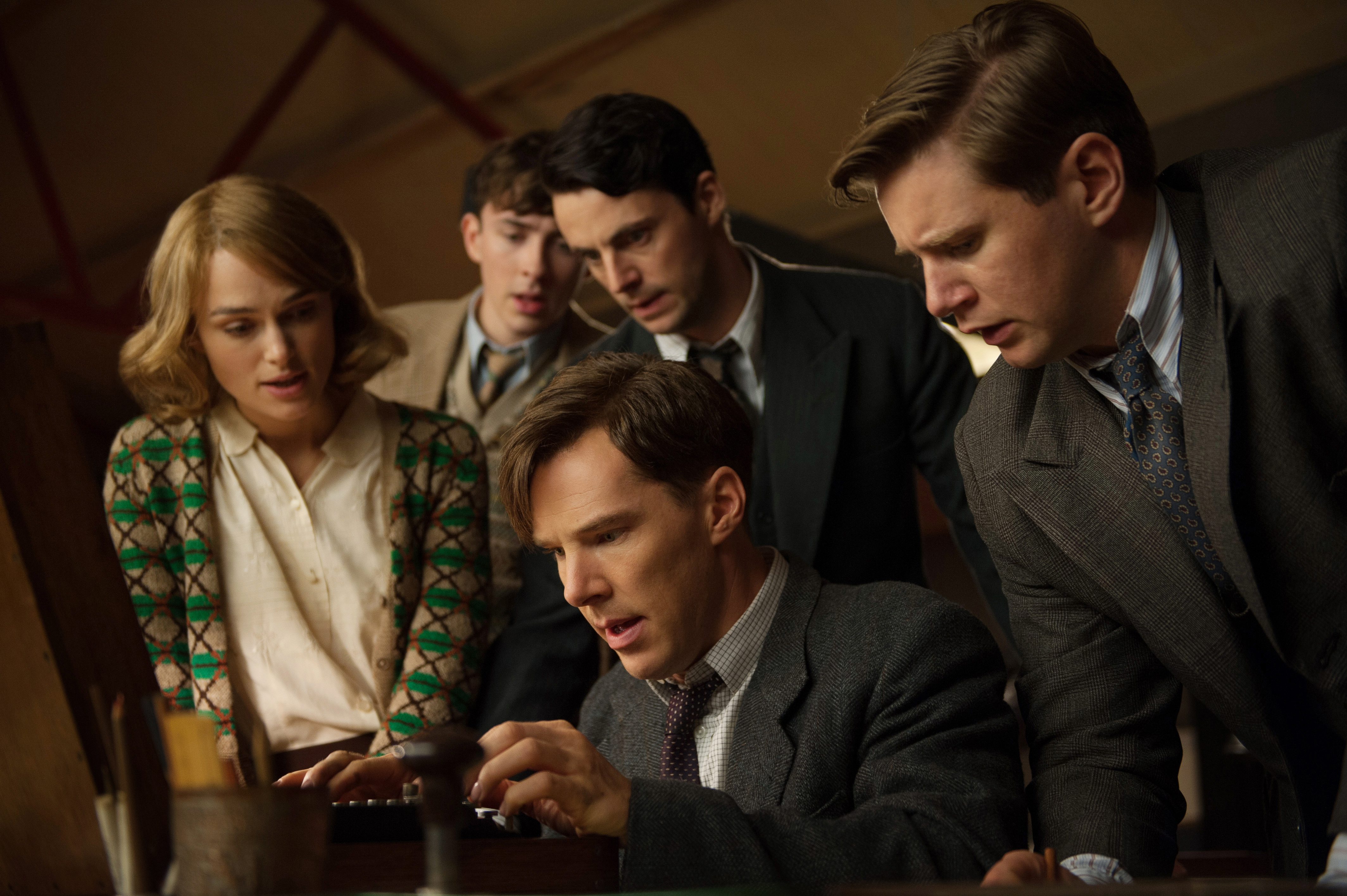
The Imitation Game - Cast

Images credit: IMP Awards, Collider

Images copyright (©): StudioCanal, The Weinstein Company

Gone Girl (2014)

★★★★★

Gone Girl PosterDirector: David Fincher

Release Date: October 2nd, 2014 (UK); October 3rd, 2014 (US)

Genre: Drama; Mystery; Thriller

Starring: Ben Affleck, Rosamund Pike

Somebody encourage Rosamund Pike to clear her schedule for early next year. By many accounts — relative superficiality considered — the awards rounds that take place in January and February can manifest as quite the gruelling undertaking, particularly for those nominated without much hope. I bet the endeavour is worth it though, all the glamming up and invariably rigorous speech preparation, when your name bellows around LA’s Dolby Theatre and that egregious Academy countdown begins.

Should she get there (and she should) Miss Pike will be an Oscar newbie come February 22nd. It’s early, granted, but the performance(s) she delivers in Gone Girl will take some beating. Gillian Flynn’s spotless adaptation of her own novel to screen might also take some beating. Heck, David Fincher may well find himself in another directorial gong joust. Gone Girl is not fun and games, just games. It’s downbeat and harsh and at times painfully glum. It’s intelligent and gripping and oddly satirical. It’s very, very good.

On his fifth wedding anniversary Nick Dunne (Ben Affleck) returns home to find a toppled table and smashed glass all over the floor, but not his wife Amy (Rosamund Pike). Upon subsequently reporting her missing, the bar owner plummets into a media frenzy fuelled by accusation, exoneration and consequence. Exactly what has happened to Amazing Amy?

Fincher refers to his back catalogue for inspiration, a method ultimately met with total vindication. Gone Girl refuses to settle on one genre platform and instead deftly mingles around a number of areas from which the director has previously thrived. The taut tension felt in Panic Room returns with a vengeance in tandem alongside Zodiac’s murky mystery. Much of what unfolds during the two and a half hour runtime does so in a mellow-ish manner; solemn, yet clawing away underneath the surface. We don’t really know what to believe or who to trust and Fincher works hard to emphasise that point. Historical diary entries penned by Amy are interspersed between the present, where husband Nick is battling the elements. Revelations come unstuck and we become part of the evolving saga, our minds constantly mobilising.

The director does this brilliantly, teasing us with character faults that we simply cannot ignore and that resultantly challenge our moral head space when nastiness arises. A coating of mystique, irrespective of its level, remains throughout all three acts — each of which vary in agency. What begins as a simmering thriller re-emerges as a social commentary on cultural norms, before climaxing in a fit of peculiarity and deceit. (Fincher himself has used the term “absurdist” to describe part of the story, and he is obviously spot on).

A lack of narrative jarring ought to be admired too, as each element works cohesively with the one before ensuring that there is no lull in proceedings. Don’t bring a watch, you won’t need to check the time. Perhaps the most interesting train of thought is the film’s exploration of a self-created image; this idea that we generate an idyllic version of ourselves to parade in front of others, when we’re in public. What happens, then, after five years of marriage? Script writer Gillian Flynn has an answer, and you get the sense that her adaptation to the big screen has come at an optimal time — the novel was only released in 2012, therefore the themes remain wholly tangible.

Another of those themes is one that seems to go hand in hand with personal façade: an exploration into the role of media. Specifically, media grossness. We watch the aftermath of Nick’s press conference where he outlines the brief details behind his wife’s disappearance, and the fallout is quite cruel. People become puppets via talk show hosts and public photographs and, to an extent, the film becomes less about finding Amy than it does Nick attempting to revitalise his own tarnished image. Ben Affleck paints Nick as a flounderer to a degree, but still as someone you’d fancy getting along with. The engulfing news storm is a usurping force of nature that strives to internalise the character’s prerogative, so much so that we doubt him relentlessly.

Navigating Rosamund Pike’s role as the eponymous gone girl is akin to traversing a recently laid mine field, and that is to the credit of Fincher and company. The actress is truly marvellous, a sentiment echoed in passing by Tyler Perry’s charismatic fixer Tanner Bolt: “Aww, she is good.” She is. Perry himself is one part of a diverse cast sustained by precision and efficiency, but it is the interaction between Affleck and Pike that engages most. Conversations between the pair relived through Amy’s diary entries are somewhat disoriented by a peculiar, haunting ambience. It is a haze struck up masterfully by the combined efforts of cinematographer Jeff Cronenweth and music men Trent Reznor and Atticus Ross, all three well versed in Fincher lore. Cronenweth’s visual sheen resembles the pristine surface and texture of The Girl with the Dragon Tattoo and, backed up by a disquieting score, relays a melancholic haze.

It’s worth pointing out the satirical infusion brought forth by the film’s final act, at a time when proceedings really begin to marshal around the absurd. Though we spend moments throughout the film tickled by characters’ comical reactions (an early police interrogation, for example) as proceedings start to unravel what might have seemed amusing an hour ago morphs into a manifestation of discomfort. Events on screen are obtusely elevated, of course, but at a base level there lurks a degree of potential reality.

Brought to fruition by a supremely talented cast also including the likes of Neil Patrick Harris and Carrie Coon, and guided magnificently by a director whose work has finally struck an impenetrable balance, is a film not afraid to break the mould; one that defiantly stands beside the courage of its own convictions.

Evidence hardly ever amounts to clarity during Gone Girl, but Gone Girl most certainly is evidence that David Fincher is on the top of his game.

Gone Girl - Affleck

Images credit: IMP Awards, Collider

Images copyright (©): 20th Century Fox

The Sacrament (2014)

★★★

The Sacrament PosterDirector: Ti West

Genre: Horror; Thriller

Release Date: June 6th, 2014 (US limited); June 8th, 2014 (UK)

Starring: AJ Bowen, Joe Swanberg, Amy Seimetz

The horror genre’s latest aficionado Ti West is back with another vibrant take on spook-ville. The director employs a seemingly ever present found footage style that gives his film an engaging intimacy, but that ultimately struggles to uphold much legitimacy. West is an intriguing prospect, someone who will doubtless see his name hurtling towards the annals of scary cinema before long. The filmmaker’s outings are always at least partially efficient and that is once again the case here. It’s not that The Sacrament is half cooked — the movie is better than that — rather, what opens promisingly soon flounders at the mercy of the found footage Kool-Aid and never quite musters the strength to bounce back.

Under the topical guise of VICE, reporter Sam (AJ Bowen) joins cameraman Jake (Joe Swanberg) and photographer Patrick (Kentucker Audley) as they venture to the home of a mysterious cult hoping to find the latter’s missing sister. Upon arrival, the trio discover apparent serenity embodied wholly by said sister Caroline (Amy Seimetz) whose sparky demeanour is overflowing with positivity. The group soon wander into an air of uncertainty and, unsurprisingly, all is not quite as it seems.

It should come as no surprise to viewers that West’s film is accomplished in a technical sense. The director knows how to work with mood and setting and here he combines the two with deft touch, even if the overall outcome is not completely satisfying. The Sacrament looks good, which is no mean feat given the gritty and sometimes turbulent parameters set out by the found footage genre. Those who have previously seen West’s segment in V/H/S will already be privy to his work alongside the eternal shaky cam — his Second Honeymoon narrative was arguably the best of a mediocre bunch — and that experience has paid off for the most part.

Where The Sacrament struggles is not in technical execution but instead when caught in the limited web of its shooting style. Sure, the simplicity surrounding found footage inherently induces a somewhat unlimited scope. Yet the genre has never really ascended beyond those conventions set out by The Blair Witch Project. Contrivance is abound and the usual questions rear their aching heads. Why are they still filming? Where does the second camera come from, and why wasn’t it used up until the point of necessity?

West and company attempt to get around these issues by inducing an added layer of realism. Something that gives off a more justifiable air. Our characters adopt the increasingly popular VICE tag, one supposed to lure us into a false sense of authenticity. It doesn’t really. The adoption of a company banner that we know of as genuine, in a film that we know for sure is fake, strikes as rather misguided. Events not caught on camera are textually narrated and the time occasionally flares up on screen in a documentary slant, by which point we’re calling out for a normal horror outing and not another flagrant attempt at pseudo-realism.

The shooting style can — and probably does — draw attention away from scares. Regardless, for a solid 50 minutes this is quite unnerving. The filmmakers successfully manipulate an obviously eclectic tone, one that is really quite odd. Sam and cameraman Jake, who we follow around for the most part, conduct everyday discussions with the cult residents when we’re instead expecting some form of kookiness. The landscape is usual and calm when it shouldn’t be and thus there manifests an offset nature, a decentralising vibe that is suitably unsettling.

The introduction of Father, the cult leader, also signals a swift switch away from normality. Played squirmingly well by Gene Jones, Father is eerily charismatic and utterly captivating. (“Everything just got caught up in this weird energy, I couldn’t think straight… he had a way about him”, recoils interviewer Jake). The man prescribes a nonchalant edginess, as if he is disconnected from those around him and too focused on the tainted greater good; the way he replies to Jake, his drawling laugh, that knowing grin — we are well aware that he’s up to no good but the residents are lost in his gaze. It is certainly not an inspired narrative, but Jones’ scenery-chewing execution is simply so fun to watch.

When we’re not enraptured by Father’s spell — he almost ventures into Scooby-Doo villain territory with his preemptive warnings (“You boys have a nice evening…”) — West shifts focus away from the haunting atmosphere to one fuelled by social commentary. Though in other hands this manoeuvre could be troubled by indulgence, West manages the informative titbits well without ever lecturing his audience. He’s an intelligent guy and gets his points across without condescension, choosing to single out our over reliance on technology and inability to be self-preserving.

It is a shame that the final act falters. Rather than capitalising on the creepy mood, the film turns towards gross out gore and action-influenced sequences. A prerogative that was previously guided by admirable restraint is quickly caught up in an unnecessary need to get things done, and therefore the subsequent end result is too generic to be impactful. An attempt at a shock-fest appears to infiltrate proceedings; it’s almost as if the outing substitutes Ti West for producer Eli Roth.

The Sacrament never quite usurps the constraints laid out by its choreography — in truth the genre is becoming increasingly stale. Despite this, and notwithstanding its blanket conclusion, the film is a superbly delivered piece. AJ Bowen, Joe Swanberg and Amy Seimetz should be noted for their ever welcoming screen presences in a movie that is really quite hair-raising for an hour.

The Sacrament - AJ Bowen and Joe Swanberg

Images credit: IMP Awards, Collider

Images copyright (©): Magnolia Pictures, Magnolia Home Entertainment

The Guest (2014)

★★★★

The Guest PosterDirector: Adam Wingard

Release Date: September 5th, 2014 (UK); September 17th, 2014 (US)

Genre: Thriller

Starring: Dan Stevens, Maika Munroe, Brendan Meyer, Sheila Kelly

Hot on the heels of their inverted slasher jaunt You’re Next, director Adam Wingard and writer Simon Barrett are back with another bold outing. The Guest moves along purposefully, fuelled by a pulpy beat that adds to its wholesale allure. In some ways it’s one of those that is difficult to consume in a single sitting — there are so many astutely placed kinks to pick out and admire.

Yet, the story is simple. A generally agreeable tale that would undoubtedly flounder in lesser hands. Wingard and Barrett are too committed to let matters evade them and The Guest thrives as a result.

As she opens the door to a stranger whom we later come to know as David (Dan Stevens), mother Laura Peterson (Sheila Kelly) is still wiping from her face the fresh and presumably frequent tears brought on by the thought of her son’s death in Afghanistan. David claims to be the deceased soldier’s squad mate, having stopped by in order to uphold a promise and offer his condolences. His presence immediately fills a gap and the popular David finds himself around for the long haul. Only, something about the visitor doesn’t sit correctly with daughter Anna (Maika Munroe).

It’s obvious that the director cherishes each and every frame afforded to him as the screen is relentlessly tinged with meaning and inquisition. We’re gripped from the get-go, unable to shake of the taut dinner table ambience or Dan Stevens’ malice-sprinkled gaze. The Guest isn’t a conventional thriller because it doesn’t rely on snappy movements or authoritative language. There is a lot of weapon speech (“I’m a soldier, man. I like guns,” David reassures us) but the tension here lies almost universally upon the brow of the lead actor.

The Downton Abbey star is far from lord-like on this occasion, though Stevens does retain a resolute posture, unmoved and unflinching. When we first meet him he manifests as a fairly ordinary guy, a former soldier about to make his way back into society. A peculiar glance is at first distracting, and then nerve-jangling. Stevens gives off an impression of suppressed power; his character is always in control and, to make matters worse, the Stevenson family are completely unaware. They are caught in a charisma spell. So are we.

Frankly, the actor is brilliant, his simple delivery layered with complex volume and mysterious motives. It’s almost as if Barrett penned the character with Stevens in mind. Superseding said performance is the actor’s ability to consistently engage the viewer, to make us like him even though we are unequivocally aware that the chap before us is a dodgy guy. His iffiness pours from every crevice and, somehow, we cannot help but egg David on. This element centres the film and effectively pulls the various pieces together. Part thriller, part mystery, part character study, an immediate need to like David infects proceedings with a darkly comedic underbelly.

It’s dark. It’s devious. It’s horrible. And it’s bloody delightful. As Robby Baumgartner focuses his camera on David, carefully edging closer into his nasty glare, we become the devil on the wanderer’s shoulder and indulge in helpings of fun as a result. Wingard knows he is appeasing the genre audience every step of the way. The director has history, rewriting the pillars of horror to accommodate something different in You’re Next, and this mantra is once again capitalised upon here.

The other performances are somewhat overshadowed by the excellence of the lead actor, but it is worth singling out newcomer Maika Munroe’s work as the entranced-cum-anxious daughter. Anna could very easily have stumbled over into annoying territory, but Munroe just about reigns in the mood swings and does enough positive rallying to see her through unscathed. Sheila Kelly’s performance as devastated mother Laura is also commendable. We believe in her plight to keep David around, though misguided due to the loss of her son, and we can therefore sympathise rather than judge. In between moments of ill-advised glee, we ultimately care about the family.

The sheer abundance of solid work done beforehand enables us to forgive the overly ironic haunted maze finale, and instead pass it off as a humorously cheesy side order. Everything else is so good. If such an anomaly exists in our ever diverging cinematic universe, The Guest is intelligent popcorn entertainment. And if such an anomaly exists, Adam Wingard might be on his way to mastering it.

The Guest - Dan Stevens

Images credit: IMP Awards, Collider

Images copyright (©): Picturehouse

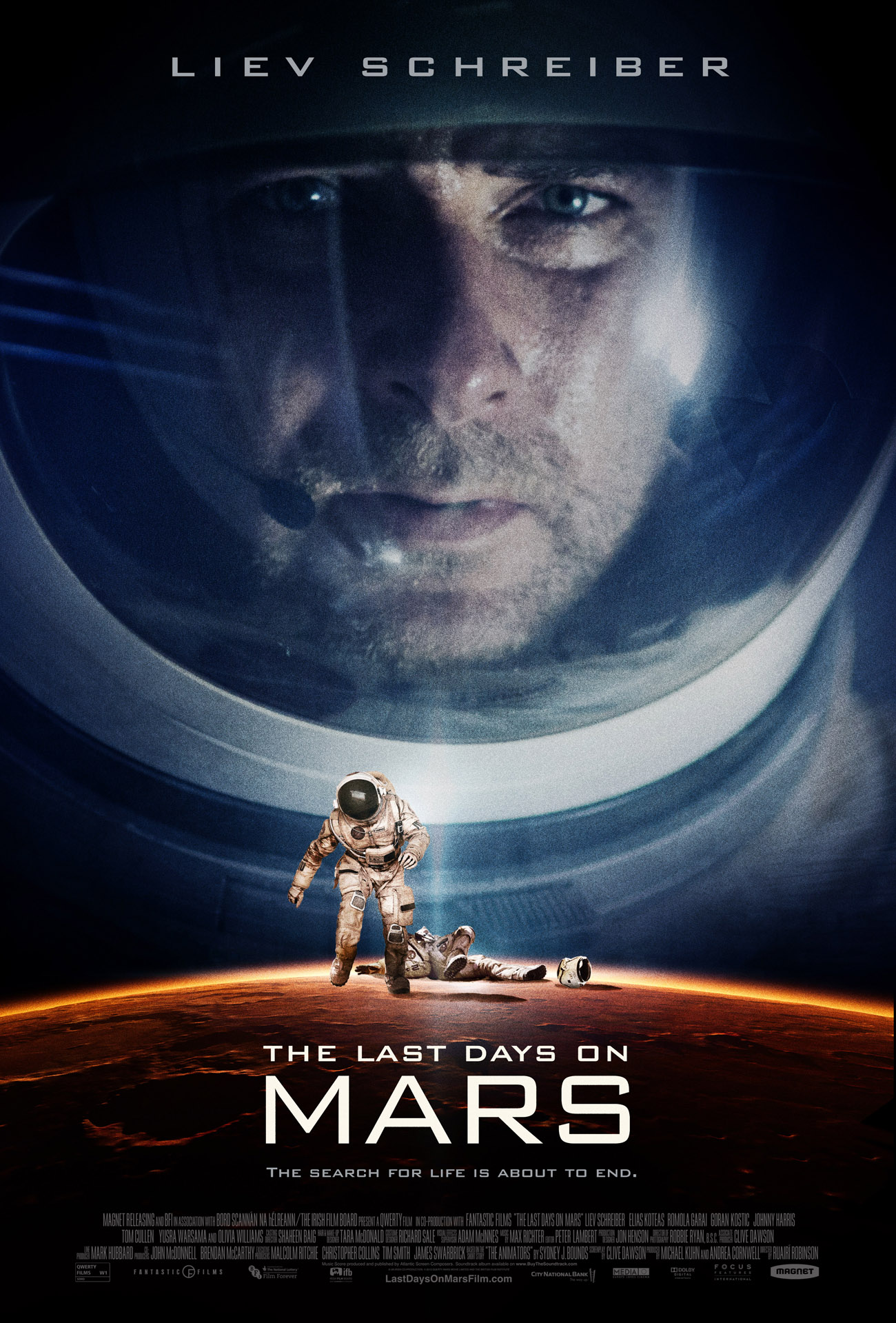
The Last Days on Mars (2013)

★★

The Last Days on Mars PosterDirector: Ruairí Robinson

Release Date: September 19th, 2013 (UK); December 6th, 2013 (US limited)

Genre: Horror; Science-fiction; Thriller

Starring: Liev Schreiber, Elias Koteas, Olivia Williams

The Last Days on Mars begins with a fairly promising sequence that sees two characters attempt to navigate an approaching dust storm. They bat around bouts of small talk, clean-sounding due to the atmospheric vacuum, quickly establishing their roles in the process. The air is quite eerie, uncanny almost. For five minutes, Ruairí Robinson’s outing works. Unfortunately, for ninety minutes it doesn’t. This subtle, edgy poise rapidly loses out to a flimsy skeleton; plot, characters and decision-making all broken and seemingly unmendable. On the Sunshine scale, The Last Days on Mars drifts miles yonder of Event Horizon before landing worryingly close to Apollo 18. Eek.

Thirty years or so from now, a team of scientists stationed on Mars are less than a day away from extraction. The incoming Aurora spacecraft is set to shuttle the crew back to Earth, but not before Marko (Goran Kostić) can covertly investigate some odd bacteria that he has come across. His findings are extraordinary, indicating the primitive existence of some new life form. However the nature of said discovery proves to be horrifying, and subsequently puts the remainder of the team in immediate danger.

In translating to the big screen, sci-fi historically carries a fairly patchy record. One element that has consistently shone though, is how the genre permeates atmospherically. Vastness is vast, and filmmakers are essentially unlimited given the nature of space potential. The Last Days on Mars makes fine work of the opportunities on offer, parading a visual spectrum that is encapsulating for the most part, and an aura that meanders tactfully between normal and creepy. Cinematographer Robbie Ryan delivers more than any other, affording the piece its one true success story. It’s only fair to point out Max Richter’s occasionally disconcerting score too, his musical interludes apparently effective enough to land him recent gigs as part of The Leftovers and As Above, So Below.

Annoyingly, this eerie-cum-wondrous soundscape signals the end of all things positive. The film tries too hard to be a slasher when the setting is far better suited to a probing approach. For some reason director Robinson cannot wait to show off his monster, and as a result the reveal comes sooner than expected. Scare factor crumbling, we turn to chaotic, jerking camera movements surrounded by pitch black darkness, all fruitful cinematography gone. Slotted indiscreetly amongst the outpouring of brash-yet-monotonous horror are snippets of philosophical musings.

It is as if the filmmakers, having mismanaged or simply forgotten the science-fiction element of their piece, feel the best solution lies with invariably adding earthy monologues. (“Do you think any part of us survives after death?” says one character, the notion shot down in a flicker as the next creature attacks). At one point we float over into unintentionally hilarious territory as the group argue about existing and dying over a deceased corpse that is showing signs of life. Sci-fi should engage its audience by channelling smart reflections and themes with gravitas, but the faint attempts displayed here reek of laziness.

The cast, quite well known despite the small budget, haven’t a hope in the world. Or in any world. Liev Schreiber leads as the claustrophobic Vincent and is granted the most material to work with. Once we’ve given up hope in terms of trying to figure out why a person afraid of small spaces would select space travel as his profession — he refers to their shuttle as a “coffin” — we’re left with hardly any inkling as to who Vincent and the other crew members are. The human characters are so poorly mapped out that it’s a wonder all of the actors found the set. It becomes an eternal struggle to care about any of them, or their fates, simply because we don’t know anything about the group. Mission psychologist Robert is the first one to lose his mind. Tedious.

Clive Dawson’s screenplay isn’t much better. Aside from the lack of scares and occasional deep thoughts, the narrative trundles along without vigour and fuelled by coincidence. The entire set-up hinges on a chain reaction of monumental contrivances: having spent a whole six months on Mars the team just so happen to discover this evil bacteria hours before they jet off home and the only reason said bacteria makes it on board is because a petulant crew member decides to look up the location of an errant mate and subsequently finds him at the site of the bacterial breeding ground. It is ridiculous and unashamedly so.

Perhaps the most grating factor of the lot is the fact that The Last Days on Mars could have been fun hour and a half. It never shows any signs of restraint or wisdom, thus the film was never going to be a serious sci-fi jaunt. But there is room for some B movie silliness. Though the whole thing is ravaged by a disappointing and ineffective requisite to walk the line tonally, a few looser ends here and there would undoubtedly have induced waves of low end but high value madness. It would’ve been a welcome turn of events for most of the cast — including well-travelled names such as Olivia Williams and Elias Koteas — who are instead left to suffer through cringeworthy speeches and poorly written characters.

The Last Days on Mars has been done immensely better before. It’s not necessarily that this is a horrible film, because it isn’t. Robinson’s piece is certainly bereft of many working parts but I’ve seen much worse. The movie is unavoidably boring though, and lazy. It wallows. With the ingredients laid before us — brimming with promise — it should, at the very least, be shooting for the stars and missing. Yet, The Last Days on Mars relents from even aiming skywards.

The Last Days on Mars - Liev

Images credit: Collider

Images copyright (©): Universal Pictures, Focus Features, Magnet Releasing

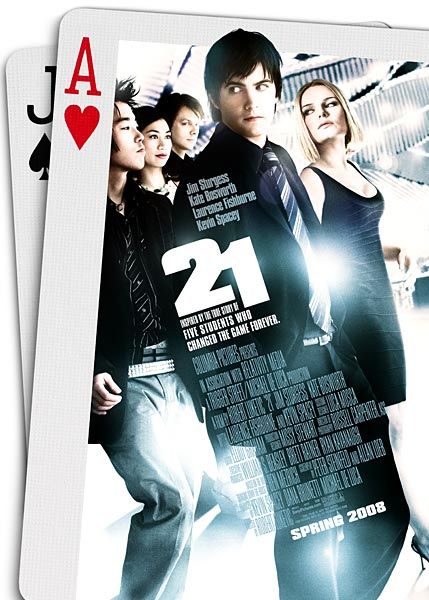
21 (2008)

★★

21 PosterDirector: Robert Luketic

Release Date: March 28th, 2008 (US); April 11th, 2008 (UK)

Genre: Crime; Drama; Thriller

Starring: Jim Sturgess, Kevin Spacey, Kate Bosworth

When it comes to playing cards there are two ways a trick can go wrong. A plethora of impressive skills, perhaps including some nifty sleight of hand, culminating in unexpected disaster. That’s the first. The finale is disappointing, but at least you get the temporary thrill of expectation. The second revolves around a bland illusion. When a trick hits all of the correct spots yet fails to sparkle. 21 is a bland card trick. Its deceptively pacey opening hints at promise however, when the hands have been laid and the chips counted, Robert Luketic’s film amounts to nothing more than a serviceable few hours.

Inspired by true events, 21 tells the tale of six MIT students and their advantageous teacher who coalesce together in order to pull off card counting blackjack victories. Ben Campbell (Jim Sturgess) is the team’s newest recruit, having joined in a desperate attempt to fund his Harvard dream. Though the Las Vegas voyagers get off to a successful start, rising tensions begin to chisel away at the group’s policy that denounces in-game emotion, and their cover is threatened.

If you struggled to follow any of the poker lingo in the opening paragraph, 21 will probably have you pulling your hair out after half an hour. (I’m almost bald now). The first few frames are snappy and strategy-led, though quite unnecessary given the content is repeated later on. In short, infrequent bursts, detailing the logistics of what our characters are doing is fine. The nature of the narrative needs some exposition to keep the film bubbling along. But we hear about rules and game play so often, and without vindication too. The film isn’t about blackjack — it isn’t about anything really — blackjack is simply a means to an end. That is how the characters see things (“It’s just business”) and it should be how we see them too. Unfortunately, writers Peter Steinfeld and Allan Loeb get too caught up in the explanation part that they forget about storytelling. It’s all a blur, really: stat crunching, pluses, minuses, attributing animals to numbers. Who cares?

This need to accurately relay the ins and outs of the gambling world leaves little room for narrative clarity, ushering forth an enormous helping of laziness. Coincidence is rampant from the get-go; “The Robinson is going to someone who dazzles,” a Harvard representative informs Ben, giving him his only motivation to cheat. If that wasn’t cheap enough, the interviewer goes on to tell Ben he needs more life experience. Money and life experience, huh? If only there was a quick-fix solution to both. Good thing our lead is intelligent as well, otherwise we’d be spending almost two hours — a ridiculously long run time — watching him pay his way to Harvard in a suit store. We never really believe in Kevin Spacey’s teacher by day, Vegas kingpin by night either. You’d think a flustered student would have ratted him out by now. Navigating the outing’s incredulity becomes increasingly arduous as the events dive deeper.

Kevin Spacey is pretty good though. Perhaps there is an element of phoning it in going on, but the actor’s charisma works wonders for his character even if it does accentuate the mundanity of those around him. His delivery strikes as quite perceptive on occasion. Presumably he is aware of the invariably groan-inducing dialogue. (“Ben, let the car drive by itself,” says Micky after hearing about his student’s attempt to create a self-driving car). The other performers tough it out, but they can’t overcome the bland material. Jim Sturgess is okay as the main player, never threatening to erupt from his character’s generic chains. It is worth pointing out Josh Gad, who is quite amusing as Ben’s obnoxious best mate.

The characters join the plot in the doldrums of commonality. We’ve seen it all before: the group member who succumbs to jealousy; the friend left hanging in the lurch; the suave leader with ulterior motives; the hard-to-get girl whose beauty matches her romantic indecision. Sure, 21 looks alright when the gang reach Las Vegas but even then there are so many aerial shots that we begin to wonder if the director simply has no idea what to do next. Since there is inability to conjure up any emotional connection, the filmmakers recruit surface elements to grab our attention. The bright lights and quick edits fail to yield pizazz, and even a fairly sparky soundtrack feels diluted amongst the mechanical air.

Laurence Fishburne shows up every now and again and effectively sums up the film’s failures. He plays casino security chief Cole Williams, and his moral stance is never really unfurled. Cole hates the incoming modernisation — he’s an old school guy, preferring film to digital — and the soon to be implemented facial recognition software is sure to leave him out of a job. The guy is a dick though, more or less working the antagonist role opposite our card counting clan. It is conceivable that Cole’s ambiguity is a reflection of dubious actions elsewhere, and gambling in general, but that is probably awarding too much credit to an otherwise uninspired production. So we don’t care about him.

21 is eternally insipid. Everything from plot to character diversity reeks of carefulness, even the group’s motto is tedious. (“Don’t get caught counting”). Kevin Spacey provides the occasional spark that the piece seeks dearly. It wishes to dazzle, some might say, but eventually peters out. I’m still trying to figure out why an underground gambling hub exists in a Chinese restaurant.

21 - Cast

Images credit: IMP Awards, Vulture

Images copyright (©): Columbia Pictures

I Know What You Did Last Summer (1997)

★★

I Know What You Did Last Summer PosterDirector: Jim Gillespie

Release Date: October 17th, 1997 (US); December 12th, 1997 (UK)

Genre: Horror; Mystery; Thriller

Starring: Jennifer Love Hewitt, Sarah Michelle Gellar, Ryan Phillippe, Freddie Prinze Jr.

We probably shouldn’t be too surprised that a film called I Know What You Did Last Summer reeks of laziness. Just as someone couldn’t find the time to come up with a proper title — it ain’t bad, but it is a tagline at the end of the day — renowned screenwriter Kevin Williamson must’ve had better things to do when he should have been jotting down ideas for this particular outing. Odd too, given some of Williamson’s best work hit cinemas only a year prior. Released during the peak of slasher popularity, I Know What You Did Last Summer is an almost wholesomely generic film that seldom has something fresh to offer. Though when it occasionally does, it’s quite fun.

The day is July 4th — it always is — and a group of friends partying at the beach are celebrating the end of high school life. Fuelled by alcohol, their lively drive home in the early hours of the morning takes a violent turn when designated wheel man Ray (Freddie Prinze Jr.) inadvertently hits a stranger. A year later, the quartet reconvene to face their demons after Julie (Jennifer Love Hewitt) receives a worrying letter from an unknown threat.

Riding on the coattails of horror’s slashiest sub-genre at its peak, this may well have worked for audiences 15 years ago. For those 90s kids who were willing to manoeuvre away from their post-Fresh Prince couches and venture along to the cinema in a search for their latest scare kick, an air of fragmentary vindication likely arose. The proceeding 15 years haven’t done Jim Gillespie’s piece any favours though as these days I Know What You Did Last Summer communicates sluggishly rather than scarily.

Characters who were once amusingly familiar are now dully recognisable; here we watch incompetent cops, hysterical teens, unappreciative family members and an oddball whose home is a cabin in the woods fight it out for screen time. You could go one further and split our four leads into general types: the douche, the do-gooder, the good-looking chick and so on. The lot presented before us are hardly fleshed out at all, not figuratively anyway — when main ladies Julie and Helen reconnect after a year, the duo interact as if they’ve only been apart for the length of a toilet break. Emotion, posted missing.

It is peculiar, then, that we sort of like the characters. The high profile names involved do well with the lightweight personas laid upon them — at least the car accident at the beginning manifests as some sort of an attempt to taint our protagonists with an iffy moral shadow early on. Jennifer Love Hewitt and Sarah Michelle Gellar are accommodating screen presences, and both veer closer to the scream queen tag than the annoying gal stamp. In a divergence from rule, we’re essentially roused to root for a pair of leading females and the film does well to split its time between them. Although Sarah Michelle Gellar’s Helen is a pageant contestant she is also quite resourceful and not stigmatised by her materialism. On the other hand, when he is afforded something to do Ryan Phillippe is either angry or the purveyor of comical nodes. “You can’t drive for shit, you know that?” Barry exclaims seconds before his pal runs somebody over. Slick.

Perhaps Kevin Williamson is aiming for self-awareness throughout his screenplay, akin to the tone promoted in Scream the year before. There is a noticeable pronunciation in certain elements that would indicate as such; from telling ghost stories around a campfire to dumping a body in a dark lake, at night, surrounded by mist and eerie silence. But the film gets caught somewhere amid tongue-and-cheek and deadly serious. Unlike Scream, a picture that successfully manages both overriding irony and a sinister underbelly, I Know What You Did Last Summer plods along an uncertain middling route. Humorous moments are infrequent yet amplified when they enter the fray. It doesn’t help when action lulls are supported by dialogue that is often erroneously funny. (“Maybe he wanted to die?”)

And it wouldn’t be a nineties slasher flick without splurges of stupidity either. Conversations are crummy but these are nothing compared to the baffling silliness on display, an unnatural lunacy that regularly exudes the horror norm. Some instances we are forced to forgive for the sake of sanity, such as the arrival of an ominous note on the exact same day Julie returns home, or that her mate just happens to work locally and not be in New York during Julie’s time of need. Other scenes are notable for their unavoidable absurdity: at one point Sarah Michelle Gellar’s character enters her bedroom and dozes off whilst the baddie hides in the cupboard, refraining from killing her. Guess someone behind the scenes managed to inform the villain just in time that there’s another thirty minutes to go.

Slasher outings aren’t really meant to be scary, not exclusively. The aim is to shock, to rattle the audience. Unfortunately this does nothing more than encourage a few winces. Admittedly, our persistence is somewhat rewarded with a couple of good ones. The first kill, for example, is impactful without being overly gory. From here Williamson’s screenplay hints profusely at who the killer is and does so effectively. We foresee a twist coming, we think we know the culprit. Ultimately, the conclusion flatters to deceive but the ponderous build up is admirable and an insight into what could have been.

I Know What You Did Last Summer clumsily loses touch with its tone. The piece cajoles between hokey and ominous, and the end result is rather fluffy. Sure, it is sort of fun if you are looking to suspend you brain for over an hour and a half. But it’s certainly not anything to scream about. And it’s certainly not Scream.

I Know What You Did Last Summer - Cast

Images credit: IMP Awards, The Movie Buff

Images copyright (©): Columbia Pictures

Only God Forgives (2013)

Only God Forgives PosterDirector: Nicolas Winding Refn

Release Date: July 19th, 2013 (US limited); August 2nd, 2013 (UK)

Genre: Crime; Drama; Thriller

Starring: Ryan Gosling, Kristin Scott Thomas

When Gareth Evans’ The Raid hit cinemas a few years ago, the film brought with it an urgent sense of bludgeoning violence and hard-hitting combat. Unflinching and at times eye-scrunching, The Raid was also heralded as a bloody masterstroke. The fights were astoundingly well choreographed and, though it wasn’t the most prominent element, the story meant something. Rightly, Evans’ film felt the accommodating brunt of financial and critical adulation, ushering forth a sequel.

Only God Forgives is the antithesis of all things great about The Raid. It fails to yield any semblance of narrative, instead opting to parade a bunch of hateful characters throughout a maze of disorientating sequences. And it is brutal, gratuitously so. The unsubstantiated violence is the worst part.

Julian (Ryan Gosling) runs a Muay Thai club in Bangkok, but uses it as a veil to cover his successful drug smuggling business. After his brother is savagely murdered, Julian finds himself caught up in a storm of hate and vengeance. His spiteful mother Crystal (Kristin Scott Thomas), having made the trip to Thailand on the back of her son’s death, orders Julian to seek out his brother’s killer and attain revenge, a demand the American expatriate isn’t too overjoyed about.

Unlike in his previous disparately blood-fuelled outings Valhalla Rising and Drive, director Nicolas Winding Refn follows a half-fulfilled mantra here; one that pits grisly style over any form of substance other than the red stuff. The chain of grotesqueness begins almost before the opening credits, as we see murder compensate for more murder. Whereas the likes of both Valhalla Rising and Drive relayed a method to their differing levels of violent outburst — a curious soul and a pulsating beat, respectively — Only God Forgives squanders any opportunity to inject a sense of purpose. Essentially, it is violence for the sake of violence. There is no prevailing message. At one point Kristin Scott Thomas’ character despicably murmurs, “I’m sure he had his reasons,” when she catches wind of a particularly awful revelation. I’m sure Refn has his reasons too, but they are few and far between here.

When the film is not painfully boring it is an uncomfortable watch for all the wrong reasons — certainly, it’s not distressing in an adrenaline-driven way. This is partially due to the uncompromising and baseless brutalities on show, but it is also down to the palette of characters present before us. Either we hate them — and we hate most of them — or they are treated woefully. The females either represent a gaping hole searing through the heart of humanity (in the case of Crystal), or they’re token prostitutes (in the case of everyone else). Refn is painting just one picture that seeks to represent just one slice of humankind, which is fine. But must that picture really be as degrading to women as this is?

The guys aren’t let off lightly either. Ryan Gosling plays Julian, perhaps the least reprehensible of the lot. He has something of a moral backbone, one that stops short of unjust killing. (We’re into that territory, where murder must be separated into unjust and “ach, well maybe he deserved it”). Instead Julian funds his tumultuous conscience by running a drug smuggling operation and, more or less, employing a woman to be his puppet. The character stuffiness does absolutely nothing for Gosling. He’s trapped in a body too similar to the driver in Drive: emotionless, straight-backed but this time without that unorthodox charisma. Despite portraying genuine evil Kristin Scott Thomas is at least afforded the ability to be the only fluid person stuck among a meandering rabble of perceived luminaries. Crystal is a horrible person but she does move in a three-dimensional manner. The rest could pass for robots.

Refn’s customary art house injection arrives by way of the film’s visual appeal. Only God Forgives tries to manifest as a nifty, slick-looking film and cinematographer Larry Smith actually performs commendably. It does look good. Vogue photo shoots also look good, which is exactly what this is — a 90-minute photo op with a Halloween theme set in Thailand. The camera constantly looms around with precision, latching onto folk who are often standing as if giving prior notice; poised, posing and ready for their cover shot. Superficiality reigns supreme, a notion backed up the incessant air of boredom disguised as arty silence.

Aside from the early gore fest, the picture’s opening thirty minutes are bereft of any intrigue, subsequently setting the desolate tone moving forward. Ryan Gosling stares blankly into space. Characters walk so slowly. The violence might be gratuitous, but this carry on is borderline self-indulgent. Even the ambient music — an element Refn often gets spot on — is a little underwhelming. It certainly doesn’t make staring at wallpaper any more interesting. (Though staring at wallpaper might be more interesting than Only God Forgives.)

Nicolas Winding Refn tries to combine the successful strands of two previous outings — Valhalla Rising’s disconcerting climate and Drive’s brute force — yet ends up with the worst possible result. If we are taking this outing as a primary source, attributing Refn with a bleak view of humankind is probably fair. We’re all unmerciful maniacs.

Apparently only God forgives. Well hopefully God won’t see this, else we’ll be living in a world without forgiveness.

Only God Forgives - Kristin Scott Thomas

Images credit: IMP Awards, Collider

Images copyright (©): Radius-TWC, Lionsgate

Runner Runner (2013)

★★

Runner Runner PosterDirector: Brad Furman

Release Date: September 27th, 2013 (UK); October 4th, 2013 (US)

Genre: Crime; Drama; Thriller

Starring: Justin Timberlake, Ben Affleck, Gemma Arterton

At some point near the beginning of Runner Runner, Justin Timberlake’s snappy student Richie Furst says, “Make no mistake, if you’re betting something, you’re gambling”. In this solitary sentence the character sums up the film within which he aimlessly meanders. It’s such a throwaway line, one that is so obvious it becomes irrelevant. Much like the whole of Brad Furman’s utterly conventional outing. But more than that, the words resonate with truth. Runner Runner isn’t betting on anything other than the knowledge that its audience is well-versed in poker lingo. There is no gambling going on here, only playing it safe. And safety is really boring.

Having blown his big break in Wall Street, Richie Furst (Justin Timberlake) is now ploughing his way through college. Unable to afford the master’s jump, Richie gambles all of his savings in a game of online poker and comes up short. Though, it turns out he’s been conned by Ivan Block (Ben Affleck), a rich business tycoon whom Richie endeavours to tell off in Costa Rica.

For a film centred on gambling — a concept pillared by unpredictability — Runner Runner is endlessly predictable. It relies on cheap normalities more often than not, and subsequently fails to sizzle in any way. Proceedings kick-off with yet another montage comprised of news reports, an introductory method that is becoming increasingly common in contemporary cinema. It’s too easy. Writing partners Brian Koppelman and David Levien contribute a screenplay bereft of originality and stained by familiarity; we watch the typical story of a guy with a gift (this time it’s intellect) who decides to throw everything away by dabbling in unethical stuff. Where does this bustling need to be edgy come from? A troubled parent of course (this time it’s the father), a dad who lived beyond his means and not with his son’s best interests at heart.

We struggle to engage with the film then, primarily due to the trampled road down which it blindly ventures, and behind many better pieces that have gone before. Timberlake himself has starred in a more focused slick-fest, The Social Network, a flick that Runner Runner seemingly aspires to be. That film had Aaron Sorkin’s witty script and David Fincher’s scintillating direction, whereas this would claw at the chance to boast half of the aforementioned duo’s inventiveness. Unless we’re quoting lines to demonstrate an incessantly plodding nature, the dialogue is severely unmemorable. It is a shame too, for a more enterprising approach might have made this a sleek addition to The Social Network or even Ocean’s Eleven brand. Yet, it’s not even on 21’s table.

And it is not as if the filmmakers aren’t trying to add a stand-out quality, they just frequently miss the mark. Richie wanders into a nightclub fairly early on where there is an obvious attempt to infuse events with style. Camera glued to the travelling student, an array of luminous colours give way to a myriad of energetic tunes. What should be glossy instead feels forced and unnatural. The moment is too music video-esque. In fact the whole presentation is laced with this sense of unimportance — chopping a few scenes wouldn’t make any difference. Nor would the addition of Kanye West miming lyrics to his new song.

When we’re not being bogged down by uneventful narrative, we’re still challenged to fend off relentless onslaughts of casino lingo. The entire opening poker scene is a verbal tennis match, Timberlake constantly serving to our body with language that is either too difficult to grasp or too boring to care about. Furman and company revel in the speech. As do their characters, who collectively spend large periods of time explaining the plot and, in doing so, don’t really condone gambling. Just the illegal side of it. Betting is an inherently negatively regarded activity, which presents a problem in so much as there is a resultant air of deceit that surrounds all of the characters from the start.

Ben Affleck is the one who phones it in most often. And who can blame him? Post-Argo, and probably still basking in that rich, dense frame of mind during filming, it is no wonder that he gives off the impression of someone memorising and then robotically regurgitating lines. He plays Ivan Block. Block calls his boat ‘The House’ because “the house always wins”. He’s a millionaire. Even the imperiously charismatic Justin Timberlake’s attempts to overcome the dreary script are unfounded. His character is a bit rubbish too — Richie is so desperate to gain a master’s degree that he gambles away all of his tuition money and then leaves college forever. When the filmmakers remember she is on the payroll, Gemma Arterton appears. Like the others she’s much better than the stinker of a role afforded to her, but Arterton does make an effort and is quite amiable.

Runner Runner is an intuition vacuum. By the time any shallow complexities begin we’ve been too dazed by convention and a superfluous insistence on casino-tongue to figure anything out. It’s not necessarily a badly made film, or even a bad film at all. It’s just really dull.

Runner Runner - Ben and Justin

Images credit: IMP Awards, Collider

Images copyright (©): 20th Century Fox