Oscars 2016 — Final Predictions

Oscars 2016

Another year, another highfalutin awards season (we love it really) culminating in an Academy Awards ceremony blighted by controversy. Despite the perceived change in acceptance and diversity — 2015 welcomed same-sex marriage legalisation, for instance — Hollywood, it seems, is struggling to keep up. Academy President Cheryl Boone Isaacs declared a plan to usher in urgent change, though chances are the Oscars’ lack of diversity is a consequence of a grander Hollywood problem as opposed to the definitive headache.

I digress. We have what we have and, in fairness, this year’s nominee crop is a good one. On a personal level, I enjoyed all of the films up for Best Picture, some pretty significantly. The women are top of the acting class having smashed their male counterparts to performing pieces, and in a Streep-less year too. Only one of the five directors up for a statuette has been nominated before, and Rocky Balboa’s back after a 40-year break. Alright, let’s get on with it.

I’ve watched more of the crop than ever before this time around, but as circumstance would have it I still have a few blind spots. The categories below the break host films I haven’t seen for various reasons (mainly the UK release schedule — disappointingly, many of the foreign language nominees are not yet out over here), however I’ve still made a prediction in those categories, for the sake of completion if nothing else.

Click links for reviews.


Best Picture

The Big Short

Bridge of Spies

Brooklyn

Mad Max: Fury Road

The Martian

The Revenant

Room

Spotlight

— Will win: The Revenant

— Should win: Mad Max: Fury Road

— Should’ve been nominated: Girlhood, SicarioStraight Outta Compton

The Revenant, Spotlight and The Big Short have been jostling for the number one spot throughout this awards season, with each film taking home at least one main prize (critics have favoured Spotlight and producers The Big Short). The Revenant, meanwhile, seems to have cleared the pack following its victories at the Golden Globes and BAFTAs, though this one could still go any way. It should go to either Mad Max: Fury Road for its sublime achievement against all odds, or to Room for its sheer emotional devastation.


Best Director

Lenny Abrahamson (Room)

Alejandro González Iñárritu (The Revenant)

Tom McCarthy (Spotlight)

Adam McKay (The Big Short)

George Miller (Mad Max: Fury Road)

— Will win: Alejandro González Iñárritu (The Revenant)

— Should win: George Miller (Mad Max: Fury Road)

— Should’ve been nominated: Steven Spielberg (Bridge of Spies)

Iñárritu has all of the momentum as well the admiration of the Academy, who rewarded him last year with Best Director and Picture wins over Richard Linklater and Boyhood (grrr). And with no clear, solitary challenger, it looks like a similar scenario will play out again this year. George Miller could be in the running though, and he should be given his stunning all-round effort on Mad Max: Fury Road. The Aussie has a significantly better chance of winning in this category than the one above.


Best Actor

Bryan Cranston (Trumbo)

Matt Damon (The Martian)

Leonardo DiCaprio (The Revenant)

Michael Fassbender (Steve Jobs)

Eddie Redmayne (The Danish Girl)

— Will win: Leonardo DiCaprio (The Revenant)

— Should win: Leonardo DiCaprio (The Revenant)

— Should’ve been nominated: Jacob Tremblay (Room)Jason Mitchell (Straight Outta Compton)

Okay. It is not his best performance; there are times it mightn’t even be a performance. He should have won for one of The Aviator, Django Unchained or The Wolf of Wall Street. And sure, the end-of-days narrative peddled throughout his campaign has jumped from barely-worth-considering to head-rollingly-cliché. But of the five fighting for Best Actor, nobody is better than Leonardo DiCaprio. Fassbender comes close as Steve Jobs, but that’s it. The Academy will see this as righting a wrong — it’s DiCaprio’s year.


Best Actress

Cate Blanchett (Carol)

Brie Larson (Room)

Jennifer Lawrence (Joy)

Charlotte Rampling (45 Years)

Saoirse Ronan (Brooklyn)

— Will win: Brie Larson (Room)

— Should win: Brie Larson (Room)

— Should’ve been nominated: Emily Blunt (Sicario)

Jennifer Lawrence elevates Joy far beyond the limits set by its messy underbelly, and Blanchett and Rampling both offer subtle, powerful performances. But this one, rightly, will go to either Brie Larson or Saoirse Ronan. It’ll almost certainly be the former given her numerous wins on the circuit — Larson’s showing in Room is probably the best of the year, pained and hopeful in equal measure — though a victory for the wonderful-in-Brooklyn Ronan would be just as pleasing.


Best Supporting Actor

Christian Bale (The Big Short)

Tom Hardy (The Revenant)

Mark Ruffalo (Spotlight)

Mark Rylance (Bridge of Spies)

Sylvester Stallone (Creed)

— Will win: Sylvester Stallone (Creed)

— Should win: Mark Rylance (Bridge of Spies)

— Should’ve been nominated: Benicio Del Toro (Sicario)

Though Rylance entered the season as the likely winner here, Stallone seems to have gained increasing momentum since his win at the Golden Globes. I think Tom Hardy’s performance has been undervalued, and Ruffalo too is terrific in Spotlight. Come to think of it, this is probably a stronger category than it has perhaps been given credit for. The award could go to Stallone or Rylance. I’d be happy with either.


Best Supporting Actress

Jennifer Jason Leigh (The Hateful Eight)

Rooney Mara (Carol)

Rachel McAdams (Spotlight)

Alicia Vikander (The Danish Girl)

Kate Winslet (Steve Jobs)

— Will win: Alicia Vikander (The Danish Girl)

— Should win: Jennifer Jason Leigh (The Hateful Eight)

— Should’ve been nominated: Fiona Glascott (Brooklyn)

Competitiveness is key in the Best Supporting Actress section, arguably the toughest of the bunch to call. Jennifer Jason Leigh is a massive outsider here despite her maniacal excellence in The Hateful Eight, and McAdams’ chances are even lower (though she is great too). Winslet is back in the race following her BAFTA win and her grounded performance in Steve Jobs would be worthy most other years. Rooney Mara is the lead in Carol, she’s in the wrong category. I’ll go for Vikander, who steals the show in The Danish Girl.


Best Adapted Screenplay

The Big Short (Adam McKay, Charles Randolph)

Brooklyn (Nick Hornby)

Carol (Phyllis Nagy)

The Martian (Drew Goddard)

Room (Emma Donoghue)

— Will win: The Big Short (Adam McKay, Charles Randolph)

— Should win: Room (Emma Donoghue)

— Should’ve been nominated: Steve Jobs (Aaron Sorkin)

When I sat down to watch Room, one of the last things on my mind was Emma Donoghue’s screenplay. Not because I expected little from the novelist-turned-screenwriter, but because the buzz surrounding the film had mainly been for its two central performances and Lenny Abrahamson’s deft direction. But Donoghue’s adaptation of her own work is careful and stunning, truly. The Big Short will probably win here given its wit and snap (some very good wit and snap too), but it’d be nice to see Donoghue take the trophy.


Best Original Screenplay

Bridge of Spies (Matt Charman, Joel Coen, Ethan Coen)

Ex Machina (Alex Garland)

Inside Out (Pete Docter, Meg LeFauve, Josh Cooley, Ronnie del Carmen)

Spotlight (Tom McCarthy, Josh Singer)

Straight Outta Compton (Jonathan Herman, Andrea Berloff, S. Leigh Savidge, Alan Wenkus)

— Will win: Spotlight (Tom McCarthy, Josh Singer)

— Should win: Ex Machina (Alex Garland)

— Should’ve been nominated: The Hateful Eight (Quentin Tarantino)

Any of the above could conceivably win with justification: the Coens’ sly influence over Bridge of Spies is noticeable and welcome; Inside Out thrives upon words carefully constructed and beautifully relayed; McCarthy and Singer’s steely determination to shine a light upon good reporting works because their script allows it; and the seemingly written-by-committee Straight Outta Compton fizzes with authenticity. But I’m rooting for Alex Garland’s Ex Machina screenplay, a smashingly construed, tense, and insightful piece of writing.


Best Documentary — Feature

Amy

Cartel Land

The Look of Silence

What Happened, Miss Simone?

Winter on Fire: Ukraine’s Fight for Freedom

— Will win: The Look of Silence

— Should win: The Look of Silence

— Should’ve been nominated: N/A

Joshua Oppenheimer’s shocking Act of Killing should have won in 2014. Amy and Cartel Land are probably the more obvious choices facing the Academy, but I’m going to put my (perhaps misguided) faith in voters to pick Oppenheimer’s Act of Killing follow-up, the less striking but still wholly compelling and defiantly brave Look of Silence.


Best Cinematography

Carol

The Hateful Eight

Mad Max: Fury Road

The Revenant

Sicario

— Will win: The Revenant

— Should win: Sicario

— Should’ve been nominated: Slow West

Roger Deakins is long overdue Oscar-shaped recognition having received 13 nominations with no return, and Sicario should be the conduit for that eventuality. This is another strong category; any of the five could win with justification — Robert Richardson captures the claustrophobic egomania of Minnie’s Haberdashery, John Seale the muscular aplomb of a post-apocalyptic desert-scape, and Ed Lachman the crackling romance of 1950s New York. Emmanuel Lubezki looks destined to claim the award for the third year running though, which would be a cinematography record.


Best Visual Effects

Ex Machina

Mad Max: Fury Road

The Martian

The Revenant

Star Wars: The Force Awakens

— Will win: Star Wars: The Force Awakens

— Should win: Mad Max: Fury Road

— Should’ve been nominated: The Walk

Much has been made of George Miller’s desire to be as practical on set as possible, and when the result is as good as Mad Max: Fury Road, that desire ought to be rewarded. A word too for the visual effects team on Ex Machina, whose budget would have been significantly lower than those of their category compatriots, yet whose end product is futuristic, uncanny, and effortlessly employed.


Best Film Editing

The Big Short

Mad Max: Fury Road

The Revenant

Spotlight

Star Wars: The Force Awakens

— Will win: The Big Short

— Should win: Spotlight

— Should’ve been nominated: Straight Outta Compton

Mark Kermode talks about the key to a great editing job being its undetectability. You should be so wrapped up in the content that cuts should play naturally, and to an extent that is a fair assessment. I would challenge his assertion when it comes to The Big Short though, a film which is so furiously edited by Hank Corwin you are supposed to take notice (this rapidness fits the crazed culture of Wall Street). Having said that, I’m pulling for Tom McArdle’s considered work in Spotlight.


Best Production Design

Bridge of Spies

The Danish Girl

Mad Max: Fury Road

The Martian

The Revenant

— Will win: Mad Max: Fury Road

— Should win: Bridge of Spies

— Should’ve been nominated: The Hateful Eight

One of the most endearing and successful things about Bridge of Spies is how the film pits an internally bubbling United States against an externally fractured East Germany. Much of that has to do with the Cold War climate drawn up by the production design team: you feel the domestic, retro anxieties of the US, and then you really feel the frostiness of Germany. Plus, Mark Rylance tinkering with magnificently integrated espionage devices? Come on.


Best Costume Design

Carol

Cinderella

The Danish Girl

Mad Max: Fury Road

The Revenant

— Will win: Carol

— Should win: Carol

— Should’ve been nominated: Crimson Peak

Sandy Powell is up against herself here, though her chances for Carol probably carry more weight than her chances for Cinderella. Unlike the production design in The Danish Girl, the film’s costume design is interminably fitting: at times bombastic, at times reserved, always representative of the time period. Having said that, I really like Powell’s work in Carol and Jenny Beavan’s efforts in Mad Max: Fury Road, so a win for either of those would suit me.


Best Original Score

Bridge of Spies

Carol

The Hateful Eight

Sicario

Star Wars: The Force Awakens

— Will win: The Hateful Eight

— Should win: Bridge of Spies

— Should’ve been nominated: Macbeth

Since it’s his first western score since the 1980s (not to mention the first original score in a Tarantino flick), chances are Ennio Morricone will take home the bacon here. Jóhann Jóhannsson’s piercing, unsettling Sicario sound is a real masterstroke and would justify a win, though my favourite of the five is Thomas Newman’s score for Bridge of Spies. It flirts tremendously between Saving Private Ryan’s brassy grandness and a number of beautiful, touching piano melodies.


Best Original Song

“Earned It” (Fifty Shades of Grey)

“Manta Ray” (Racing Extinction)

“Simple Song #3” (Youth)

“Til It Happens to You” (The Hunting Ground)

“Writing’s on the Wall” (Spectre)

— Will win: “Til It Happens to You” (The Hunting Ground)

— Should win: “Manta Ray” (Racing Extinction)

— Should’ve been nominated: N/A

I quite like “Manta Ray”, but y’know, it’s Gaga and the Oscars.


Best Sound Editing

Mad Max: Fury Road

The Martian

The Revenant

Sicario

Star Wars: The Force Awakens

— Will win: Sicario

— Should win: Sicario

— Should’ve been nominated: Everest

As mentioned above, Jóhann Jóhannsson’s score in Sicario is a beauty, though it is complemented and enhanced by some gritty, punchy sound editing (I’m reliably informed editing refers to the seeking out or creation of various sound recordings, such as gunfire or general dialogue, whereas mixing involves finding the correct combination of all sound elements within a film).


Best Sound Mixing

Bridge of Spies

Mad Max: Fury Road

The Martian

The Revenant

Star Wars: The Force Awakens

— Will win: Mad Max: Fury Road

— Should win: Bridge of Spies

— Should’ve been nominated: Sicario

I’m surprised Sicario hasn’t been nominated again in this category. Given mixing incorporates all sound elements, I feel compelled to root for Bridge of Spies.


Best Animated Feature Film

Anomalisa

Boy & the World

Inside Out

Shaun the Sheep Movie

When Marnie Was There

— Will win: Inside Out


Best Foreign Language Film

A War (Denmark)

Embrace of the Serpent (Columbia)

Mustang (France)

Son of Saul (Hungary)

Theeb (Jordan)

— Will win: Son of Saul (Hungary)


Best Documentary — Short Subject

A Girl in the River: The Price of Forgiveness

Body Team 12

Chau, Beyond the Lines

Claude Lanzmann: Spectres of the Shoah

Last Day of Freedom

— Will win: Claude Lanzmann: Spectres of the Shoah


Best Live Action Short Film

Ave Maria

Day One

Everything Will Be Okay

Shok

Stutterer

— Will win: Day One


Best Animated Short Film

Bear Story

Prologue

Sanjay’s Super Team

We Can’t Live Without Cosmos

World of Tomorrow

— Will win: World of Tomorrow


Best Makeup and Hairstyling

The 100-Year-Old Man Who Climbed Out the Window and Disappeared

Mad Max: Fury Road

The Revenant

— Will win: Mad Max: Fury Road


Oscars 2016 - Best Picture

Images credit: ScreenScoopVariety

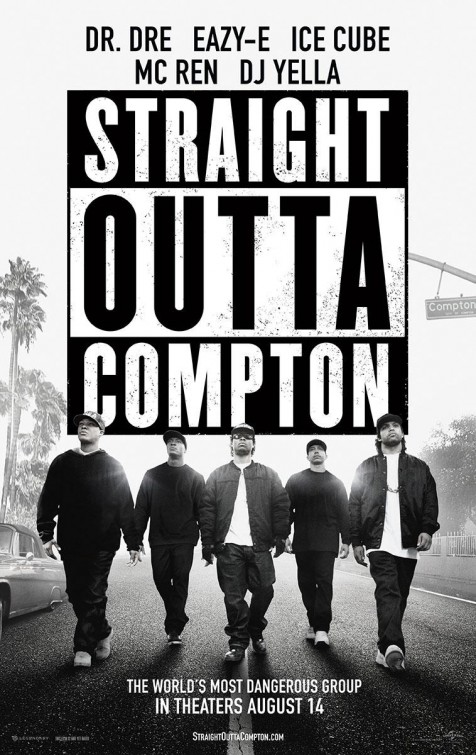
Straight Outta Compton (2015)

★★★★

Straight Outta Compton PosterDirector: F. Gary Gray

Release Date: August 14th, 2015 (US); August 28th, 2015 (UK)

Genre: Biography; Drama; History

Starring: O’Shea Jackson Jr., Corey Hawkins, Jason Mitchell

Full disclosure: I’m not a big late-80s/early-90s hip hop fan. Before F. Gary Gray’s Straight Outta Compton, I likely would have associated the letters “N.W.A.” with a professional wrestling promotion as opposed to anything of the rap variety. But cinema is a great enlightenment tool and here I am, enlightened, and all the better for it. The film takes us all the way back to 1986, to Compton, California and to the inception of one of the most influential groups in music history. Not that I know anything, but to me Straight Outta Compton plays like a film worthy of the N.W.A.’s hefty legacy.

It is primarily centred around the three most pivotal members: Eazy-E (Jason Mitchell), Ice Cube (Jackson O’Shea Jr.), and Dr. Dre (Corey Hawkins). We meet the former surrounded by guns and drugs, and the latter hopes and dreams. Despite its obvious pitfalls — impending violence and police sirens — the Compton hip hop culture proudly wears an aspirational quality that bellows from the screen; this is especially true during musical interludes, though these aren’t interludes as much as natural story progressions. And it is this underbelly of aspiration that resonates universally, beyond hip hop. What we have is a piece that serves its real life protagonists honourably by dismissing glorification and highlighting the relatable traits they foster.

This feels like the rise of the N.W.A., not an imitation. Every performance is authentic, from Jackson O’Shea Jr. who is more than just his father’s uncanny lookalike, authoritative and assured, to Jason Mitchell as Eazy-E, the rebel of rebels turned sympathetic figure. Mitchell sieves through the aggravating side of his character in order to trap something really genuine. It helps that the focus is not always on Eazy-E; we spend significant time with Dr. Dre, played with a terrific sense of roundedness by Corey Hawkins, and with Paul Giamatti’s Jerry Heller, a businessman with dollar signs in his eyes. This is a cast rich in talent, both raw and honed, backed up by strong supporting players (R. Marcos Taylor as Suge Knight; Aldis Hodge and Neil Brown Jr. as MC Renn and DJ Yella, respectively).

As is always the case when a biopic hits the stands, much has been said about historical fudgings. Most notably, the non-reference to Dr. Dre’s violent outbursts against women. That’s a fair quarrel, though I can only judge what I see. The guys on-screen are absolutely not angels, nor do they hold themselves to such a moral standard. They partake in overblown confrontations — the camera makes a point to zoom in on a tightly-grasped glass bottle during one conflict. Women are not treated well, often as little more than instruments to use (this does change upon the arrival of maturity). And bouts of in-fighting gain frequency as the group gains success. You believe in the bond between the members, but you also recognise the potential for bloated egos to overrule harmony. So when bloated egos overrule harmony, it’s not a shock.

The most charged relationship Gray’s outing explores, though, is not one between individual artists, but a collective one between all artists and the police. Our real world news media has been awash with the pitiful treatment, and worse, of black men in particular by US police officers, and this exceptionally tense relationship is reflected from the word go. For instance, we see Dr. Dre on the receiving end of a brutish arrest for no apparent reason: “I was literally just standing there… that’s it.” Police brutality is obviously an issue with complex ties to the rise of the N.W.A., therefore the extent to which it is featured here does seem justified and in many ways inevitable, but that inevitability does not diminish its impact at all.

Cop cars stalk the group constantly; they appear from nowhere almost to the point of parody, their lights flashing and alarms blaring. Conversations between officer and victim cement the shoddy use of power structures — one side inflicting orders with no real basis, the other side angrily demanding an explanation. This amounts to a handful of on-the-nose interactions (“You can’t come down here and harass my clients because they’re black”) but then these interactions are probably wrapped up in absolute truth, which makes the whole saga all the more infuriating for us folks on the side of those being unlawfully discriminated against.

On a lighter note, at two and a half hours long the film advances with unrivalled exuberance. This is all Gray’s direction; you can feel it. Be it in establishing compelling dialogues or encouraging us to head-bop along, the director never lets up: we zip through recording sessions and into electric live performances, and the spotlight evolves from a lone studio glow into an array of kinetic beams. The best example of this vitality is in an unrelenting diss sequence during which the picture cuts between the disser dissing and the dissees listening. It is a track that stems from a dispute based on artistic and financial integrity, another industry strand the piece explores in some detail.

It’s not as earnest as something like Crazy Heart or as indebted to soul-searching as a Walk the Line, but Straight Outta Compton thrives on the strength of its key figures and the scintillating, abrasive music they make. For someone like me, a representative of those uninitiated in the musical culture on display, this character-centric approach affords the film a grounding from which to flourish. Good characterisation, good storytelling — these are two of the tenets of good cinema, and Straight Outta Compton revels in both. That makes it good cinema.

Straight Outta Compton - Corey Hawkins

Images credit: IMP Awards, Collider

Images copyright (©): Universal Pictures

Grimsby (2016)

★★

Grimsby PosterDirector: Louis Leterrier

Release Date: February 24th, 2016 (UK); March 11th, 2016 (US)

Genre: Action; Comedy

Starring: Sacha Baron Cohen, Mark Strong

Should you walk into a screening of this latest Sacha Baron Cohen flick not knowing what exactly to expect, you’ll be brought up to speed almost immediately. The first thing we see is a sweaty, mouthy sex scene between Cohen and Rebel Wilson, and here’s the kicker: it takes place atop a mattress in a furniture store. Thankfully Cohen, playing Grimsby goof Nobby Butcher, chooses to purchase said mattress having already christened it. We watch him wheel the thing home using an abandoned shopping trolley; he’s docked out in an England strip and is sporting a 90s britpop hairdo. Meanwhile, Blur’s “Parklife” blares in the background.

It gets much grosser than an in-store romp, though Louis Leterrier’s Grimsby never matches the unfiltered rowdiness of Borat, Cohen’s pinnacle comedic achievement. The film tries — you’ll know it when you see it — but the actor, once a laudable harbinger of satirical bite (and he may be still), is suffocated by a plethora of unoriginal sexual antics. Obvious targets are set up to be shot down: Bill Cosby, blandly, and Donald Trump, more amusingly. Smarter quips are less prevalent, though there is at least one (“Chilcott was dismissed for good reason,” claims an agency insider). It doesn’t want to be that sort of film, which is fine, but the invention isn’t there to justify a simple 90-minute yuck-fest.

An opening Call of Duty action sequence makes use of Leterrier’s background in the genre (The Transporter, The Incredible Hulk): we take the viewpoint of Mark Strong’s Sebastian as he leaps onto vehicles and sends enemies flying with a barrage of roundhouse kicks. The violent obstacle course suitably concludes just as “Directed by Louis Leterrier” hits the screen. Sebastian is an MI6 agent and also Nobby’s brother, though the two haven’t been together since their childhood separation. Inevitably, their reunion sees the latter interrupt the former during a mission, resulting in the shooting of an ill, wheelchair-bound youngster and the escape of Sebastian’s actual target. And so, the brothers find themselves on the run.

In tandem with Cohen’s screenplay — co-written with long-time partner Peter Baynham and Wreck-It Ralph story moulder Phil Johnston — Leterrier attempts to infuse proceedings with that Edgar Wright sense of snap and whizz. It doesn’t work. Partly because the centrepiece jokes are based around sequences that overstay their welcome, thus any built-up momentum succumbs to comedic culling. But the use of flashbacks is also a great hindrance: we see the brothers as annoying kids, loud, sweary and arrogant. Not exactly the sympathetic formula required to make us feel for them when they are split up via fostering.

“Cigarettes & Alcohol” is the soundtrack to the film’s best scene: Nobby, having ditched the football jersey, dons his brother’s spy gear (including a black turtleneck jumper) and saunters forth in slow motion with enough Liam Gallagher swagger to match his Liam Gallagher mod mullet and sideburns combo. It is funny because you can feel a similar sort of pay-off building from the moment Leterrier intercuts Northern English football culture with britpop tunes and britpop attire. And it works because you believe in Cohen’s false big-headedness. He is fairly good as Nobby, it’s just that Nobby isn’t a particularly intriguing character.

The return of Barkhad Abdi to the silver screen is a welcome one, even though his role (drug runner) demands very little from a former Academy Award nominee. Booze comedian Johnny Vegas and Royle Family mainstay Ricky Tomlinson have fleeting supporting roles as two of Grimsby’s football-loving troupe: set during the 2016 World Cup, if ever there was something within the narrative to exemplify the film’s lack of reality or relevance, it would be the England national football team’s success. On the female side of things, Isla Fisher plays a helpful MI6 agent stuck behind mobile phones and computer screens while Penélope Cruz, well, has another portfolio credit.

Fans of Cohen might still enjoy this tamer-in-execution offering so long as they enter not expecting the piercing offence prevalent in earlier outings. Grimsby is basically just Johnny English Reborn, the not-so-good one, but with cruder jokes. There is a working class versus establishment thing going on, I think, but both sides are so plainly drawn nothing new or interesting sees the light of day. This is no Kingsman, which struck the correct balance between heightened impact and genre appreciation. Having said all of that, I did learn of Grimsby and Chernobyl’s twin city relationship. Wait, that was a joke?

Grimsby - Mark Strong & Sasha Baron Cohen

Images credit: IMP Awards, Collider

Images copyright (©): Columbia Pictures

45 Years (2015)

★★★★

45 Years PosterDirector: Andrew Haigh

Release Date: August 28th, 2015 (UK); December 23rd, 2015 (US)

Genre: Drama; Romance

Starring: Charlotte Rampling, Tom Courtenay

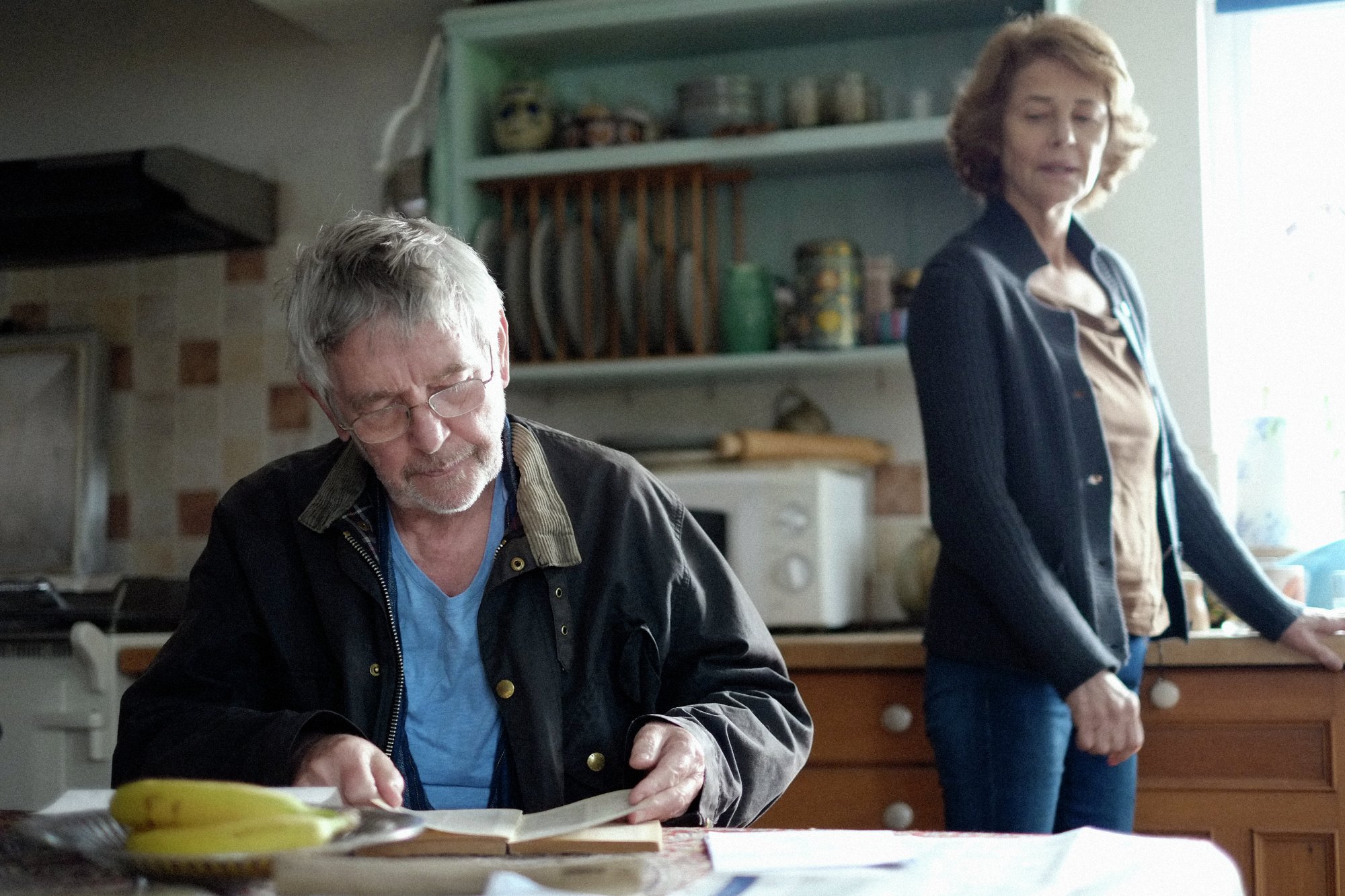
Apparent normalcy reigns supreme before being crushed in Andrew Haigh’s 45 Years. It is instantly established that our central couple — Kate (Charlotte Rampling) and Geoff (Tom Courtenay) — live an ordinary life together, or at least that they have done up until the point we meet them. We see, for instance, Kate having an amiable chat with her postman, a former student, as she finishes up her daily walk with the dog. Life is as it would be for just about any ageing couple: very innocuous. What’s also innocuous, though, is the means by which said life is turned upside down.

Geoff receives a letter in the mail and, upon reading it at the breakfast table, finds out that the frozen body of a former lover has been found in a Swiss crevasse (this following said lover Katya’s tragic death in the early 1960s). The immediate conversation reverts, again, to normalcy. The two discuss how they feel about the news, its similarity to the Tollund Man, the science of glaciers and their preservation qualities. Even the possibility that the body mightn’t, in fact, be that of Katya. All the while, Lol Crawley’s camera remains settled on the couple, affording them as much time to breath and converse as they need.

It’s Kate and Geoff’s 45th wedding anniversary on the Saturday — the film follows a day-by-day structure, starting on Monday — for which they are having a party, though what should be a time for pleasurable anticipation turns into one of uncertainty and eventual dread. “So full of history you see, like a good marriage,” Kate hears from her Maître d’ at the very start of the film, shortly after the news but before any anxieties have truly set in. Later, Kate makes her own assertion about the undisclosed histories of she and her husband: “We were both going through something really unpleasant and yet we never talked about it in all the years that we’ve known each other.”

Rampling is the more practical of the pair as Kate, the active one (she seems to be the main force behind the upcoming party and does most of the dog-walking). The film tends to see events from her point of view: we open with her, traverse the moors with her, travel into town with her, and investigate Geoff’s past with her. Rampling obliges by assuming an authority through her presence; not the bossy kind but the controlled sort that a former teacher might bear. She probably has the tougher role of the two given Kate’s detachment is a more gradual, subtle affair (Geoff, on the other hand, has his head in the clouds as soon as he learns of Katya’s fate).

Geoff is less sound, more wavering, and Courtenay plays him with a stuttering sensibility. His memories of Katya seem clear and he often appears nervous when relaying them to his wife. Haigh’s screenplay is understated, so much so that the film can only thrive upon its own, bare-bones merits, of which there are many — the acting is restrained, as is Haigh’s direction. So when secrets inevitably spill out, they take centre stage. We are compelled to listen and listen we do: to snippets of withheld information and the considered reactions that follow said revelations.

There is an excellent scene around halfway through the film during which we see Kate and Geoff meet with their friends, the camera floating between conversations that neither of the two are actively participating in. This is the corruptive power of a seemingly banal secret. Time also hangs over the piece; its inevitability is something both Kate and Geoff find themselves weighing up during a chat where they casually lament the lack of children and grandchildren in their life. Geoff speaks of Katya being frozen in time, and how it feels odd to him that he has aged immeasurably by comparison. He worries about “losing that purposefulness” and his fear resonates because it is something that all of us will someday comprehend.

Music is utilised minimally — there’s hardly a score, if one at all, Haigh instead placing confidence in the storytelling ability of nature’s tweets and gusts. Terrifically frosty shots of the Norfolk countryside highlight both the dewy autumn setting and the impending sense of isolation our main characters feel. 45 Years is a superbly told domestic trust drama. The underlying tension isn’t edge-of-your-seat, but rather needling and discomforting. From something to look forward to, Saturday’s party becomes a lingering dark shadow. And parties are supposed to be fun.

45 Years - Tom Courtenay & Charlotte Rampling

Images credit: IMP Awards, Collider

Images copyright (©): Artificial Eye

A Bigger Splash (2016)

★★

A Bigger Splash PosterDirector: Luca Guadagnino

Release Date: February 12th, 2016 (UK)

Genre: Crime; Drama; Mystery

Starring: Tilda Swinton, Ralph Fiennes, Matthias Schoenaerts, Dakota Johnson

Ever sat through a film that looked splendid, had winning actors winningly performing, bore intrigue and yet that made you want to claw your eyes out? A Bigger Splash announced itself in such a way to me, although to be fair its teeth-grating annoyance did eventually improve to a state of plain old manageable annoyance. The negative overlay has to do with a severe disconnect between viewer and three wholly unlikeable characters: filmmaker Paul (Matthias Schoenaerts) isn’t all that aggravating — probably because he looks eternally fed up with his predicament — though the same cannot be said for rocker Marianne (Tilda Swinton), music producer Harry (Ralph Fiennes), and student Penelope (Dakota Johnson).

Marianne and Paul’s quiet, idyllic Italian break built around sun, sex and relaxation gets interrupted suddenly by the screech of phone call and the whoosh of aeroplane (it’s a metaphor). On the other end of the line is Harry, Marianne’s pal and former lover, who is calling to let her know his plane is about to land at the nearby airport. He has brought his daughter with him, for some reason. More significantly, Harry brings raving obsession, with Marianne first and foremost, but also with rambling — for two hours, the guy is physically unable to hold his tongue. He seems fittingly well-versed in the island’s community, at one point hilariously showing up at a resident’s house just to try their risotto.

It isn’t initially clear how the four know each other thus interactions are racked with awkwardness, though that doesn’t stop Harry mouthing on about how he once served the Rolling Stones. These introductions are inelegant also because Marianne cannot speak — she is a rock star and rock stars have to go on voice rest, though she does eventually wispily chatter when the film realises silent sex isn’t enough for somebody of Swinton’s calibre. She does at least get to don full Bowie-esque getup in flashbacks. Marianne’s beau, Paul, suffers from headaches brought on by medication brought on by a serious life event brought on by his ailing career, or something. Crucially, the headaches are not an issue at the start (remember Marianne can’t talk), only flaring up upon Harry’s arrival (remember Harry can’t shut up).

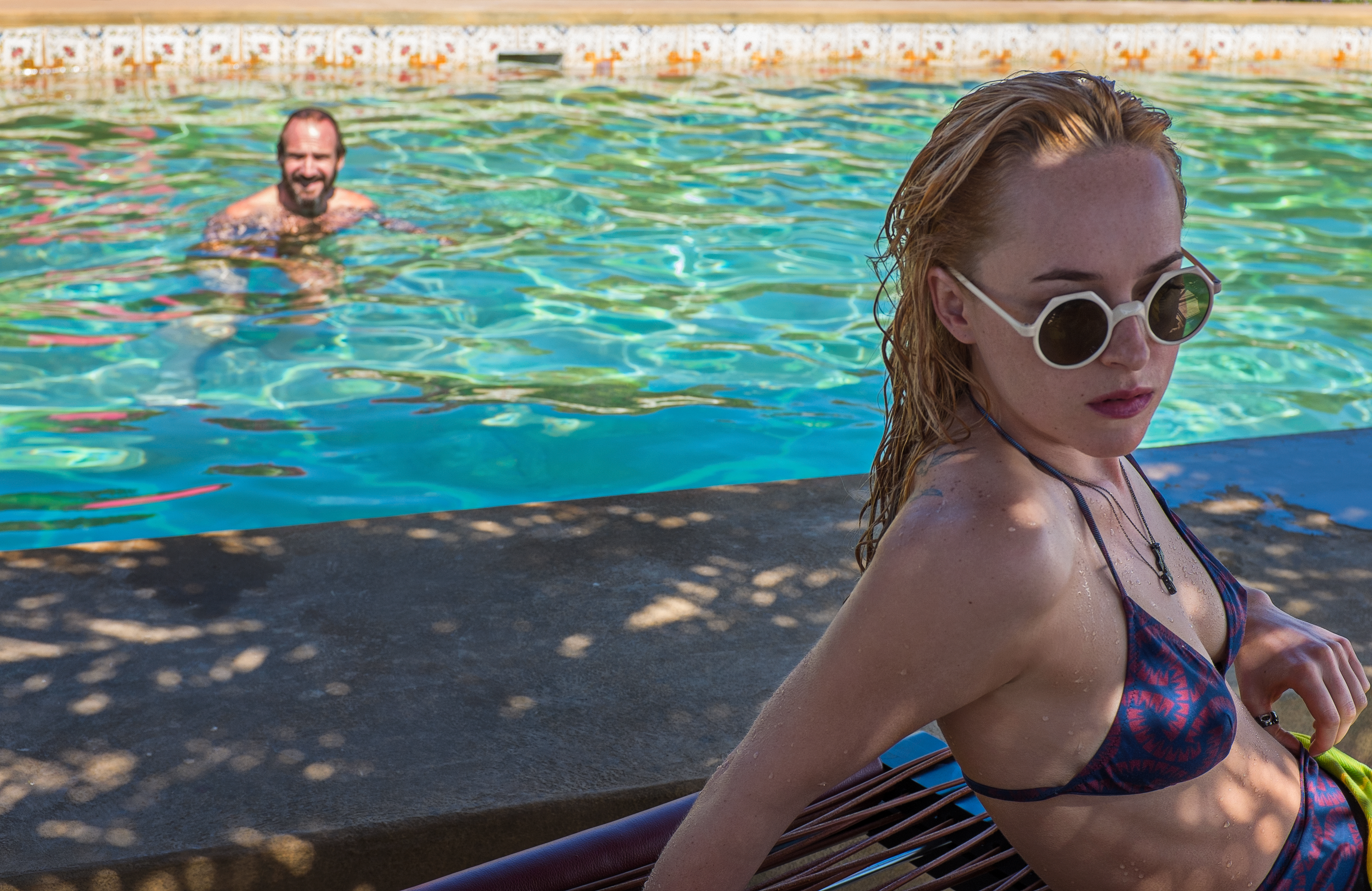
The latter’s daughter, Penelope, is moody, scheming, and unpredictable (and then entirely predictable). An age issue suggests miscasting; Johnson, otherwise, doesn’t have much to do apart from laze around. The four characters spend most of their time lazing around in truth, often naked — the camera lingers but does so exclusively — as they wind each other up about their respective troubles and life philosophies. You can see what the screenplay is going for, that feeling of rising tension and impending drama, but the underlying menace reaches boiling point after 30 minutes and only starts to subside thereafter.

What begins as an odd pseudo-romantic endeavour becomes something else entirely, a would-be thriller if the film was at all thrilling. Its musical inclination — the suggestion is that Marianne and Harry were once big partners in sound and debauchery — beckons A Bigger Splash towards a more drugged-fuelled narrative, perhaps something akin to Kill Your Friends. In fact, that comparison pits Fiennes in the wrong film: his self-serving, self-destructive nature is far more suited to the Owen Harris flick. He does commit to the role admirably, delivering a performance buoyed by genuinely creepy eccentricity, but the horridness of Harry means Fiennes is constantly fighting a losing battle for sympathy.

Despite all that, there is a small hint of intrigue going on in Luca Guadagnino’s retreat escapade. Without giving anything away, you do find yourself awaiting a genre shift towards a more mysterious tone, and when said shift does inevitably arrive it feels right in a story sense. But it’s also very abrupt and too late in the game, therefore the movie concludes before character reactions reach full formation and story arcs can be suitably sewn up. I’m not against open-endedness (quite the opposite; as a fan of Lost, unanswered questions are right up my street) but the film’s overlong buildup renders the eventual pay-off a tad undercooked.

Potentially rewarding themes attempt to break through the superficial limelight, nods towards a clash of cultures and the obliqueness of fame for instance, but none of these make a true mark. In the end, it is all a bit celebrity Mad Dogs without the desired amount of madness or dogged captivation. There is nothing to chew on and nobody to root for. The only splash here, unfortunately, is one into shallow water.

A Bigger Splash - Johnson & Fiennes

Images credit: IMP Awards, Collider

Images copyright (©): Fox Searchlight

Hail, Caesar! (2016)

★★★★

Hail, Caesar! PosterDirectors: Joel and Ethan Coen

Release Date: February 5th, 2016 (US); March 4th, 2016 (UK)

Genre: Comedy; Mystery

Starring: Josh Brolin, George Clooney, Scarlett Johansson, Alden Ehrenreich

Hail, Caesar! might as well be a sequel to the Coen brothers’ early-90s writer’s block masterstroke, Barton Fink. The filmmaking duo are back on familiar turf, their gaze once again fixed upon their own industry, only this time it is an exploration of post-screenplay life. Set in 1951, a decade after Fink, we re-enter the mania of motion pictures during a time of internal and external struggle; as studios lose control within the self-contained confines of Hollywood, the real world is dealing with political crises and threats of nuclear decimation. Thankfully George Clooney, Channing Tatum and Scarlett Johansson are on hand to spread some joy.

Even those wary of their thematic craftsmanship or storytelling abilities must hold the Coen brothers’ world creation to the highest of standards. Here, the duo conceive Capitol Pictures (another Fink throwback) in all of its glory: bombastic sets tinged with old charm; backlots bearing their own gravitational pull that revolve around the movie star present — when interested parties hear Baird Whitlock (Clooney) will be starring in their feature, the reaction is an audible “oh my”. And office doors get in on the excess, wearing flashy, golden-chrome nameplates. Cinematographer Roger Deakins, fresh from stunning work in Sicario, shoots the grandiosity with skill and a sense of cosiness. It all just looks right.

The studio system is on its last reels and given the aforementioned extravagance, it is plain to see why. The social zeitgeist is one of populism, of westerns and biblical epics designed to quell the moviegoer’s fear of Communism and nuclear war if only for a few hours at a time. On a side note, Hail, Caesar! and Trumbo might make a worthwhile double-bill as here we are introduced, teasingly, to the Communist cause without ever delving far into its core. The Coens are interested in the production line, the behind-the-scenes craziness, of which there are many components — too many for such political allegiance to warrant thorough analysis.

Eddie Mannix is the common thread binding those components, superbly played by Josh Brolin (straddling the line between aloofness and competence). He is not a moral man, or so his cigarette-decrying priest would have him believe. He is a studio fixer, that is, a liaison between star and head financier. As the story progresses Mannix increasingly takes the form of a walking, talking manifestation of movies as life’s be all and end all, therefore false pretences must be upheld and personalities must be moulded to suit the needs of a fearful America. “The public loves you because they know how innocent you are,” Mannix informs Johansson’s DeeAnna Moran. She is pregnant and single, which is obviously a problem.

Less of a problem is the town’s new personality ready for shaping, that of proverbial cowboy star Hobie Doyle (Alden Ehrenreich). He is an amiable up-and-comer who has plied his trade horse-riding and lasso-snapping, though the Capitol leaders wish to broaden his appeal. Of course, the kid has no experience in dramatic acting, especially not in delivering the mirthless chuckles and ruefulness ordered by his new, pompous director Lawrence Laurentz (Ralph Fiennes in fine cameo form). Regardless, Hobie will be the next big thing because that’s what Mannix wants, and on the basis of his performance, Alden Ehrenreich will be too.

The movies we see in production adhere to a culture of emboldening, where lighting cues are so obviously artificial you cannot help but laugh when they announce themselves, and where acting is defined not by subtlety but by overemphasis. Clooney, playing the easily cajoled A-lister Baird Whitlock, is a master at such overemphasis: an early scene in which he is drugged by two plotting extras, the real life version of Pain and Panic from Hercules, ought to rouse significant amusement at the behest of his delayed water guzzling. It is a delay brought on by the actor’s strenuous effort to convey the hilarity of a joke, of course.

Whitlock spends the entirety of the film wearing the same gladiatorial costume and Clooney answers by sauntering like a Roman solider, sword a-swinging. We get those idiosyncratic moments, Coen watermarks, side quests not related to the central storyline but that are an absolute hoot to watch: two of the best in Hail, Caesar! involve a raucous religious rabble and an impromptu enunciation lesson. There is a sequence in the third act during which the piece knowingly gets ultra-meta: a late-night drive is montaged, scored by brass, Dutch angles invoked. It is like watching a movie within a movie about classic Hollywood movies.

Perhaps the need to accommodate as many kooky industry strands as possible means the film can’t be as richly textured as the Coens’ previous outings (although there are similarities with Barton Fink, deep thematic layering isn’t one). However, you are hoisted along with so much momentum by waves of nutty humour that it is almost impossible not to revel in it all. You find yourself gleefully anticipating the next big, showy scene, expecting it to topple the last in levels of arrant silliness — a high bar awaits tap dancing Tatum, though he sails through with flying colours.

Mannix spends time considering whether or not to ditch his Hollywood gig and assume an executive position at the aerospace organisation, Lockheed. A salesperson from the company occasionally appears, looking to coax Mannix into signing on the dotted line. “I’m sure the picture business is pretty damn interesting, but I’m sure it’s frivolous too,” the Lockheed man says. He’s right, in a wider world context, on both counts. Fortunately, thanks to movies like this and filmmakers such as the Coen brothers, that which is interesting far outweighs that which may be frivolous.

Hail Caesar - Channing Tatum

Images credit: IMP Awards, Collider

Images copyright (©): Universal Pictures

Cinderella (2015)

★★★

Cinderella PosterDirector: Kenneth Branagh

Release Date: March 13, 2015 (US); March 27th, 2015 (UK)

Genre: Drama; Family; Fantasy

Starring: Lily James, Cate Blanchett, Richard Madden

From the larger-than-life comic book strands of Thor to the slick, considered action of Jack Ryan: Shadow Recruit, Kenneth Branagh’s latest outing reflects the director’s willingness to venture down varied paths. Cinderella is certainly more in line with his traditional genre work — Shakespeare and classic novel adaptations — but it also shares the same vibrancy as Branagh’s recent outings. It does not rely heavily on the originality of any specific component; this is as competently classic as you are going to get. Rather, Cinderella works as a fairly fruitful whole.

We all know the story and the film knows we all know the story. Screenwriter Chris Weitz quickly disposes of the origin formalities with a sickly-sweet preamble starring Hayley Atwell and Ben Chaplin as mum and dad, the former filling in any narrative gaps via voice-over (and perhaps underused in retrospect). Mum dies — even on her deathbed, Atwell’s mother looks a brush of hair away from being ready to attack the day — and dad tragically follows suit, leaving not-yet-Cinder-Ella at the mercy of her bullying stepfamily. “Have courage and be kind” is the motto by which she must adhere, and adhere she does.

Since the fairy tale’s ins and outs are common knowledge, you expect to see something new from this Branagh-led incarnation, or at the very least something old told exceedingly well. It is more of the latter, if not entirely either. The screenplay typically weaves class and identity into the story: Prince Charming (Richard Madden) wishes to sell his own personality and not his superfluous value to Cinderella (Lily James), while Cinderella has no obvious desire to wed royalty, only to wed the kind apprentice she just met in the forest. Meanwhile, necessary excess — the grand carriage, the stunning gowns, the sheer beauty — is combated by Branagh and co. through emphasising other factors: courage, kindness, honesty, and humour.

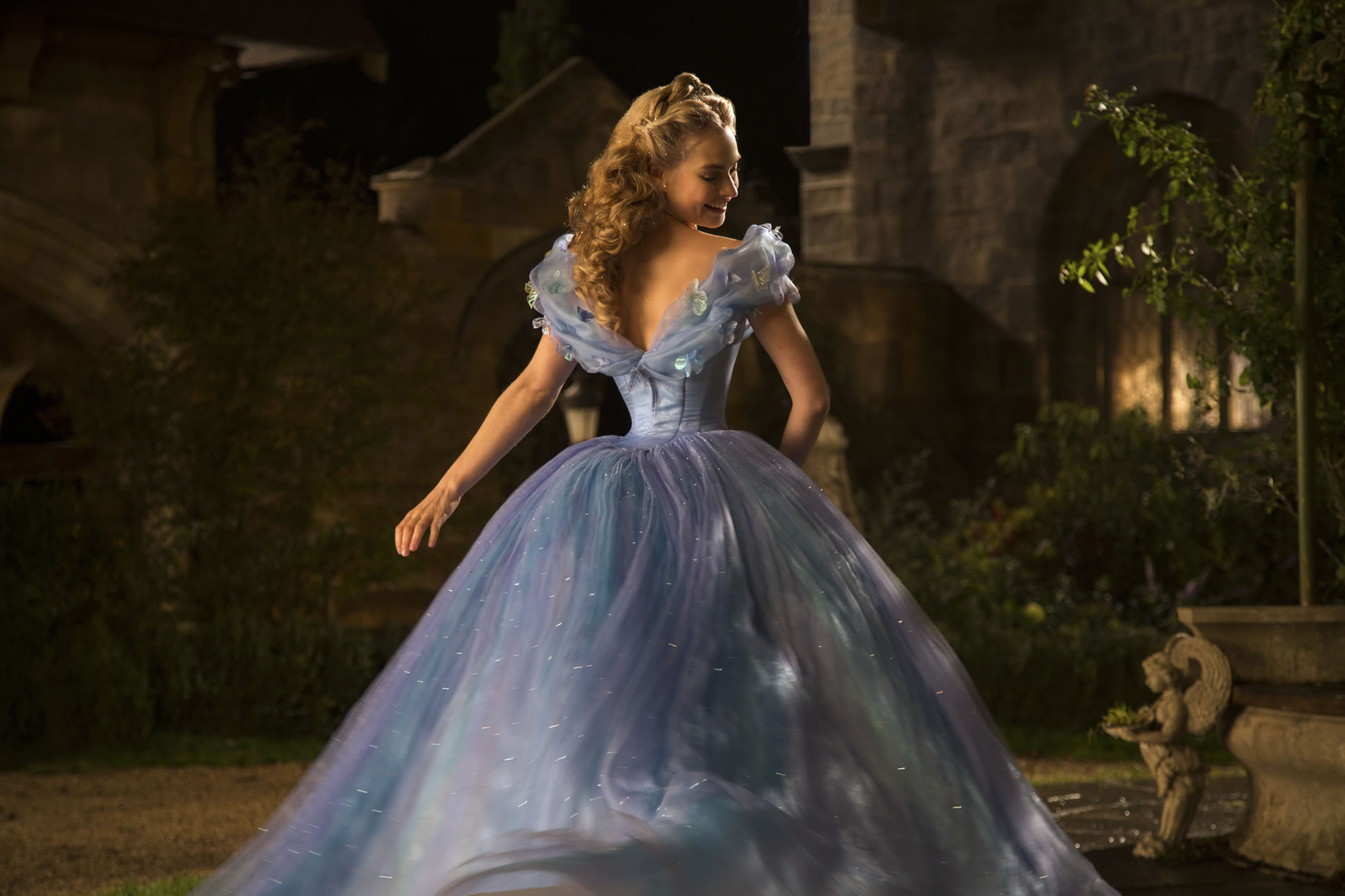
Cinderella is so morally upstanding she opts to live her life in the company of insensitive rogues simply to uphold a promise made to her parents, to honour their memory through the upkeep of their residence. Lily James plays the fairy tale stalwart with such commitment and invitation; only a cast iron soul would find her demeanour off-putting. Cinderella is at times naive to the point of ridicule, but you always believe in her good nature regardless. And there is a commendable individuality to the lady-in-waiting: she seems in control, even when her fate is essentially dungeon-dwelling, control embodied by the not-so-subtle power she has over the prince (via love) and the more subtle power she has over her stepfamily (via her love for the prince).

Speaking of whom, Lady Tremaine (Cate Blanchett), Anastasia (Holliday Grainger) and Drisella (Sophie McShera) make a suitably nasty counterweight. “She too had known grief, but she wore it wonderfully well,” we hear of Tremaine, Blanchett evoking a devious allure while robed in blacks and dark turquoises. The trio usher a culture of gambling and partying into Cinderella’s civilised household upon arrival, antics mirroring their deceptive tendencies. Along with Grainger and McShera’s proverbial stepsisters, Blanchett could have easily arrived for shooting directly from the set of A Series of Unfortunate Events. Like Jim Carrey, she chews the scenery, hams it up and more with success.

Her understudies are perhaps too cartoonish though they do provide occasional comic relief. Richard Madden has a better time of it and does very well in what could have been a tough role. You might expect a pristine rich boy to promote aggravation through smugness even unintentionally so, but Madden is far from that as Prince Charming, down-to-earth and somewhat — somewhat — relatable. And if not, he is definitely likeable. And also named Kit, coincidentally (Nonso Anozie shows up, another Game of Thrones connection). Conversely, some characters are not quite as assured in delivery. Stellan Skarsgård’s Grand Duke, for instance, bends morally without warning.

Patrick Doyle provides a score that sways from the bombast of brass to light, frothy strings. It matches the allure of the story’s royal ball, which in and of itself takes on even greater aplomb than is perhaps expected. The sequence wears the extravagance of Baz Luhrmann’s Great Gatsby, beckoned forth by fireworks and golden décor. Haris Zambarloukos’ camera loves Cinderella, as it should, and shows her in sparkling form even when she is doing the washing or ash-strewn from stoking fires.

In the end it does amount to something pretty conventional, but Branagh ensures a consistent level of quality is maintained in spite of the narrative’s recognisable outlay. This is a piece very much aware of its fairy tale heartbeat and it values said heartbeat accordingly. Sure, some of the conversations characters share are on the saccharine side and the thematic rituals are a bit too broad, but Cinderella is a thoroughly well-made and enjoyable live action expedition.

Cinderella - Lily James

Images credit: IMP Awards, Collider

Images copyright (©): Walt Disney Studios Motion Pictures

Deadpool (2016)

★★★

Deadpool PosterDirector: Tim Miller

Release Date: February 10th, 2016 (UK); February 12th, 2016 (US)

Genre: Action; Adventure; Comedy

Starring: Ryan Reynolds, Morena Baccarin, Ed Skrein

When you strip away the humour, the action and the madcap characters, Ryan Reynolds’ decade-long pet project is a standard revenge tale. Reynolds plays Wade Wilson, a cocky mercenary who becomes the seemingly invincible — and significantly cockier — Deadpool following an immoral experiment designed to cure his cancer. To make matters worse, Ajax (Ed Skrein, honouring his Britishness through elongated pauses and exaggerated vowels), the man who dished out said experimentation, now has it in for Wilson’s on/off lover, Vanessa (Morena Baccarin). What we’ve got then is an unethical Robin Hood whose payback meter is on the brink of breaking point. Quite straightforward really.

Justly, a slow motion opening sequence ushers in the prevailing two-fingered mood. Rather than the names of the actors involved, we’re graced with the generic roles they will be playing: “A gratuitous cameo, a British villain, a hot chick.” Such blanket roles form part of an assault on the genre, supported by profanity-laden wisecracks. That’s all Deadpool is really, one giant gag. The jokes are self-referential to no end, and many of them aren’t even jokes — invoking names like McAvoy and Stewart, for instance, doesn’t take that much effort. A Detroit quip suggests smarter thoughts are at play, but they seem drowned out by an unflappable need to guffaw at anything genital-related.

Yet on the visual side of things, the film exceeds its own humorous expectations. Laughter might be hard to come by verbally, but visually director Tim Miller has crafted a goldmine: from an early shot of Deadpool popping his head out of the window of an overturned vehicle to arguably the movie’s funniest moment, a joke based around a mask. The latter works because Miller and cinematographer Ken Seng are careful in its construction, opting to tease us by positioning their camera at a certain angle. Another effective shot sees Wilson journey to his torture destination aboard a stretcher, creepily reimagining a similar scene in Jacob’s Ladder.

Perhaps the greatest flaw in Deadpool isn’t anything to do with the film itself, but its retrospectively overcooked marketing campaign. If you consider not just the punchlines but also the build up to those punchlines, there are probably around 30 or 40 minutes of Deadpool that anyone who has seen the trailers (which is everyone) will be familiar with. This means the jokes land with less oomph in the cinema, if any oomph at all — you could argue the best jokes are those that generate a laugh irrespective of how they are heard, which isn’t the case here. Here, repetition sucks the life out of would-be key moments, such as the opening vehicular mayhem or the standoff between Deadpool’s crew and Ajax’s gang.

By railing against the typical genre trappings, you would expect the film to at least offer something different upon nearing its conclusion. There is a joke about International Women’s Day that takes issue with uneven gender roles — a problem not completely eradicated on the superhero movie front — after which I found myself anticipating Deadpool’s response, for the film to maybe lead the way in making a statement. But it never does. Of the three main females on-screen, one is a wordless brute (Gina Carano), another is a moody teenager (Brianna Hildebrand), and the third is a prostitute (Morena Baccarin). And they remain as such: at no point do we see any of them deviate from their characters’ genericisms.

That was quite a lot of negativity, but Deadpool is undoubtedly an enjoyable twist on the genre and a piece that boasts its fair share of genuinely entertaining moments. The action is vigorous, any pulling of punches outlawed. It is a fairly brutal adaptation that certainly earns its stateside R rating; as violence goes, this has more in common with Marvel’s Daredevil than anything from the studio’s recent cinematic portfolio. A word too for an inventive closing credits sequence that implores you stick around, which is just as well given the post-credits scene is also cracking, an homage to one of cinema’s very best anti-authority comedy outings.

The movie wouldn’t be half as good without Ryan Reynolds, who looks and sounds like he is having a blast in spandex, his condescending voice a perfect match for the provocatively annoying character. The actor’s kid-in-a-candy-shop exuberance pollutes the air and spreads throughout the audience. It is a testament to Reynolds’ physical abilities that he manages to evoke Deadpool’s unique personality despite spending most of the flick beneath a mask. Mutant Wilson, by the way, looks like a terrifying cross between Freddy Kruger and the monstrous figure from Sunshine, so the mask is definitely a good call.

I’ll be the first to hold my hands up: in a packed screening room, my mellower reactions were consistently drowned out by uproarious laughter. This is a film that many have anticipated for a long time and it appears to have pleased the vast majority. There is clearly a desire to reflect the source material, which is admirable if a tad foolhardy. Maybe it’s the rebellious streak, or perhaps the cathartic undoing of distinctly poorer previous superhero incarnations (see X-Men Origins: Wolverine and Green Lantern). Thanks to Ryan Reynolds, at least Deadpool offers something a bit different.

Deadpool - Ryan Reynolds

Images credit: IMP Awards, Collider

Images copyright (©): 20th Century Fox

Trumbo (2016)

★★★

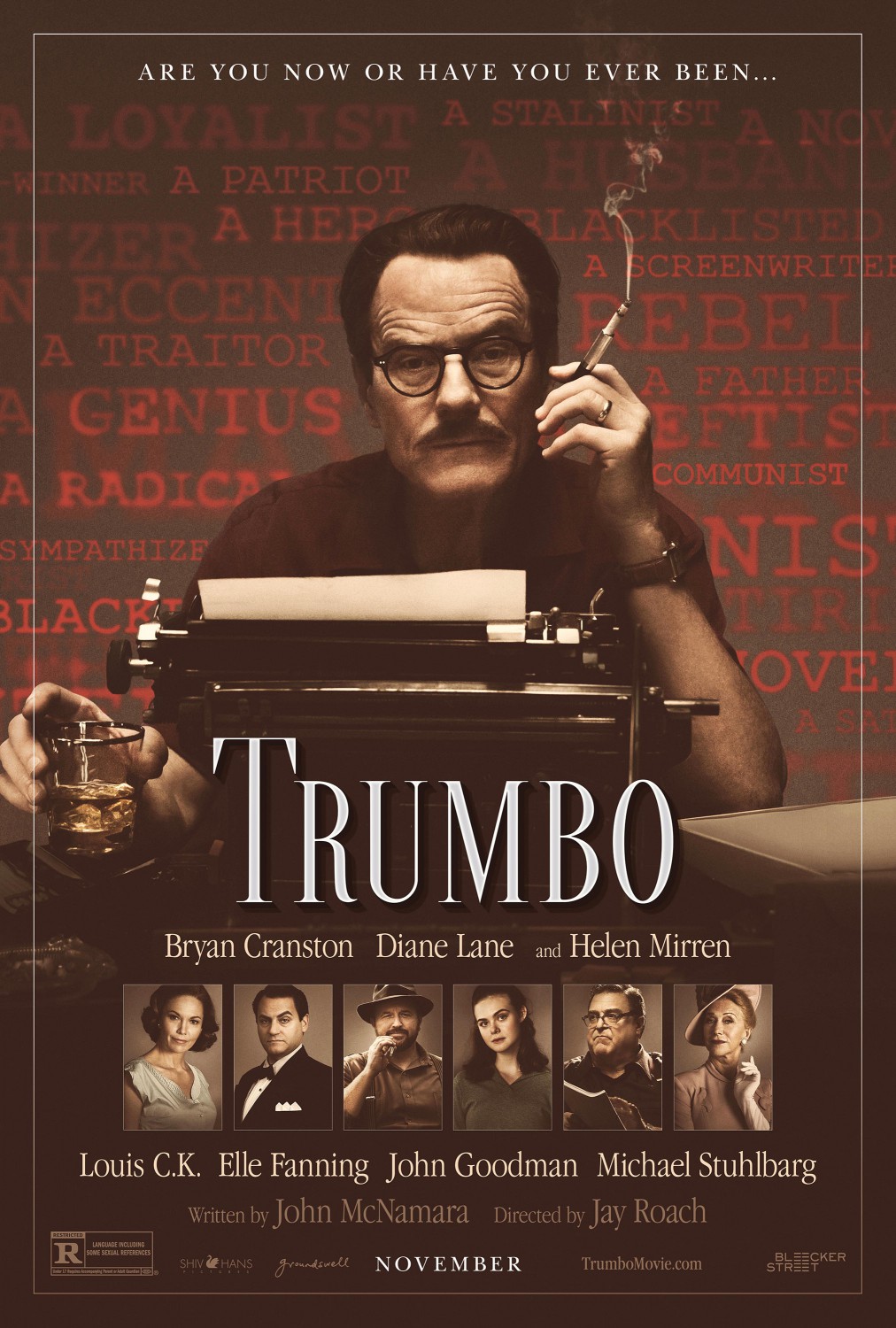
Trumbo PosterDirector: Jay Roach

Release Date: November 25th, 2015 (US); February 5th, 2016 (UK)

Genre: Biography; Drama

Starring: Bryan Cranston, Diane Lane, Helen Mirren

Trumbo is about two things: the trials and tribulations of a successful screenwriter, and the cultural acceptance of an uncommon political discourse. We spend time examining both, but never truly get into the meaty centre of either. Said screenwriter is Dalton Trumbo (Bryan Cranston), a creative caught up in a battle of black-and-white politics; it’s us versus them and US versus Russia. “The Blacklist was a time of evil,” he bemoans, and it probably was. Fighting against tonally light content, we don’t see that evil.

It is mid-20th century America and Hollywood has been torn in two, ambiguous grey areas nowhere to be seen (certainly not in this filmic incarnation). There are those with ties to Communism and ideals driven by wealth distribution, none more so than the aforementioned Trumbo. Then there are the others — studio heads, directors, actors — who bear defiant patriotism, unwavering in their hatred for the Communist agenda. The turbulent ripples become clear, crossing the personal-professional divide almost instantly: “[Trumbo is] among us. Sure as hell ain’t one of us,” says one director, and he ain’t referring to movie guilds.

Director Jay Roach employs newsreels that lambast Communism by throwing the words “radical” and “anti-democratic” around. Trumbo himself, though grouchier as the film wears on, is a beacon of idealism: the imaginative writer, accepting, and willing to give the benefit of the doubt to those on the other side of the fence. When he’s not doing that, Trumbo is storytelling — we see him awaken in a bathtub and pick up his pen as if he hadn’t stopped for a snooze break. He ponders thoughts before his typewriter, smoke clouding his headspace, evoking a sense of artistic megalomania. Cranston plays him well, naturally manoeuvring between cartoonish cheer and patchy introversion.

The movie moves with welcome momentum, but there is a lack of bite in each narrative stroke. That the rabble of screenwriters charged with Communist associations are, at worst, fairly wealthy white males ought to be more of an issue given the film’s discriminatory context, but that is only brushed over during a brief conversation between Trumbo and fellow writer Arlen Hird (Louis C.K.) — the civil rights movement becomes a meagre agent of friction between father and daughter, forgotten after a heart-to-heart. In fairness, unfair haranguing by Supreme Court magistrates does show us how little progress we have made in terms of political jousting and partisan stubbornness.

You would think the criminalisation of the Hollywood Ten (as the writers are collectively known) would have a creative impact on the film industry, but we don’t really see any immediate consequences. Irrespective of politics, incarceration means a loss of talent and that loss is skimmed over even after Trumbo and co. are released from prison and subsequently blacklisted. The workaround is fairly obvious: sell one’s work under somebody else’s name. Trumbo does just that, penning and then passing on the critically acclaimed Roman Holiday (1953) to his untainted screenwriter pal Ian McLellan Hunter (a typically effective Alan Tudyk).

It’s when he decides to work with B movie studio exec Frank King (John Goodman) as a script curator that we see some sort of occupational impact — these films are shoddy, far from Trumbo’s intellectual norm. As King puts it, “Quality minimum; quantity maximum”. Goodman’s arrival ushers in a Coen touch, a bout of heightened satire and craziness, and probably the film’s best moments too (a baseball-bat-wielding Goodman is a sight to behold). This stuff is enjoyable, though you do get the sense the filmmakers are too caught up in moulding an accessible film to carve out something significant.

What this means for the characters, and Trumbo especially, is a lack of piercing emotional rigour during moments of plight. Forced to strip off all of his clothes, Trumbo’s entry into jail is clearly demeaning and disheartening, however it should be tinged with so much more emotional verve. But up until that point there is no gravitas urging you to sympathetically invest in the scribe. Trumbo’s only emotional ties are those the film does not really have to earn: to his family, including daughter (Elle Fanning) and wife Cleo. Fanning shows spark and in spite of her fairly thankless role — wife and mother — Diane Lane manages to imbue Cleo with a dose of likeability.

Helen Mirren channels her inner Rita Skeeter as Hedda Hopper, the media’s harshest Communist critic. “Bad box office? No, bad politics,” she says, more concerned with political allegiance than money which, given her job relies on a thriving Hollywood, is quite something. John Wayne is arguably her biggest ally from within the industry, played here with brutish aplomb by David James Elliot. Perhaps somewhat surprisingly, other big anti-Communist thinkers such as Joseph McCarthy are tiptoed around, Roach opting instead to focus on Hollywood figures.

On the aesthetic face, lots of high-waisted trousers and charcoal fedoras help to amplify the time period. Pathé-esque newscasts look real — some are, such as one depicting a John F. Kennedy film critique (two thumbs up) — while Roach’s use of newspaper prints to relay the national agenda is a nifty touch. These visual styles culminate in a retro flavour that generates more authenticity; it’s no Carol, but it’s good. Vowels are even offloaded with deeper verve. Cranston’s Trumbo sounds like someone who once resided in one of those old, grainy video recordings from many decades past.

Screenwriter John McNamara has a lot to juggle content-wise so perhaps the hit-and-miss nature of Trumbo shouldn’t come as much of a surprise — Kirk Douglas (Dean O’Gorman) and Otto Preminger (Christian Berkel) arrive without warning as the film reaches its scattergraph finale, name-checking Kubrick and negotiating screen credits. The film is essentially a trivial overview of a much more interesting period in US and Hollywood history than is given credit. But Trumbo is wholly watchable and Cranston commendably holds the screen, amounting to a piece worth its papery weight in entertainment.

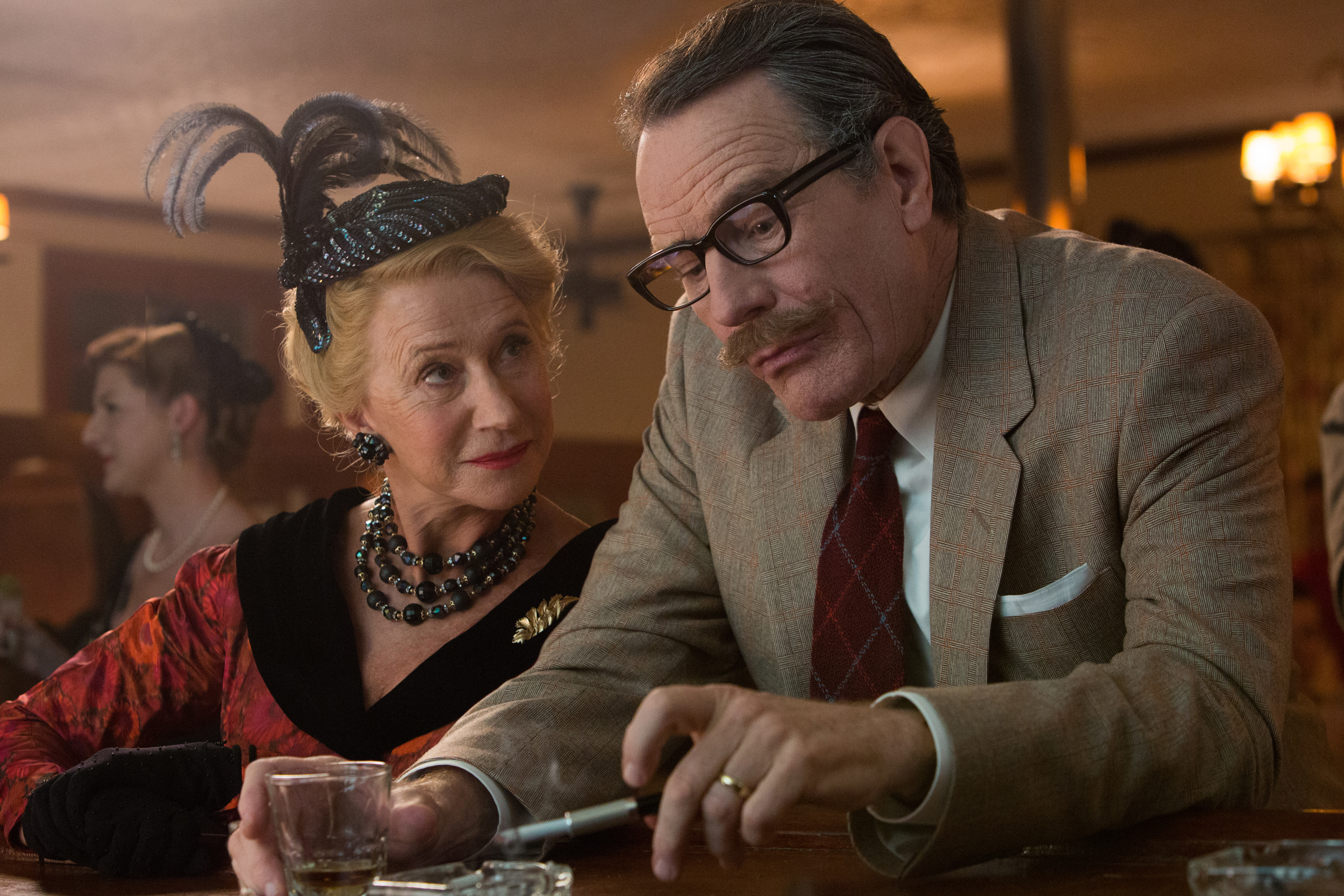
Trumbo - Cranston & Mirren

Images credit: IMP Awards, Collider

Images copyright (©): Bleecker Street