Back to the Future, Back in the Cinema

Back to the Future - Doc & Marty

It’s the franchise that was never supposed to grace the silver screen again — director Robert Zemeckis has said so himself on many occasions — but the Jaws 19-decrying Back to the Future trilogy zoomed back into cinemas all over the world on Wednesday, breaking its own steadfast rule as a result. Great Scott! Heavy indeed.

But fear not. Zemeckis’ insistence that there shan’t ever be a Part IV is still set in stone, and as such Back to the Future’s legacy will remain firmly intact for the foreseeable, um, future. The trilogy’s re-release arrived as part of a wholesale cinematic celebration and moviegoers seemed to lap it up, attending screenings in their droves. October 21st, 2015 is a date that has been permanently marked in all of our calendars ever since Marty McFly and Emmett “Doc” Brown ventured from their 80s-set suburban existence through time, before landing in a world of self-tying trainers and hoverboards. The former has come to fruition in real life. Sadly, we are still waiting on the arrival of latter.

Back to the Future - Jaws 19

Variety is reporting that the trilogy garnered a respectable $4.8 million worldwide from its one-day rendezvous, a total comprised of North America’s $1.65 million domestic gross and an international intake of around $3.2 million. Those are heartening figures, especially when you take into account the day of the week (i.e. that it wasn’t a Friday or a weekend) and the pretty demanding near six-hour runtime for those sitting through all three films.

By comparison, Ghostbusters gained an extra $3.5 million in domestic revenue when it embarked upon its 30th Anniversary encore last year, and we all know just how highly regarded that outing is. Zemeckis, who coincidentally had to face off against himself at box office on Wednesday, will presumably be delighted that his franchise — produced by Steven Spielberg’s Amblin Entertainment — is still held in such high regard after 30 years. That’s the power of love.

For those few of you out there who aren’t up to speed on the madcap world of Hill Valley, California, the trilogy follows the trailblazing exploits of Marty (Michael J. Fox) and Doc (Christopher Lloyd) as they invariably travel backwards and forwards through time in order to influence a whole host of life events. Hilarity, unsurprisingly, ensues. Lea Thompson, Crispin Glover, Thomas F. Wilson, and Elizabeth Sue also star in one of cinema’s most endearing products.

Back to the Future - Mum & Marty

Images credit: Collider

Images copyright (©): Universal Pictures

Horns (2014)

★★

Horns PosterDirector: Alexandre Aja

Release Date: October 29th, 2014 (UK); October 31st, 2014 (US)

Genre: Drama; Fantasy; Thriller

Starring: Daniel Radcliffe, Juno Temple, Max Minghella

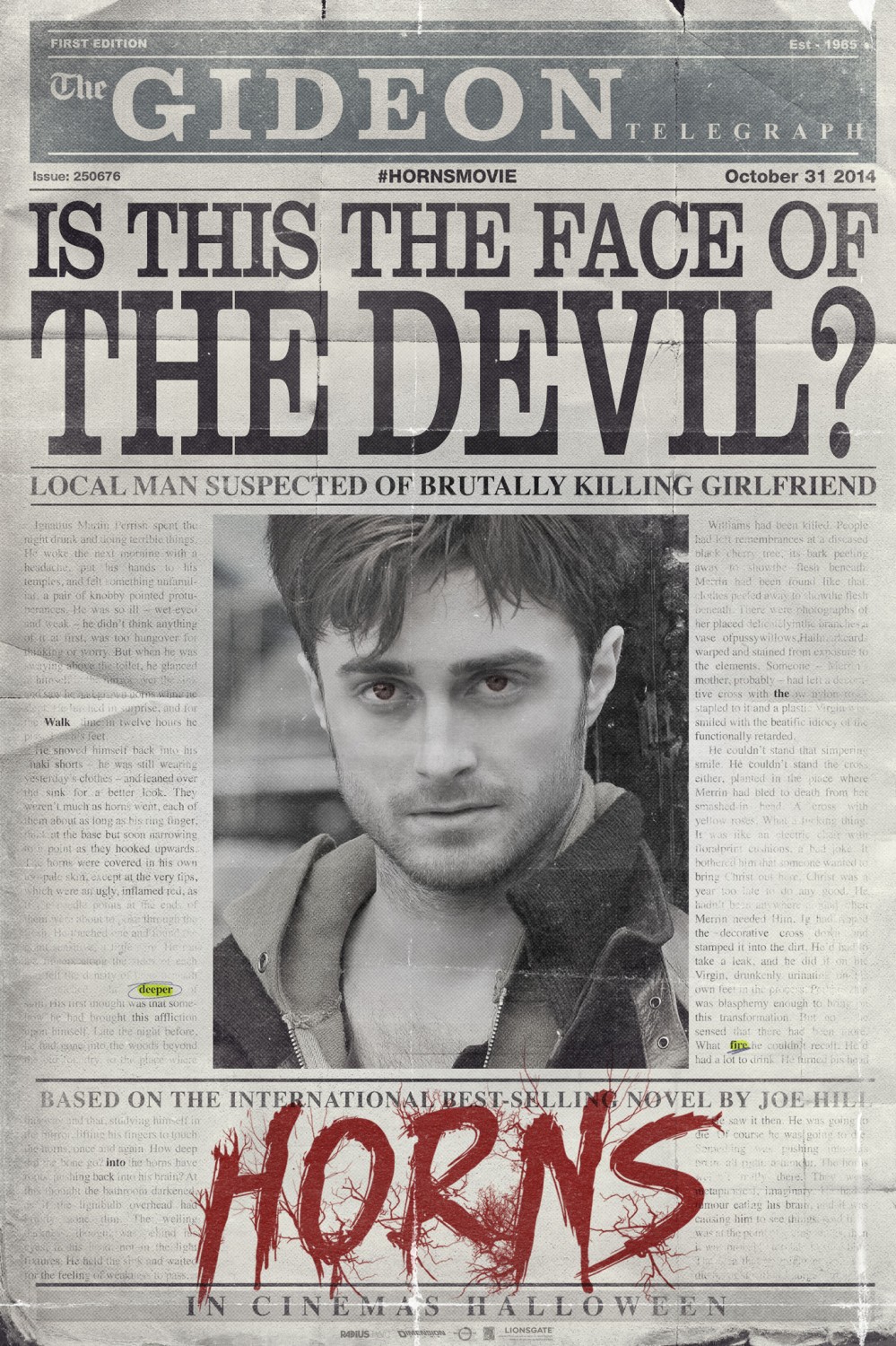
Based on author Joe Hill’s novel of the same, Horns represents another opportunity for Daniel Radcliffe to shed his boy-wizard skin. The actor ought to be commended for selecting varied post-Potter roles that, at least from the out looking in, continue to pose different challenges: in recent years, he has played an Edwardian-era lawyer, a Beat Generation poet, and now a horn-growing murder suspect. This might be his most interesting role on paper, but not even Radcliffe’s admirable effort can save Alexandre Aja’s inconsistent adaptation.

Labelled a killer by many in his community, Ig Perish (Radcliffe) wakes up one morning to discover a pair of bulging discs protruding from his forehead. The swollen abnormalities eventually evolve into manic-looking devil horns which, despite Ig’s best efforts, cannot be remove. Bereft of answers, he tries to get on with his life in as normal a manner as possible, and this mainly involves conferring with childhood mate and legal counsel Lee (Max Minghella). Only, those around Ig don’t quite follow suit.

The tone at the beginning is almost wholly comedic. Animal horns fully realised, whenever a mournful Ig finds himself in the company of others, people start acting horrendously: a mother vehemently denounces her young daughter’s fairly innocent behaviour; a receptionist spits vulgarities in the presence of a child; and a doctor yearns for drugs, only not the healthy kind. Yet it all feels forced. The aloof ambience doesn’t really have a foundation, spawning with no support. Why are people acting abominably? Why does Ig have horns? And if we must: who killed girlfriend Merrin (played by a seriously short-changed Juno Temple)?

The latter question is the one that instigates the film’s goings-on, but it isn’t necessarily the one that drives the piece. Horns doesn’t really have a central pivot point as far as the narrative goes. Instead, there a few floating plot strands, none of which are amply examined. Most time is spent disputing the reality of Ig’s jagged head attire; there is an ongoing debate surrounding whether the horns actually exist, or if they are simply a figurative manifestation of guilt. See, not everyone is privy to the mini antlers, and the presumption therefore is that they can only cast a spell on immoral folk: “Maybe the horns just don’t work on good people?”

It’s a premise that has potential, as evidenced by the book’s success, but director Aja struggles to maintain a settled tone, nonchalantly jumping around from dark comedy to revenge-thriller to grotesque horror. This hampers events on-screen and distracts us. You get the sense a straightforward crime-mystery would have been more palatable — the oddness, the tonal inconsistency, is too isolating. It also hurts Ig; he gets caught up in the film’s vacillating tonal underbelly, cracking jokes one minute and weighed down by despair the next. Radcliffe affords his character a degree of watchability, but it is tough to sympathise with a wimpy and agitated protagonist.

Aja is aiming, it seems, for a 21st century hipster-ish Twin Peaks. Heather Graham appears as a waitress wearing bubblegum-red lipstick and cream -pink overalls. If that is not enough, at one point the camera pulls away from a band playing in a club, the background aquarium-blue in colour and the atmosphere red-tinted. Though, by then you’ve probably already loaded up disc one of the Twin Peaks box set. Whereas David Lynch’s mesmeric concoction — both TV series and film — bore elements of genuine horror and hazy addiction (not to mention its band of universally compelling characters), this succumbs to a disorientating factor that it never shakes. Horns needs a Horne.

We get a Scream citation in the form of a doting detective, short hairdo and moustache combo invoked, but sadly it ain’t circa-1996 David Arquette. Even though there is always room for peer admiration, the film gets too caught up in saluting other, frankly better, horror instalments and inevitably misses its own creative train as a result. When Horns does try to chisel out original content it makes a host of unsubtle references to faith and Hell. A parade of snakes stalk Ig at one point, but on this occasion Parseltongue bites the dust.

In another underfed narrative thread, an explosive childhood flashback recalls The Butterfly Effect. Its intention, I guess, is to subsidise the edgy themes at large and suggest that violence once brought Ig and his cohorts together and now violence is in the process of tearing them apart. Had screenwriter Keith Bunin spent more time exploring how we, as a public, engage in tragedy-induced media frenzies, there might have been more for viewers to chew on. Gone Girl is a recent film that bitingly critiques how people reveal their true selves in dire moments, and it is overflowing with fascinating relevance. Admittedly, Gone Girl is also simply an all-round better film.

Horns is quite well-played in parts. A battle sequence performed to “Personal Jesus” makes very little sense yet garners a chuckle. The outing also has a laudable non-distinctive aesthetic; it could be set at any time in the last thirty years. The piece deposits its comedic purpose for something scarier later on, though it’s nothing truly frightening. It’s all just a bit grim really.

Horns - Daniel Radcliffe

Images credit: IMP Awards, Collider

Images copyright (©): Dimension Films, RADiUS-TWC

Crimson Peak (2015)

★★★★

Crimson Peak PosterDirector: Guillermo del Toro

Release Date: October 16th, 2015 (UK & US)

Genre: Drama; Fantasy; Horror

Starring: Mia Wasikowska, Tom Hiddleston, Jessica Chastain

The fact that Guillermo del Toro’s latest offering is a carnival of visual ebullience probably won’t come as a shock to anybody out there. A 19th century Gothic nightmare with lots of frothy verbiage, every last word enunciated to the nth degree, Crimson Peak delivers in most of the areas we would expect but not all of the areas we would like. Granted, this is not a horror movie nor does it try to be anything of the sort, but its fleeting moments of fright never quite amount to the haunted atmosphere del Toro covets. The narrative also takes some time to explode into life, eventually doing so with menace. At least until then we have a bedazzling aesthetic to keep us company.

Mia Wasikowska plays Edith Cushing, a young woman who seeks to carve her own way in the world without relying on her father’s (Jim Beaver) wealth. She writes (stories with ghosts, not ghost stories), though Edith’s professional hopes are initially dashed under the guise of superfluous reasoning when a superior decries her “feminine handwriting” and the lack of romance in her tale. Crafty and stubborn, she swaps pen strokes for typing but remains steadfast on narrative content. Matthew Robbins co-wrote the film with del Toro and, in Edith, the pair have concocted a female character whose determination to evade tradition is at odds with the prevailing social structure.

She meets Thomas Sharpe (Tom Hiddleston) when the latter shows up looking for funds to support his clay processing invention, and the duo fall in love. From dad to would-be muse Dr. Alan McMichael (Charlie Hunnam), everybody is wary of Thomas’ intentions: “There’s something about him that I don’t like”. Everybody except Edith, who really should have taken the hint upon seeing Thomas converse with his mischievous sister Lucille (Jessica Chastain) in the shadow beneath a large, looming tree.

Crimson Peak’s technical prowess is there for all to see, its rich texture and engrossing visuality arguably on a par with del Toro’s masterpiece Pan’s Labyrinth. But it lacks that film’s beating heart, perhaps because it is tougher to empathise with Edith here than it was Ofelia there. Pinpointing exactly why the Edith’s plight doesn’t translate as well is difficult; Wasikowska is perfectly fine in the role and her character is not disagreeably construed. It is true that her words are often quite gushy, certainly more so than those spoken by Lucille, and at best on a par with Thomas’ dialogue.

The film isn’t excessively melodramatic but its swirling air of grandiosity can hinder the credibility of characters’ actions — from where, for instance, is Edith’s insurmountable trust in Thomas born? To align grand romantic gestures and sap-filled exchanges with Gothic fiction would be a fair assessment, though I’d argue the genre itself is in that case flawed. Or, at the very least, the aforementioned traits don’t meet the screen with enough grounded authenticity in Crimson Peak, and definitely don’t fit a character who is trying to break free from cultural the norm.

Edith’s mother appears in ghost form, an apparition cut from the same ocular cloth as the spectre in another Jessica Chastain outing, Mama. Chastain has more to sink her teeth into here; as Lucille she is very mysterious, her movements icy and her stare searing. She often dawns extravagant gowns but unlike the bright, undiluted garments worn by her sister-in-law, Lucille’s attire often reflects her dark interior (deep rose-coloured and sharply defined). Her undulating poise sets a tone of torment and, as it transpires, Chastain is a terrific passive-aggressive tormentor. But Lucille is also on the verge of mental collapse — her composure, fake, could come unstuck at any moment.

Tom Hiddleston is also very good, though his role commands a different shade of mystery. He must be both a schemer and a sympathiser, and the actor finds the correct balance between the two. You feel his conflicted plight, yet you still can’t fully trust his crow-esque demeanour. In a sense the film is crying out for more interactions between the siblings, especially during its less compelling first half. A word too for Burn Gorman who is superbly cast as a sly detective of sorts, slinking around in the much the same vein as Metropolis’ Thin Man.

At times del Toro’s film is exceptionally violent. One bathroom-set murder harkens back to Casino Royale’s pre-title brawl, only this one is much blunter and probably much bloodier too. It is part of an effervescent production design that somehow straddles the line between realistic and dreamlike: marvellously crafted sets, eye-catching costumes, piercing sounds (just wait for Lucille’s ceramic-screeching monologue).

Enshrouded in a bleak snowy mist, Allerdale Hall — the mansion that hosts proceedings — could pass for a miniature Voldemort-led Hogwarts. Dan Laustsen’s camera swoops around torn halls and through once-noble doorways as if flaunting the Titanic. When it comes to housing, del Toro is decorative master and he incites every moan, groan, and grumble from Allerdale Hall as possible. Blood red clay seeps from floorboards and bleeds down the walls in Evil Dead II fashion; it’s as if the building is literally sinking into hell.

Crimson Peak benefits from the process of time, with each passing second coaxing greater momentum and a rise in intrigue level, until the film reaches its barnstormingly gory finale. But it also benefits from boasting a cast who collectively prescribe to the mood of the piece, and a director who knows this genre — his genre — better than most.

Crimson Peak - Tom Hiddleston & Mia Wasikowska

Images credit: IMP Awards, Collider

Images copyright (©): Universal Pictures

The Walk (2015)

★★★

The Walk PosterDirector: Robert Zemeckis

Release Date: October 9th, 2015 (UK & US)

Genre: Adventure; Biography; Drama

Starring: Joseph Gordon-Levitt, Charlotte Le Bon, Ben Kingsley

In 1896 the Lumière brothers screened one of their debut films, L’arrivée d’un train à La Ciotat. Legend mischievously has it that audience members, shocked by the sight of a steam locomotive moving towards them, fled from the vicinity with vigour. It’s one of those historic stories draped in romanticism that you desperately want to believe, and films such as The Walk give credence to stories such as those. The Walk isn’t as authentic as James Marsh’s brilliant Man on Wire, but then that documentary never dangled us 1,350 feet above Lower Manhattan.

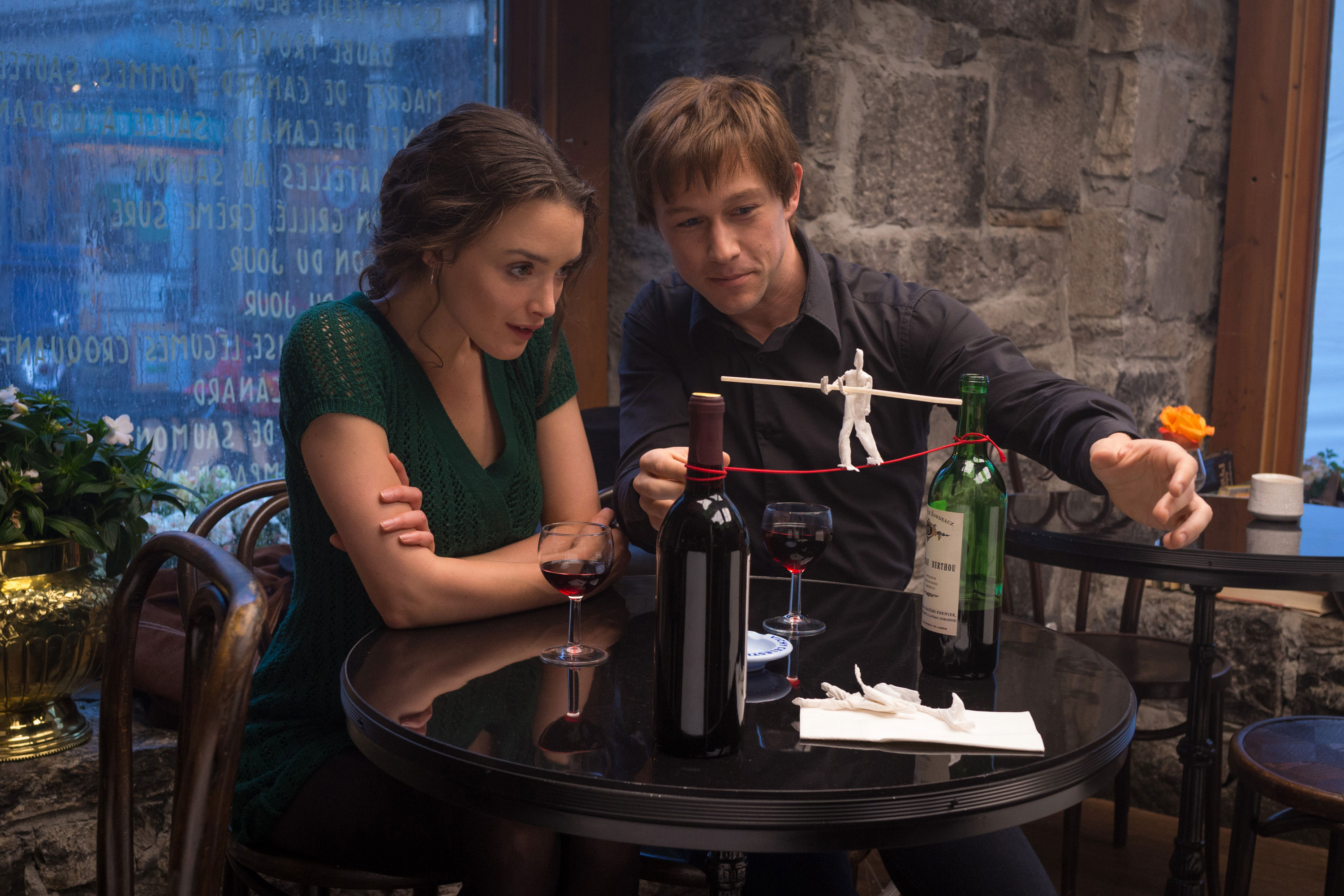
Philippe Petit (Joseph Gordon-Levitt) does not believe in “getting a permit”. He can say that again. After biting into a sugary sweet, the French street performer scuttles over to his local dentist and then moans about having to struggle through two hours of toothache as he waits for an appointment. He ain’t the only one squirming for two hours; if you don’t get along especially well with heights, things might get a bit tetchy. Petit’s pain-stricken time at the dentist acts as a catalyst for what he would later call the “artistic coup of the century”: a tightrope walk between the Twin Towers.

But before we can ascend, there is stuff to do. Narrative, or set-up, or something. The visuals down on ground level are oddly ropey. It’s as if the film is trying to mix a Toy Story-esque texture with real life, and it doesn’t quite work. The objective is clear and sort of understandable: to evoke a fairy tale quality that supports Petit’s impossible task, one bearing mythical connotations. But the uncanny aesthetic funds a light, sprightly momentum when perhaps something grittier would have been more interesting — the real Petit, for instance, has never shunned away from acknowledging his foolish qualities. In fairness, Joseph Gordon-Levitt does energetic vanity well.

Writer-director Robert Zemeckis and co-writer Christopher Browne do at least shed some light on Petit’s stubbornness. The performer’s selfish mantra in the pursuit of artistic merit places unfair stress on his friends and family, a sentiment also explored in Everest. As such Petit veers exceedingly close to unlikeable, which would be fine if the film wasn’t so hell-bent on trying to sell him as the dream-conquering saviour of New York. The screenplay takes liberties with specific true events. In Man on Wire, Petit admits to cheating on his girlfriend Annie (Charlotte Le Bon) immediately after achieving his goal, but the film shies away from this revelation and the alternative it proposes is unsatisfactory.

Petit’s characterisation could be bolder. In an interview on the Empire Podcast, Zemeckis revealed why he chose to selectively colour his lead: “The character I thought the audience could identify with is the one that I portrayed”. His reasoning is fair, but the director is underselling his audience’s willingness to empathise with shades of grey. Towards the end, one of Petit’s comrades suggest he has finally given soul to the Twin Towers, which might also be a fabrication. But at least this is part of Zemeckis’ attempt to pay homage to the World Trade Center post-9/11, and the idealistic notion is actually quite sweet.

Back in France we occasionally rendezvous with Ben Kingsley, playing tutor Papa Rudy, who sports a non-specific European accent — it’s all over the place and nowhere in particular. One of the team members recruited by Petit to fulfil his self-penned destiny suffers from vertigo, while another, who spends the film intoxicated on drugs, jokes about the height of the stunt (though to be fair, the latter’s Shaggy from Scooby-Doo demeanour is quite amusing). Petit himself donates to this atmosphere of farce with statements such as, “I whisper so the demons won’t hear me”.

It is all quite ludicrously caper-ish. Ocean’s Eleven atop the world’s tallest building. As the team plans Petit’s vertical-turned-horizontal heist, the tightrope walker dawns a number of amusing disguises: reporter, construction worker (foot impaled by nail included), tourist, businessman. Composer Alan Silvestri even occasionally treats us to Mission: Impossible’s famous vacillating whistle. The soundtrack also borrows from Damien Chazelle’s Whiplash, fielding a cantankerous drum and jazz beat aided by the prevailing tension. Thankfully there is no rushing during The Walk.

Inevitably, the outing has to wade through a sea of invasive anticipation. Most of the events that occur during the opening two-thirds are fine, but we’re only really here to trial the fearful majesty of high, high, high-wire walking. Following Petit’s lead — his calming influence is a saviour — the first time we peer over the edge of the World Trade Center an undeniable rush of exhilaration and terror ensues. This is where Dariusz Wolski’s cinematography really comes to fruition, at night unveiling a wonderful neon carpet below, and during the day capturing the voluminous bustle of New York City. The towers look incredible too; it’s nice seeing them relayed in such a positive light.

But is the walking part of The Walk just a stunning gimmick, or is it a genuine cinematic experience? Probably a bit of both. As Petit steps onto his wire you brace yourself in much the same way someone would prior to pelting down a steep slope on the world’s fastest roller coaster, but the sequence also incorporates classic movie tropes: burgeoning threat, visual amazement, a visceral personal reaction. There is one moment involving a seagull that almost ruins the spectacle (it’s ridiculous and unnecessary) but thankfully that dissipates quickly.

If 3D is one of modern cinema’s aggravating realities then this is the way it ought to be used. For around half an hour, the format contributes to the genuine awe you feel when balancing between the towers. Zemeckis has set a new benchmark in three-dimensional movie-making. Upping the ante? That’ll be a tall order.

The Walk - Charlotte Le Bon & Joseph Gordon-Levitt

Images credit: IMP Awards, Collider

Images copyright (©): TriStar Pictures

Sicario (2015)

★★★★

Sicario PosterDirector: Denis Villeneuve

Release Date: October 2nd, 2015 (US); October 8th, 2015 (UK)

Genre: Action; Crime; Drama

Starring: Emily Blunt, Benicio Del Toro, Josh Brolin

For Denis Villeneuve, Sicario marks something of a departure from Enemy’s odd intricacies and the personal anguish of Prisoners. It has more in common with the latter — a nasty streak and a bleak underbelly — but Villeneuve’s third English-language outing is a different beast entirely. It’s a very cold film. There is so much bloodshed that you almost become impervious to feeling, though attempts to humanise its various players are admirable and fairly successful. Sicario’s concerns are wrapped up in the (under)world of grisly cartels, and in how the war on drugs has fostered moral imprecision, even on the ‘good side’.

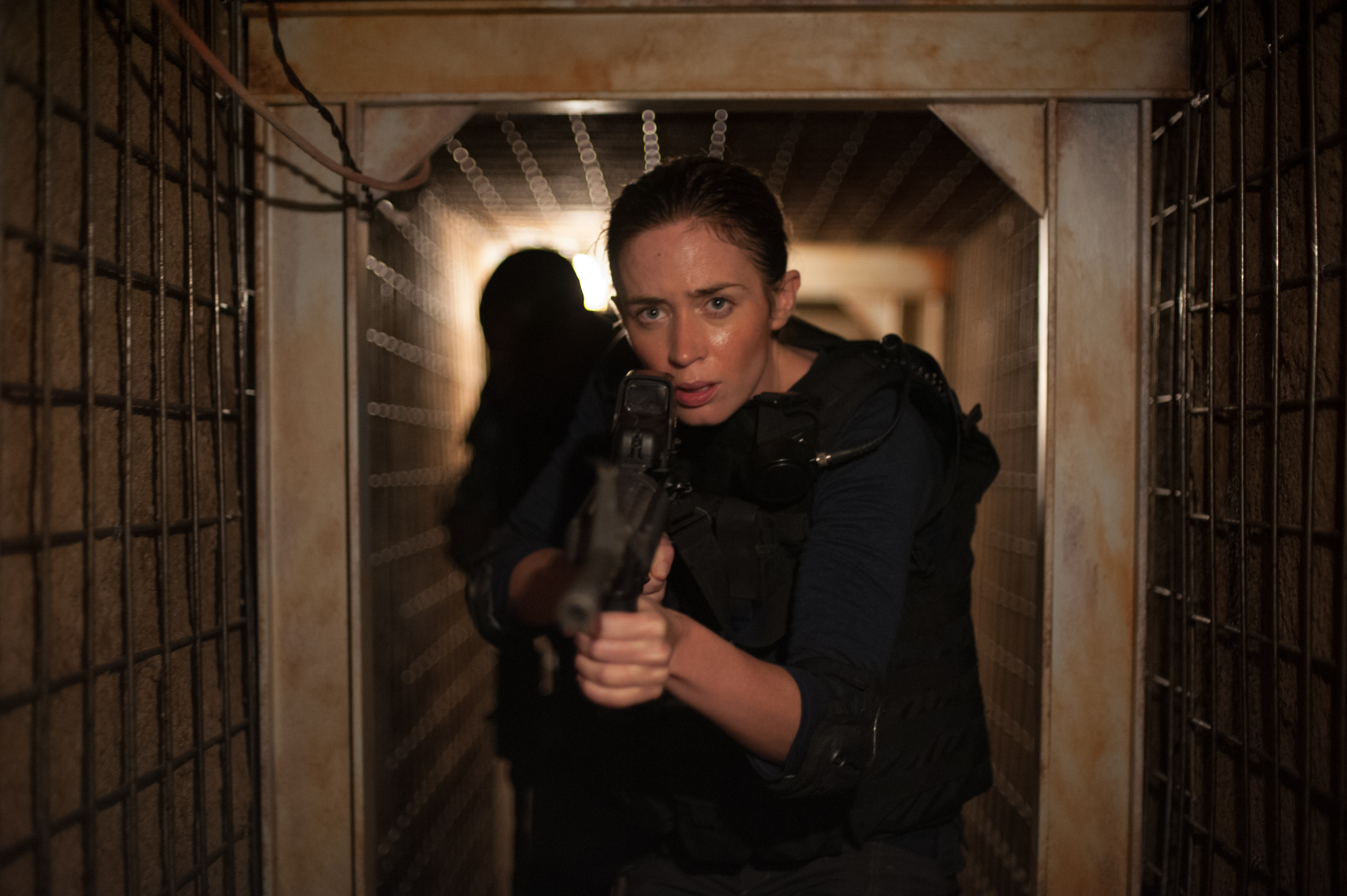
FBI agent Kate Macer (a brilliant Emily Blunt) is part of that good side, and one of only a few individuals whose outlook relays consistent righteousness. We realise instantly that Kate is both strong and capable, yet not at all infallible. Nobody is for that matter — when her team finds a myriad of deceased bodies plastered behind the walls of a house, physical and mental repulsion take over (there’s a lot of vomiting). This discovery triggers an IED explosion that kills two agents, setting in motion a covert investigation into some serious criminal wrongdoing. Kate, driven by a need for revenge, volunteers for the job.

She has to navigate a landscape dominated by important-looking men wearing suits and asking personal questions (“Do you have a husband?”). Josh Brolin’s Matt Garver is one of those men, an advisor-cum-field officer whose macho posture is supported by a spine of arrogance — for some reason he wears sandals during mission briefs. Garver leads the field operation, batting back Kate’s inquisitive questions with vague swings; you get the sense his unwillingness to reveal all has less to do with bureaucracy infecting law than it does pomposity.

Pitting Kate in amongst cowboys and sheriffs and gruff Texans with gristly beards seems to be Villeneuve and screenwriter Taylor Sheridan’s way of acknowledging reality while also challenging the effectiveness of a masculine culture. While most of the men — not all, Kate’s partner Reggie Wayne (Daniel Kaluuya) is similarly noble, though he too is portrayed as an outsider — are energised by the presence of their egos, Kate, indiscreet and somewhat inexperienced, is our key moral fibre. It’s through her gaze that we peer into an immoral world, and it increasingly feels like only her actions can reshape said immorality.

Sicario is clear in its admission that nothing is clear. People are neither good nor bad (in fairness some are quite bad) but instead exist somewhere along an ethical spectrum. A Mexican cop whom we visit throughout the film is shown interacting with his family, particularly his football-loving son. Joe Walker’s editing — which cuts from the search operation to the officer’s modest home — implicates the cop in some form of corruption, yet his family-conscious roots are never invalidated. The vast majority of people on-screen are treated as human beings, a trait often missing in films that depict warring factions (see American Sniper).

If government agencies and drug cartels are the factions at war, Juárez, Mexico is the battlefield. The city is introduced as a final level boss: maze-like, audibly inscribed with tales of dread, bookended by a pulsating score. It’s the urban equivalent of Everest’s Death Zone — the longer you stay, the more likely you are to die. Perennial, and future, Oscar nominee Roger Deakins often gives scenes time to breath, funding the perception of encroaching danger. Civic infection has wreaked havoc upon the people of Juárez, so much so that civilian life is now inseparable from criminal activity. Just ask Silvio, the aforementioned policeman.

Early on, we take a drive through the cartel capital in a stretch of truly exceptional filmmaking. It’s tense, eerily subdued. It makes you feel ill, and its conclusion ushers forth one of the most anxiety-ridden traffic jams in silver screen history. Following the film’s incredible opening third (which is ostensibly a 40-minute horrorfest) the pulse inevitable drops. What follows isn’t quite as interesting; it’s the downtime between assignments, where Kate and co. swan around bars and stare diligently at maps, invoked to add character depth.

One of those characters is Alejandro Gillick (Benicio Del Toro), the titular sicario. Del Toro saunters on screen parading a mystique that suggests he ain’t to be messed with. He folds his jacket even though it is already creased, a move that mirrors his make-up: externally unruffled but internally blazing. The actor has that grizzled veteran demeanour, his hitman reminiscent of Charles Bronson’s Harmonica in Once Upon a Time in the West. Gillick says very little, affording extra reverence to the few words he does speak: “You’re asking me how a watch works. For now, let’s just keep an eye on the time”. Or, in layman’s terms, conquering a complicated cartel network is inescapably complex.

Lines are blurred and identities masked in Sicario’s post-9/11 society. This is Zero Dark Thirty with a narcotic skin. There is a wonderful sequence that precedes the final act (at which point the tension re-escalates): darkened human silhouettes descend into the black abyss below a brooding, orange-tinted skyscape. It’s a sublimely serene moment in a film otherwise dominated by impending threat. The serenity, like life in Juárez, is short-lived.

Sicario - Emily Blunt

Images credit: IMP Awards, Collider

Images copyright (©): Lionsgate

Macbeth (2015)

★★★★

Macbeth PosterDirector: Justin Kurzel

Release Date: October 2nd, 2015 (UK); December 4th, 2015 (US)

Genre: Drama; War

Starring: Michael Fassbender, Marion Cotillard

Justin Kurzel’s ferocious take on Macbeth begins and ends with death. Though its Shakespearean format might isolate those who aren’t well-versed in the Bard’s prose, the film attains a degree of accessibility by dealing in brute force and thematic clarity. We see a Star Wars-esque information trail at the start, but this time the text is in blood red. Jed Kurzel, Justin’s brother, concocts a score that drills and hammers in tandem with bellowing battle cries, bestowing total discomfort upon us. Writers Todd Louiso, Jacob Koskoff, and Michael Lesslie opt to examine how the loss of innocence can incite the immoral side of power, and the results are unflinching.

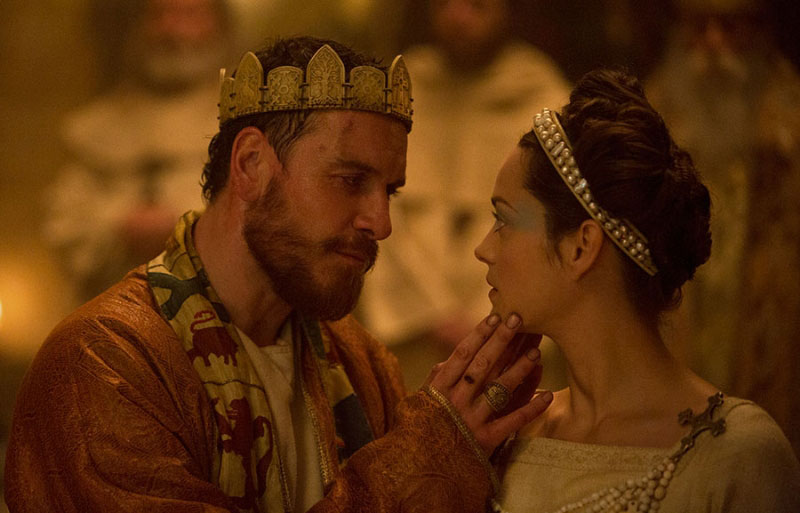
Upon discovering he is destined to be king, Macbeth (Michael Fassbender) weighs up the immediacy of his sure-fire thronage. Lady Macbeth (Marion Cotillard) urges her husband to commit treasonous murder, to speed up the process by killing King Duncan (David Thewlis). Convinced, and perhaps driven by grief brought about by the death of his own child, the Thane of Scotland slays his superior. From then we see the man crumble, haunted by visions of dead clansmen he swore to protect in battle. He becomes a mad king increasingly propelled by unfettered impulsion and corrupted by power (“Full of scorpions, is my mind”).

Kurzel’s film will likely appeal to a specific audience; attempts to widen its potential reach are few and far between. Ye who enter devoid of prior knowledge, like myself, will have to contend with a movie that communicates entirely through the diction of Shakespeare. As such, it functions much in the same way a foreign language piece without subtitles would, which might alienate some viewers. It shouldn’t though. Blindly following the story is never too difficult as the actors offer a tangible, precise translation. It’s a testament to the performances of Fassbender and Cotillard in particular that the narrative is sold to us without a verbal parachute.

With Fassbender, it’s all in the eyes. His Macbeth, a brooding warrior at the fore, grows bags that darken beneath increasingly absent pupils as the pressure of sovereignty takes over. We never really know where we stand with him — his irreverent actions eventually hit a point of no return, but until then there’s a sorrowful tragedy surrounding Macbeth. In a case of role-reversal, it is Lady Macbeth who must take on the burden of regret. Cotillard is more subtle than her male counterpart. Her words, though often beautiful, are enshrouded in hysteria and pain; the camera unblinkingly lingers on her face during a scene towards the end as the actor speaks with utter command, evoking genuine heartbreak.

The framework from which the duo perform is comparable to how Eddie Redmayne and Felicity Jones navigated The Theory of Everything: one exercises true physicality while the other evokes a delicate-yet-purposeful poise. There is often a lingering stillness that is only interrupted by Fassbender’s increasingly perturbed movement, and only Cotillard has the guile to reign in said eccentricity. Friend-turned-foe Macduff, played by an emotionally-wrought Sean Harris, christens Macbeth the “Fiend of Scotland”.

Nicolas Winding Refn’s Valhalla Rising might have been a touchpoint for Kurzel, especially in a visual sense: the unquenchable mist, the moorish setting, the breadth of visceral savagery, all invoked. Battle scenes could very well be taking place among the Dead Marshes on the boggy road to Mordor. The Scottish setting, not unlike modern times, is always cloudy, or rainy, or dank, but the aesthetic is never mundane — fog is crimson coloured and dynamic. Cinematographer Adam Arkapaw mixes steady shots with a shaky cam effect, mirroring the vacillating levels of order and chaos afoot.

Arkapaw shot the soon-to-be iconic six-minute drug den raid in True Detective season one, and Macbeth revels in similar technical prowess. From sound, to look, to how the film is edited, it’s quite stunning. Scenes showing brutal murder, such as the death of King Duncan, are intercut with instances of solemn hush. A contrast is evident throughout, pitting light against dark (or perhaps it is dark against post-dark). The sound design is worth mentioning too: rallying howls echo with spine-tingling reverence around cavernous cathedral-like rooms.

To the credit of those on and off-screen, it never feels like we’re watching a play. In many ways this is a niche offering; much of the verbiage might not make sense, yet you can’t help but stare. And when what you’re staring at is this good, this impactful, words are almost inconsequential. Here are two more anyway: Hail Macbeth!

Macbeth - Michael Fassbender & Marion Cotillard

Images credit: IMP Awards, Collider

Images copyright (©): The Weinstein Company

The Martian (2015)

★★★★★

The Martian PosterDirector: Ridley Scott

Release Date: September 30th, 2015 (UK); October 2nd, 2015 (US)

Genre: Action; Adventure; Science fiction

Starring: Matt Damon, Jessica Chastain, Chiwetel Ejiofor, Jeff Daniels, Kate Mara

As Ridley Scott’s fourth headline entry in the science fiction genre, you might pre-emptively think The Martian is one giant leap too many. The film opens with a steady pan across wondrous space, a shot that harkens back to his first offering, Alien. But this isn’t Alien, far from it. Nor is it Blade Runner or Prometheus. The Martian is too busy swimming in the delightful proclivities of space pirates and gaffer tape to concern itself with morose terminators and monstrous creatures. In short, this giant leap is the best one Scott could hope to make at this stage in his career and, indeed, the right one for mankind to feast on.

Drew Goddard recalibrates Andy Weir’s highly regarded novel with impetus, creating a screenplay that sparks with life and manifests on screen in surprisingly slick 140-minute form. It’s about botanist Mark Watney (Matt Damon) who finds himself stranded on Mars after an Ares 3 mission catastrophe (a scene shot with intense furore). Accordingly, we spend a lot of time in the company of a man whose technical wizardry acts as a lifeboat. There is a lot of scientific space lingo and control room hubris, yet a combination of Goddard’s wily script and Damon’s charming performance renders the would-be impersonal exceedingly personal.

Mars’ landscape is incredible — when Watney awakens from his unconscious state and ambles across the rusty sand, you really feel his isolation. The grandeur both intimidates and inspires. His first call of duty is a squirm-worthy medical scene involving pliers and the astronaut’s gaping abdomen. Matt Damon recaptures the tortured spirit unleashed by Noomi Rapace in Prometheus, and the excruciating results would make her proud. His eyes are black and heavy at this point. To fund the sense of total seclusion, we’re stuck with Watney on Mars for a good chunk of the movie (though “stuck” suggests it is time spent against our will, when in fact it is some of the best time I’ve spent at the cinema this year).

The Martian is about a smart person (and later people) doing smart things, and Damon is perfect as the savvy loner. He is brilliant company, erupting with charismatic poise and an everymanness that usurps his specialised occupation. You feel an authentic burst of joy every time he connects the problematic dots via intellect and nous. Cinema will do well to conjure up a more likeable presence before 2015 is out. There’s no volleyball, but for a companion Watney employs a webcam and, like Cillian Murphy’s Capa in Sunshine, our hero speaks to the camera as if conversing with us and not with a machine. Emotions become capital and we absolutely get our money’s worth: whenever Watney wells up our natural instinct suggests we do the same.

The self-proclaimed greatest botanist on the planet often wears a scowl that implies a freak out is imminent, but instead whimsical quips relieve any tension. He has to be sarcastic and jokey in order to survive, and his jokes are unequivocally funny (“It has been seven days since I ran out of ketchup”). David Bowie’s “Starman” tune is part of an expertly employed soundtrack that feeds the genial air surrounding Watney’s shenanigans — potato growing, alphabet reconfiguration, machine hacking, to name but a few.

In any other Ridley Scott sci-fi effort, the titular man-Martian would be cursing God and trembling through his deserted predicament. But not here. Here, the prevailing sentiment is a hearty, somewhat sly, “Fuck you Mars.” Watney throws a plethora of insults at his host — the planet becomes the enemy. It’s man versus wild, and there is an acknowledgement from the filmmaker that threat ought to still linger despite the upbeat atmosphere. Watney, as such, has to contend with peril constantly swirling around him, danger emboldened by the movie’s forthright sound design.

Goddard’s screenplay — which he initially wrote intending to direct — likes to poke fun at PR and at press discourse. The film is barely five minutes old before the digs start: “Mark just discovered dirt — should we alert the media?” (as fate, or otherwise, would have it we got a water-related Mars announcement from NASA just days before the film’s release). While Watney does his best to stay alive, the mission back on Earth is to somehow spin his survival into a non-destructive PR story. Those doing the spinning, somewhat amazingly given the cynical Zeitgeist in which we live, are far from deplorable.

They each have flaws: Jeff Daniels’ NASA chief is a bit impersonal; Sean Bean’s Ares 3 crew supervisor heralds gut reaction over practicality; and even Kristen Wiig’s publicity woman can be on the dismissive side. But they are all amiable people trying to do good. While on Mars it is all about Spielbergian wonderment, quirky humour, and a genuinely winsome crust, the Earth arc mixes a jaunty detective movie with corporate drama. Bureaucracy plays a part — should they or should they not inform the Ares 3 crew that their man is still alive? Those at NASA struggle to keep up with Watney’s ingenious prowess despite their technological advantage, and the film hilariously emphasises this.

The cast is rich in depth but very large, and you worry that some might suffer due to a lack of screen time (a criticism many aimed at Baltasar Kormákur’s Everest). Thankfully, by the end, the vast majority are afforded a moment to shine. It’s great seeing Chiwetel Ejiofor in a breezier role, and he fits the bill as home-based NASA engineer Vincent Kapoor with coolness to spare. Jessica Chastain, Kate Mara, Michael Peña and the remaining Ares 3 crew members function like a well-oiled team despite their comparatively short-lived screen stint. Mackenzie Davis is very good as the freshman NASA analyst, energising a potentially corny role. Kristen Wiig, too, confidently plays against type.

As the film advances, the Sol counts (the number of days spent on Mars) that are systematically thrown up on screen do lose their clout. It could be argued that the piece unwittingly stumbles into a pacing issue; not that it ever threatens to plod along, but rather that the on screen presentation of advancing time is a tad careless. The longer we go, the less it impacts on us (though admittedly, by the time the grand conclusion gets under way nobody really cares).

It is dramatically better than Apollo 13. Visually, it rides the same rocketship as Gravity — Dariusz Wolski’s cinematography is foolproof. The Martian probably isn’t Ridley Scott’s best sci-fi movie (both Alien and Blade Runner will take some beating), but his love letter to human dexterity, perseverance, and personality is an utter triumph.

The Martian - Matt Damon

Images credit: IMP Awards, Collider

Images copyright (©): 20th Century Fox

Maze Runner: The Scorch Trials (2015)

★★★

Maze Runner The Scorch Trials PosterDirector: Wes Ball

Release Date: September 10th, 2015 (UK); September 18th, 2015 (US)

Genre: Action; Science fiction; Thriller

Starring: Dylan O’Brien, Kaya Scodelario, Thomas Brodie-Sangster, Patricia Clarkson, Aiden Gillen

As a direct follow up to The Maze Runner, Maze Runner: The Scorch Trials grants director Wes Ball an opportunity to throw us straight out of the frying pan and into the fire. There is no time to catch up, no dialogue wasted on refresher exposition. You could stitch the final reel of the former onto the first reel of the latter and the flow would be seamless. It’s an approach that respects up-to-date viewers but also risks alienating franchise newbies; unlike the Divergent series, the lingo in this mid-franchise outing is harder to grasp — we suddenly learn of a virus called the Flare, a mountain-based faction who go by The Right Arm, and more about the horribly named corporate wrongdoers WCKD.

Aiden Gillen’s Janson, a facility head with an iffy demeanour, sets the scene: “The world out there’s in a precarious situation”. Perhaps the only thing less stable than civilisation is Gillen’s vacillating accent, though in fairness he does fund the film’s early uneasy air. Having escaped the maze, the Gladers — including Thomas (Dylan O’Brien), Teresa (Kaya Scodelario), Newt (Thomas Brodie-Sangster), and Minho (Ki Hong Lee) — find themselves holed up in a bunker eerily similar to the one run by Ava Paige (Patricia Clarkson) in the last film. Free from seclusion, freshly cooked food, their own bunk beds. It’s as if everything is too good to be true.

Only, in reality, nothing’s good anymore. The world outside, aptly rechristened the Scorch, has been ravaged by heat and disease. Zombie-like creatures called Cranks roam freely in search of flesh to chew on. A step up from the maze beasts, these clambering speedsters evoke a 28 Weeks Later vibe, especially as they are positioned within a climate of militant command and clinical action. Thomas, in spite of all this misery, manages to muster up some rebellious positivity. He is the eternal optimist in a pessimistic world.

Maybe they see a ray of hope radiating from Thomas in the wake of his stubborn idealism, but people do trust him too easily and this undermines the credibility of the story. Aris (Jacob Lofland), a loner who spent time in another maze before the bunker round-up, opts to collude with Thomas despite not knowing him. It is a theme throughout: our hero is heralded as a morally, physically, and mentally infallible being. When the group come across a refuge disguised as a dumping ground for old garments and rusty equipment, they all take the opportunity to dawn suitable Scorch clothing. Apart from Thomas, who discovers a suave jacket among the dross, something that could have graced Ryan Gosling in better times.

It’s as if all the others know he is the film’s central star. Fortunately none of this canonisation really matters because Dylan O’Brien is such a charismatic and inviting screen presence (a less capable frontman might’ve been insufferable given the circumstances). The film is arguably at its most compelling during those rare moments when Thomas does have to confront vulnerability. There’s an animosity at the fore, driven particularly by Teresa who begins to question her counterpart’s role in bringing about rebellion. Are they doing the correct thing by evading WCKD? Was the Glade as good as it was ever going to get?

Regardless, we know WCKD boasts an immoral underbelly. Towards the beginning, Thomas and Aris find out that Janson’s apparently safe retreat is actually a giant-shrimp-breeding-cum-human-blood-harvesting factory controlled by the aforementioned organisation. It may be a source material problem, or an issue with mainstream popcorn fiction in general, but the narrative occasionally lacks plausibility. Aside from the Thomas trust issue, even more blatantly obvious coincidences rear with jarring nonchalance: a revealing crisis conversation between Janson and Ava just so happens to occur in the company of Thomas and Aris on the night they break into the secret facility.

The message is clearly anti-corporation and anti-oppression, and T.S. Nowlin’s screenplay not-so-subtly channels that message via Thomas’ middle finger. These mature themes are matched by a horror-inspired underbelly that teeters right on the edge of a 12A UK rating. Fans of the Fallout video game series might mistake certain set pieces for similar looking locations in said game’s nuclear-torn Washington D.C. (an abandoned subway station springs to mind). Cinematographer Gyula Pados has more to play with here and the wider scope benefits Ball’s film greatly. Broken cities incite awe and wariness as they resemble the urban desolation shown at the end of Inception, while seemingly endless storm-strewn deserts echo Peter Weir’s The Way Back.

Giancarlo Esposito is one of a plethora of effective secondary characters — casting director Denise Chamain deserves credit for employing so many actors willing to maximise the potential of their bit part statuses. As leader of a ragtag stowaway group, Esposito purveys a mystery that keeps you on your toes (like Rick from The Walking Dead, he also always greets newcomers with three inquisitive questions). There’s an exquisitely queasy turn from Firefly favourite Alan Tudyk — who could do with a wash — though he is part of an unnecessary sideshow plot. Game of Thrones’ Nathalie Emmanuel turns up as a Scorch survivor alongside Rosa Salazar’s strong-willed Brenda.

Having run the maze in sufficient time, they’ve now passed the trials with a splash of merit. It has been an entertaining if unspectacular effort so far. Let’s hope when part three — The Death Cure — rolls into the Scorch, SuperTom and co. finish with aplomb.

Maze Runner The Scorch Trials - Cast

Images credit: IMP Awards, Collider

Images copyright (©): 20th Century Fox

Everest (2015)

★★★★

Everest PosterDirector: Baltasar Kormákur

Release Date: September 18th, 2015 (UK); September 25th, 2015 (US)

Genre: Adventure; Drama; Thriller

Starring: Jason Clarke, Josh Brolin, Jake Gyllenhaal, Keira Knightley, Emily Watson

“One in four died.” That’s the first thing we see on screen, a solitary line in a block of informative dialogue detailing the worrisome history of Everest expeditions. It is our dramatic lever, pulled at the inception just in case we’re not already aware of Mount Everest’s indiscriminate harshness. Throughout, numerous avalanches interrupt our viewing but unlike the false threat exhumed from similar-looking shots in the alpine-set Force Majeure, the danger here is very real.

William Nicholson and Simon Beaufoy’s screenplay (which may or may not be based on John Krakauer’s Into Thin Airdraw your own conclusions) sheds light and dark on the late-90s mountaineering disaster involving rival trekking companies. Going in bereft of any knowledge probably isn’t much of an advantage; there is a moment at around the forty minute mark that essentially earmarks the film’s ending. It is one of those disaster movie clichés — Titanic’s “You jump, I jump”; any conversation between Bruce Willis and Ben Affleck in Armageddon — that acts as a sentimental forewarning.

Admirably, it is the only instance of pure sentimentality in a film more concerned with truth. Everest is cold, at times freezing, but authentic and gripping and no less emotionally involving as a result. Realising the dangers of a crowded field, opposing expedition leaders Rob Hall (Jason Clarke) and Scott Fischer (Jake Gyllenhaal) — the former is excellent, relaying an exhausting and exhaustive performance — opt to team up during a simple scene bound by numerous layers: it shows two experienced climbers anxiously bowing at the mercy of the mountain, but does so in a manner that provides one of the film’s only junctures of light relief.

Fischer asks who will lead when they near the summit, and both men laugh. There is clarity in his words, an assertion that the need to achieve will always usurp the right to survive. Or, if you like, it’s just a rare chance to giggle. Baltasar Kormákur hones in on the competition between colleagues, a smart move that affords these men and women who are otherwise embroiled in an unrelatable escapade a degree of accessibility.

Invoked from the get-go, this competitive edge mirrors a layer of unsettled snow poised to subside at any moment. At the beginning the banter is weightless — it’s there, but the sly digs between Josh Brolin’s Texas-bred Beck Weathers and the aforementioned journalist John Krakauer carry an ominous undercurrent. The film’s atmosphere is driven by poorly disguised trepidation, and you just know something has to give. “There is competition between every person on this mountain,” says the hippie-esque Fischer, and it is palpable. But any interplay between the climbers is superfluous and Fischer acknowledges this shortly thereafter, declaring the mountain will inevitably have the last word.

In a sense Everest is about the pull of an unavoidable thrill. “Why?” asks Krakauer as he documents the climbers’ journey. “Because it’s there,” is the comically-inclined universal reply, but it is also the best reply the mountaineers can muster. Nobody really has a solid answer — postman Doug Hansen (John Hawkes) talks about his desire to be the everyman who conquered the monster and achieved the impossible. We’re left to ponder whether the reward eclipses the risk, a contemplation that becomes increasingly one-sided the more Hall’s pregnant wife (a game Keira Knightley) appears. Various other members of the group give their reasons: Yasuko Namba (Naoko Mori) references her need to complete the Seven Summits, having already commandeered the other six.

But each response to Krakauer is admonished with persiflage. It is as if the alpinists know the risk is too great, and they’ve simply given in to the thrill. An unfortunate offshoot of the film’s competition element is a spot about the completion of a celebratory magazine article. Emily Watson, who graciously adds oomph to her fairly thankless role as a glorified receptionist (the actors are very good en masse in generally underfed roles), is stressed about her company receiving a bad review in the midst of the encumbering drama, a whim that feels tonally fake.

Death is an inevitability and when it occurs it is visceral in a non-violent way. Shades of grey don’t exist; the landscape yields either white tundras or black crevasses, and as such when people pass they do so bluntly. Analysing the effectiveness of a death scene in this instance feels egregious and unnecessary, particularly given the victims are real people, but Kormákur does handle said moments with candour and, crucially, without mawkishness. Mass amounts of clothing and equipment make it difficult to differentiate between those on screen, reinforcing the notion that on Everest individuals are merely pawns, merely statistics.

Kormákur’s direction is adroit initially, and it gets better as things get worse. We often see the misty, black peak looming over base camp like a plague. Oxygen masks quickly resemble gas masks. Each second the climbers spend plodding up slopes represents an ounce of life extracted from their bodies. This dangerous aura is complemented by Salvatore Totino’s visual flair — the snow-covered ridges could easily pass for one of The Two Towers’ awe-inspiring New Zealand shots.

Enhanced by booming screening room speakers (Everest is definitely a cinema movie), the sound design frequently jabs at your solar plexus. You instinctively breathe a little more vociferously when things start to go wrong and the outing’s audio power does nothing to ease the tension. There is one tranquil shot that is particularly wonderful; at twilight, camped in the eye of the storm, the camera pans calmly around Hall and co. as they gaze longingly at their lofty goal.

Everest stays true to its subjects in a way that is both compelling and respectful, even if some individuals don’t receive the attention they likely should due to the constraints posed by an excessively large cast. By the end, as the credits paid tribute to many of those involved, I found myself in a morose state of sadness, agitation and admiration. For a ‘big disaster movie’, that’s pretty good going.

Everest

Images credit: IMP Awards, Collider

Images copyright (©): Universal Pictures